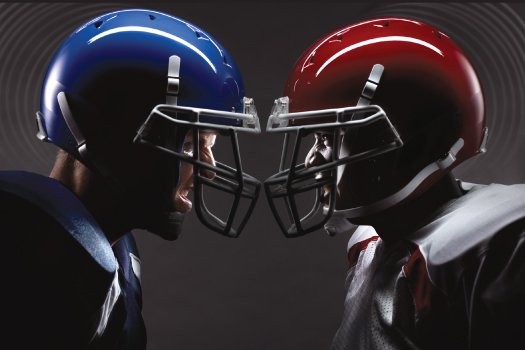
Athletes in the U.S. suffer 3.8 million sports-related concussions each year. While helmet makers dither with small improvements, Swedish scientists have built something that could protect us all.

Helmet Wars
Helmet Wars Travis Rathbone

On August 19, 2012, in week two of the NFL preseason, Indianapolis Colts wide receiver Austin Collie ran 17 yards out from the line of scrimmage, cut right toward the center of the field, caught a pass, and was immediately tackled by Pittsburgh Steelers cornerback Ike Taylor. As Taylor came in for the hit, his helmet appeared to glance off the left side of Collie’s helmet. Then the cornerback wrapped his arm around Collie’s neck and jerked the receiver’s head to the right. An instant later, Steelers linebacker Larry Foote came barreling in from the opposite side and slammed his elbow into the right side of Collie’s helmet. As the receiver fell to the ground, his helmet first hit Foote’s knee and then struck the ground face-first.

Collie sat up, dazed, and had to be helped off the field a minute later. He didn’t return to play for three weeks. The diagnosis: concussion. It wasn’t the first time Collie had suffered what’s clinically called a traumatic brain injury. On November 7, 2010, he spent nearly 10 minutes lying motionless on the 34-yard line after being hit in the head almost simultaneously by two Philadelphia Eagles players. Medics carried him off the field on a stretcher. In his first game back, two weeks later, he left in the first quarter with another concussion. He missed three more games, only to suffer yet another concussion on December 19, which ended his season.

Professional football players receive as many as 1,500 hits to the head in a single season, depending on their position. That’s 15,000 in a 10-year playing career, not to mention any blows they received in college, high school, and peewee football. And those hits have consequences: concussions and, according to recent research, permanent brain damage. It’s not just football, either. Hockey, lacrosse, and even sports like cycling and snowboarding are contributing to a growing epidemic of traumatic brain injuries. The CDC estimates that as many as 3.8 million sports-related concussions occur in the U.S. each year. That number includes not only professionals but amateurs of all levels, including children. Perhaps most troubling, the number isn’t going down.

In the past two years, the outrage surrounding sports-related concussions has mounted. In January 2011, Senator Tom Udall (D-NM) called for a Federal Trade Commission investigation of the football helmet industry for “misleading safety claims and deceptive practices,” which the agency is currently pursuing. In June 2012, more than 2,000 former NFL players filed a class-action suit against the league as well as Riddell, the largest football-helmet manufacturer and an official NFL partner, accusing them of obfuscating the science of brain trauma. The litigation could drag on for years and cost billions of dollars.

The real issue is that lives are at stake. In 2006, this fact became tragically clear when former Philadelphia Eagles star Andre Waters committed suicide by shooting himself. Subsequent studies of his brain indicated that he suffered from chronic traumatic encephalopathy (CTE), a form of brain damage that results in dementia and is caused by repeated blows to the head. A sickening drumbeat of NFL suicides has followed, including former stars Dave Duerson, Ray Easterling, and Junior Seau, who by one estimate suffered as many as 1,500 concussions in his career.

For equipment manufacturers, the demand for protective headgear has never been greater. Leading companies, as well as an army of upstarts, have responded by developing a number of new helmet designs, each claiming to offer unprecedented safety. The trouble is that behind them all lie reams of conflicting research, much of it paid for, either directly or indirectly, by the helmet manufacturers or the league.

For players or coaches or the concerned parents of young athletes, it’s hard to know whom to believe. And despite all the research and development, and the public outcry, the injuries just keep coming. What makes the situation even more tragic is that a helmet technology already exists that could turn the concussion epidemic around.

THE TROUBLE WITH CONCUSSIONS

To understand why current helmets aren’t better at reducing concussions, consider the nature of the injury. A concussion is essentially invisible. Even the most advanced medical-imaging technology isn’t sensitive enough to show the physical manifestations, the damaged brain tissue. Diagnosis, then, is based entirely on symptoms and circumstances. Is the patient dizzy or confused, or was he briefly unconscious? Does he have a headache or nausea? Does he remember what happened, and did it look like he got hit in the head really hard?
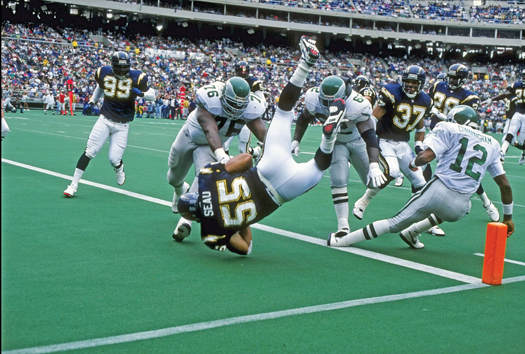
The Fallen
The Fallen: Junior Seau’s suicide in 2012 heightened the controversy around head trauma in athletes. Colts receiver Austin Collie [above] received three game-ending concussions in 2010 before he was benched for the season.  Doug Pensinger/Getty Images


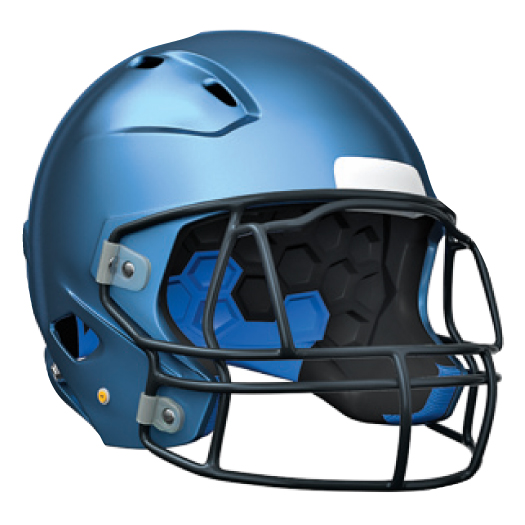
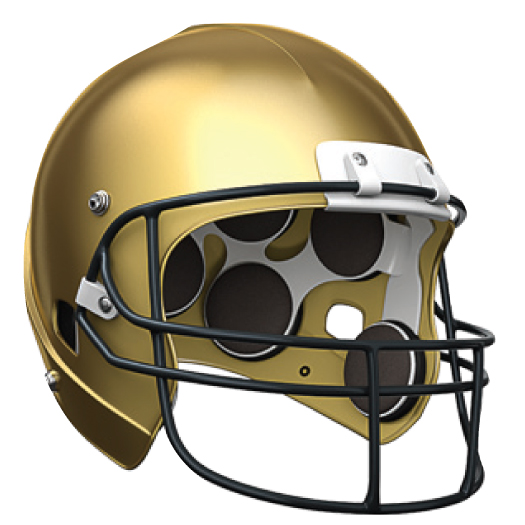
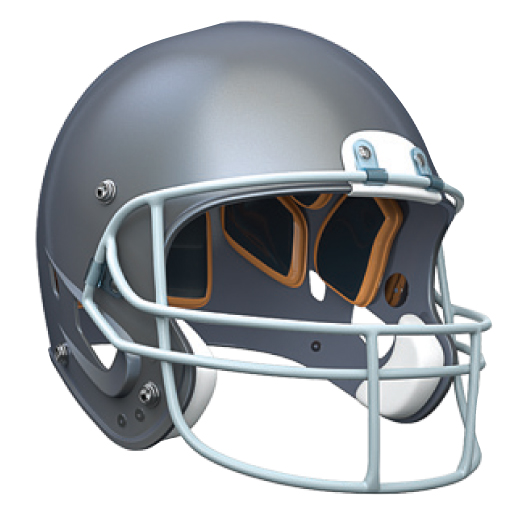
Click to tour the booming helmet market.

Even if doctors could reliably diagnose concussions, identifying the injury does little to protect against it; for that, scientists need an accurate picture of what’s happening inside the head. For generations, doctors believed that concussions were a sort of bruising of the brain’s gray matter at the site of impact and on the opposite side, where the brain presumably bounced off the skull. The reality is not nearly that simple: Concussions happen deep in the brain’s white matter when forces transmitted from a big blow strain nerve cells and their connections, the axons.

To understand how that happens, it’s important to recognize that different types of forces—linear and rotational acceleration—act on the brain in any physical trauma. Linear acceleration is exactly what it sounds like, a straight-line force that begins at the point of impact. It causes skull fracture, which makes perfect sense: You hit the bone hard enough, it breaks.

Rotational acceleration is less intuitive. It occurs most acutely during angular impacts, or those in which force is not directed at the brain’s center of gravity. You don’t have to know much about football or hockey to realize that rotation is a factor in a whole lot of hits. “Think about it,” says Robert Cantu, a neurosurgeon at Boston University School of Medicine and the author of 29 books on neurology and sports medicine. “Because most hits are off-center and because our heads are not square, most of the accelerations in the head are going to be rotational.”

Further complicating matters, the human brain is basically an irregularly shaped blob of Jell-O sitting inside a hard shell lined with ridges and cliffs. After a football tackle or a hockey check, that blob moves, and does so in irregular ways. “Rotational forces strain nerve cells and axons more than linear forces do,” Cantu says. “They’re not only stretching, but they’re twisting at the same time. So they have a potential for causing greater nerve injury.”

Strained Brains
Strained Brains: Most helmets do a good job preventing skull fractures but do not directly address concussions.  Travis Rathbone

So what’s the problem? If scientists know that a concussion is nerve strain caused largely by rotation of the brain, why can’t they figure out a way to stop the rotation?

Just as the actual injury isn’t visible to medical imaging technology, the rotation that causes the injury isn’t measurable in impact conditions; scientists cannot be inside an athlete’s brain measuring its movement. But in a grisly 2007 study, researchers at Wayne State University in Detroit used a high-speed x-ray to observe the brains of human cadaver heads fitted with football helmets and struck from various angles. The research, corroborated by computer models, showed that the brains moved very little—just millimeters. Yet those small movements are enough to cause nerve strain and affect neurological function.

Making things even more difficult is that every brain is different. Young brains respond differently than older brains, female brains differently than male. Researchers have also found that weaker, subconcussive hits can have a cumulative effect over time and lead to CTE, which is likely the cause of many former-player suicides. But how many hits it takes, and what kind, is unclear—and the condition can’t be diagnosed while the player is alive. Only when his brain is cut open can researchers spot the dead zones in the tissue.

The scientific ambiguity surrounding concussions clearly impedes the development of better helmets. But there’s another reason helmet technology hasn’t improved, one more troubling than gaps in our knowledge: a self-regulated industry governed by badly outdated safety standards.

40-YEAR-OLD STANDARDS

Picture the head of a typical crash-test dummy, the kind you see in car commercials. It’s attached to a rigid metal arm that hangs above a cylindrical anvil topped with a hard plastic disc. A lab technician straps a football helmet to the headform, cranks the arm up to precisely five feet above the anvil, and lets it drop—crack. Inside the dummy head, an accelerometer positioned at the center of gravity records the linear acceleration transmitted during impact. This brutish trial is called a vertical drop test, and it’s the basis for how all football helmets are certified safe by the National Operating Committee on Standards for Athletic Equipment (NOCSAE), an association funded by equipment manufacturers, which in turn funds much of the research on sports-related head trauma. The standard has remained largely unchanged since its creation in 1973.

 Now think back to Austin Collie’s concussion in August 2012—the jerking of the head after the initial hit, the collisions with Larry Foote’s elbow and the ground. Those impacts don’t look much like the straight-line force of the NOCSAE drop test. And that brings up a very important question, perhaps the central question scientists and helmet makers are trying to solve today: Is the linear acceleration measured by a drop test correlated to rotational acceleration, and if so, by how much?

Shock Treatment
Shock Treatment: A horizontal impact test.  Courtesy Stefan Duma/Virginia Tech

Untold lives and billions of dollars in sales, medical fees, and litigation costs could depend on a clear answer. If the relationship between the forces is strong, the key to reducing rotational acceleration is the same as reducing linear acceleration: Add more padding. Clearly helmet manufactures would prefer such a simple solution. If the connection is weak, however—or at least weak in the most dangerous hits—more padding will do little to reduce concussions, and companies will need to rethink current designs entirely, a very costly endeavor.

In 2003, a New Hampshire–based company named Simbex introduced a research tool called the Head Impact Telemetry System (HITS). Among other things, it seemed to have the potential to answer the question of correlation. HITS is an array of six spring-loaded accelerometers positioned inside a helmet to record the location and severity of significant impacts. After any hit over a certain threshold, the system beams the data to a companion device on the sidelines. Coaches can monitor players in real time, and researchers get reams of real-world data to dig through. Stefan Duma, the founding director of Virginia Tech’s Center for Injury Biomechanics, is among those working with HITS data; at his urging, every player on the university’s football team wears a HITS-equipped helmet. After analyzing data from two million impacts, Duma says there is a clear and strong connection between linear and rotational forces.

Unfortunately, other researchers say it’s not that simple. The correlation is high if you look at all hits, they say, but it falls apart when you look at highly angular ones—the hits that carry a greater risk of concussion. “Take an extreme example,” says Boston University’s Cantu. “If you impact the tip of the face mask, if you have another player coming at it sideways, you’re going to spin the head on the neck and have very low linear acceleration and very high rotational acceleration.”

Indeed, for every advocate of the HITS data, there exists an equally vocal critic. They say that helmets deform under the force of a 250-pound linebacker, skewing data. They say the HITS algorithm that calculates rotation is flawed. They point out that the founder of HITS is a co-author on all the published studies that validate the system. Blaine Hoshizaki, a biomechanics professor at the University of Ottawa whose research focuses on angular hits, sounds exasperated when I ask him about Duma’s findings. “You’ve got to look at the events that are really contributing to concussion,” he says. “It may be that in 1,000 hits, only 50 are highly non-centric, but maybe those 50 are the most dangerous—and that’s what our data shows.”

In essence, the system created to answer questions about concussions has raised a lot more questions. The resulting confusion sets off a cascade of effects. Unclear science makes for unclear standards, and unclear standards leave a lot of room for interpretation. The impact on the helmet industry is conspicuous: It’s become a free-for-all.

THE HELMET ARMS RACE

In December 2010, a longtime auto-racing safety equipment maker named Bill Simpson happened to attend one of the Colts games in which medics helped Austin Collie off the field after a concussion. Following the incident, Simpson asked the Colts’ offensive coordinator, a friend, what had happened to his receiver.

“Oh, that’s just part of the game,” the coach said.

Simpson saw an opportunity. In auto racing, he’s known as the Godfather of Safety, and once set himself on fire to demonstrate the efficacy of one of his racing suits. He figured he could make a better football helmet, so he got to work in his Indianapolis warehouse. By 2011, several pros, including Collie, were wearing early experimental versions of Simpson’s helmet.
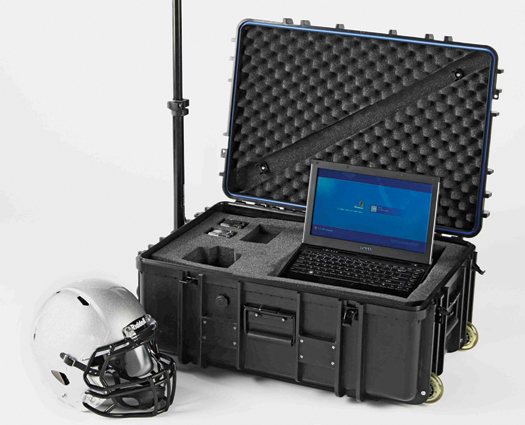
Impact Tracker
Impact Tracker: Coaches and medics can use the Head Impact Telemetry System (HITS) to monitor the force and location of certain tackles from the sidelines.  Courtesy Riddell

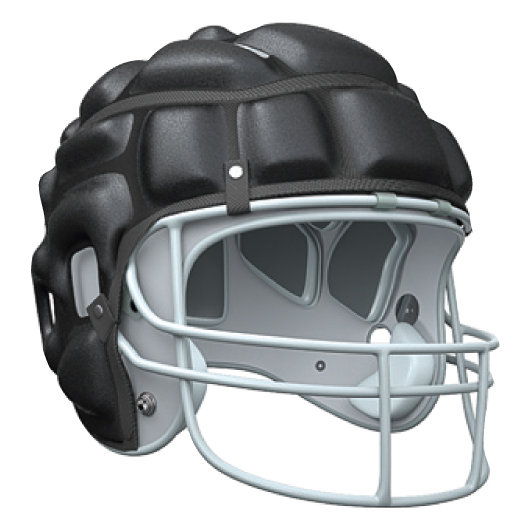
That an individual inventor could develop, produce, and deliver a product into the hands of professional athletes speaks to the upheaval in the world of helmet manufacturing. What was once a rather staid industry dominated by a few large companies has now grown to include an increasing number of upstart firms, serial entrepreneurs, and individual inventors. The result has been a proliferation of new designs. Mainstream helmet makers have stuck with variations on previous models: polycarbonate shells filled with various densities and thicknesses of padding. Newcomers have developed more creative, albeit less rigorously tested, approaches. Perhaps the best-known is the bizarre-looking Guardian Cap, a padded sock that slips over a typical helmet. Another approach that received a lot of attention in 2011, the Bulwark, came from the workbench of an aerospace engineer and self-professed “helmet geek” in North Carolina; it had a modular shell that could be configured to match the demands of different players. It never made it out of prototype stage.

For his part, Simpson officially launched his SGH helmet in October 2012 to immediate fanfare. Sports Illustrated “injury expert” columnist Will Carroll tugged one on and had someone whack him over the crown of the head—a strong, almost purely linear force. He reported not feeling much at all. His conclusion: This helmet must work.

When I called Simpson to discuss the helmet and ask how it reduces the forces responsible for concussion, he mentioned that none of the neuroscientists he’s spoken with have been able to tell him what forces actually cause a concussion. “How do you know you’re stopping the right forces, then?” I asked him. “If you don’t know what’s causing a concussion, how can you prevent it?”

“You’re asking me a lot of questions that are pretty off the wall, my friend,” he said. “A lot of questions I can’t answer.” He explained that his helmet uses a composite shell made of carbon fiber and Kevlar, plus an inner layer of adaptive foam made of Styrofoam-like beads. It performs better in a NOCSAE-style drop test than anything else on the market, he said.
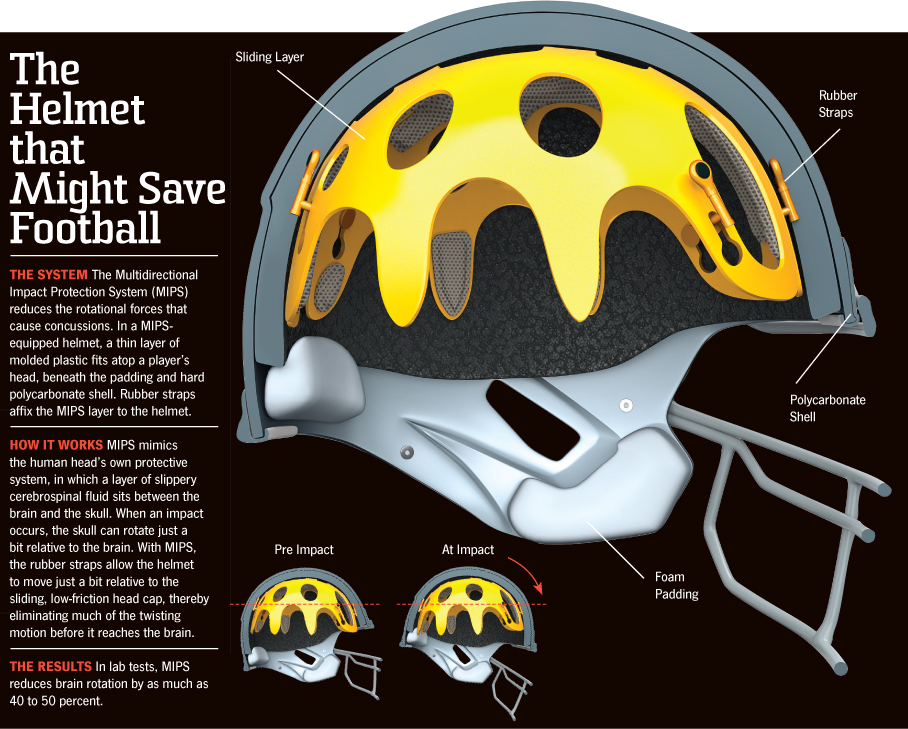
The Helmet That Might Save Football
The Helmet That Might Save Football: Click here to see this image larger.  Graham Murdoch

“Does it specifically address rotational acceleration?” I asked.

He laughed. “No helmet does that.”

I tried a more direct approach: “Can you make claims about concussion reduction with your helmet?”

“Oh, hell no,” he said, “I would never make a claim about that.”

The NFL, at least since Congress took an interest, has gotten serious about sorting out who is claiming what—or not. “There is not a week that passes that I don’t see a new device,” says Kevin Guskiewicz, a University of North Carolina sports medicine researcher and MacArthur Genius Grant recipient who also chairs the NFL’s Subcommittee on Safety Equipment and Playing Rules. “There’s a binder weighing down the corner of my desk. I don’t think you’re going to see the NFL flat-out endorsing a product, but they certainly feel that they’re responsible for trying to help prevent these injuries. So we’re going to be reviewing these technologies in order to say, here are three or four that need to be studied further.”
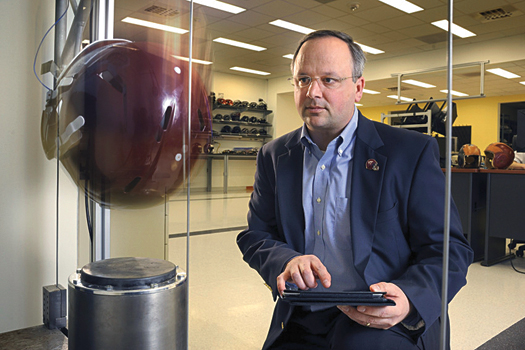
Stefan Duma
Stefan Duma: Duma, a biomedical engineer at Virginia Tech, studies the forces exerted on a helmet during a vertical-drop test.  Courtesy Stefan Duma/Virginia Tech

The boldest claim from mainstream helmet makers comes, perhaps not surprisingly, from Riddell. The company’s newest helmet, the 360, builds on a system called Concussion Reducing Technology (CRT), which it first launched in 2002. According to a highly adrenalized promotional video, which has since been removed from the Riddell website, engineers designed CRT in response to an NFL-funded study by a Canadian research lab called Biokinetics. Researchers looked at film from actual NFL hits that resulted in concussions and attempted to map their location, distance, and speed. The two main findings: that rotational acceleration is a major factor in concussions, and that players get hit a lot on the side of the head.

In response to the study, the designers developing CRT added energy-attenuating material (extra padding) to side- and front-impact areas. They also increased the overall dimensions of CRT-equipped helmets by a few millimeters to allow for still more padding. The designers of the 360 built on the CRT but went a step further, adding an even greater amount of padding to the impact areas. It wasn’t clear to me how those changes addressed rotation—the single greatest factor in the concussions that CRT and the 360 helmet meant to reduce. So I asked Riddell’s head of research and development, Thad Ide. “Well, in many cases the linear acceleration and the rotation that linear imparts go hand in hand,” he said, echoing Duma’s HITS findings at Virginia Tech. “Reducing linear forces will reduce the rotational forces.”

So the question remains: If addressing linear force is the key, and better padding is the way to do that, then why hasn’t the number of concussions decreased? “You haven’t seen it change because [the helmet makers] haven’t addressed it,” says the University of Ottawa’s Hoshizaki.

A NEW HOPE

In a small room off the basement garage of a building on the outskirts of Stockholm, an entirely different kind of helmet test is taking place. Peter Halldin, a biomechanical engineer at the Royal Institute of Technology, is strapping a helmet onto a dummy head affixed to a custom drop-test rig. Rather than slamming a helmet into a stationary anvil, as in the NOCSAE test, Halldin’s rig drops it onto a pneumatic sled that moves horizontally. By calibrating the angle of the helmet, the height of the drop, and the speed of the sled, Halldin says he can more accurately re-create the angular forces that result in rotational acceleration than other labs can. Within the dummy head, nine accelerometers measure the linear force transmitted during impact; a computer nearby calculates rotational acceleration from that data.

Today Halldin is testing two ski helmets that are identical except for one thing: Inside one, a bright yellow layer of molded plastic attached with small rubber straps sits between the padding and the head. This is the Multidirectional Impact Protection System (MIPS), which is also the name of a company he co-founded. Halldin spends about half of his time as CTO of MIPS and the other as a faculty member of the Royal Institute.

The idea behind MIPS is simple: The plastic layer sits snugly on a player’s head beneath the padding. By allowing the head to float during an impact, MIPS can eliminate some of the rotational force before it makes its way to the brain.

First up in Halldin’s test is the non-MIPS helmet. Halldin flips on a high-speed camera and steps back from the impactor, ready to catch the helmet on its rebound. “Five, four, three, two, one…” There’s a loud clattering as the sled shoots forward at 22 feet per second and the helmet drops to meet it at 12 feet per second—crack.

I can see on the computer that the head sustained about 170 Gs of linear force, and it rotated 14,100 radians per second squared (the standard scientific metric for rotation). It’s a big hit, one that would probably result in a concussion or worse.
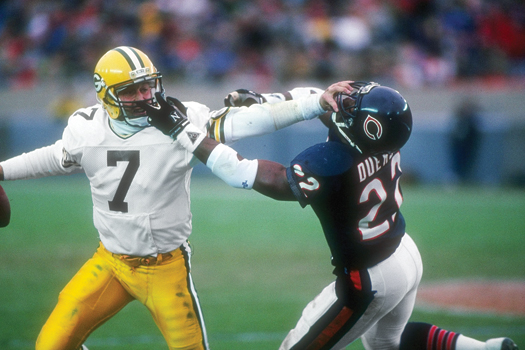
Dave Duerson
Dave Duerson:  Jonathan Daniel/Stringer/Getty images

Now comes the second helmet. Every variable is the same as in the first test except for the addition of the low-friction MIPS layer. “Five, four, three, two, one…”—crack. This time the computer shows rotation of 6,400 radians per second squared, a 55 percent reduction.

Halldin starts in on a detailed explanation of the effects of multiple impact tests on the performance of a helmet over time, but I interrupt: “How would you characterize that test result?”

He looks at the colorful graphs on the computer screen again. If the test dummy were a football player, he would have just walked away from a game-ending impact without a concussion. Halldin smiles just a bit, and permits himself a very un-Swedish boast. “I would say that’s f--–king amazing.”

Halldin is careful not to claim the MIPS system can create those kinds of results in all impacts in all helmets. But, he says, “we can reduce rotation in all directions, and it’s significant in most directions. We might get 35 percent in one direction, 25 percent in another direction, and 15 percent in another. And hopefully the 15 percent is not in the most common impact direction for that sport.”

MIPS is not new: The company’s roots go back to 1997, when Hans von Holst, a neurosurgeon at Stockholm’s Karolinska Hospital (the same hospital that adjudicates the Nobel Prize for medicine), got tired of seeing patients come in with brain injuries from hockey and other sports, and decided to do something about it. He joined up with Halldin at the Royal Institute, and together they spent the next 10 years studying traumatic brain injuries.

Rotational forces quickly became their focus, and eventually they came up with the idea for MIPS. The first product was a complete helmet, designed for the equestrian market. Although the helmet was well received, the team quickly learned that a smart concept in the lab doesn’t easily translate into a successful product launch. Production problems and quality-control issues led the team to rethink their strategy and hire a new CEO, an experienced Swedish executive named Niklas Steenberg. Steenberg took a look at the situation and decided that, like airbags in cars or Intel chips in laptops, MIPS was not an end-market product. Instead they would focus on licensing it to existing helmet companies so those manufacturers could improve their own products.

Since then, MIPS has licensed its sliding low-friction layer to about 20 helmet manufacturers, for sports from snowboarding and skiing to cycling and motocross. Recently, Steenberg decided, the company was ready to start hunting the big game—first American hockey and then the biggest of all, football.

FOLLOW THE MONEY

One would think the Riddells of the world would fall all over themselves to license or create something like MIPS, a simple product that directly addresses a critical factor in concussions and incorporates easily into existing helmet designs.
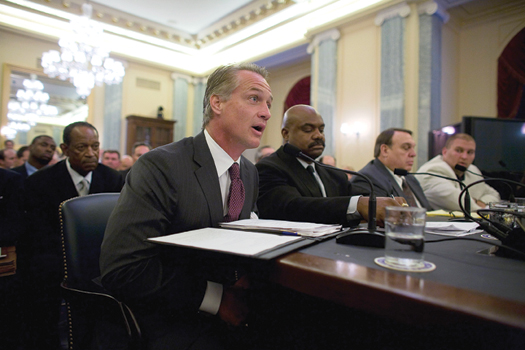
Calls For Justice
Calls For Justice: Former NFL players Daryl Johnston and Dave Duerson in 2007 at a Senate hearing on disability benefits for retired athletes. Duerson committed suicide in 2011 by shooting himself in the chest. He left a note asking that his intact brain be donated to the Boston University School of Medicine for research.  Chuck Kennedy/MCT/MCT via Getty Images

“I thought we’d have people hugging us, saying, ‘Thank you!’ ” says Ken Yaffe, a former NHL executive who left the league in March 2012, after 19 years, and signed on with MIPS to help them get an audience with U.S. manufacturers. But after nearly a year of squiring Steenberg and Halldin around to different companies, he says, “we’ve been met with skepticism.”

One of the reasons, Yaffe suspects, is that current safety standards don’t require the companies to do anything more than what they’re already doing. It’s a criticism privately echoed by most helmet researchers: Simplistic certification standards provide convenient legal cover for the manufacturers. If NOCSAE certifies a company’s helmets as safe, then the company has less risk of being held responsible for injuries. On the other hand, if that same company goes above and beyond the standards, it could put itself at risk of getting sued: Suddenly all of its existing helmets would appear to be inadequate, and worse, the company might have to admit knowing that they fell short.

Duma, of Virginia Tech, points to NOCSAE’s industry funding to explain how such a situation has persisted in football. “Follow the money,” he says. “Imagine if Ford were the only organization testing its cars, and it was saying that every one got the top rating. It’s a very unusual arrangement.”

To Steenberg, the MIPS CEO, the situation is both harmful and backward. “If something is available that makes your helmet more safe, you should be held liable for not using it,” he says. It’s not the first time a new safety technology has faced such a paradox. All too often implementation hangs on the grim calculus of whether the cost to industry of adopting a safety measure is more or less than the cost to the public of going without it. When liability enters the equation, lawyers and judges and lawmakers get involved, and even the most urgent matters can end up mired in argument. For example, it took more than a decade to legislate seat belts as standard equipment in automobiles. It’s worth noting that the two companies that first popularized and implemented seat-belt standards were Saab and Volvo, both Swedish.

Change is on the horizon, though. The University of Ottawa’s Hoshizaki has a grant from NOCSAE to develop a new standard that incorporates rotation. “I want to be fair to the manufacturers,” he says. “If they could make a safer helmet, they would. I don’t think they are against it; they’re just making sure they don’t cross that line and say, ‘Yeah, we should be managing rotation,’ because that would bring up liability issues.” With a new standard, that roadblock could vanish.

One enterprising company has already launched a product to directly address rotational acceleration in another contact sport. In the summer of 2012, Bauer, the number-one helmet maker in ice hockey, released the Re-akt. Inside the helmet, a thin, bright-yellow layer of material sits loosely between the head and the padding, allowing the head to move a little bit in any direction during an impact.

Called Suspend-Tech, the layer appears, to the color, suspiciously similar to MIPS. In fact, during the development of the Re-akt, MIPS co-founder Halldin tested an early version on his impact rig at the Royal Institute. The stories diverge as to how that collaboration came about, and how Bauer came up with the idea for a sliding layer, but any questions that arise about intellectual property may not matter. Bauer’s Suspend-Tech is a significant debut: It is the first attempt by a mainstream company to include a rotational layer in contact-sports helmets. MIPS is betting that since one hockey manufacturer has embraced the idea, the rest of the field will start shopping for their own version. And that, in turn, could create enough momentum for MIPS to break into the football market.

In perhaps the most hopeful sign of all, the NFL acknowledges that MIPS-like products have the organization’s attention. Kevin Guskiewicz of the NFL’s safety equipment subcommittee says the league is already evaluating the concept. “We’re looking at it very seriously,” he says.

Meanwhile, as scientists do more tests and manufacturers bicker, 4.2 million people will suit up and play football this year, most of them children with still-developing brains. Every one of them needs a good helmet.

Tom Foster is based in Brooklyn, New York. This is his first story for Popular Science. It originally appeared in the magazine's January 2013 issue.

25 Comments

Instead of trying to find a better helmet, which will ultimately lead to even more aggressive tactics rather amend the rules. In some countries Rugby ( Union ) is very popular. It is a very physical game. In my opinion much more so than American Football. Only soft helmets are optional and not worn by many players. Shoulder pads are not used either. Head injuries happen, but they are not a major problem. It all depends on the rules.

there will be 6D Helmet With New Innovative Technology to Debut in February 2013

Sumit- etechmag.com

It always amazes me the stupidity in designing helmets with the surface as hard as a diamond. They surface should be ABSORBING some of the impact-just like knee and thigh pads do. Making the surface hard like billiard balls is just transferring more of the impact forces to each players respective head--any idiot knows that! Having absorbent layers inside is self-defeating when the outside is designed to forward all the energy just like billiard balls do.

Remember the old physics display item with the 5 Pin-ball balls on a string as they transfer their energy to the other balls swinging on those strings? Same thing with the hard helmets. That's always been as dumb as thing as could be done.

Your better off having a deformable plastic that can avoid being ripped to shreds but still provide some energy absorption--flexible layers built into it with a slippery outer layer. If they break down and need replacement 4 or 5 times a game too bad for the sport costing more.

Mr. Rathbone's article is almost entirely lacking in scientific foundation, which is quite remarkable given the forum. One would have thought that the background work leading up to such an article would have included interviews or conversations with representatives of NOCSAE, the nonprofit organization he inaccurately characterizes as "an association funded by equipment manufacturers, which in turn funds much of the research on sports-related head trauma. The standard has remained largely unchanged since its creation in 1973." The work that NOCSAE does and has done in the area of sports safety specifically including research and scientific advancement in the areas of concussions comes from the dedication of 16 directors, only 4 of whom have any association with equipment manufacturers. These directors include representatives of the American College of Sports Medicine, the National Athletic Trainers Association, the American Medical Society for Sports Medicine, the American Academy of Pediatrics, the American Orthopedic Society for Sports Medicine, and the Athletic Equipment Managers Association. NOCSAE is not an association, and owes its only loyalty and duty to the protection of athletes through the development of science-based sports equipment standards.
NOCSAE charges equipment manufacturers a licensing fee as a part of a strict license agreement. These are not voluntary payments. Using the revenue generated from these licensing fees, NOCSAE has been the primary nongovernmental source of research funding in the area of sports related concussions. Since 1994, NOCSAE has funded more than $6 million in concussion specific research grants. These research grants are independent research programs almost exclusively performed at major research universities and university programs. Research grants are chosen in accordance with NIH grading and review protocols. Either Mr. Rathbone knew this and chose not to share it with his readers, or he simply didn't take the time in research and preparation of this article to find out the truth. He quotes extensively from Dr. Kevin Guskiewicz and Dr. Robert Cantu. Dr. Cantu is Vice President of the NOCSAE board and represents the American College of Sports Medicine. Dr. Guskiewicz, the 2012 MacArthur Genius Grant recipient and Chairman of the Department of Exercise and Sport Science at the University of North Carolina, has performed substantial research under grants awarded by NOCSAE and serves on the NOCSAE Scientific Advisory Committee.

NOCSAE football helmet standards have undergone more than 50 revisions and modifications since 1998, and today a football helmet meeting the NOCSAE standard will outperform any helmet certified to any standard, whether bicycle, motorcycle, or motorsport.

Long before sports related concussions were a topic of public discussion in the forums such as this, NOCSAE was searching for a way to address concussions through helmet performance standards. The first NOCSAE sports related concussion grant was awarded in 1994. Almost 8 years ago, in 2004, NOCSAE drafted a proposed testing standard that would utilize additional impact methodologies to generate rotational accelerations in the helmet certification testing protocol. The complexity of introducing these kinds of accelerations on a repeatable and consistent basis across multiple testing locations has been difficult, but significant progress has been made. But even if this testing standard were in place today, there is no scientific basis to determine what the appropriate injury threshold should be for rotational accelerations. One of the problems with identifying threshold is that many concussions are caused by rotational accelerations occurring without a direct impact to the helmet. The violent whiplash type movement of a receiver's head who is hit in the chest or shoulders after catching a pass generates significant rotational accelerations with no impact to the helmet.

It should also be made very clear that NOCSAE does not certify helmets nor does it approve any particular piece of equipment. NOCSAE standards are voluntary, and unless compliance is required by a sport governing body such as the NCAA, or the National Federation of State High School Associations, no manufacturer has an obligation to comply with the standard. Certification of a helmet to the NOCSAE standard is made by the manufacturer in strict compliance with the quality control, quality assurance, labeling, and performance mandates contained in the NOCSAE standard.

Manufacturers regularly make football helmets that exceed the performance requirements of under the NOCSAE standard. Exceeding the requirements of the NOCSAE standard is done in part for statistical quality assurance reasons so that even with 3 standard deviations applied, a helmet's performance would still meet the NOCSAE standard. This level of quality assurance is not required by any other helmet standard, including governmental standards for bicycle helmets.

Properly addressing sports related concussions is of vital importance, and helmets are an integral part of that protection, but there are more effective and immediate ways to reduce the frequency and severity of concussions that must be a part of any response when addressing concussions. Avoiding those hits that are avoidable, teaching young and old players not to lead with the head in making tackles, reporting symptoms of concussion and submitting to a thorough medical evaluation, and following strict and medically supervised return to play requirements will have the most immediate effect on reducing the frequency and severity of concussions, and more importantly reducing or potentially eliminating the possible long-term consequences of concussions and repeated sub-concussive impacts.

screw making it safer!! add spikes to the helmets and pads. no kill limit. throw in a few death row inmates as players. exploding balls. and the winner gets a prize. but not a few million bucks a game. a twinkie.

“Popular”, “Science”, you know that magazine for nonscientist types, the same one that told us in July 1957 that we would have flying cars in nearly every garage by 1967, has branched out to the fantasy helmet realm. While there may be a few flying cars around, I have yet to see one in my neighborhood. They certainly aren’t affordable, safe, reliable, or practical enough to be common, it is only 45 years after the predicted date, so perhaps I am just impatient. The point is a helmet to eliminate or effectively reduce concussion is just as much a fantasy today as that flying car was in 1957. Perhaps “Popular” in the name of this publication means jumping on the latest fantasy band wagon (in this case a magic helmet, without regard to the “Science”) is the norm for them, we do have 55 years of history on the publication that would indicate that is the case. Relying on such stellar scientific journals as the NY times as a reference and resource for any magazine with the name Science in the title simply underlines the fantasy filled blathering found therein.

Concussion in sports is a serious issue, with lots of good science, funded almost entirely by the organization, NOCSAE, who the magazine and some who were interviewed indicated was a money front for the manufacturers. It is interesting that these same contributors suckle at that teat, and NOCSAE is happy to fund them in the hope they contribute to the science. One of them is funded to develop a new standard. A standard that would threaten the cushy set up claimed in the magazine, how hypocritical can you get with your accusations? Well, it is, after all, fantasy. Most all of these criticizers serve on other standards committees, none of them have a better standard, none have a more demanding standard, and none have a standard that attempts to capture rotational accelerations, let alone establish a limit for such forces.

While others can explain how NOCSAE is funded and how the board of directors, who all work for free, decides on funding, I can tell you that the manufacturers of products certified to NOCSAE standards have a very minimal representation on that board. They are not there because it is their money; they are there to provide their input on whether what is going to be demanded in a standard has a chance of being accomplished. They have a voice, not the only voice, not the loudest voice and they cannot take there money and go home. The reason they cannot take their money and go home is because NOCSAE has zero, as in no, none, zip, nada, power to demand anyone ever use their standard. The people who do so are the governing bodied of the sports, and they these governing bodies have no say, or vote in the development of the standards. This disconnect renders all the conspiracy theories about “follow the money” completely moot, but that fantasy makes for “Popular” reading and enables the saber rattling of “we must do something” faction to get in print in spite of the “Science”. To be clear if there was a scientifically based and demonstrably better standard that was shown to reduce injuries then those governing bodies would demand compliance with that and there would be no need for NOCSAE. Manufacturers would have no choice but to comply with the new standard or not sell product. Of course those details of scientifically based and demonstrably better are a mouthful and no one has promulgated a better document. Not NOCSAE or the government or the critics of either, because as of today it is not possible.

Now, as for the science, it is emerging, and the latest credible science indicates, some would say proves, the long held belief that there is a correlation between the linear acceleration (easily measured) and the rotational forces, injury causing resultant is flat wrong, in real injury causing events where people are wearing certified helmets. This is a real issue for those who have built their name or business on that particular linear correlates to rotational fantasy. To them lower the linear acceleration = reduce the problem, an easily determined outcome that clearly has not happened. Yet they cling to the long held belief that they have published or sold to people in the form of some product or another. Talk about follow the money that might be a place to look.

Now as for the helmet that will save football fantasy. Despite the testing on disembodied heads (no neck and torso) indicating the MIPS type system makes a difference (talking about test scenarios designed to make the product look good) look no farther, but do look deeper. If ever my disembodied head is about to strike a fast moving, inclined plane conveyor belt, designed to grab the helmet, sign me up for one of them MIPS helmets. But it would be hard for me to sign my name being just a head and all.
The design and invention of the MIPS system is a wonderful solution to a problem that does not exist on the playing field despite the seeming reasonable explanation of Mr. Collie’s injury in the article. The fact is, no helmet couples with the skin and hair, no skin, hair and scalp couples with the skull and no brain couples with the inside of the skull in such a way to allow this rapid spin like a top motion to be mitigated by a helmet slip plane. The mechanics are simply different from what the device is trying to effect. Talk again about follow the money and the only thing that becomes F…king amazing about this story is that nobody notices the disembodied head.

The real issue is that both pre and post kinematics (motions) of the head are at work and there is no correlation between linear and angular forces in the events that result in concussion while wearing certified helmets on the field in nearly every case. Most important is that motion is not to spin the head like a top about it center of gravity, or center of mass or geographic center, it is more akin to the head being an 11lb object at the end of a flexing hose (the neck) getting whipped before and after the impact. In other words the center of rotation is about some vertebral body in the cervical spine not between your ears. This fly swatter like motion causes shear strains that do not correlate to the linear impulse but only to the complex rotational forces. It is the head traveling through an arc that is the rotational inertia causing the damage in either one or both directions, not a spin about the center of the head exorcist style, thus something to mitigate that spin has no chance of helping.

So there is no fantasy helmet, there is no helmet made by anyone that is going to effectively change this situation. It is the game that will change, if football is to survive, not some magic fantasy device that everyone is clamoring for. The real follow the money trail is folks selling products that they claim, without the science to support them, will either make the problem go away or predict for you when it happens. Why is this so appealing? Because every Pop Warner Mom, every high school Dad, every NFL players better half and every fan wants an answer that allows the status quo of the game to remain as it is. That, for all of you have endured this missive to the end, is the real fantasy, and the true money trail.

P.D.Halstead Technical Director Southern Impact Research Center Adjunct Professor University of Tennessee

Glad to see there’s a debate starting here. I’m Tom Foster, the author of this article. (Mr. Rathbone, referenced in Mr. Oliver’s comment, is Travis Rathbone, the PopSci photographer.) Just to be clear to readers, Mr. Oliver is NOCSAE’s executive director.

Regarding Mr. Oliver’s points, I’d like to make a few clarifications:

First, thanks for responding. The point of an article like this is to advance the public’s understanding of an important issue, and a healthy discussion in this forum can only help with that. Popular Science’s only agenda here is to examine the advances in science and technology that can reduce the number of concussions. There are certainly other measures that will help – rule changes, culture changes – and we applaud all of them. Many such changes have taken place in the past couple years, and there’s a good debate going about other possibilities. This article focused on the helmet-technology piece of the puzzle, so I’ll keep my comments here focused on that, and just note that I agree with Mr. Oliver wholeheartedly about the importance of non-helmet safety measures.

Regarding NOCSAE funding: As Mr. Oliver points out, it comes from fees paid by the helmet manufacturers, and that money in turn funds helmet research. That’s correct, and it’s what the PopSci article says. Again, I don’t think there’s any argument here.

Regarding Mr. Oliver’s assertion that I did not speak to NOCSAE: As he says several sentences later, I in fact quoted extensively from my conversations with NOCSAE Vice President Robert Cantu, as well as numerous other experts who have done and are currently doing work for NOCSAE.

On the point of NOCSAE’s testing standards and whether they take into account rotational acceleration: As Mr. Oliver points out, they do not. That’s what the article says as well. NOCSAE tests for high levels of linear acceleration that could cause skull fracture. That’s what the standard was developed to do 40 years ago, and that’s what it still does. What it does not do is address concussion. That has not changed for 40 years.

Finally, Mr. Oliver points out that there are plenty of hits that occur on the football field that cause rotation without any impact to the helmet – a whiplash effect from hits to other parts of the body. That’s absolutely correct, and no helmet will be able to address that problem. But again, the point here is to talk about what helmets potentially CAN do. Helmet design has for the most part ignored rotational acceleration to date, so it’s crucial to examine a design that does so. Mr. Oliver says that NOCSAE has long been searching for a way to address sports-related concussion through helmet performance, so I hope the organization takes a serious look at future helmets that incorporate a sliding rotational layer, or any other future innovation that addresses rotation. But first the testing protocol and standards have to change to be relevant to concussions. As the article points out, NOCSAE is funding research to develop a standard for rotational acceleration. Kudos – I look forward to it, and so should anyone who plays contact sports or cares about others who do.

One additional note for readers: P D Halstead (author of the comment right after Mike Oliver's) is NOCSAE's technical director.

@gizmowiz Quite right. Nearly all of the designs are to protect the wearer. Never to protect someone the wearer may run into!

Helmets are made backwards. They need to be soft on the outside, to absorb the impact before it gets to the wearer. This applies to all kinds of protective helmets. I've known this for years. Try it yourself. Put a hard surface over a piece of foam, with your hand under the foam. strike the hard surface. See how much you feel in your hand, then reverse it, put the foam on the outside and strike it with a similar blow. you'll feel much less, if anything. couple that with some more foam or other impact absorbing material on the inside, then most blows would not be a problem. Why the people that design helmets can't see this, I don't understand. It's simple logic, absorb the impact so it can't be transmitted to the wearer in any form. Easy peasy. The material that goes under shoulder pads and the like would do for the outside, as it's impervious to water and sweat. come to think of it, they should rethink the shoulder and thigh pads too.

I think that it should be obvious that this article is focusing on the need for improvement of a single implement, the football helmet.

It is sad to see how defensive the NOCSAE got with their responses.

Neither hope nor help appears to have been coming from the NFL, NCAA, NOCSAE or the traditional equipment manufacturers in terms of significant improvements to the design of the football helmet in regards to preventing concussions.

Michael Oliver said above, "Almost 8 years ago, in 2004, NOCSAE drafted a proposed testing standard that would utilize additional impact methodologies to generate rotational accelerations in the helmet certification testing protocol. The complexity of introducing these kinds of accelerations on a repeatable and consistent basis across multiple testing locations has been difficult, but significant progress has been made."

I'm glad this pace of forward progress was not witnessed during the Apollo 13 crisis. Engineers and scientists came together to figure out a problem that they hadn't foreseen with only hours to save a three lives. What you see going on at NOCSAE is the lack of incentive to change. They may not understand all the variables, but they can hide behind that controversy as an excuse for their inability improve standards.

The bottom line is that the NOCSAE is not responsible for concussions in football. But they are acting like it with their defensive responses.

The NFLPA, NFL and NCAA have the biggest stakes to see improved safety in football. To use a cliche "follow the money." They appear to be risking popular fallout if an unfortunate combination of multiple celebrity players fall victim to the sustained affects of head injuries. The evidence is mounting. Increasing occurrences of suicides, homicides, and developed mental disorders are encouraging deeper investigation. But it isn't enough, right now.

There's a story about a dog that howled every couple of minutes as it laid on an old porch. When asked the owner explained to his neighbor that the dog had laid down on top of an exposed nail that was hurting him and the dog howled in pain. The neighbor then asked, why doesn't the dog get up and move to a new spot? The man said that it didn't hurt enough.

Who is the dog? The players? Their parents/spouses? The NFL/NCAA? Congress?

When can we all agree that it hurts enough to make a change and work together towards practical solutions?

Personally, I think the game should be left alone. These guys make more money for playing a sport than soldiers and cops do for putting their lives on the line each and everyday. Yes, the game has risks but, again, they make millions so... let's let them earn the money.

Beyond that, this part is a message to PopSci -

I tried clinking on the image gallery twice and got this:
ACCESS DENIED
You are not authorized to access this page.

Must be a referee nearby that didn't like my opinion...

All good and nice but, the Head is not supposed to be used as a battering ram. You have sholder pads for that and arms to tackle. The Helmet is to protect your head. What about their necks and spine they could do life altering injury. No one whats that. It's illegal to use your head as a ram to hurt someone defenceless. And get heavely fined by the NFL for dirty play. And those who have never played football or enjoyed it as a sport to watch and enjoy don't know the rules to the game should learn first. The Helmet alone is to just protect your Head.

Those who think that the helmets outer shell should be soft are overlooking the obvious - the outer shell is one part of a multi-level energy management system. The 'hard' outer shell flexes upon impact, absorbing some of the energy that would otherwise be transferred to the protective inner liner. A soft outer shell means more of the impact forces are permitted inside the helmet. That means that the inner liner must be engineered to absorb and redirect more energy and that leads to disposable one-impact helmet since the materials used to absorb higher levels of impact forces are sacrificial. It goes without saying that not all impacts in football are of sufficient force to fracture the hard outer shell that would render a conventional helmet incapable of protecting the players head.
A better approach would be to create a two-piece helmet using the hard shell to protect a disposable liner custom fitted to a players individual head. A re-usable shell and sacrificial liner would improve protection while controlling equipment costs. A replacement liner would be far less expensive than replacing a complete helmet yet offer better protection.

Hello-

My name is Niklas Steenberg and I’m the CEO of MIPS, the 11-year old Swedish helmet technology company profiled in the current issue of Popular Science magazine and referenced in the discussion above.

First, let me say that this public dialogue about concussions and helmet safety is very positive and essential in finding the best solutions for athletes and other active individuals. Given some varied views among top experts in the field, we welcome this and future discourse and believe it is an important step to help make sports like football, ice hockey and other high impact sports safer.

I want to clarify the record and emphasize that MIPS has never claimed to offer technology that would prevent all concussions. As this story and many commenters have noted, concussions can be caused in various ways by impacts to the head, but also by blows to the shoulders, chest and neck etc. Naturally safer helmets address hits to the head and it is true they are only part of the solution of addressing concussions in sports.

However, we do strongly believe and have scientifically validated the position that advanced helmet technology can and will reduce concussions. And while there is a lot of debate as to how concussions occur, a majority of scientists and doctors worldwide agree that rotational forces are a major factor in brain injuries.

The technology behind MIPS, which has been in development for over 17 years, has been proven to reduce rotational forces caused by oblique impacts to the head. Dr. Peter Halldin and Dr. Svein Kleiven, Biomechanical Engineers from the Royal Institute of Technology and Professor Hans von Holst, neuroscientists from the Karolinska Institute in Stockholm created MIPS. We have volumes of scientific data to support our claims. You can access some of those reports, published in peer reviewed technical journals, here: http://mipshelmet.com/facts-and-tests/research-documentation. As well, a number of major helmet manufactures such as SCOTT, POC and Burton are already implementing the MIPS Brain Protection System for a range of sports activities including ski, snowboarding and cycling.

As a comment to previous comments that all rotational forces being caused by the neck we have both experimental results in-house as well as with the well renowned North American test institute Biokinetics, Ottawa, Canada and in addition we have numerical results from a detailed Finite Element model of the human neck, showing that it is possible to absorb rotational acceleration in a helmet even if you are testing with the neck. The conclusion is that the tests carried out at the Royal Institute of Technology without the neck are giving similar results as tests with the neck conducted at other test institutes.

We encourage NOCSAE and other similar authorities to develop testing that measures how helmets reduce rotational acceleration. Ultimately systems such as MIPS, which cause reduction in rotational energy in the brain, should be an ingredient in all helmets. Advancement in helmet technology can and will reduce the severity and frequency of concussions. When combined with rule changes and cultural changes targeted at players safety we will take a significant step towards preservation of football and other sports faced with the concussion epidemic.

Sincerely,
Niklas Steenberg, CEO
MIPS AB

It looks like these research efforts could use a few more woodpeckers on their teams. The rubber bands in the helmet suggest that their may be a woodpecker or two in that lab.

Why don't you opt for playing real "foot ball" y mean using your "foot" only to kick the "ball", in that sport if someone is playing rough against you is not allowed, they call foul

An excellent article, and the testy (and somewhat unprofessional) reaction from NOCSAE officials indicates that Tom Foster has exposed some facts they prefer to hide.

My only quibble: "... even sports like cycling and snowboarding are contributing to a growing epidemic of traumatic brain injuries." This falsely implies that cycling is a significant source of serious brain injury.

In truth, bicycling contributes almost nothing to the tally of serious brain trauma. For example, Victor Coronado et. al., "Surveillance for Traumatic Brain Injury Related Deaths, United States, 1997-2007", Centers for Disease control and Prevention, shows that bicycling causes only 0.6% of America's TBI fatalities. Other sources show cycling produces perhaps 1% of serious concussions. Motoring and even pedestrian travel are far riskier regarding TBI. (Pedestrians are at significantly higher risk per mile traveled!)

Furthermore, bicycle helmets have apparently not reduced the toll, minor as it is. Certainly, despite greatly increased bike helmet use, bicycling fatalities in the U.S. have not fallen as fast as pedestrian fatalities. And the best data from Australia and New Zealand (where bicycling is illegal unless a helmet is worn) shows head injuries per remaining cyclist actually increased following helmet laws. (The laws greatly reduced cycling levels.)

The failure of bike helmets is perhaps due to angular accelerations of the head and brain, as addressed in the PopSci article. Indeed, the helmeted head presents a larger target, and a longer moment arm for tangential forces, compared to a bare head. Furthermore, as in football, there's a real chance that the _feeling_ of protection that comes from a helmet leads to lack of caution and more head strikes.

It may be time for U.S. football to go the way of rugby and Australian-rules football and ditch the headgear entirely. And certainly, there's no reason to scare ordinary bicyclists into adopting ineffective helmets.

This article could just as easily apply to helmets used in other activities, particularly cycling. Helmet use in American football and hockey is limited to the citizens of a few nations only. Cyclist use has much greater potential globally.

Although not explicit, the article suggests that in very oblique impacts helmets can convert a minor injury into a brain injury. In those jurisdictions where use of helmets has been mandated for cyclists, a significant ethical issue arises. In the US and other democracies the principle that man has a right to life and liberty is constitutionally entrenched. If an increased risk of brain injury cannot be ruled out, then forcing someone to wear a bicycle helmet not only violates a constitutional right (for some) but also infringes on a human right everywhere.

We should be reluctant to exchange the risk of a laceration or fractured skull (or no injury) for the risk of a brain injury. I shall continue to ride a bicycle without a helmet.

in order to thank everyone, characteristic, novel style, varieties, low price and good quality, and the low sale price. Thank everyone

http://3yu.net/cVx

http://3yu.net/cVx

http://3yu.net/cVx

http://3yu.net/cVx

│\_╭╭╭╭╭_/│  
 │         │\|/  
 │ ●     ● │—☆—  
 │○ ╰┬┬┬╯ ○│/|\  
 │   ╰—╯   /  
 ╰—┬○————┬○╯  
  ╭│     │╮  
  ╰┴—————┴╯ fgjhrjtrsafghtrjrt

“The Best Defense against Concussion is a Helmet with a Kinetic Offense”

TBI is a result of brain movement at higher accelerations than the tissue can support. This movement is caused by direct linear and angular rotation forces applied to the head via the helmet AND by forces transmitted by the neck.

The hit on Davis of the 49ers during last Suday's game with the Seahawks (as seen here: http://www.youtube.com/watch?v=fH1i1N1eENw) revealed a safe hit that did not impact the head. In this impact, the body is hit so hard that as it tugs on the head hard and causes what looks like a forward head snap around the neck’s pivot point. The inertial forces of the brain's own mass within the skull created the damaging rotational accelerations.

No current technology, including the MIPS system would have prevented Davis's concussion. This last year I looked into the limits afforded by "passive" designs and and have patented a novel and possibly significant helmet innovation.

The Kinetic Response Helmet generates an anti-rotation force within the helmet shell by able to counter the extreme rotation changes. It does this by creating a torque in free space by accelerating a small mass (F=MxA)at a high rate for the duration of what would other wise be damaging. The sensors to evaluate the onset of an extreme hit exist (see X2Impact and the Stanford studies) while the high tech mechanical systems able to control and deploy airbags are common. Together they can be used to create another layer of safety for all contact activities.

In the case of the 49er event on Sunday, none of the other technologies would have been able to help (lacking any helmet impact), only the kinetic response could have helped.

There is a saying in football that the best defense is a good offense. The truth behind this saying is that by exerting enough force against your opponent, you have the best chance of protecting yourself. This truth is the foundation of the Kinetic Response Helmet (KRH).

I am interested in any comments. Thanks you.

I'm getting the impression that not very many of the other commenters understand that the article's intention is to relay that helmets we use today are not being altered to reduce concussions. Not whether or not helmets are the only thing that can prevent a concussion, or that the head is the sole perpetrator of ALL concussions.

...and I got a pretty good laugh when I found out who P.D. Halstead was. ;)

I have seen helmet technology change over the years as everyone seems to think better helmets is the answer. No one gets it; except QuietStormX and me, apparently. Thanks QuietStorm for your comments. The High School Football rule book has been around for decades and has been in use for Pee Wee/Pop Warner players right up to the NFL. Stated in the book in BOLD PRINT: THE USE OF THE HELMET OR FACEMASK AS A WEAPON IS ILLEGAL. However, I have seen the opposite in practice for the last two decades including the teaching, coaching, and condoning of that technique in tackling and blocking throughout the sport. I was taught to use my shoulder pads as the point of contact for blocking and tackling. My helmet in 1952 as a sixth grader was made of leather and a flimsy composite. There were no head or neck injuries in those days to speak of. GET BACK TO THE PROPER FUNDAMENTALS OF FOOTBALL OR CLOSE DOWN THE GAME. AT LEAST MAKE AN ARREST INSTEAD OF THROWING THE FLAG.

@African Rover I say this from experience. Much respect for rugby ...tough game, no doubt! But, it's obvious people who speculate have never been devoured by an offensive outside lineman; 6'5" 250 lbs of lean muscle and fiberglass, who's one objective is to in-flick maximum pain and incapacitate you. Is why the average shelf life of a Pro rugby player is 6 years. NFL lineman... 3.3 yrs. Theory based on opinion, only.

This great controversy over concussions in all levels of football and sports brings up a difficult question. Who decides the path of science? It is obvious that players in the National Football League blatantly disregard their own health in order to compete. They do so despite knowledge of the dangers of concussions and its impact on their performance. Just this past October, Brady Quinn, a quarterback for the Kansas City Chiefs said, “I tried to play through it (a concussion), and that’s my fault for not being smart about it.” (www.profootballtalk.nbcsports.com/2012/11/07/quinn-says-he-played-with-concussion/) Similar instances of players hiding concussion symptoms from doctors to remain in games prove that football players lack the drive to eliminate concussions from their sport. Even those that manage the players in the league as doctors or rule makers fail to eliminate concussions from the game. In fact there is such confusion that evidence shows teams and players frequently mix up the terms head injury and concussion. (www.espn.go.com/espn/otl/story/_/id/8706409/nfl-concussion-program-marked-inconsistencies-making-difficult-assess-whether-league-making-progress-issue) Despite efforts to defend the league’s reputation, the NFL has struggled to implement uniform guidelines for the treatment and prevention of concussions. As this article states, there are 3.8 million sports-related concussions each year. This fact alone makes it clear that the problem of concussions in athletes affects more than just gridiron veterans. Furthermore, there is no evidence that states that the casual sports player is any better informed about the dangers of concussions or lacks the drive to keep playing despite knowingly having a concussion. Thus, this complex societal problem has no solution without the implementation of science and technology. The introduction of the Multidirectional Impact Protection System created by Peter Halldin and Hans von Holst takes a significant step towards eliminating the dangers caused by concussions and the resulting brain damage named chronic traumatic encephalopathy. The development of this helmet system also answers the question of who decides the path of science. Undeniably it is the scientist that guides that path of scientific study. The scientists in this case have decided what should be done for public good. They have deemed it necessary to protect the vitality of such young people in our community. In my opinion, this will forever remain the case, as despite knowing and acknowledging the dangers of concussions, the public is not willing to take a stance to resolve the issue. Thus, to resolve this societal issue, we have scientists who come up with such great technological improvements.


140 years of Popular Science at your fingertips.

Innovation Challenges


Popular Science+ For iPad

Each issue has been completely reimagined for your iPad. See our amazing new vision for magazines that goes far beyond the printed page


Download Our App

Stay up to date on the latest news of the future of science and technology from your iPhone or Android phone with full articles, images and offline viewing


Follow Us On Twitter

Featuring every article from the magazine and website, plus links from around the Web. Also see our PopSci DIY feed


February 2013: How To Build A Hero

Engineers are racing to build robots that can take the place of rescuers. That story, plus a city that storms can't break and how having fun could lead to breakthrough science.

Also! A leech detective, the solution to America's train-crash problems, the world's fastest baby carriage, and more.


Online Content Director: Suzanne LaBarre | Email
Senior Editor: Paul Adams | Email
Associate Editor: Dan Nosowitz | Email

Contributing Writers:
Clay Dillow | Email
Rebecca Boyle | Email
Colin Lecher | Email
Emily Elert | Email

Intern:
Shaunacy Ferro | Email

circ-top-header.gif
circ-cover.gif
bmxmag-ps