
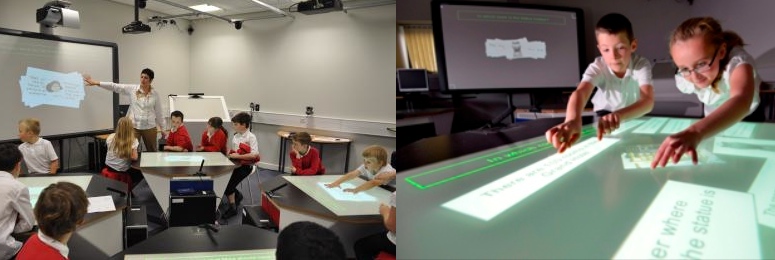
Observe the criticisms of nearly any major public education system in the world, and a few of the many complaints are more or less universal. Technology moves faster than the education system. Teachers must teach at the pace of the slowest student rather than the fastest. And--particularly in the United States--grade school children as a group don’t care much for, or excel at, mathematics. So it’s heartening to learn that a new kind of “classroom of the future” shows promise at mitigating some of these problems, starting with that fundamental piece of classroom furniture: the desk.
A UK study involving roughly 400 students, mostly aged 8-10 years, and a new generation of multi-touch, multi-user, computerized desktop surfaces is showing that over the last three years the technology has appreciably boosted students’ math skills compared to peers learning the same material via the conventional paper-and-pencil method. How? Through collaboration, mostly, as well as by giving teachers better tools by which to micromanage individual students who need some extra instruction while allowing the rest of the class to continue moving forward.
Traditional instruction still shows respectable efficacy at increasing students fluency in mathematics, essentially through memorization and practice--dull, repetitive practice. But the researchers have concluded that these new touchscreen desks boost both fluency and flexibility--the critical thinking skills that allow students to solve complex problems not simply through knowing formulas and devices, but by being able to figure out what the real problem is and the most effective means of stripping it down and solving it.One reason for this, the researchers say, is the multi-touch aspect of the technology. Students working in the next-gen classroom can work together at the same tabletop, each of them contributing and engaging with the problem as part of a group. Known as SynergyNet, the software uses computer vision systems that see in the infrared spectrum to distinguish between different touches on different parts of the surface, allowing students to access and use tools on the screen, move objects and visual aids around on their desktops, and otherwise physically interact with the numbers and information on their screens. By using these screens collaboratively, the researchers say, the students are to some extent teaching themselves as those with a stronger grasp on difficult concepts pull other students forward along with them.
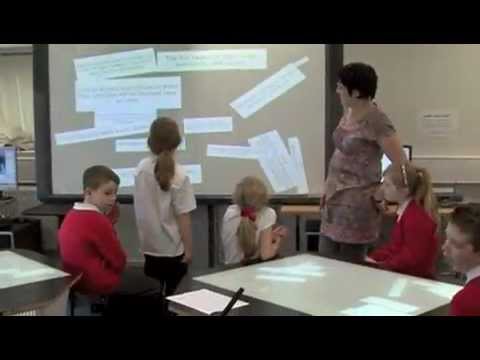
Moreover, the teacher can simultaneously monitor what’s happening on various desktops via a master screen, allowing he or she to intervene quickly if one student or group of students begins to derail over a particular concept or problem. From the master desktop, the instructor can beam different problem sets to different groups around the classroom, or move one group’s set of solutions over to another desk for a second group to check or build upon. This enhances the collaborative aspect and keeps the entire class moving forward together at a steady pace, without any one student or group of students getting way ahead or falling woefully behind.
At least, that’s what the study published in the most recent journal Learning and Instruction suggests. This kind of stuff can be really hard to quantify, though testing showed that 45 percent of the students who used the technology for instruction were able to increase the number of “unique mathematical expressions” they were able to produce, compared to just 16 percent of those students taught via traditional paper-based exercises. (Just a note here: neither of those numbers inspires an overflow of confidence.)
It’s going to take a lot more time, research, and money (especially money) to prove this out, though we’d venture to guess that even if the “classroom of the future” isn’t necessarily boosting student performance it’s likely not hurting it either. After all, the future is increasingly multi-screen and multi-touch, wireless and paperless. Shouldn’t elementary education reflect that?

140 years of Popular Science at your fingertips.
Each issue has been completely reimagined for your iPad. See our amazing new vision for magazines that goes far beyond the printed page
Stay up to date on the latest news of the future of science and technology from your iPhone or Android phone with full articles, images and offline viewing
Featuring every article from the magazine and website, plus links from around the Web. Also see our PopSci DIY feed
Engineers are racing to build robots that can take the place of rescuers. That story, plus a city that storms can't break and how having fun could lead to breakthrough science.
Also! A leech detective, the solution to America's train-crash problems, the world's fastest baby carriage, and more.


Online Content Director: Suzanne LaBarre | Email
Senior Editor: Paul Adams | Email
Associate Editor: Dan Nosowitz | Email
Contributing Writers:
Clay Dillow | Email
Rebecca Boyle | Email
Colin Lecher | Email
Emily Elert | Email
Intern:
Shaunacy Ferro | Email
While this is certainly encouraging, I do not believe the touch screen is really to credit here.
These kids are rather young. That means the math they are handling is more intuitive, and less abstract. It can easily be visualized, and therefore a high image medium may be beneficial.
But I find a more compelling explanation would simply be that the device acts as a videogame of sorts - something more interesting. The touchscreen interests the kids a bit more, and therefore they actually focus, compared with the 'boring' normal method.
I learned the same math at roughly half their age with computer games from The Learning Company. No touching required; just an engaging system that requires me to think about numbers and spacial relations.
The same improvement can be effected by a good teacher, and a home environment that expects kids to pay attention and try hard at school. The mathematical concepts these kids are learning are not outside the comprehension of virtually anyone. The failure to comprehend is only a failure to apply themselves to something that doesn't interest them. (And newsflash parents; telling your 10 year old that math is needed in everything they do a decade from now has roughly zero motivational potential. They need to see a direct benefit or immediate interest.)
All this goes to say that, while I would have loved this device, and I'd love my kids to have it, I'd much rather see this money towards hiring more competitive and competent teachers. We've been throwing money at schools for the past 40 years, with zero improvement in academic comprehension. We make 'better and better' computing tools and games, when the ones from a decade ago can accomplish the same thing at literally a tenth of the cost.
How is it that with the advent of computers streamlining information gathering, word processing, and self-teaching to a level never seen in human history, and the largest sum of money in history dedicated towards each person to provide these miracles, we get zero improvement?
Keep pushing technology, but stop selling more expensive toys as a solution for education.
@brian144,
Thank you, thank you, thank you!!
I believe your post described perfectly what I also feel is the real issue and the problem.
People don't like to think or be told that they're deficient at what they do, and teaching professionals are no different. So how do companies turn that to their own advantage? Tell the teaching professionals that they're not bad, but that it is a hard job and that they have a cool new tool that will make it so much easier to teach kids. In effect, "It's not that you're bad at what you do, or lack the required effort. It's that you should be able to use our new tool to teach kids more, while working less. Isn't that great? Now just sign here and pay there, and you'll be turning out little Einsteins in no time!"
We all want to believe that to be true in our work. But most of us have to make the hard decisions as to whether that expenditure, which comes out of our own pocket, is really going to do what's advertised. In a system where there is little/no outside incentive to spend prudently on things that will produce the best teaching return/dollar, that hard decision is rarely made. And instead we get large expenditures with little to no gain in education.
I like to think back a month to the press statement about an experiment by the One Laptop Per Child organization where they dropped off laptops in remote Ethiopian villages. So the kids had no teachers, just cheap little laptops, which they had never seen before. The goal was, "to see if illiterate kids with no previous exposure to written words can learn how to read all by themselves, by experimenting with the tablet and its preloaded alphabet-training games, e-books, movies, cartoons, paintings, and other programs."
Here is what happened:
"Earlier this year, OLPC workers dropped off closed boxes containing the tablets, taped shut, with no instruction. “I thought the kids would play with the boxes. Within four minutes, one kid not only opened the box, found the on-off switch … powered it up. Within five days, they were using 47 apps per child, per day. Within two weeks, they were singing ABC songs in the village, and within five months, they had hacked Android,” Negroponte said. “Some idiot in our organization or in the Media Lab had disabled the camera, and they figured out the camera, and had hacked Android.”
After several months, the kids in both villages were still heavily engaged in using and recharging the machines, and had been observed reciting the “alphabet song,” and even spelling words. One boy, exposed to literacy games with animal pictures, opened up a paint program and wrote the word “Lion.” "
No teachers involved, no directions, no expectations, no grades, just a way of learning that was engaging. We humans generally like learning. We're a curious bunch. And we learn either because it is engaging or because it is necessary for our survival. Well, right now most students don't have either motivation. Sometimes parents threaten, which kicks in the survival motivation, but that never lasts long, right?
@brian144
"We make 'better and better' computing tools and games, when the ones from a decade ago can accomplish the same thing at literally a tenth of the cost."
Okay so you get your slide rule il get my graphing calculator we'll see who can get more work done in less time. You get your paper and pen out il get my Microsoft word out and we'll have a writing competition. you get your map and compass out and il get my GPS or google maps and we'll map out a route to take. you get your encyclopaedia il get my wikipedia and we'll see who can look stuff up faster.
My point here being Yes you can accomplish the same task at a tenth of the cost but I can accomplish that task much much faster and as the old saying goes time is money.
I don't know that this concept is bad. I do know that periodically there's an annoucement of a new tech that will 'revolutionize' education.
- round school buildings (why?)
- internet connected projector style whiteboards
- etc etc etc
We do this in the US. I don't know if it's done in Europe. I'm pretty sure that it's NOT done in Japan, a nation that generally waxes us in interational math competition.
( Do we study their methods? - I've never heard that we do )
What I have read is that Japanese kids HATE math class because it's extremely hard. Their gpas are generally fairly low. (At the time of the study US kids had better gpas -- unfortunately the standards may have been lower. )
I've also read that Japanes parents will attend school when their kids are sick -- to ensure that they don't miss anything.
My point is that while there may be tech that helps somewhat -- at the core it takes hard work. Competent teachers can help students understand, but the students have to want to do it. Parents can help in that regard.
All kids are natural geniuses. Too bad they have to grow up to be so dumb with their loss of vision, lol.
It’s only a few that keep their genius ability.... sigh.
Ah, children with who naturally dream and see other realities!!!!!!
As a current high school student, I can assure you all that the failing education system is not at all the the fault of the teachers.
Rather, the fault is with the students, for not applying themselves to the curriculum. Education works only when both the teacher the the student apply effort. The teachers are doing their job. The students are not.
Therefore, anything that increases student interest in the subject will also increase the amount the student learns. Whether that be a touchscreen desktop or a computer game from the 90's. The only reason the touchscreen is better in this case is because students have higher standards of what is interesting.
Ultimately, the problem lies with student apathy, not teacher incompetence. The money throwing that brian144 described has been hiring new teachers for the past 40 years. They are not the issue, that is why the problem has only grown. Only when the students care will they learn. Money spent on making students care (even on such hugely expensive things as the touchscreen desks) is more valuable than replacing a perfectly able teacher.
Fix the student, not the teacher.