
We may earn revenue from the products available on this page and participate in affiliate programs. Learn more ›
A computer desk is more than just a coffee table and some extension cords. It’s a dedicated space for the computer, and it’s the literal foundation for all your work and online play. Fortunately, computer desks have come a long way since folding card tables and particleboard eyesores, with models that bend and shape to your specific needs. Finding a computer desk with useful options but not add-on gimmicks and unnecessary flourishes is important. It should be nimble enough to handle your tasks and sturdy enough to support your workload. And, most importantly, it should make you happy and excited to get stuff done. You can easily get overwhelmed with choices or discouraged by high prices. Be strong. You’ll find plenty to pick from as you scroll through our recommendations for the best computer desks below.
- Best overall: Walker Edison Modern Computer Gaming Desk
- Best adjustable: Flexispot Kana Pro Bamboo Standing Desk
- Best for two people: Tribesigns Double Computer Desk with Printer Shelf
- Best for small spaces: Prepac Wall Mounted Floating Desk
- Best for corner: Teraves Reversible L-Shaped Desk
- Best for gaming: NTENSE Genesis Adjustable Gaming, White Desk
- Best budget: Cubiker Computer Desk
How we chose the best computer desks
I’m a writer and editor with more than 15 years of experience who has done extensive product reviewing. In compiling our recommendations for the best computer desks, we considered options from dozens of brands. We prioritized computer desks that provide good value for the money and serve a wide range of needs.
Our desk recommendations cover couples sharing home office space, gamers looking for a rad home for their battlestation, creatives who use two big monitors, and people with little floor space or money for a desk. We also considered the materials, durability, versatility, and storage space of the available options.
The best computer desks: Reviews & Recommendations
Comfort, efficiency, and style should combine when picking the most important piece of office furniture—next to an ergonomic office chair and a dependable coffee maker. Corner desks, adjustable desks, standing desks, portable desks, ergonomic desks, folding desks, dual monitor desks—there’s a desk for every job and every computer.
Best overall: Walker Edison Modern Computer Gaming Desk
Built to Last
Pros
- Durable design
- Provides storage
- Allow for plug-ins
Cons
- Doesn’t provide adjustability for standing
Specs
- Material: Driftwood and metal
- Dimensions: 23.5 inches D x 48.12 inches W x 30 inches H
- Storage: Drawer and shelves
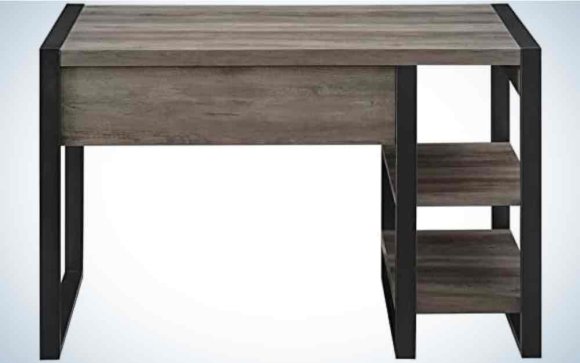
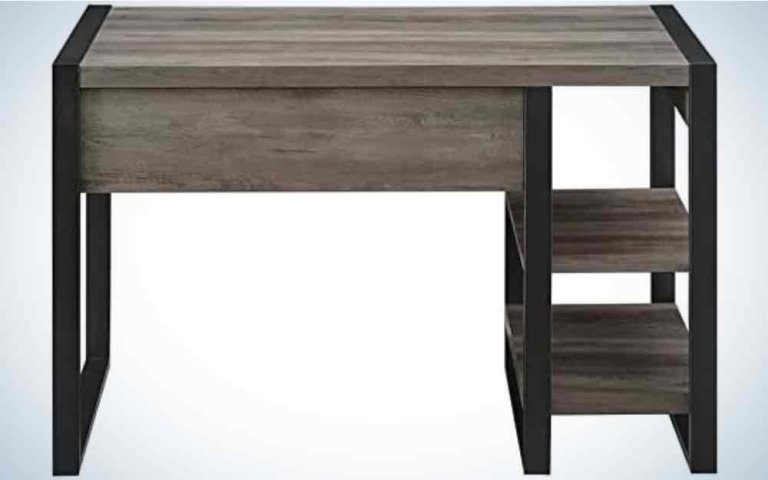
Why it made the cut: This industrial-looking desk will work well in a home office or for gamers. It comes with a drawer and shelves for storage, plus a USB port and AC plug-in for additional power.
Thanks to the handy shelves, plugs, and ports, the Walker Edison Modern Computer Gaming Desk is more useful than a standard table desk. A simple pull-out drawer provides enough space for your supplies, and the open shelves prevent gadgets, cameras, paperwork, and other items from getting lost in a dark, dingy filing cabinet. If you’re looking for a nice computer desk, everything is open and inviting, yet built to withstand even the hardest typers or heaviest lunches.
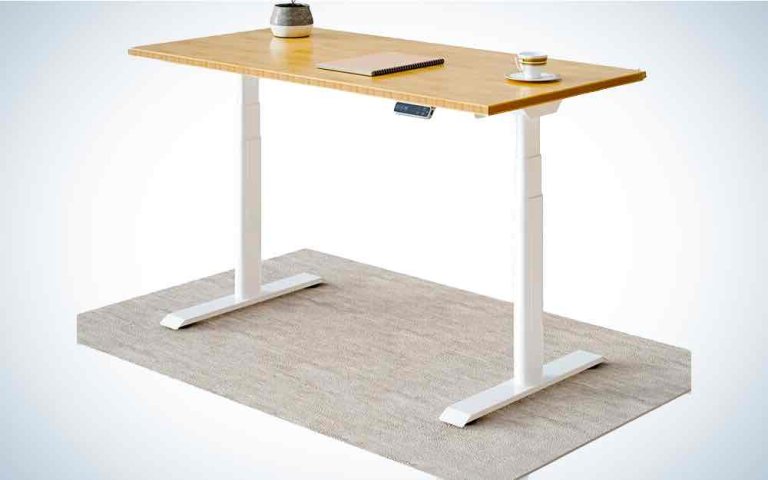
Best adjustable: Flexispot Kana Pro Bamboo Standing Desk
Pros
- Customizable sizes
- Eco-friendly material
- Safety features for working at home
Cons
- Expensive
- No storage space
Specs
- Material: Bamboo
- Dimensions: Rectangular or curved, from 48 inches x 24 inches to 78 inches x 30 inches
- Storage: None
Why it made the cut: This beautiful bamboo desk is durable, comes in a variety of shapes and dimensions, and comes with safety features like a child lock to make it safe for the home office.
You shouldn’t have to choose between standing and sitting desks. Get the best of both worlds with the Flexisport Kana Pro. This durable model comes in rectangular and curved shapes with various dimensions, so you can pick the size you need. Made of long-lasting bamboo that’s finished with a scratch- and water-resistant lacquer, this standing desk’s frame comes in white, black, or gray and is also available with casters for portability.
This modern desk mechanically adjusts between 23.6 inches and 49.2 inches, so you can easily alternate between sitting and standing. Safety features include anti-collision technology and a child lock that make it safe for home use. And a cable management system keeps your cords organized and your workstation tidy. That said, the desk is somewhat expensive and has no dedicated storage space beyond the desktop.
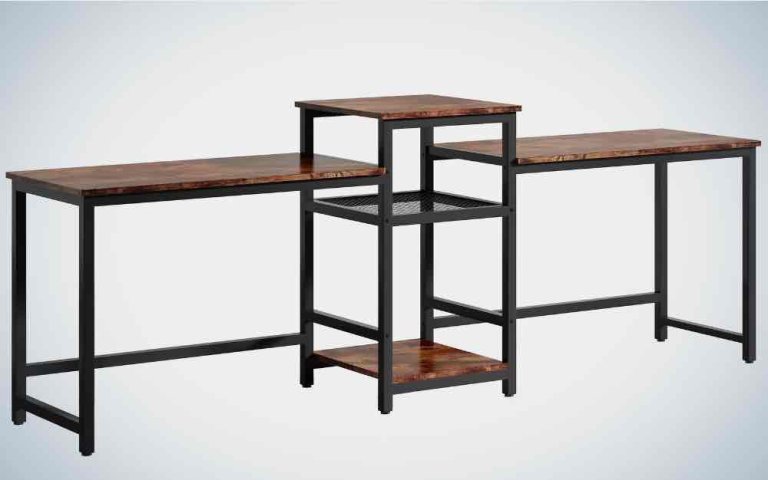
Best for two people: Tribesigns Double Computer Desk with Printer Shelf
Shared Space with Privacy
Pros
- Ample workspace for two people
- Room for a printer built-in
- Clean design
Cons
- Isn’t adjustable for standing
Specs
- Material: Engineered wood
- Dimensions: 19.7 inches D x 19.69 inches W x 29.5 inches H
- Storage: Stand for printer and two shelves underneath
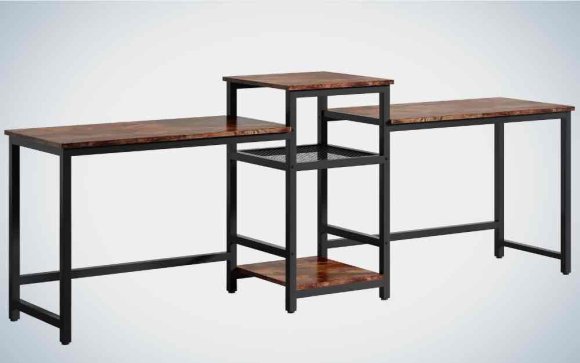
Why it made the cut: The desk is designed to make the most of a home office for two, with space for a printer dividing two substantial desks.
Share the space, but not the frustration with this two-person computer desk from Tribesigns. The inexpensive dual-desk gives you the surface area needed to get things done with the privacy needed to focus. A printer shelf sits between each workstation, making you feel like you’re in your own little office. And with accessories like printers and scanners easy to reach for both workers, you won’t be interrupted with, “Can you hand me that?” Add a few plants or books for more privacy. Perhaps best of all, the simple, understated style is less likely to cause fights over design when shopping for furniture. This is the best desk for storage on our list.
Best for small spaces: Prepac Wall-Mounted Floating Desk
A Desk that Fits Everywhere

Pros
- Solution for a small space
- Attractive espresso color
- Decent storage for such a small desk
Cons
- Assembly and wall mounting make take some time
Specs
- Material: Composite wood
- Dimensions: 19.75 inches D x 42.25 inches W x 39.5 inches H
- Storage: Small shelves
Why it made the cut: If space is at a premium, this wall-mounted floating desk allows you to make the most of your wall and provides some storage to boot.
It’s not for everyone or all types of work, but the wall-mounted Prepac desk provides a flat place to rest a laptop and get to work. The accompanying (removable) shelves can hold supplies and cables, and the tabletop is just big enough for a laptop and mouse. If you don’t want a big piece of furniture hogging up valuable space or need to add a workspace to a cramped living space quickly, this small computer desk is the most efficient workstation available. You will need to mount this on the wall, which adds another step to the already annoying task of desk assembly. But once put together, the desk is surprisingly sturdy. While you shouldn’t rest your 45-pound desktop computer on this surface, it can hold up against most office work. If you want more vertical storage, check out this minimalist wall-mounted desk.
Best for corner: Teraves Reversible L-Shaped Desk
Large Surface, Multi-Use Desk
See It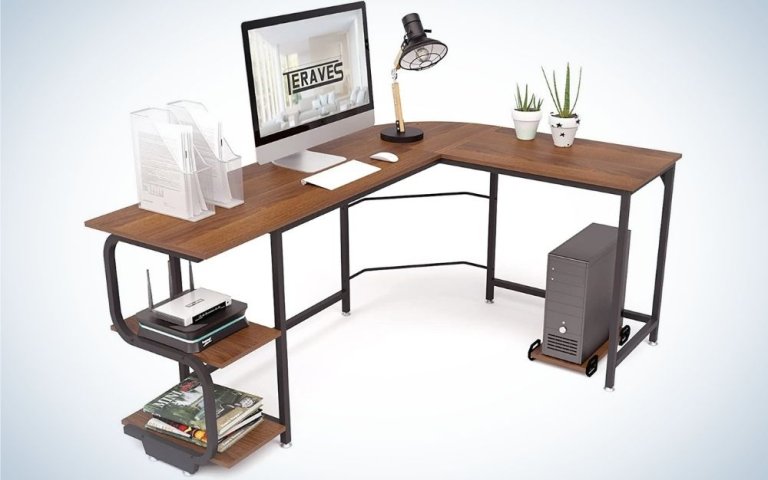
Pros
- Large workspace
- Comes with shelves for storage
- Made with durable materials
Cons
- Can take up a lot of space
Specs
- Material: Engineered wood and metal
- Dimensions: 68.9 inches D x 53.1 inches W x 30 inches H
- Storage: Two shelves
Why it made the cut: This L-shaped desk provides plenty of workspace for one or two people, plus room for files or a large monitor for creatives and gamers.
The Teraves Reversible L-Shaped Desk gives you space and options. The elegant desktop surfaces can be arranged to suit your needs. It’s great for work and gaming and is one of the most affordable desks that fits nicely in a corner. The long side gives you 69 inches of space. The short side is 53 inches long. That’s plenty of room to work, so it would be best for two monitors, yet it isn’t too bulky to block your office door. Theoretically, you could fit a second person at the desk if you’re willing to give up some privacy.
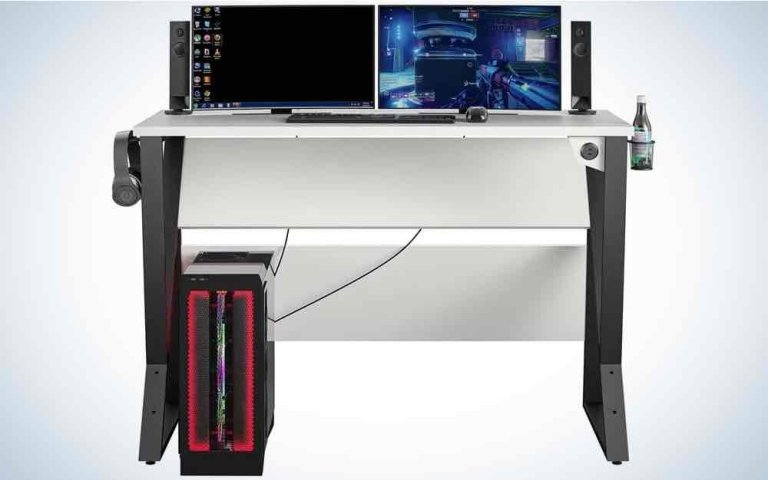
Best for gaming: NTENSE Genesis Adjustable Gaming Desk
Sleek and Subtle
Pros
- Height adjustable
- Comes with LED lights
- Dedicated space for cup holder and headphone hook
Cons
- Expensive
Specs
- Material: Engineered wood and metal
- Dimensions: 29.8 inches D x 53.62 inches W x 40 inches H
- Storage: None
Why it made the cut: Designed for gamers, this sleek modern desk comes with LED lights to enhance the experience and also allows you to adjust from sitting to standing.
The simple NTENSE Genesis Desk can be adjusted to three different heights to give you the right angle for work or gaming. A built-in wire trough keeps cords from strangling your productivity and snagging your legs. The headphone hook and cup holder can be installed in four different areas, ensuring everything you need is within reach. But best of all, this modern model looks good. Remote-controlled RGB LED lights make this best gaming computer desk glow and shine like a futuristic work hub without looking like a disorganized cyberpunk rig.
Best budget: Cubiker Computer Desk
Affordable Writing Desk
See It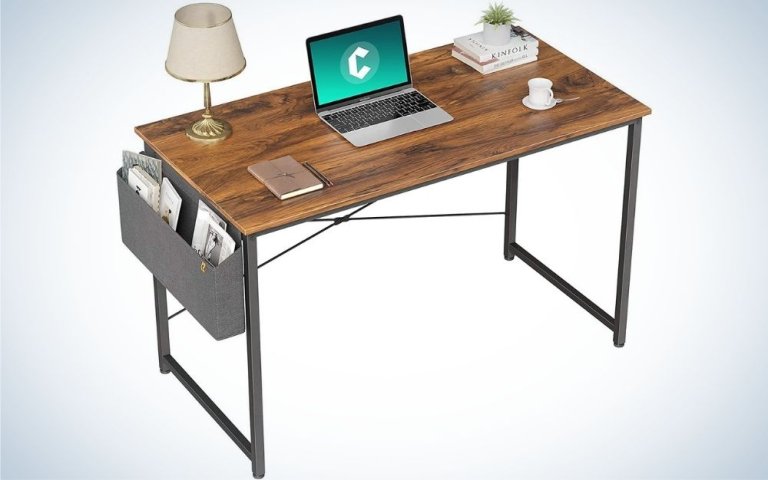
Pros
- Modern look
- Range of sizes available
- Affordable
Cons
- Not much storage space
Specs
- Material: Engineered wood, steel, fabric
- Dimensions: Available in 32, 40, 47, 55, and 63 inches.
- Storage: Side storage bag
Why it made the cut: This affordable option comes in five different widths and has a side for storage.
The Cubiker Computer Desk checks off the three most important boxes for any quality desk: It’s flat. It’s durable. It’s the right size. While some budget desks are puny tray tables, the Cubiker’s 40-inch surface has enough space for a laptop and two monitors, with room to spare. The modern design will fit into any home office or gaming room, and the storage bag keeps things organized. It lacks USB ports and electrical outlets, but a few extension cords can turn this simple desk into a bonafide gaming hub. And go ahead and cover it with coffee stains, phone numbers, and stickers—it’s inexpensive!
What to consider when shopping for the best computer desks
The best computer desk means different things to different people. Do you want a small and sleek modern computer desk? Or something large and multi-functional? Think about your computer use and what would make your current workspace more efficient.
Look for longevity
A well-made computer table won’t break or bend under pressure; it will last your entire career. Think of your desk as a hard-headed, dependable friend even when work gets stressful. This is not the time for cheap plastic and too many moveable (i.e., breakable) parts.
While it might seem cost-effective to buy the cheapest work table to simply “get the job done,” investing in a more substantial desk will eliminate furniture breakdowns and keep the workflow flowing. Working on a solid, dependable surface makes any task, from closing a deal to Slack-ing funny memes, feel important.
If you want a permanent workstation, think carefully about style and material. Tiny desks with spaghetti-thin legs won’t last past one intense Zoom call or Twitch livestream. And enormous, solid wood desks belong in Ebenezer Scrooge’s office, not your house. Simplicity is best, with clean lines, dark wood surfaces, and metal accents. Desks that are too trendy will look dated faster than you can say “spinning CD storage racks.”
Luckily, there are solid desks that have an airy, lightweight aesthetic and storage for all the necessary tools of your trade.
A two-person desk doesn’t have to break the bank, or your relationship
As more people now work from their house, your home office desk might be getting crowded with a new “employee” (significant other) or pesky “interns” (kids). But adding a second worker to the office can quickly get pricey. Buying a two-person desk is often cheaper than buying two separate desks. And the style will be uniform instead of looking like your office is a collision of tastes.
When shopping, think about how the two of you will work together. You want to conserve office space, but working on top of each other is a path towards annoyance and arguments. You need a little privacy and room to focus.
Instead of a single tabletop, consider a two-person computer desk with desk space between workstations. This boundary will improve your work and prevent your relationship from falling apart before lunch.
Gaming desks don’t need to be elaborate
Desks don’t have to be all about work; they can still meet your needs with style. Even if your gaming rig has multiple screens, keyboards, wires, and a wildly expensive steering-wheel controller, it can all rest on a single level of an impressive-looking desk.
Multi-level desks are often bulky, and some of those cubbyholes will only be used to store a dusty old ream of sprocketed Commodore 64 printer paper. Plus, the more planes and elements to a desk, the more the desk takes over, and the work and gaming become secondary. You need a workspace, not a 12-foot-tall cat tower.
Save as much space as possible
How small can a computer desk be? If you want a desk that’s one step above working on your lap but a few steps below standard workspaces, there are tiny options that conserve space for those organized enough to handle the limited surface area and lack of storage.
Hidden desks that fold or roll away can turn any room into an office as needed. With a few flips and twists, your hallway is now your work HQ. Those living in cramped apartments or overcrowded houses need a desk as small as possible. And because tiny desks can be mounted or placed anywhere, your options for workspace subscribe to the number-one rule of real estate: Location, location, location.
The guest room, the living room, even the bathroom can be a viable workspace with a compact computer desk. If you need the basics or even less than the basics, go small and keep your work-life balance leaning towards life.
Find a computer table that bends to your needs
L-shaped computer desks offer all the space you need while taking up as little space as possible. The L-shaped desks are standard for those serious about working from home and feeling in charge. You can make your own L-shape by combining two rectangular desks together, but a properly designed L-shaped desk will add uniform style and functionality to your workspace.
When shopping online, take special notice of the size. L-shaped desks quickly grow and grow. And when shopping in-store, know the big airy sales floor will make any desk look perfect for your room. Remember: Measure twice, buy once.
You can also arrange and rearrange most L-shaped desk layouts, giving them a bit more versatility than you may assume. And you can easily fit two people at one well-sized L-shape desk, if privacy isn’t a concern. The L-shaped desk might be the most-used piece of furniture in the house.
Can a desk be healthy?
Like the desk itself, the standing desk trend rises and falls. One year these moveable tall tables are all the rage. Next, a Harvard study finds standing desks to be of no real benefit for weight loss. It comes down to your own personal taste.
Standing desks do offer the benefit of keeping you on task. It’s hard to zone out when you’re upright. Remember when shopping for a standing desk that you want one that works efficiently. If the act of raising and lowering the desk requires six steps and a key, it probably won’t do you much good.
It’s also important that the standing desk offers enough workspace for your laptop and other accessories. If you have to bend down to get equipment every ten minutes, your back won’t be a happy worker.
Price
Computer desk prices can vary significantly, with luxury furniture pieces skyrocketing past the $5,000 mark. You just need a place to work. But before you fork over $10 on the cheapest thing you can find, know that a low price may mean less workspace, poor quality, or a deadly combination of both.
Scrutinize the product dimensions to ensure you get an adult-sized desk and not a breakfast-in-bed tray. And see if there are any weight limits in the specifications because a decent-sized desk isn’t worth much if it can’t even support a Nintendo Switch.
Luckily, a computer desk is a simple, readily available piece of furniture, so you should be able to find one within your budget that won’t collapse under a mild breeze. Don’t spend hundreds of dollars if you only need a basic table with legroom and some storage.
FAQs
A computer desk can cost anywhere from under $100 to more than $1,000, depending on its size, the materials it’s constructed from, and whether it includes a mechanical component that allows it to range from a sitting to a standing desk.
Start by measuring your space. The best computer desk for you fits where it needs to fit. Everything else, such as shelves and accessories, is secondary to the size. A desk that’s too small will hinder productivity. A desk that’s too big will clog up a room. You want a desk that fills the perfect amount of available space.
The best desk is thick enough to hold your laptop or desktop computer and everything else you need without bending or buckling. Be wary of anything thinner than 19mm (about the size of two standard Lego bricks stacked together). Some sleek, stylish gaming desks look great, but the thin material can’t take a beating.
The best wooden computer desks are made of hardwoods such as oak, walnut, and cherry. But a solid wood desk will be more expensive and much, much heavier than you probably need. Unless you’re using the computer desk also to chop firewood or weld car parts, you can feel safe and supported using composite material and medium-density fiberboard (MDF). Avoid glass, because chipped, scratched wood can look rustic and cool, but the nicked glass looks cheap and sad.
It depends on your computer setup. If you have multiple monitors and bulky accessories (think printers) on your desk, it makes sense to use an L-shaped desk because you’ll have enough space for them. If you have a minimalist computing setup, the extra space afforded by an L-shaped desk won’t be necessary.
Yes. If you want to buy wood and feet for yourself, you can assemble your own computer desk from scratch. The upside is you can tailor its size perfectly to your room, but it’ll require tools and some DIY knowledge.
Final thoughts on choosing the best computer desks for you
- Best overall: Walker Edison Modern Computer Gaming Desk
- Best adjustable: Flexispot Kana Pro Bamboo Standing Desk
- Best for two people: Tribesigns Double Computer Desk with Printer Shelf
- Best for small spaces: Prepac Wall Mounted Floating Desk
- Best for corner: Teraves Reversible L-Shaped Desk
- Best for gaming: NTENSE Genesis Adjustable Gaming, White Desk
- Best budget: Cubiker Computer Desk
The best computer desk has one job: support your computer. Find a well-made desk that won’t crumble in a year and won’t overpower a room. Everything else is up to your own personal preference. Do you want shelves? Desk drawers? Do you need an L-shaped or corner desk to fit into a specific space? Do you want to try a standing desk? Before clicking “add to cart,” think carefully about how you’ll use the desk. It’s more than just a slab of wood. You need something more specialized than a kitchen table and more attractive than a folding table. But most of all, you need a computer desk that works.