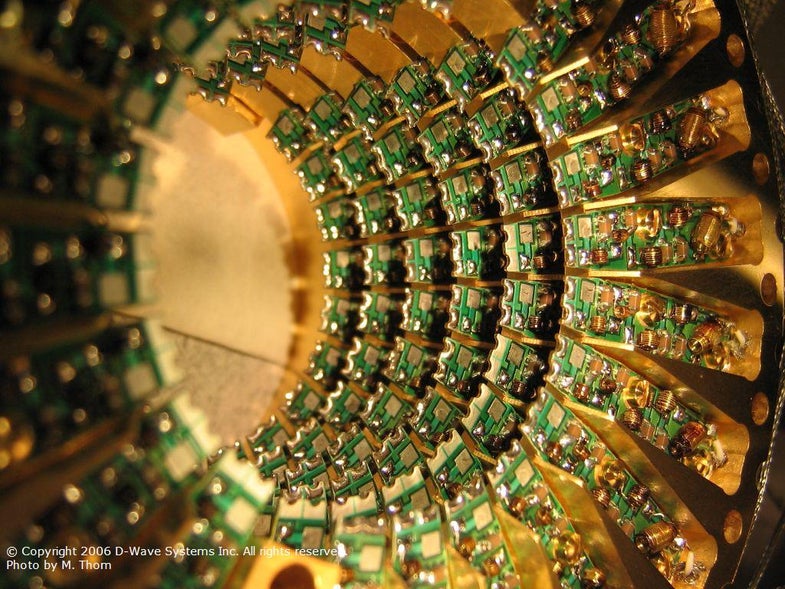
Vancouver-based quantum computer maker D-Wave Systems is the kind of company that often gets mixed reviews--either kudos for working on the very edge of a new and potentially groundbreaking technology, or dismissal for not exactly delivering the kind of Earth-shattering technology that people were perhaps expecting. Regardless, today D-Wave is marking one in the win column after announcing that it has achieved the world’s largest quantum computation using 84 qubits.
A quick quantum computing primer: qubits, or quantum bits, are the basic units of quantum information, comparable to (but quite different from) a classical bit. The main benefit of qubits is that they can exploit the laws of quantum mechanics to exist in two states simultaneously. In comparison to classical computing, that means a single superconducting qubit can exist as both a “one” and a “zero” at the same time, whereas a classical bit can only be one or the other.
This vastly improves speed and computing power. It also has proven pretty difficult to execute. A decade ago quantum computers were using a handful of qubits to factorize numbers and do other grade-school level computations. And in recent years, they haven’t come much further forward, even as D-Wave released a $10 million 128-qubit quantum computer for sale.To prove that quantum computing really is pushing forward, Zhengbing Bian at D-Wave used one of the company’s machines to tackle a very difficult calculation known as a “two-color Ramsey number.” This is somewhat explained by the “theorum on friends and strangers,” which you can feel free to read up on but will not be explained in detail here for reasons including, but not limited to, the fact that I can’t begin to adequately/coherently explain it. But the math isn’t the point here. The point is that the math is mind-numbingly difficult, and the quantum computer solved it in just 270 milliseconds.
The system required just 28 qubits to actually solve the Ramsey problem, using the other 56 for error correction. And, because this was a Ramsey problem that has already been solved by conventional means, Bian and company know that their D-Wave computer came up with the correct solution (it was 8).
Whether or not this glowing achievement is going to boost confidence in D-Wave’s technology and approach is yet to be seen, but the company already has some support in industry. A certain Mountain View-based Internet search company has taken an active interest in D-Wave’s computing technology, and last year Lockheed Martin bought one of D-Wave’s quantum computers for itself.
Five amazing, clean technologies that will set us free, in this month's energy-focused issue. Also: how to build a better bomb detector, the robotic toys that are raising your children, a human catapult, the world's smallest arcade, and much more.


Online Content Director: Suzanne LaBarre | Email
Senior Editor: Paul Adams | Email
Associate Editor: Dan Nosowitz | Email
Assistant Editor: Colin Lecher | Email
Assistant Editor: Rose Pastore | Email
Contributing Writers:
Kelsey D. Atherton | Email
Francie Diep | Email
Shaunacy Ferro | Email
Yay Canada!
Maybe one day we'll have computers powerful enough to catch spammers like patent boy
So please give us some scale so my little mind can say wow or duh, like how long would it take a reg. computer to do that or a super computer. Because I know 8 is a big number (bigger that the 7 numbers that come before it) I don't know it this is a big deal or not.
I thought the answer was 42?
So did I! Zaphod will be so disappointed...
Quantum computing scares and excites me.
This is crazy, I was always kind of skeptical about quantum computing, but now I just feel stupid. To see one of these calculating a decent problem finally, I can't wait to see where these get to.
BRAIN AHSPLODE!
-Knock knock
-Who's there?
-The Doctor.
-Doctor Who?
-Yes
Can we get a calculation time on a normal computer? or if it's that much greater than a normal computer why couldn't they use it to calculate one of the numbers that has yet to be found? :/ I'm intrigued but would love a comparison.
Like what littleman and hitmandam said, how long did a regular computer take?
Hi, I'm new here. :)
From this article: http://ajc.maths.uq.edu.au/pdf/19/ocr-ajc-v19-p91.pdf
For the given input data in the various cases of the proof of Theorem 1, the
execution time of the algorithm on our Pentium 300 computer was less than one
second in cases (1) to (8) for the multicolor Ramsey numbers.
Important part here:
The two color numbers, cases (9), (10) and (12)took from just over an hour to just over three hours, and the remaining cases took from nine and a half hours to nearly fifteen hours.
Now this is from an anicent Pentium 300 Computer, how fast a modern super computer would do this I cant tell, but its probably maybe close to the Quantum Computer. So that does take a bit of the amazingness away.
Thanks C--
i imagine a future where each regular PCU has a small embedded quantum unit with say a few hundreds qubits
D13: We all already know that, I find it a little disconcerting, but you try to be a wise one with PopSci posts, rewriting the obvious. As your post contains little but general quantum knowledge and some applicability possibilities. Sorry, now don't take it as an attack against you, I just had to be critical ;) (I love your redneck rebel attitude though)
Another problem with quantum computers is that they can only take relativley few instructions at a time due to their slow and complex read and write process that has to be done by conventional Computers. Hence often only relatively short equations(yet long in execution time needed) are fed into quantum computers. Hence always the Ramsey Equations done by D-Wave. Go Canada, for the entire world! (Wait maybe quantum computing one day turns out not to be such a good idea...)
I do not believe electronic, or mechanics will ever achieve free human thought and intelligence. But I do believe with the development of medical science and the merging of electronics a synthetic brain will be achieve, intimately to humanities DOOM!
All Boom, Doom and Gloom... Cheer up fella! The Universe is a big place :D
YAy, now go cure cancer, clone organs, and fix the world economy.
So, when exactly will computers be able to stop spelling and grammar errors?