
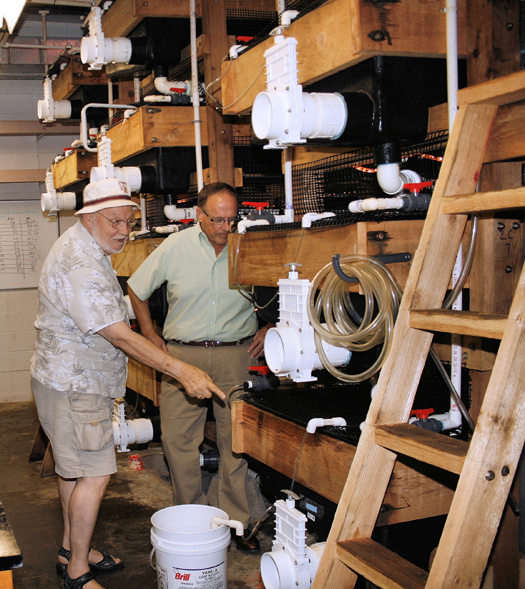
Dr. Addison Lawrence, Left, and His Stackable Raceways System Patty Waits Beasley via PhysOrg

Remember that part of Forrest Gump where Forrest and Captain Dan are looking for shrimp but can’t find any because there’s too much competition for shrimp, but then the hurricane passes through and suddenly there’s no competition for shrimp and there’s just tons of shrimp to be had? This story is mostly not like that one, except it ends with a lot more shrimp than it starts with.

A new shrimp farming technology devised by researchers in Texas is churning out record-setting levels of shrimp. Called super-intensive stacked raceways, its a system of indoor aquaculture that generates far more shrimp per cubic meter of water than open pond farming or any other aquaculture technique. And it could be deployed just about anywhere.

The shrimp grow in huge enclosed tubs called raceways, stacked four high in a column. As the shrimp develop and grow under computer-controlled conditions (the water is carefully circulated but not completely renewed, keeping environmental costs and water usage in check), they are moved downward from one raceway to the next--baby shrimp go in the top and progress downward to the bottom raceway, from which they are eventually harvested.

That innovation--the ability to raise very large, protein-rich shrimp (they’re called U15, but you probably know them as “jumbo”) in very little water--means the kilo-per-cubic-meter numbers are through-the-roof: 25 kilograms of shrimp from just one cubic meter of water. For some perspective, that’s equivalent to 1 million pounds of shrimp per acre of water. U.S. shrimp farms top out at about 20,000 pounds per acre of water. The best shrimp farms in tropical climates, working year round, yield something like 60,000 pounds per acre in a good year.

So we’re talking about a vast improvement to our shrimp stores. But the impact isn’t just an abundance of jumbo shrimp to batter up and fry. For one, it provides countries like the U.S. with a means to produce fresh shrimp (we import the vast majority of ours, and it’s usually frozen and thawed a few times before it gets to us). And shrimp exporters like China are on the verge of becoming shrimp importers due to socioeconomic trends and population growth, and that would make shrimp quite expensive. With stacked raceways, we could have our own domestic supply of shrimp, circumventing the need for a series of violent “shrimp wars.”

But further, this method could provide a simple-to-produce means of protein in places where food in general and protein in particular are growing scarce. Plus: jumbo shrimp you guys! These will go great on an hors d'oeuvre table next to those popper-optimized jalapenos we’ve been cultivating.

15 Comments

It's Lieutenant Dan

haha shrimp wars

Sounds like more GOOD EATIN'!

Time to get America back into distribution like our forefathers did to make it an economic power house.

And the shrimp shall lead the way.

Why did then not supply the address of this company so applicants can apply, sheesh! ;)

That girl in her home study drives course keeps repeating to herself.

I AM GOING TO PASS THAT STUPID DRIVERS TEST! I AM GOING TO PAST THAT STUPID DRIVERS TEST! I AM....

well you understand...

now if only they can over come the shrimps not as good as wild caught taste i dunno perhaps vary their diet more

This article is a nod to bubbagump...who's with me??

@Aldrons Last Hope haha good call didn't connect that, but was wondering where he went today and last few days. Must have gotten the banhammer, unless he was just upset. Seemed like people were dog piling on him, no pun intended :), in the last few days.

This is awesome by the way! I don't even like shrimp but would totally incorporate this into an off grid farming operation. I wonder how the shrimp waste works as fertilizer for things like hydroponics, I know you can have a pond with fish and harvest that for hyrdoponics to much success. This reminds me of hydroponics actually, with the water effeciency.

We do not see things as they are, we see them as we are. ~Anais Nin~

You think they are growing shrimp. These are really portable stills for making some good old fashion whisky.

/drool wonder if u can use this for crab or mmmm lobster

Good things to know about shrimp.

Shrimp are loaded with protein, vitamin D, vitamin B3, and zinc. The iodine in shrimp is good for the proper functioning of the thyroid gland which controls the basal metabolic rate. Shrimp contain astaxanthin, a carotenoid that gives them their pink color and that can act as a potent antioxidant and protect the skin from premature aging. Also the omega-3 fatty acids in shrimp provide antioxidant protection.
...................................
Forrest Gump was well received by critics and became a commercial success as the top grossing film in North America released that year. The film earned over $677 million worldwide during its theatrical run.
..................................
The Bubba Gump Shrimp Company Restaurant and Market is a seafood restaurant chain inspired by the 1994 film Forrest Gump. As of September 2010, thirty-two Bubba Gump restaurants operate worldwide.
..................................

YEA BUBBA GUMP!!!!!!!!!!!!!!!!!!!!!!!!!!

My second comment from the top was a mistake, sorry. I meant to post that at another article. Before I post, I put my comments in Microsoft word to help remove errors, then I copy and paste them. It seems somebody felt the need to 'report this comment'.

I am interested to know more about the new technology for shrimp & would like how i can get franchise to setup s small size unit here in India.

Please guide us.

Thank you,

Faiz Sange

Dear Sir, I would like to know more about this new indoor shrimp farming technique to start-up a similar small indoor farm and cultivate the Macrobrachium Amazonicum (giant river shrimp, in the country of Suriname, South-America.
Please advice.
Regards,
Rabin Sahtoe

Mariculture is the term used for the cultivation of marine organisms in seawater, usually in sheltered coastal waters. In particular, the farming of marine fish is an example of mariculture, and so also is the farming of marine crustaceans, molluscs and seaweed. Thanks.
Regards,
http://www.aquaponicssystem.org/


June 2013: American Energy Independence

Five amazing, clean technologies that will set us free, in this month's energy-focused issue. Also: how to build a better bomb detector, the robotic toys that are raising your children, a human catapult, the world's smallest arcade, and much more.


Online Content Director: Suzanne LaBarre | Email
Senior Editor: Paul Adams | Email
Associate Editor: Dan Nosowitz | Email
Assistant Editor: Colin Lecher | Email
Assistant Editor: Rose Pastore | Email

Contributing Writers:
Rebecca Boyle | Email
Kelsey D. Atherton | Email
Francie Diep | Email
Shaunacy Ferro | Email

circ-top-header.gif
circ-cover.gif