
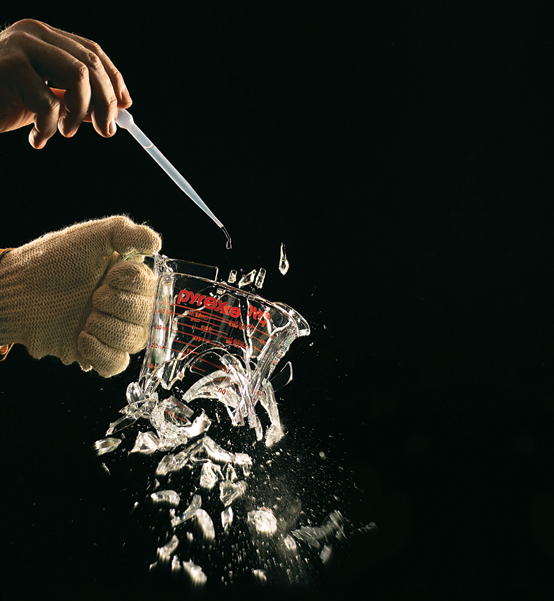
Most people probably don’t think of Corning as a crime fighting company, but when it sold its Pyrex brand to World Kitchen in 1998, the company accidentally made the illegal manufacture of crack cocaine more difficult—a fascinating example of unintended consequences.
Ordinary glass shatters if it’s heated too quickly: Pour boiling water into a common flintglass tumbler, and it’s likely to fall apart seconds later. The glass on the inside expands when it gets hot, putting stress on the cold glass on the outside. When the stress gets too great, it cracks.
Pyrex, which originally was always borosilicate glass, solved this problem by adding boron to the silica (quartz), the main ingredient in all glass. Boron changes the atomic structure of glass so it stays roughly the same size regardless of its temperature. Little thermal expansion means little stress. Thus borosilicate glass withstands heat not because it’s stronger, but because it doesn’t need to be stronger.
When World Kitchen took over the Pyrex brand, it started making more products out of prestressed soda-lime glass instead of borosilicate. With pre-stressed, or tempered, glass, the surface is under compression from forces inside the glass. It is stronger than borosilicate glass, but when it’s heated, it still expands as much as ordinary glass does. It doesn’t shatter immediately, because the expansion first acts only to release some of the built-in stress. But only up to a point.
One unfortunate use of Pyrex is cooking crack cocaine, which involves a container of water undergoing a rapid temperature change when the drug is converted from powder form. That process creates more stress than soda-lime glass can withstand, so an entire underground industry was forced to switch from measuring cups purchased at Walmart to test tubes and beakers stolen from labs. Which just goes to show, if you think you know all the consequences of your decisions today, you’re probably wrong.

138 years of Popular Science at your fingertips.
Each issue has been completely reimagined for your iPad. See our amazing new vision for magazines that goes far beyond the printed page
Stay up to date on the latest news of the future of science and technology from your iPhone or Android phone with full articles, images and offline viewing
Featuring every article from the magazine and website, plus links from around the Web. Also see our PopSci DIY feed
A 10,000-rpm, no-pulse heart is completely revolutionizing how we think about transplants. Plus: rapid-response virus hunters, a shocking cure for migraines, the world's youngest person to have achieved nuclear fusion (in his parents' garage!), and much more.
"Thus borosilicate glass withstands heat not because it’s stronger, but because it doesn’t need to be stronger."
"[soda-lime glass] is stronger than borosilicate glass"
So in what sense is the soda-lime glass stronger, it is more resistant to chipping? It certainly doesn't seem stronger with respect to temperature swings, which worryingly is what happens to it everyday in the kitchen...
due to the fact that the glass has residual compression stresses any external force would have to overcome these internal forces before it could do anything such as breaking the glass, so correct it is more resistant to chipping and breaking
So, just because the crack cocaine industry is using their cookware, they make their glass shatter when it experiences a rapid temperature change... What if I pull a pan out of the oven and set it on say the stove surface which has a droplet of some colder liquid, is this pan going to explode like in this video? You know this was driven by someone complaining that the Drug market is using Pyrex so they should do something about it.
The point of the story is that the crack industry was an unintended effect of the change.
My guess is that soda-lime glass is cheaper and as the story states stronger than borosilicate glass. The decision had nothing to do with crack.
And I doubt very much you'll have issue with your cooking unless your cooking in a very hot open flame. The torch they are using is designed to put close to a thousand degrees (over in some cases) into an object. I think the hottest recipe I have asks for 500F.
Lab grade glass measuring cups can be purchased online just as easily as pyrex at big-box-mart. There is really no reason a crack-head can't transform their chemistry hobby into something more constructive. Or at the very least, they can pick up baking instead. ;)
It does affect home use. We had one explode in our house because of this. However the new glass is supposedly more resistant to drops, which are apparently the most common cause of kitchenware breakage.
I've had a cassarole dish "explode" due to temp changes as well. We had stored the dish in the fridge with food in it. We set it on top of a hot stove with a burner that was off but, had only been off for a few minutes so it was still very hot. It took about 20 seconds for it to explode.
@Fxer:
Strength in one area for most materials means weaknesses in other places. Metal properties are usually a good example. Some metals are very resistant to tension forces but, fail easily to weight loads (bending forces.) While others are exactly the opposite.
If you take a look into the changes for PYREX cookware (The change of use from borosilicate glass to soda lime glass) you will find that only the US manufacturers of PYREX cookware made the change. European Manufacturers of PYREX cookware still use borosilicate glass when making their goods.
One could jump at the conclusion that the US manufacturers did this to combat crack cocaine labs and that this article in itself saying that it was an accidental causation is to cover the fact up until you start to look at costs between the two glasses.
Borosilicate glass is far more expensive than your cheap soda lime glass which is comparatively less than 1/4th the cost of borosilicate. Look at the ridiculousness of that. I'm more pissed they are selling shitty dishware saying that the new material is better...it isn't.
Americans love cheap goods though, and we aren't getting any richer. Capitalism really does get bitter in the end, wouldn't you say?
If you think World Kitchen is concerned about anything more than their bottom line, then you are a fool.
Tumblers are made of flint glass?
That seems unlikely. Crown glass would be a better candidate - greater surface hardness, and cheaper. Which is why it's used to make plate glass, bottles, etc.
Isn't that the entire point of Pyrex, that it's resistant to temperature changes?
What an utterly bad idea to change that. If they want to market a stronger (more resistant to being dropped) glass, fine, but call it something else. Honestly, what an awful thing to do. It's not just confusing and deceptive, it's dangerous.
I agree with fummfur and dustmouse: Why do you call it "Pyrex" when we have all known the Pyrex name (and its additional cost) meant rugged temperature resistance?
And instead of this being an example of capitalism gone bad, this is a perfect example of the free market responding to a bad/fraudulent product.
If this is true -- if World Kitchen has indeed diluted/inflated/destroyed the trusted, world-famous Pyrex name in a vain attempt to con its customers for short term gain -- World Kitchen has lost me as a customer forever.
I will never pay the "Pyrex premium" again for what I now know is shoddy second rate material masquerading as the real thing. My prediction: World Kitchen goes bankrupt. The market is a cruel mistress.
What I don't get is the ridiculous extreme the author goes to connecting Pyrex with, of all things, crack cocaine. Was it to soften the blow that we are being snookered by World Kitchen? Of all the Pyrex vessels produced, what minuscule percentage are used in illicit labs? The literary hook is really silly.
For 20 years I have appreciated the qualities of Boron. Unfortunately, someone else invented the single-crystal tourmaline laser before me. Boron can be used in lattice structures, including gels, as a dopant to both retain molecular structure, and excite (and polarize) light waves.
I see the first photonic brain incorporating such a structure. Organic silicate replicators such as sponge spicules are nanotubes just aching to be used as conduits for energy and matter. Add to this structure two more elements: organic relay ganglia, and magnetism, and you have the primitive elements of a functioning wet photonic brain.
Fummfur: "Capitalism really does get bitter in the end, wouldn't you say?"
No. But anyway: dustmouse, I'm with you. When I think "Pyrex," I don't actually think "chip-resistant" FIRST. The product was marketed - always - as able to withstand temperature changes, unlike other cooking dishes. Straight from the freezer and into the oven without worrying about cracking, right? Huge pain in the neck to put your frozen casserole in to cook for dinner, try to take it out an hour later, and it's glopped all over and baked onto the inside of your oven.
I guess it's not unprecedented that a product can try to undo its prior marketing (look at original, REALLY original, Coca Cola!) and survive. But when the product was sold based on safety and the nature of that safety is what is compromised by the product change, they probably ought to be very, very clear about it.
Capitalism really does get bitter in the end, wouldn't you say?
As opposed to Communism (and its variant socialism) which is bitter from the beginning.
Go to pyrex dot com
two sites to pick from:
1) Pyrex® Kitchen Cookware
2)Pyrex® Laboratory Glassware
visit each and type Borosilicate in each search box.
Kitchen cookware site never heard of it.
Laboratory glassware site, 165 hits
I'm looking for an importer of European borosilicate cookware for future purchases. I'll vote with my wallet.
Yup, old news from 1998
America's Test Kitchen did a story on this.
Cooks Illistrated
Does anybody else feel cheated?
This article, while interesting and has a fun video, is still perpetuating the urban legends of Pyrex. A simple internet search turns up several notable results, first, Pyrex themselves deny the claim that they switched ingredients in 1998:
www.pyrexware.com/thetruthaboutpyrex/index.htm
And secondly, snopes says that myth is false:
www.snopes.com/food/warnings/pyrex.asp
(although one of their main sources is pyrex).
I love this column and all the fun chemistry experiments they do, but this article needed some fact-checking first.
falconerd,
You sound like you work for World Kitchens, and those articles you link are what is dubious, not this well presented Pop Sci article.
I am disgusted that I buy Pyrex for the same reasons as everyone else, only to learn here that PYREX IS NOW THE MOST DANGEROUS BAKE-WARE I OWN.
I find this akin to people buying say the most crash resistant car their whole lives just to learn that years ago it lost that property, and now if those vehicles do crash they explode more violently than other brand's vehicles.
I love my kitchen and feel highly taken advantage of. Someone should sue you guys and require you to help change public misconception more than what is being done. Warning Labels should be affixed to all glassware products and their packaging explaining this HUGE difference from what Pyrex used to be to what it is now. That is the only way for every purchasing consumer to become fully aware. Also needed is some way to get to all the current owners that may not be buying much or any bake-ware.
Please.
Pyrex cookware is purchased for safe heating/cooling properties. Pyrex "Visions" stove top cookware is phenomenal in it's ability to cook rapidly and then go right into the sink. It is unfortunate that World Kitchen changed the composition, and I agree that it creates a hazard for anyone who does not know there is a difference between the new and old Pyrex products. I had the misfortune of a baking pan "blow-up" and immediately realized the glassware was inferior. To replace it, I purchased one at a garage sale.
I visited America and was surprised at how cheap pyrex was in Walmart. I bought two oven dishes. They both shattered, the first when I took it out of the oven and put it down on a wet surface. The second when I poured a batter into a heated dish. Until reading this I thought I had bought two from a defective batch.
The change in Pyrex was covered, from a consumer perspective, earlier this year in Consumer Reports:
www.consumerreports.org/cro/magazine-archive/2011/january/home-garden/glass-cookware/shattering-bakeware-affects-coworkers/index.htm
(sorry, don't know how to get around the forum rule against links)
There are several issues that just have to be cleared up. I'll try to do my best. (I do not work for any glass ware company. I am not a shill for any company.)
1) A few facts, Pyrex was a "brand trade mark name of Corning" for its heat-proof glass cookware invented in 1915, and in the earlest years of the cookware the cookware was made of borosilicate glass, then both borosilicate glass and soda lime glass, and now in America only soda line glass. Both Corning, and now World Kitchen report that dishes labeled "Pyrex"have been made of soda lime glass for the past 60 years, the changeover occurring in the 1940's. Corning sold its consumer housewares division to World Kitchen in 1998, which has produced the Pyrex products in the same plants using the same materials since then.
It appears that at some point both borosilicate glass and soda lime glass were used to make Pyrex dishes, but by the 1980's, such dishes were made of soda lime glass for several reasons - cost, environmental issues, product safety, etc. Dishes and pot tops made under the Pyrex label were often clear see-through glass. This would be well BEFORE World Kitchen came into existence - hence World Kitchen "did not deceptively change the formula" as suggested by some comments.
2) All glassware products suffer from thermal shock - that is a rapid temperature change, however some glasses handle thermal shock better than other glasses. There are some 370 million pieces of Pyrex cookware in use, it is found in 80% of American homes - suggesting that many consumers find the products useful.
3) Pyrex is not "indestructible" - all glass will break under certain conditions, and the cookware has usage guidelines that should be followed. For example, generally the cookware marked as Pyrex (regardless of being soda lime glass or borosilicate glass) in its use guidelines say to NOT PUT the cookware under the BROILER. The cookware was not designed for such direct heat uses.
4) Corningware - the white dishes are based om a glass-ceramic process that produces dishes that can withstand a variety of temperature changes. The material was originally designed for use as the nose cones of ballistic missles in the 1950's. Millions of the white dishes with the blue cornflower and other designs were produced. Corningware was manutactured by Corning, until the sale to World Kitchen, and for a few years it was also produced by them.
The original pyroceramic glass version of CorningWare was removed from the US market in the late 1990s. It was re-introduced in 2009, due to popular demand. After coming into existence World Kitchen has produced similar dishes made of a common white glazed stoneware. The packaging for these newer "CorningWare" branded cookware products say specifically that they are not for stovetop use.
5) Visions by Corning was a glass cookware line introduced in 1982 and widely popular. Visions was a ceramic cookware line, with glass (Pyrex type) lids. It is available again through World Kitchen, including their outlet stores and through the web. These dishes were produced into two basic colors: a tinted brown, and a raspberry/purplish color.
Visions dishes especially the "base parts" are NOT Pyrex - only the dish lids are Pyrex. Visions dishes are "tougher" than Pyrex dishes in the sense of handling temperature extremes and changes. So yes, there were videos and commercials showing the "extreme" things that could be done - but these dishes are NOT Pyrex! Visions dishes available to consumers were never clear see-through glass, but always tinted glass.
Visions could go directly from the oven on to the stove for further cooking - Pyrex can not - Pyrex bakeware was not designed or meant for the stove - it says so right on the cookware! Using Pyrex dishes containing frozen food - it was suggested to allow the food to thaw before heating, especially in the days BEFORE microwave ovens. Visions like the older white Corningware was made for the stove-top, oven, freezer, etc. and to be taken directly from one to the other. Although most times it is best to actually let food thaw out a bit between switching places - better for the food that is.
I hope this clears up some of the statements made in the article and the comments.
Mike
Dear Michael549, just a few days ago I purchased Visions cookware pieces from eBay. The seller said the pieces were from two different estate sales, used. Of the pieces:
-1 skillet and 1 deep fryer have Visions Corning France stamped on the handle. Are these 2, then, imported from France and therefore contain borosilicate rather than soda lime?
-1 skillet has Visions Corning USA 10 stamped on the handle. I do not see a 10" Visions skillet being sold on the World Kitchen website. Does this mean that this is a skillet produced by Corning, Inc? Is it made with borosilicate or soda lime?
-The other pieces are 4 saucepans of 4 sizes that nest, all stamped with Visions Corning USA stamped on the handle. Again, made with borosilicate or lime soda?
Lastly, since these are Visions cookware, are you saying that as long as they do not experience thermal shock they shouldn't shatter/explode?
Thanks,
JH
Maybe I was not clear in my previous message.
WISIONS COOKWARE IS NOT PYREX!
Let me say that again. Visions Cookware (the brown tinted, and magenta tinted cookware) is NOT PYREX!
Visions cookware was a glass-ceramic material created by Corning during the 1980's and 1990's. Now is it available on the World Kitchen website, and on places like E-Bay. Visions cookware meaning the base parts - (since often at Corning and World Kitchen - the pot lids are Pyrex - the see through glass) the base parts - the pots themselves - have the same basic temperature and hot/cold tolerances as the white Pyroceram cookware used for decades.
So this stuff about "soda-lime glass" or "borosilicate glass" does not apply to Visions - it never did apply - since Visions is a glass-ceramic material. Just as there are different metals - lead, copper, aluminum - there are different kinds of glasses. While some folks may put the words - "Pyrex Visions" together to mean the same thing - they are not the same thing. While copper and stainless steel are both metals, and both are used in making pots and pans - there are differences between copper and stainless steel. No one would ever say that a copper pan and a stainless steel pan are the same - that just does not happen. Just as there are different metals, there are different kinds of glasses.
Visions glass-ceramic cookware has been made at both the US plants and at plants in France. There is no difference or issues about where the Visions cookware is made. The Visions cookware as marketed by Corning (and now World Kitchen) only came in two colors - the tinted brown, and the magenta color. They did not market a clear glass Visions product - so if one sees a clear glass dish it can be safe to assume that the dish is NOT VISIONS - it could be Pyrex, etc. But it is NOT VISIONS.
Visions cookware, like the white Corningware Pyroceram dishes with the blue flower - can be used on the stove-top (gas/electric - but not induction), the oven (electric/gas/microwave/convection, etc.), dishwasher, freezer, frig, and table-top. Like the white Pyroceram Corningware dishes used for decades, Visions cookware can handle extreme temperature changes - going directly from frig/freezer to the stove-top or oven. While such a practice might no be good for the food - the dish itself could handle the changes.
Visions cookware, like the Corningware white Pyroceram dishes used for decades - handles thermal shock - quick temperature changes very well. One indication is to look at the warranties that came with the products from Corning. Like the white Pryoceram dishes (blue flower, etc) Visions cookware had a warranty about thermal shock that extended TEN YEARS to replace any dish that cracked due to thermal shock. The warranties for all of Corning's Pyrex products was TWO years. Now "READ BETWEEN THE LINES" - the Visions and the Corningware Pyroceram products handle thermal shock much better than the Pyrex products (soda lime or borosilicate glass) that is why the warranty periods were that long, it was an expression of confidence in the product. Visions and the Corningware Pyroceram - glass-ceramic products handle heat, cold, and thermal shock much much much better than Pyrex.
Visions cookware - the pots - are not Pyrex - they are tougher than Pyrex! Should I have to repeat that again?
Please note that World Kitchen stopped and then started again making the Pyroceram based dishes that used the label "Corningware". For most of the late 1990 and 2000's, World Kitchen marketed ceramic stone-ware dishes (casseroles and other bakeware) with the label "Corningware". These dishes often have a rough ring on the bottom of the dish, and are not made for the stove-top - as indicated on the packaging. These dishes can not handle quick temperature changes (says so on the boxes), but can be used in the oven, frig/freezer, etc. The idea that is folks will let the food thaw out a bit before placing the dishes into hot ovens, or cool down before placement in the frig. or freezer. Economics may have played a role in the changes. In any case - one has to be careful about which products that they are talking about.
The bottom line: a) Visions Is Not Pyrex! b) Since one of the items purchased was a skillet - that would mean that Visions is meant for the stove-top, since in modern times neither Corning or other glass-cookware producer made any Pyrex skillets. c) I hope that this information has been helpful.
Mike