
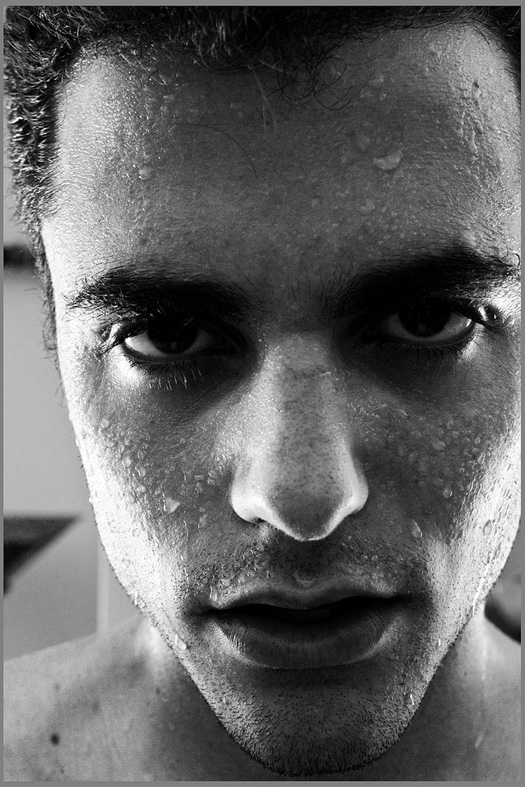
Never Stop Sweating Jetportal is Jeffrey Montes on Flickr

It all depends on the size, physical fitness and hydration of the person in question, but it’s possible to sweat buckets before heatstroke sets in and we pass out. After all, there are about three million sweat glands on the human body (the highest concentration is on our palms), and the average person aggressively working out perspires about 0.7 to 1.5 liters per hour. Theoretically, if we were attached to a treadmill and pumped full of liquids, it’s possible to keep sweating forever.

Particularly active people sweat about 1.5-1.8 liters an hour, while a triathlete can produce nearly four liters of sweat in the same time. During the Ironman Hawaii, competitors perspire some 15 liters (about four gallons) throughout the combined marathon run, 2.4-mile swim and 112-mile bike ride. Lawrence Spriet, an exercise physiologist at the University of Guelph in Ontario, says that after losing 3 to 5 percent of our body weight, the sweating process begins to slow down.

Lawrence Armstrong, an environmental and exercise physiologist, has proved that the human body continues sweating no matter how dehydrated it is. As long as the hypothalamus sends nerve impulses to the sweat glands, we’ll perspire. If sweating stops, then something is terribly wrong.

If our core temperature goes above 104º, the body begins to overheat to the point where its proteins denature. When this happens, “membranes of the tissues lose their integrity, and things leak out,” Spriet says. The intestines can discharge bacteria into the bloodstream, and the body goes into shock. But by then we would probably be unconscious, maybe even in a coma. The whole point of sweat, of course, is to prevent this from happening by keeping us cool. But even while our innards ooze, we may still perspire. As Armstrong points out, it’s impossible to sweat out all the water in our bodies: “People don’t shrivel up until they are dead.”

Have a science question you've always wondered about? Send a tweet to @PopSciFYIGuy or email to fyi@popsci.com

5 Comments

"Theoretically, if we were attached to a treadmill and pumped full of liquids, it’s possible to keep sweating forever."

This is false. You cannot consume enough electrolytes (salts) in your system to replace all that are lost through vigorous sweating. Also, you cannot consume all the right kinds you need but you have to make some kinds yourself.

Sweating too much while only replacing the fluids will kill you. Its called Hyponatremia.

The article says, "Theoretically", which means the article is correct.

And also, who says the word liquids is only referring to water? It could mean a lot of things.

All you need is some more GATORAIDE!!!

I've gotta back up chief on this one -- assuming he has his facts straight

"theoretically" still means that something is possible -- normally it refers to the fact that it's never been done.

However, he pointed out that the body itself must make some of the needed items from the raw fluids. So, you wouldn't be able to process the raw fluids fast enough -- game over


140 years of Popular Science at your fingertips.


Popular Science+ For iPad

Each issue has been completely reimagined for your iPad. See our amazing new vision for magazines that goes far beyond the printed page


Download Our App

Stay up to date on the latest news of the future of science and technology from your iPhone or Android phone with full articles, images and offline viewing


Follow Us On Twitter

Featuring every article from the magazine and website, plus links from around the Web. Also see our PopSci DIY feed


February 2013: How To Build A Hero

Engineers are racing to build robots that can take the place of rescuers. That story, plus a city that storms can't break and how having fun could lead to breakthrough science.

Also! A leech detective, the solution to America's train-crash problems, the world's fastest baby carriage, and more.


Online Content Director: Suzanne LaBarre | Email
Senior Editor: Paul Adams | Email
Associate Editor: Dan Nosowitz | Email

Contributing Writers:
Clay Dillow | Email
Rebecca Boyle | Email
Colin Lecher | Email
Emily Elert | Email

Intern:
Shaunacy Ferro | Email

circ-top-header.gif
circ-cover.gif