
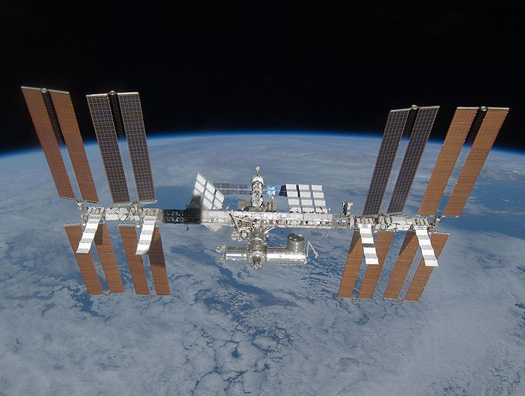
It’s never happened, and NASA feels confident that it never will. For one thing, astronauts generally don’t float free. Outside the ISS, they’re always attached to the spacecraft with a braided steel tether, which has a tensile strength of 1,100 pounds. If it’s a two-person spacewalk, oftentimes the astronauts are also hooked to each other.
Should the tethers somehow fail, however, astronauts have an awesome backup plan: jetpacks! Each one wears what’s called a Safer, for “Simplified Aid for Extra-vehicular activity Rescue,” a backpack with built-in nitrogen-jet small joystick to propel himself back to the station.
Of course, Safer is useful only if the astronaut is conscious. What if an astronaut gets bonked on the head, becomes untethered, and can’t operate the jetpack? “A rescue effort could and would be undertaken by the second spacewalker and/or other members of the spacestation crew,” says Michael Curie, a spokesman for NASA’s space operations. He wouldn’t speculate on the exact steps a rescue team would take, because they would depend on the circumstances. But he adds, “we are really happy with the tether-and-Safer approach.”
Jim Oberg, a space journalist who worked at the space shuttle’s mission-control center for 22 years and specialized in rendezvous procedures, weighs in on the options for rescue. The station’s robotic arm, he explains, is usually not within range of where the astronauts work and moves too slowly to grab someone. The Soyuz vehicles need a full day to power up and undock. By then, the carbon dioxide filters in the astronaut’s spacesuit would run out, asphyxiating him. And the ISS cannot redirect its positioning rocket quickly enough to catch up to a runaway astronaut.
In a worst-case situation, the only rescue option, according to Oberg, would be for a second astronaut to link together several tethers end-to-end, attach them to the station, and then use his Safer pack to jet over to his crewmate and haul him in. Certain conditions could make a rescue easier, he says. If an astronaut floated away more or less at a right angle from the station’s orbit, orbital dynamics (which require too much math to explain here) dictate that he would float back toward the station in about an hour.

Five amazing, clean technologies that will set us free, in this month's energy-focused issue. Also: how to build a better bomb detector, the robotic toys that are raising your children, a human catapult, the world's smallest arcade, and much more.


Online Content Director: Suzanne LaBarre | Email
Senior Editor: Paul Adams | Email
Associate Editor: Dan Nosowitz | Email
Assistant Editor: Colin Lecher | Email
Assistant Editor: Rose Pastore | Email
Contributing Writers:
Rebecca Boyle | Email
Kelsey D. Atherton | Email
Francie Diep | Email
Shaunacy Ferro | Email
I think we all know the answer to this question.
"If an astronaut floated away more or less at a right angle from the station’s orbit, orbital dynamics..." This perked my interest! Off to see what I can find out about it.
Dain Binder
@dbin78
Intriguing stuff, but please proofread! "a backpack with built-in nitrogen-jet small joystick to propel himself" sounds like one of the spambots!
But what if a meteor hit and damage the station causing a door jam prevent the rescue crew to come, the cable cord failed, and then the astronaut was left unconscious? I know how about a couple of back up door, but then what if all the doors mysteriously jammed?
Have a sticky grapple gun or a outside robot to rescue him.
But what if:
- astronaut is unconscious
- cable fails
- all doors jam
- rescue bot obtains a virus
- and grapple gun becomes unsticky
@GetRevenge
That's funny.
A sticky gun like the one they had in the Mission to Mars movie?
The solution is a device with three concentric toroidal waveguides running at different phases. This produces a gear-tooth space-time curvature down the center-line that can be used to push the astronaut further away or bring the astronaut closer to the space station. It could also be used to push space debris away from the station. This is how cows are lifted into alien spacecraft for mutilation.
Solution 1 - Use more Robots in Space (remove the human cargo)
Solution 2 - Powerful land or space-based lasers kill drifting human (human purchase life insurance)
Solution 3 - Invent Teleportation Device (beam me up scotty)
Solution 4 - Chinese only in space (workers are expendable)
Solution 5 - Cover up (nothing to see here, move along)
Problem solved!
getrevenge- the gun idea is interesting but remember when he shoots the gun the astronaut will travel away from the direction it is aimed as fast as the suction part will be traveling towards the station. remember newton's second law.
WOW i definitely meant 3rd Law. of all places to get it wrong, a science website is close to last.
@Igot1forya - I like Solution 2. Target practice is not only practical training, it's fun!
i think ud need.. the simple things
liiike
chewing gum, a piece of string, and mantracker of course! ;D
What about allowing Remote SAFER controlling?
@kb1kb1
"...when he shoots the gun the astronaut will travel away from the direction it is aimed as fast as the suction part will be traveling towards the station..."
Not necessarily true. In this case Conservation of linear momentum can be expressed as;
m1v1 = m2v2
where m1 and m2 are the masses of the astronaut and sticky projectile, and v1 and v2 are the change in velocity of the two masses.
If the astronaut's mass is 100x that of the sticky projectile then his velocity will change by 0.01(v2) of the projectile. This is kinda like a recoil of a gun; the bullet leaves the gun traveling very fast, but thew recoil speed of the much heavier gun is much slower.
A sticky gun might not be effective. What if it hits something on his suit that it won't adhere to?
Harpoon gun would be better.
At least the family would have a body to bury...
Pretty sure this type of situation would be someone's worst nightmare... Drifting off into space, Yuck.
Not exactly educated in these areas, but wouldnt some sort of magnet work? Have an emergency magnetic system attached on the outer part of the main craft that would get the unconcious, untethered guy back to the craft?
Perhaps it would be possible to project a long retrieval cord with something like a bolo or a net similar to what is used to capture birds at the end. You'd have to make sure that the balls on the bolo were soft enough that they wouldn't damage the astronaut's suit -- say by breaking his helmet -- but massive enough to wrap around the astronaut and trap him.
There would have to be some mechanism to carefully handle the acceleration back towards the ship so that the initial capture is not lost while the astronaut's velocity is reduced to zero relative to the ship and then increased toward the ship.
A sticky gun, poorly aimed, might sail past the astronaut. A bolo would significantly increase the size of the "shot pattern" and increase the likelihood of a catch.
very simple solution: re-design the jet packs to be remote controlled by other astronauts. no robots needed.
there is NO coming back. we are talking about space. please understand zero G physics. If the astroman has any significant amount of acceleration or velocity it would make catching up to him all but impossible. and IF you could catch up you probably have no fuel to get back. if he just comes untethered. no big deal he will stay in the same spot next to the station. but he is propelled away. say your goodbyes.
how about a solar powered shuttle pack that another astronaut can go get them and bring them back.
"What if an astronaut gets bonked on the head" lol, wouldn't the helmet have to crack if it knocked them unconscious, thus kill them. can you survive with a cracked helmet in space?
Looks like the best way is to not let it happen in the ist place :)
gizmoot.blogspot.com/
In helmet virtual reality activates...Beautiful woman, your at the beach...she says"well big boy this is your last request what can I do for you?"...military satelite zooms in on your location...Authorization to fire...NASA interupts the best moment you've had in weeks, showing Command Certral Director's face and he asks "Can I have your Golf clubs?"
"But what if a meteor hit and damage the station causing a door jam prevent the rescue crew to come, the cable cord failed, and then the astronaut was left unconscious? I know how about a couple of back up door, but then what if all the doors mysteriously jammed?
Have a sticky grapple gun or a outside robot to rescue him.
But what if:
- astronaut is unconscious
- cable fails
- all doors jam
- rescue bot obtains a virus
- and grapple gun becomes unsticky"
ductape?
nah, i'm kidding ya, if that happens, your SCREWD!
1100 lb cable isn't what I'd consider robust. We consider explosion to be one of the risk parameters for accident, right?
dain, the reason you'd return to the station if you floated away at right angles is due to orbital mechanics. A maneuver at right angles to your velocity vector changes your orbital plane without changing the period or shape of your orbit.
Your new orbital plane intersects your old one along a line that includes the point at which you made the maneuver and a point exactly on the other side of the orbit.
So if you pushed off from the ISS at right angles to your velocity vector, at first you'd drift away but you'd eventually slow down, stop and begin to accelerate back toward the ISS. When you reach it you'll be moving as quickly toward it as you had moved away. If you manage to miss the station you'll shoot past it, again come to a stop and return. You'd swing back and forth along the ISS orbit indefinitely until you finally hit it.
Of course, in reality you probably wouldn't push off exactly at right angles. Any maneuver along the velocity vector would change your orbital period. You'd return to the same point on the ISS's orbit one half orbit later, but probably not at the same time as the ISS so you'd miss it.
This is a simplified description assuming no perturbations, but of course the real world is never so simple.
Correction, if you pushed off the ISS with a component of velocity along the ISS velocity vector you'd return to the same point in space one orbit later, not one half orbit later.
If you pushed off in the forward direction, you'd rise above the ISS and fall behind, as your orbital period would be a little longer, and you'd return to your separation point behind the ISS. And if you pushed off in the reverse direction you'd fall below and ahead of the ISS and return in front of it an orbit later.
But a cross-velocity maneuver would bring you back every half orbit. The ISS's orbital period is about 92 minutes so you'd actually come back every 46 minutes or so.