
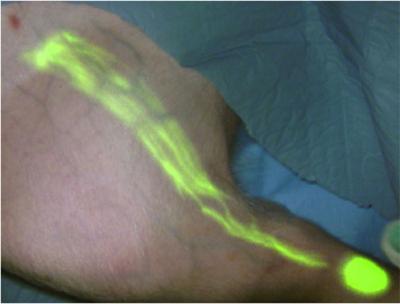
The problem with cancer surgery, or so we hear, is that it’s difficult for surgeons to know if they’ve removed all of a tumor, especially in late-stage cancers when the edges get indistinct. But a new imaging technology developed at Beth Israel Deaconess Medical Center’s Center for Imaging Technology and Molecular Diagnostics in Boston is giving cutters visual cues on just where to aim their scalpels.
The portable FLARE (Fluorescence-Assisted Resection and Exploration) system uses near-infrared light to highlight cancer cells, giving surgeons a “paint-by-numbers” guide that shows the full extent of a tumor. Before surgery, patients are injected with special dyes called NIR fluorophores that target certain cell or tumor types and glow when they are exposed to near-infrared light. (Don’t worry, your prostate won’t glow orange — this process is invisible to the naked eye). A detector relays the information to a video monitor, where the glowing cancer cells are overlaid on real-time images of the patient’s body. A footswitch allows the surgeon to magnify or change viewing angles during the operation. More advanced versions may allow the surgeon to simultaneously view other systems, like nerves and blood vessels.
So far, FLARE has been used on mice and pigs, but is going into human trials soon. But advancing the technology and using it on various cancers now depends on developing more sophisticated dyes. “The future of the technology now is really in the chemistry,” says project director John Frangioni. “We have to develop agents for specific tumors, nerves, or blood vessels we’re trying to visualize.”
[Via Eurekalert]
