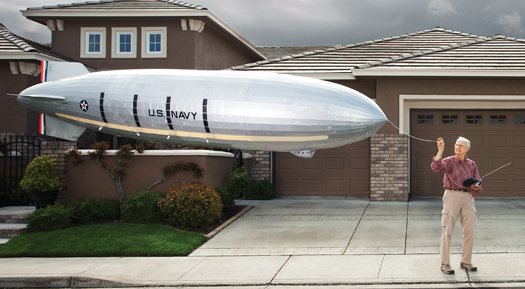
The first time retired computer engineer Jack Clemens tried to build a scale model of the USS Macon, a helium-filled naval airship lost in bad weather in 1935, his cat jumped on the prototype from a high shelf and ruined the hull. Clemens finished a second version in 2008 but totaled it during an unexpectedly windy test flight. Finally, in April, Clemens completed version number 3, a 20-foot-long radio-controlled replica accurate down to practically every detail, from the airbag to the propellers.
Clemens frequently used to commute past the Macon’s enormous hangar in Moffett Field, California. He thought returning a model of the craft to its original home would be a fitting tribute, so he requested the plans from the Smithsonian National Air and Space Museum.
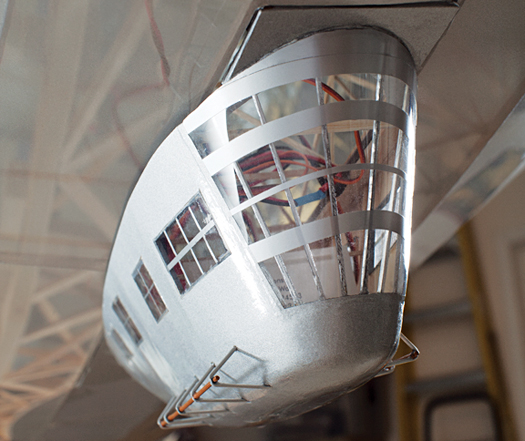
The Macon was an airship, not a blimp, meaning it had a rigid hull. A backbone made from 12 circular frames connected with strips of wood called longerons gave the 785-foot-long craft its form. Clemens wanted to mimic the structure in his model, so he built a jig to ensure that the frames--made from thousands of balsa-wood sticks--were precisely the right size. Although the Macon’s skin was a mix of cotton muslin and metal-colored sealant, Clemens’s model used Mylar because it was lightweight, tough and the right color.
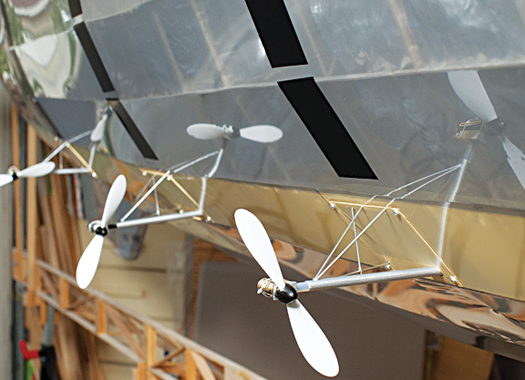
Clemens calculated that to get his craft to fly, he would need a total of eight small model-airplane propellers anchored to the sides of the frame. “It takes very little propulsive force to move an airship,” he explains. The propellers are powered by a single 2.5-ounce lithium-polymer battery that sits in the nose of the craft and helps balance the weight of pulleys and servomotors in the tail.
Currently the 20-foot-long, 3.3-foot-diameter airship resides in Clemens’s garage (“It’s the bane of my wife’s existence,” he says), but he has offered to donate it to a new museum being built in Moffett Field. He’s hoping that one day he’ll even get the chance to fly it in the Macon’s original hangar, far away from strong winds and leaping cats.
Time: 2.5 years
Cost: $6,000
138 years of Popular Science at your fingertips.
Each issue has been completely reimagined for your iPad. See our amazing new vision for magazines that goes far beyond the printed page
Stay up to date on the latest news of the future of science and technology from your iPhone or Android phone with full articles, images and offline viewing
Featuring every article from the magazine and website, plus links from around the Web. Also see our PopSci DIY feed
A 10,000-rpm, no-pulse heart is completely revolutionizing how we think about transplants. Plus: rapid-response virus hunters, a shocking cure for migraines, the world's youngest person to have achieved nuclear fusion (in his parents' garage!), and much more.
This gentleman reminds me of my grandfather, who is in parasise now. I hope this inventor had a nice time making this. I sure miss my granfather. God bless this man and his family!
Most impressive Mr Clemons.
I love that you went for a kind of obscure ship instead of one of more famous zeplins.
Really nice job! That balsa-wood skeleton is fantastic!
Really is amazing. I hope it goes into a museum or some other facility. I picked up two lessons here. Perseverance is key and get a dog.
Wow that is truly amazing. What a cool guy he is.
complete-privacy.no.tc
Technical point of order for author Gregory Mone. The statement; "The Macon was an airship, not a blimp, meaning it had a rigid hull" is technically incorrect. An airship, by definition, is a lighter than air craft that is powered and steerable. Another term (which is also commonly misunderstood) is dirigible. Any lighter-than-air craft (think balloon) if it has an engine(s) and can be steered is an airship or dirigible. The USS MACON and it's sister ship USS AKRON were rigid airships or, alternatively, Zeppelins.
Blimps (no internal structure), semi-rigids (Some internal framing such as the NORGE or EUREKA), or rigids/Zeppelins (full internal structure, GRAF ZEPPELIN, HINDENBURG, AKRON, MACON, LOS ANGELES) are all airships or dirigibles. The Goodyear (and other) blimps are just as much "airships" as any of the rigids, however, a rigid airship (or Zeppelin) cannot be called a blimp.
I remember hearing about this guy when his cat jumped on his previous model, that broke my heart! I am so happy for him that he finally finished his new model. I can't wait to see this new one at the Moffet Air Field museum. That place is a must see for any airship enthusiast. I liked it so much I made sure my comic made a stop there. Here's a link to a page with Hangar One in the background.
www.the19xx.com/?p=297
It doesn't appear to be ENTIRELY authentic as a replica; it seems to be missing the parasite fighters and the hangar bay.
The USS Macon, and sister ship USS Akron, were airships, but they were also aircraft CARRIERS; they could drop small fighter/scout planes which would then fly out, return to the airship and hook on with a trapeze. (A similar setup was depicted in the movie "Indiana Jones and the Last Crusade"; nobody believes me when I tell them it really happened!)
Ken Mitchell
Citrus Heights, CA
I understand that the frame is actually not made of balsa. It is made from the bones of the cat that ruined the original model.
^ Lmfao xDDD
38KKK
*D Ace Lee*
\m/(>.<)\m/
METAL UNION
We at Helios applaud Jack for his work, and find the humour in this article quite funny. There were some technical errors though that others pointed out. I don't know WHERE they got that definition of an airship haha. Jack would do well to use balloonettes on the inside of the main frame. Cheers!
Brady Soule
Director of Marketing
Helios Airships
www.heliosairships.com
Tried your web Helios but its closed! Anyway,I wanted to point out that the volume compensation device in airships is called a ballonet, pronounced in the French manner - balonay. It comes from the fact that the French feel they invented lighter than air flight with the Montgolfier brothers. First there were "Ballons" dont say the s, then ballon dirigable - steerable balloons and finally ballonet as the diminutive form of the French word ballon indicating it is a small internal balloon which compensates for volume change due to temperature and atmospheric pressure (climbing, descending etc. Hope this helps.
I think Mr Clemens is to be congratulated for his perseverance in producing an exquisite and very accurate model of the Macon. I have the same blueprint reproduction you can see on his wall in the first picture. The last picture is a tribute to his accuracy in construction not just to reproduce an exterior likeness but an accurate interior. BTW All Zeppelins were rigids but not all rigids are Zeppelins. Even the Germans call an airship a "Luftschiff". Luft - air, schiff - ship. Calling any rigid like the US made Akron and Macon or the British built R33, R34 R100 (private), R101 (Government) a zeppelin is like calling your Dyson Ball a Hoover.
The Akron and Macon, as kenwd0lq said, carried up to 7 aircraft which were Curtiss Sparrowhawks. (will try upload a picture. The pilots became so profficient at hooking on that theytook the gear off to save weight and improve aerodynamics! The job was to patrol the Pacific and if they had been there, Pearl Harbor would never have happened.
Douglas H. Robinson, in his book "The Airships Acron and Macon", makes the case for calling these two airships "Zeppelins" because the company that constructed them for the U.S. Navy was the Goodyear-Zeppelin Corporation, a consortium between the U.S. Goodyear firm, which had experience in mainly non-rigid and semi-rigid airship design and handling, and the German Zeppelin firm. There was considerable sharing of engineering knowledge between the two companies, with several dozen German engineers having relocated to Akron, Ohio to work on the project.
For even more information on the significant connection between the Goodyear-Zeppelin Corporation and the German Zeppelin Company read the excellent history book published by the University of Akron Press: "When Giants Roamed the Sky, Karl Arnstein and the rise of airships from Zeppelin to Goodyear" by Dale Topping, 2001, ISBN 978-1-884836-70-1.