antarctica

Searching for Antarctic Microbes with Antifreeze and Bombs

A new scientific project joins the race to explore lakes under Antarctic ice

Ice Capades: Scientists use explosives to generate seismic maps of Antarctica's Lake Ellsworth  Neil Ross/University of Edinburgh

This winter, Russian scientists will resume drilling into what may be the most pristine environment in the world: Lake Vostok, an unfrozen body of freshwater the size of Lake Ontario cut off from the world for millennia beneath two miles of Antarctic ice. The sediment on the lakebed could hold clues to past climate changes, and the waters could be teeming with new forms of life — but the slightest mistake could spoil the lake for good.

[ Read Full Story ]

Global Warming Better, Worse Than We Thought

Sea levels will rise less than predicted; but the health problems caused by global warming will be worse

This is going to be a different kind of global warming post, because there's actually some good news to go along with the bad news. Well, not GOOD, but better than previously expected. Unfortunately, the bad news is just as bad as always.

[ Read Full Story ]

Life Thrives Below Antarctic Glacier

If microbes can survive without sunlight and oxygen on Earth, what does it mean for the possibility of life elsewhere in the universe?

The McMurdo Dry Valleys of Antarctica are one of the last places on Earth you would expect to find a new living organism. With bitter cold temperatures and only about four inches of annual snowfall, scientists consider these valleys to be one of Earth's most extreme and harsh environments.

The region was believed to be devoid of complex animal and plant life, but a new study has revealed that an unusual microbial life form lives under the Taylor Glacier -- an outlet glacier that drains part of the East Antarctic Ice Sheet and terminates in the Dry Valleys.

[ Read Full Story ]

Giant Antarctic Ice Bridge Collapses

Two weeks ago, it was a 25-mile-long span of solid ice; now it's a massive flotilla of icebergs

A 25-mile-long ice bridge that linked the Wilkins Ice Shelf to Charcot Island on the Antarctic Peninsula has collapsed. NASA satellite imagery shows that the bridge's disintegration occurred sometime between March 31 and April 6. Scientists had been keeping a close eye on the bridge since last March, anticipating its collapse following dramatic changes that have taken place on the Wilkins Shelf in recent years.

[ Read Full Story ]

An East Antarctic Odyssey: The Final Segment

The team returns to the land of minus-50 temperatures and hurricane-force winds

Think you've done the ultimate road trip? Think again. That tour de force can only be rightfully claimed by a team of scientists who spent this winter driving 2,000 miles across East Antarctica -- at a top speed of about 9 miles per hour.

In late December, twelve American and Norwegian scientists set out to complete the second segment of a two-season overland traverse of East Antarctica. This year's expedition began with the team traveling in two groups, with one heading first to 'Camp Winter' to repair the vehicles that were damaged during Season 1 and then driving to the South Pole, and the second group testing equipment at McMurdo Station before meeting up with group one at the South Pole. The entire team then headed to Troll Station, a Norwegian research station located about 150 miles from the East Antarctic coast, stopping at various points along the way to fly unmanned aerial vehicle (UAV) missions and drill for ice core samples.

[ Read Full Story ]

Crazy Fast? Or Just Plain Crazy?

Three Canadians beat the world record to the south pole

The Heroic Age of Antarctic Exploration may be long past, but plenty of adventurers still share Sir Ernest Shackleton's dream of reaching the south pole. And last Wednesday three Canadians broke the world record for crossing the continent to the pole unaided, traveling 700 miles on snowshoes and skies from Hercules Inlet on the Ronne Ice Shelf to the pole in 33 days, 23 hours, and 30 minutes—beating the last record by nearly 6 days. In case you're wondering, yes, that is crazy fast. Considering the lack of even dogs to help pull the sled, it could also be considered just plain crazy.

[ Read Full Story ]

An East Antarctic Odyssey

Picture crossing the Antarctic continent in a land vehicle—at the speed of a riding lawn mower. That’s what a team of American and Norwegian scientists are doing in a two-season expedition

East Antarctica is home to the Earth’s oldest ice and harbors some of the most important information about past and future climate change, yet it is the least explored part of the Antarctic continent. The Norwegian-U.S. Scientific Traverse of Antarctica involves two overland traverses of East Antarctica: one in 2007-2008, and a return traverse via a different route in 2008-2009. The project will revisit sites that were first explored in the 1960s to look for signs of change since then and to set benchmarks for future research in the area.

[ Read Full Story ]

Rise of the Snow Bots

A remote control toy could help NASA scientists better understand Earth's polar regions

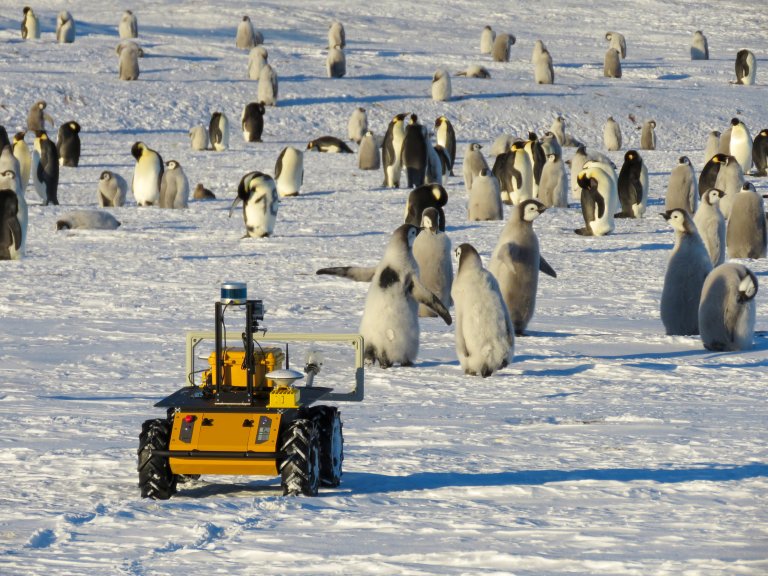
If you thought your remote control monster truck was badass, check out the SnoMote. The new remote control snowmobile was funded by NASA to help scientists in polar regions collect climate data without forcing them onto cracking ice sheets. The bots, designed to work as a team, can be programmed to monitor a target area; a fleet of bots is outfitted with sensors and cameras to navigate terrain autonomously, all the while taking temperature and barometric readings.

[ Read Full Story ]

Recovery of Ozone Hole May Increase Antarctic Warming

One step forward, one step back.

The good news is that the ozone hole over Antarctica is slowly healing, thanks to controls on ozone-depleting substances that were once widely used in products such as refrigerators and aerosol cans. Stratospheric ozone protects us from harmful ultraviolet radiation that can cause problems such as skin cancer and crop damage.

[ Read Full Story ]

Antarctic Biodiversity vs. Global Warming

Warming oceans could rob the Antarctic waters of their serenely ancient inhabitants

The waters around Antarctica are an anomaly; they're home to a marine ecosystem straight out of the Paleozoic era (the period spanning from 541 million to 251 million years ago). But global warming is about to change that, according to research presented today at AAAS. The reason for the preponderance of ancient organisms is the cold water: Predators that are capable of breaking the skeletons of their prey—modern fish, sharks, skates, and so on—simply can't live there. In fact, the most vicious predator in the Antarctic marine ecosystem right now is either a big sea star or an acid-oozing worm.

Those waters are warming, though, and possibly faster than the rest of the world's oceans.

[ Read Full Story ]


Download Our iPhone App

Stay up to date on the latest news of the future of science and technology from your iPhone with full articles, images and offline viewing


Follow Us On Twitter

Featuring every article from the magazine and website, plus links from around the Web. Also see our PopSci DIY feed


Become a Fan On Facebook

Share links with friends, comment on stories and more


November 2009: Astronaut 3.0

Inside NASA's astronaut bootcamp and the grueling new training regimen for deep space. Plus, ten young geniuses shaking up science today, one writer's quest to analyze every man-made chemical in her body and more.

Check out the issue's full contents online here

Popular Science Photo Pool


Share your photos in the Pop Sci pool at www.flickr.com!
tags_sprite.png
POP_embeddedForm_cover_May09.jpg