
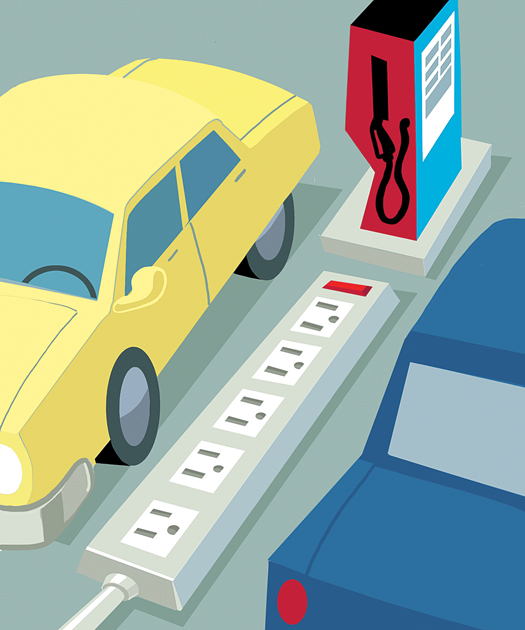
Early this year, when it became clear that the Chevrolet Volt and Nissan Leaf had missed their 2011 sales targets, critics declared the electric-car revolution over. Yet at Detroit’s annual North American International Auto Show in January, plug-in cars abounded. BMW displayed its forthcoming i3 electric city car, along with its i8 plug-in hybrid sports car. Acura unwrapped a hybrid concept version of the NSX supercar. Tesla Motors brought its all-electric Model S sedan. But the most important car on the show floor might have been one that, on the surface, seemed much less exciting: the new Ford Fusion, which will be available in gasoline, hybrid and plug-in hybrid versions.
Carmakers long refused to build plug-in cars because they said they had no idea how many people would buy them. Then, rising oil prices and environmental concerns led governments to enact stricter emissions standards and push carmakers to build cars that could meet those standards. In the U.S., the federal government lent several carmakers (not just GM and Chrysler) money to develop electric vehicles and retool factories.
Ford used part of its $5.9-billion loan to develop a system for building gas cars, hybrids, plug-ins and electric cars all on the same line. In a renovated Detroit-area factory, it will build gas and electric versions of the Focus compact car, along with hybrid and plug-in hybrid C-Max minivans. The company will use the same strategy for the Fusion.
Compared with the ambitious e-car launches of recent years—particularly those of the Chevy Volt and the Nissan Leaf—Ford’s approach might appear noncommittal. But it could turn out to be transformative. It’s evidence that once the investments have been made, manufacturing electric cars isn’t all that hard. It’s a matter of adding a few assembly-line stations where plug-in cars get their batteries, electric motors and electronic controls. And when Ford and other automakers use the same lithium-ion batteries across a range of electrified vehicles, it will help reduce the cost of those batteries, pushing electric-vehicle sticker prices down and ultimately in line with conventional gas cars.
Drivers won’t just benefit from lower prices; they will finally get some choice. Picking a power train could eventually become as simple as opting for the premium sound-system package. And making that choice won’t have to be a lifestyle statement. Outwardly, the plug-in hybrid version of the Ford Fusion will be almost indistinguishable from the hybrid or conventional versions, with the exception of a charge-port door and a little badge that says “Energi.” Habituating Americans to the concept of plugging in should make it more likely that all manner of electrified cars receive a warm reception.
The debut of the Volt and the Leaf was just one phase of a long process. First came the high-profile launches and the saturation media coverage. Now it’s time for plug-in cars to slowly become normal, even boring—or, to put it another way, accepted.

140 years of Popular Science at your fingertips.
Each issue has been completely reimagined for your iPad. See our amazing new vision for magazines that goes far beyond the printed page
Stay up to date on the latest news of the future of science and technology from your iPhone or Android phone with full articles, images and offline viewing
Featuring every article from the magazine and website, plus links from around the Web. Also see our PopSci DIY feed
Engineers are racing to build robots that can take the place of rescuers. That story, plus a city that storms can't break and how having fun could lead to breakthrough science.
Also! A leech detective, the solution to America's train-crash problems, the world's fastest baby carriage, and more.


Online Content Director: Suzanne LaBarre | Email
Senior Editor: Paul Adams | Email
Associate Editor: Dan Nosowitz | Email
Contributing Writers:
Clay Dillow | Email
Rebecca Boyle | Email
Colin Lecher | Email
Emily Elert | Email
Intern:
Shaunacy Ferro | Email
normal....one thing i never want to be.
Actually the payback period for an electric vehicle and the nuclear infrastructure to support it is less than 4 years assuming an extra 10K for the electrics over a similar petrol vehicle and $100 bl oil.
LOL, this is funny. Why does popsci always try to push the greeny agenda? These cars are not now nor will they ever be popular until they are as reliable, easy to maintain, and cast effective as their fossil fuel bretheren.
Oh ya and they are not "green", just the batteries alone are catastrofphic for the environment, suck up huge amounts of rare earths ( that means there is very little of it on the rock)have very limited range, long recharge times ( if you let the battery totally die then you just bought $14,000 worth of new batteries) and they are not even any better for the ecology, they still require huge amounts of fossil fuels to be burned to charge the batteries.
So exactly what would be even one good reason to own one? Oh ya thats right, you get to be the stuck up greeny in the neighbor hood thats better than everyine else because you drive a prius. LOL, pathetic popsci, just plain pathetic.
I would have thought by now that you would learn, every time you write on of these rediculous articles that gets mass flamed by 90% of the respondents that we are not stupid or ignorant on this suject posci, stop trying to sell your fantasy greeny crap to the world, we have already yold you many times, we know it is crap, we dont want it, stop trying to sell it to us!
Or, are intentionally eroding your reader base, so you can be like news week and all the other liberal shill media that is either bankrupt or on the way? Your readers arent stupid, if you keep trying, we will keep staying away, losing you hits per day, resulting in your declining credibilty, and profit margins that fall at 9.81m s 2!
@Reddwhite
Electric cars are about as tech forward as we can get today. They very much apply to a site about popular science.
That said, if you have to replace your batteries, they will definitely recycle them. I did a quick search, and it is $8,000 for replacement of the volt's battery pack. I think your point is still valid, but $14k is an exaggeration.
In terms of maintenance, electric cars (fully electric) do not have much maintenance. I believe that is one of the main reasons they are so slow to come out. Replacement parts are a big part of the auto companies' income. An electric motor is pretty darn robust. There is no transmission necessary. Fewer parts equals fewer failures.
Finally, your argument about burning fossil fuels to charge these is just ridiculous. Yes, fossil fuels often supply the cars with energy, but if you think your car engine is as efficient as a 250 MW combined cycle power plant, you are delusional. Heck, even coal is way more efficient than your car. If it wasn't, they wouldn't be using huge plants to make power for the grid, they'd just strap a bunch of hemi's together. On top of that, states are requiring more renewable power through Renewable Portfolio Standards. That means, over time, your battery powered car becomes "more green" as the grid catches up. Your gas car would have no chance of doing the same.
A reason to own one would be because you want to help fund a tech that you think has a bright future. You said yourself that until they have better range and charge faster, you won't consider them viable. How do you think they get to that point? If your research in a technology is expected to take years if not decades, you have to fund it somehow. Selling a half-decent product in markets where it is sufficient (read any major city in the world) is not a bad idea. Those people will buy it since you won't.
Just posted a link to this article to the Plug-In 2012 Conference & Exposition (www dot plugin2012 dot com) social media sites. Thanks!
With the push several years now of electric cars and hybrid cars, you think auto batteries for the typical car would start to become cheaper. I was checking the prices the other day for an auto battery the price typically continues to grow.
.............................
Science sees no further than what it can sense, i.e. facts.
Religion sees beyond the senses, i.e. faith.
@reddwhite
1. Considering we can recycle batteries but not fossil fuels?
2. Do you really think companies would sell you a $30k car that will allow you to brick itself by running it down? The Volt limits you to something like 80% of the battery. This way it never is fully depleted by driving and as the battery wears out and overall charge decreases your electric range does no suffer, just your safety buffer. Hopefully by then you've learned not to drive it to death, literally.
3. I don't know about you guys, but if I ever get a plug-in car I plan on investing into solar panels to charge or help charge the car (via batteries that charge all day while I work). There are many ways to generate electricity my friend.
4. Please explain to me how fuel injectors, air filters, oil changes, pistons, cam shafts, exhaust systems, etc are simpler and easier to maintain than a big battery, electric motor(s) and a power controller. I agree with ToomeyND.
This tech is only now becoming viable. I looked into converting my old Miata into an EV in a few years for a fun project. $25k plus! I covered myself earlier and said IF I ever get a plug-in because honestly, I would not be surprised if I retire and still have a gasoline daily driver. (I'm 24)
Redd, in 5 years your arguments will all be obsolete. The best way to speed of the process, and make more reliable and cheaper electric cars is to make MORE of them, economies of scale my friend.
"'Oh ya thats right, you get to be the stuck up greeny in the neighbor hood thats better than everyine else because you drive a prius."
Wow. Talk about a massive inferiority complex! I know plenty of people who own a Prius (I do not) and never once have they flaunted it, or remotely hinted that they were superior for it. Perhaps you feel inadequate about something?
"Or, are intentionally eroding your reader base..." If articles like this, get rid of people like you, we're all better off.
reddwhite: A less visionary human never lived.
Electric cars will take off and make gasoline cars obsolete by 2020.
Read these:
http://www.popularmechanics.com/cars/news/fuel-economy/8-potential-ev-and-hybrid-battery-breakthroughs?click=pm_news#slide-1
http://www.sciencedaily.com/releases/2011/11/111114142047.htm
http://www.scientificamerican.com/article.cfm?id=better-battery-lithium-ion-cell-gets-supercharged
When several of these technologies are merged we have the capability of a 'coast-to-coast' electric car--a vehicle with a 3000 mile range. Trucks, or cars, or buses and even trains.
Those with narrow tunnel vision will get stuck in the tunnel!
I had a thought on electric vehicles the other day, and I have no idea if its feasible or not. What if we were to inbed a system of magnetics? With power possibly provided by solar on the side, to charge electric vehicles as they drive. Adding in the receiving end of that in the vehicle itself. It would be almost like the system used by some charging bases to "wirelessly" charge a device by setting it on that magnetic base.
Again, I don't know the feasability of a system like this. I know it probably wouldn't be cheap and for states like mine (Wa state) where people drive with chains or studded tires, there is definatly concern on that end.
My thoughts aside, I think we're looking at the recharging end of electric cars wrong. I feel we should be somehow embedding a charging system into, or along side, the roadways that charges them as they drive. Kinetic braking is a system that only really works well in a city setting. However, A LOT of people live outside of an environment that takes advantage of that. Not to mention the nations interstate system, which of course has long stretches of no stopping and thus almost no use of brakes.
If we want electric vehicles to get more mainstream, we need to figure that out first in my opinion.
@reddwhite
Sorry to burst your bubble, but the tech is coming whether you like it or not. There's always a group of people that don't want to deal with change, and come up with excuse after excuse to fight it.
The fact is that EVs are:
- easier to maintain
- cheaper to run
- batteries will decrease in price for the foreseable future, while oil will continue to increase in price
- in 5 to 10 years EV will start to take over, and gas cars will be relegated to a smaller market segment
@reddwhite
Adoption of change is tough but you'll get through it. I'm not a "greeny" as you might define them but this is a perfectly acceptable thing to change (and the time for it to change as well).
If you don't like this you're going to flip your lid over In-Vitro meat, caloric restriction pills, stem cell regeneration (replacement organs), disposable computers, rail gun technology for flight and shuttle launches, and open sourced universities... and these are only the ones currently emerging to hit the market.
WOW! One itty bitty troll today, pulled a string and a lot of tops went a spinning, lol!
I'd buy a Volt today if the USPS would let me charge my car while I am at work. I live too far away to go there and back in one charge. I don't mind the $50K for the car. I know it isn't a fully green solution. It is a solution for reducing foreign oil. Even an expensive battery can be recycled. Even they have core value. So what if I have to replace it in 10 years.
What is with this stupid solar cell deal? You simply can't create a PV now that can create more energy than it can ever produce. You are not saving any resources with a PV. You are being duped by companies (China) that can produce electricity from massive hydro projects and complex tax codes that make a PV seem like you might get a deal. Stop the madness now! PV cells are need to get 35% or more efficient to even begin to return any money.
There is no free lunch, the electric structure is in place to charge everyone's car overnight right now. We don't need to build more nukes. The most simple way is to conserve power now. Simple things like a Federal Law that states that any power supply made for US needs to be made for 60Hz and not 50Hz. We waste more power on inefficient transformers than small counties use. Huh, simple law, conserve. Sadly each home is
Price of batteries are not comming down yet...
How about an 'Air Powered Car'!
http://www.themotorreport.com.au/53641/tata-mini-cat-air-powered-car-on-sale-from-mid-2012
....................................
Amun-Re, She was ban into a female form, but lived
her life free around abosticals with passion.
She was a King! "BEAUTIFUL!"
Okay, are we seriously arguing about this electric car B.S. again? Here is the deal. Current electric cars still require large and either heavy or combustible battery packs that add to the cost of the vehicle and they do have maintenance issues like any other electro-mechanical system. For all of you saying that the Volt or the Leaf is unable to be bricked, may I remind you that some people are idiots and even an expensive Tesla can be easily bricked. Also, there is a large portion of America that realizes that we are the most indebted nation in the world and that national debt is quite literally the enslavement of the subsequent generation, so when we see that the gov't feels like spending thousands of our hard earned dollars for every one of these little social experiments, we get more than a little hacked off.
Now, let me tell you how to make hybrids or all electric cars work. First off, for a hybrid, you need to go to a small diesel generator that runs at a constant velocity and has a stirling engine recycling the waste exhaust heat to power the low voltage electronics and creature comforts. The batteries should be small, one normal 12 volt deep cycle for the accessories and just a couple for the higher amperage and voltage drive motors that are coupled to large capacitors to absorb the shock of quick acceleration and to rapidly charge upon braking. This combination should lead to considerably better mileage due to the fact that you are capturing waste energy and you are only using the IC engine at its most efficient speed and loading.
For the all electric crowd, you need to stop using batteries and start using supercapacitors. Capacitors have a nearly infinite usable life when used within their voltage and current limits. They also do not "brick" when they become completely discharged. This means that a capacitor car left in a barn for a decade could be readily charged and driven immediately. Also, capacitors can charge and discharge infinitely faster than a battery because unlike a battery, they do not involve a chemical reaction to take place. This means that you could have comparable recharge times for a cap car as a gas car. Only when recharging an electric is as convenient as pulling into the pump will the average person accept it as normal. Lastly, cap cars can be mechanically designed so that in the event of an accident, a shorting circuit/ bar can be activated to completely discharge the vehicle rendering it completely inert in seconds.
So please stop trying to force this underdeveloped technology down our throats with the incentive of getting the money you stole from us back in our own pocket. I'm not against electric cars or even just better cars, but the gov't should not be deciding for me what is the better car. In fact, they have done a pretty damn lousy job of it. Can anyone please tell me the reasoning behind making cars with lower compression that got lower mpg's and required extra equipment to pump air into the exhaust to ensure that all the unburnt fuel was burned in the catalytic converter made of a platinum matrix that added several hundred dollars to the price of cars when they were only 4,000 new? It is only now that we are beginning to get caught back up with where we should have been in 1980.
@Sethdayal,
Can you please explain your numbers? To me the math doesn't add up. I can buy a car similar in size to the volt at 1/5 the price that gets 40 mpg. Now, with the extra 40,000 that I didn't spend buying the car, I can tag it, insure it, and put gas in it for years. Assuming even $10 per gallon gas and 10,000 miles driven annually, that gets me a fuel cost of $2500 per year. Assuming that you do the two to three scheduled oil changes and top up on windshield washer fluid and regularly wash your vehicle, let's just say that is going to cost $2750 per year in gas and maintenance. Now, if we divide $30,000 (because I've figured in 10k for tag and insurance for several years) by $2750, we get 10.9.
So to sum it up, to break even with a generic gas automobile, the Volt or similarly priced electric will take at least 10 years of sitting idle and not using any energy, requiring any maintenance, or costing you anything to tag or insure. When an electric car can be built that recharges as quick as I can fill the tank, won't brick, and doesn't cost 5x what an IC car does, then I'll buy one. Until then, you early adopters can eat the cost of your ignorance.
We have the intention of applying to the Guinness Book of Records for perhaps the longest market study on manufacturing a Utopic Vehicle(s). The idea has been to respond to the mass consumer's demand, in engineering an imperial formula = a vehicle, realistically a range of vehicles. Yet, we know there can't be such a thing as an imperial formula. There are just too many factors that make it difficult make a vehicle that suits all consumers.
Over a century of experience in EV manufacturing has culminated in the vehicles we have on the market today.
For 7.5 billion of us global warming and CO2 emissions can't be a casual encounter. Or socially acceptable credentials.
So what are the critics say about the present EVs (minus the hybrids) on the market?
1. They are expensive and only affordable by the 1% class, despite the government incentives.
2. They are produced in highly polluting plants.
3. They are heavy.
4. They are full of expensive gizmos.
5. They have very expensive battery packs.
6. The cost of battery replacement is very high.
7. They mainly have to charge from the mains grid that uses fossil fuels and coal.
8. A lot of potential buyers state "that once they can find an EV at the same price as an ordinary car, then they will buy"
So what is the Utopic solution as a lot of the 7.5 billion who have to commute daily in a no frills vehicle(s)and don't have access to public transport.
1. We offer a range of ordinary but foldable and electric bicycles to cover a wide spectrum of such consumers.
2. Electric scooters where the battery can be charged at home if required.
3. Hybrid electric scooters that eliminate the range anxiety, yet are affordable to buy and maintain.
4. A low cost electric tricycle scooter, fully covered and priced at $7.500. Includes heater for cold countries.
5. A low cost hybrid electric tricycle scooter fully covered.
6. A low cost, low consumption, low maintenance, low weight petrol EcoCa quadricycle version to be sold circa $2,000 for low budget clients, many of the 99%.
7. Our range of EcoCas can be made in a plant that can be powered 100% by renewable energy. This can be done either by connecting to a wind or solar transmission line or with a wind turbine/solar installation at the plant.
8. Where it is possible, we hope to set up mini-renewable wind or solar charging points for our individual clients at their homes.
9. All that backed by 2400 mobile mechanics all over the UK, with a response time of one hour for service and recovery.
Utopia is not too far away.
so heres food for thought, why not build in continuous generators? u got 4 tires constantly spinning when the car is in motion. if u could use that rotation to power 4 small generators to charge batteries as it goes along. along the back axle have a couple pulley wheels, use something akin to a fan belt to turn the spindle on a generator. instead of 1 giant battery, use 3 much smaller ones. one for in use, one reserve, and one charging. have them cycle through, 1 gets low it switches to reserve. ofcourse have a small diesel generator just in case.
to me thats the obvious answer for massively increased range but im admittedly no techy. now heres another question. what would it take for a electric motor to power a normal transmission instead of a gasoline engine? as a can manufacturer that would be an incredible advantage. replace the normal fuel tank with a battery bank. that would worth the investment.
btw cam across this and thought id share since its very relevant
http://mgx.com/blogs/2011/02/11/electric-vehicle-drag-racing-maximum-torque-available-instantly/
I agree SG8 that the current pricing of EV's is set to get that greenie out there spending big bucks to save the environment.
2012 Nissan Versa $11k 27 mpg combined $1909 per year
2012 Nissan Leaf $36K 92 mpg combined $612 per year
Most EV conversion experts put the cost (not the price) of an EV at about $8k more than gas/diesel with the electric drive train cheaper and battery $8K more. Until then its marketing.
The mass produced nuke power is much cheaper than the current the cost of generation, so building a bunch of nuke plants to supply the EV's has many side benefits for non transpo energy needs ie cheap mass produced nuke heat and electricity,
I've been driving my Leaf for about 6 months now. I have finally found a few of the 60 or so L2 chargers in the San Diego area. There were supposed to be some 1500 of those installed by June of 2011 and a few L3 chargers. There is over $200M in funding available to do those installations. I would be much happier if those funds would be allocated to installing L3 chargers along major corridors, like I 15 and I 5 at logical places like the Transit stations. Logically, more cars can be serviced in a shorter time by a charger that will get you to 80% charge in 20 to 30 minutes than chargers which need hours to get to the same level. This simple shift in charger installation and proper use of available funding would do more to get the EV revolution going than any production action. In the meantime, Li Ion battery technology is moving forward with metal matrix cathodes/anodes so that power density is increased, charging time decreased, and weight lessened.
Metal touching metal creates heat and its own friction, simple enough to understand. Carbon and dirt type elements mix with the oil is abrasive and helps to wear out the metal in the friction process.
Electric motors are not exposed to the carbon and dirt elements and last longer.
So larger more complex carbon engines get less fuel economy and wear out quicker. They do make more power and the need is justified if you have an actual purpose.
If your purpose is to commute to and from, merge with traffic safely and abide by the highway laws and engine can be much small in size and less complex, greatly increasing fuel economy.
Big cars and big trucks and all the additional items we added to our vehicles, beyond fulfilling the need to commute is just fill our egos and nothing more. We choose to pay for this and it comes at a cost. The more we desire these extra items, the more the manufacture will charge more for it.
Our scientist and engineers in USA can make a highly, efficient and practical car. The technology and science behind it is old and established. It is just the free market, the people, egos and greed that keeps the inefficient cars on the road.
I drove a Chevy Sprint. It was 1 liter, 3 cylinder engine of simple design. I got 52mpg with the air conditioner on and I could tightly fight 5 in this car.
I believe and the knowledge of a carbon or electric car exist, but it never comes to market or does not stay on the market long, because us, the people and our egos to not support it.
There is a company in India that manufactures a air power car, but this car will never come to USA, because we the people and our desires in USA will not tolerate such a simple car, lol.
EGO!
.............................
Science sees no further than what it can sense, i.e. facts.
Religion sees beyond the senses, i.e. faith.
What I see as a major obstacle in any EV discussion here in the U.S. is the simple and ever-present fact that each time "we the people" have one of these far reaching programs instituted for us with NEVER a public vote on the ONE issue being acted upon without our permission or control. All we get is to cast one IDIOTIC vote for one corrupted or soon to be corrupted individual who is supposed to be magically ENFORCING that ALL of the THOUSANDS of issues that person was elected to perform get done. So now, as with ALL the other programs that are part of our current problems; we have yet another unworkable scenario in place that is supposed to fix everything whether it's broken or not. While I believe in the value of the pure EV as a developing technology, the sad fact is that so much of the so-called plan for a truly functional infrastructure will have it's funding STOLEN FROM THE PEOPLE that the people will, once again, be left with significantly less of the VALUE OF OUR ACTUAL WORK than we had before...while those who perform little to no actual work yield the windfalls and tell us that it's all the political weakling Barack Obama's fault. While Obama has a lot to answer for, it is not his corporations who will make trillions of dollars this year. You all want to come on here to complain about EV's...but I bet you don't want to be an identifiable face in the way of someone like Dick Cheney. While I'd certainly never consider buying a Volt, there are more suitable options that many are actually happy with. For an emerging market, that's as it must be. It's really too bad that our technical discourses have to also take in the TECHNICAL social aspects of the infrastructure to come to a conclusion about an emergent tech, but refusal to engage in them leaves us all much worse off than before, not better. We need to start really separating the issues and HALT the lumping together of them. EV's in this current form have NOTHING to do with windmill or PV or tidal powerplants. All lumping any of them together can do is make more room for corruption even as we hinder the natural proliferation of a worthwhile technology in favor of a massively over-scaled public project that is simply not developed enough to ensure that each step in our needed growth is ACTUALLY cost-effective and beneficial to our people as a group. Now I gotta go do actual work because I have twins who will need their first cars soon. As things stand today, they won't be EV.
@Reddwhite
Rare earth elements aren't actually rare.
Durge smell soft tender people to eat in here.
I no longer subscribe to the magazine and rarely visit the PS website anymore because of their heavy handed eco crap.
Like was mentioned above, battery manufacturing is very, energy intensive as well as very un-eco friendly. I have worked with people that made them when it was done in the US. I am glad that it is done in China where they are poisoning themselves. Recycling used batteries is a good idea but it again is not super eco-friendly but it is better than trowing them into a landfill.
I want the day of the EV car to come but it has to have the range and convenience of the ICE vehicle. The energy density of gas is great and even battery for diesel (too bad the govt taxes the crap out of diesel). The process are so well developed because they have been around so long.
CO2 is an essential trace gas and our current warming cycle is arguably natural. And you know what? if it is not then that is good because if we hit another ice age, 90% of the entire world will die (plants, animals and people). Warm = good. Cold = bad.
quasi44,
Use of paragraphs, would be nice.
.............................
Science sees no further than what it can sense, i.e. facts.
Religion sees beyond the senses, i.e. faith.
This is quite obviously not just shilling, it isnt like, this site is just gonna parrot the exact same things said by the administration, right?
*sarcasm off*
Well funny thing is, every time I hear of a pipe dream that obviously wont work greenie tech, it is always front page of this site, I dont see them showing how to cut your catolytic converter to increase efficiency, I mean it does rob a significant amount of efficiency from your motor, but making internal combustion more efficient? PSH, we cant show anything like that on here, it isnt "green".
Just like they only make these cars because people want them right? Ok, I can appreciate that, so where is the market then?
Thats right, there is not now, nor wil there be one in the future. We are not running out of fossil fuels, the climate is not warming out of control, this is just a bunch of the same greenie crap, everyone is tired of hearing.
Hey popsci, your into science. Lets just make this a scientific experiment. Stop shilling and see if your bottom line doesnt improve.
It is in fact your political leanings, on a science forum, that turns people off BTW! Just saying.
It is becoming easier than ever to make the transition. Here is a look at what is coming to the military and all of the various uses for it. The M9 is the complete mobility platform and it is electric: www.powerteninc.com/Trexa_news#.T2enBtXwmxM
The interest in electric cars took off with the plans announced by Tesla Motors. The Roadster showed what's possible, but the Model S will be the model to define what a real, practical Electric car will be like. You can't buy it yet. Nissan and Chevrolet are the big guns that wanted to beat Tesla to the market. But the Leaf doesn't have the range and the Volt is not a true all electric car. The revolution hasn't really even started yet. With every revolution there are early adopters, and the early adopters are waiting for Tesla. Chevrolet and Nissan should have waited for the small company, with the limited production capacity, got things rolling, then come in for their market share. How many people have pre-ordered their Model S? It takes 4-5 years for people to replace their car. It will take that long, after the cars are even available, just to see what the initial market share electric vehicles will be in the market place. It's silly to think it was going to happen over night.
My long term goal is to work at home. I waste so much of my life on the road.
Then there is the mindset of the worker that stays in their job description. If you ask them to pick up a box or sweep the floor on occasion, they look at you like they are crazy, sitting on their fat butts. Still this same person may later pay $$$ to go work out at a gym. We USA citizens in so many different ways are spoiled and do not appreciate so many things around us. We create many of our own problems and we waste so much in products and energies.
In the future, I will own an air powered car to fulfill my needs. I will park it at my garage and yes use electricity to run a compressor to pressurize the air tank. The air tank will not expire or pollute the air in its use. People will comment I am still using electricity and I reply yes I am but it is the most efficient and cleanest way I can exploit energy. I may even use solar in the future to run the compression to pressurize my air tank of my car. There are many clean solutions. Mostly it just takes a change of minds of the consumer that defines necessity verse bling bling wants in living their lives.
.............................
Science sees no further than what it can sense, i.e. facts.
Religion sees beyond the senses, i.e. faith.
reddwhite has a point. Popsci has become very liberal. I read with a grain of salt when I come here.
However, I'm not against an electric car. BUT, THE GOVERNMENT NEEDS TO GET OUT OF THIS BUSINESS. Stop subsidizing it. Stop subsidizing any business for that matter. When the technology is there, it will viably compete with oil and we will gracefully move to the alternative for its benefits to the market. But this business of moving MY money to prop up inefficient markets is BAD GOVERNMENT!
This is what the liberal agenda has completely backwards. They're using government to prop up inefficiencies that drive a Utopian vision. However, they just turn into... Volts...
EV = 100 year old technology. Read you automotive history, people. Electric cars are not new, green, amazing, or practical.
I think Richard Hammond (Top Gear UK) said it best while reviewing the Nissan Leaf: he said that if he had one, his daily commute to and from work would take 4 days because the range was so poor!
The Chevy Volt is a bit closer to being a better idea, but they blew it when they stuck a gas engine in instead of going with a much more efficient diesel.
Gasoline isn't getting any cheaper, nuff said.
@redwhite:
I agree, they are getting very bad. They're almost as bad as wired.com and their apple hugging.
Also, I modified the pre cat in my old truck (a '05 Chevy Colorado.) For those who don't know, some vehicles contain a cat before the "primary" one, that is usually closer to the engine (the Colorado one is in the header.) This is supposed to clean your exhaust before the engine is warm. The primary cat has a minimum operating range for heat where it doesn't work effectively until it reaches that temperature. After that temp is reached (which is actually pretty quickly), the primary cat kicks in and the pre cat does nothing but block exhaust flow.
from Los Angeles, CA
@ reddwhite, John R and the other Neanderthals that froth at the mouth attacking PopSci and EVs: you're making up data that has no basis in fact, and all your screaming and whining will do nothing to delay the inevitable.
As an example, some of you third-grade dropouts talk about how much energy is wasted producing electricity-- in fact, it takes 7.5 kWh of electricity to produce one gallon of gasoline. That much electricity can give a typical EV about three times the range that you can get with a gasoline car... and on top of that, the means to transport gasoline to the gas station (a big, smelly, noisy tanker truck that requires a whole team of support crew-- driver, mechanic, dispatcher, etc.) requires an abysmal amount of energy compared to the amount of energy used to deliver electricity via the electric grid.
You talk about how EVs are not ecologically sound-- what nonsense! EVs are not running on lead/acid batteries as some of you obviously assume. There are several different chemistries used in EV batteries, and some of them are spectacular. The city of Santa Monica bought a fleet of Toyota RAV-4 EVs in the mid- 1990s, and none of them have had their battery packs replaced until now. That was one of the smartest moves Santa Monica ever made. And where do they get their charge? They are parked next to the city hall under a canopy that is covered with solar panels that charge those EVs. These cars have had only the most basic of maintenance, such as tire replacement and windshield washer fluid... no oil changes, tune-ups, air filters, spark plugs, catalytic converters, etc. If you check, you will probably find that they never even had brake jobs, since regenerative braking is used for slowing and stopping... the only time you use the brakes much is on downhills, and to come to full stops below 10 mph.
You complain about EVs getting federal subsidies-- DUHHH!!! How many hundreds of BILLIONS of dollars in subsidies do you think ICE technology has received over the decades? How much further do you think EVs would be today if they had received as much financial assistance?
If EVs were such an obvious dead end as you contend, then why is it that EVERY car company is putting massive resources into EV development? Even China and India's car companies are entering the fray.
You have to be blind to the obvious... gasoline was 25 cents a gallon for DECADES. After the first OPEC oil embargo in 1973, gasoline doubled in price overnight. it took another decade or so to go to a dollar... and ever since then, the price has continued to climb, so that now, here in California, I've already seen some stations with prices over $5/gallon, and when things collapse in Iran, Syria, and some of those other Arab countries undergoing political unrest, do you really expect that prices will not skyrocket?
Until very recently, the average Chinese and Indian citizens did not have cars-- they had bicycles and mopeds for daily travel. They have made major efforts to raise their economic standards, so now millions of people in those countries are now driving cars, competing for the same gasoline we buy. China has several times as many people as there are in the US-- do you think that will not affect the price of gasoline?! And gasoline prices are artificially low here in the States-- gasoline has always been far more expensive in all the European countries, or have you never been overseas?
All major sources of data on gasoline prices expect gasoline to top $5/ gallon very soon, and it will not stop there. Do you really not see how volatile gas prices are?
Batteries are in their infancy of development... billions of dollars is being spent every year to increase the energy density of batteries, which is the measure of how much range of driving an EV can provide. As one of the other commenters has already stated, we are very close to having batteries that can provide as much as 1000 miles range on a single charge.
Envia. a battery maker in northern California, recently announced a new battery chemistry with about three times the energy density of the best commercial battery available today, and it will only cost half as much as today's lithium batteries. It will make it possible for a car such as the Tesla Model S to get a thousand miles to a charge... a Nissan Leaf will be able to drive three hundred miles. This is not a one-off prototype, but a battery being readied for mass production.
No doubt, reddwhite will shrink into the shadows when these cars hit the street, knowing the ridiculous things he's said about EVs.
@ beefymclovin: there is no free lunch! The reason electric cars can use their motors to generate electricity when they brake is because generating electricity requires lots of energy! If you put generators on all the wheels as you suggest, you would slow your car down to a crawl! Sorry, but that would not work.
We are in a real bad place.
Being held hostage by hate and greed,and politics to higher and higher fuel prices,kept by Republicans just below riot rates and EPA and socialism Democrats to rates equivalent to other/socialist countries and more. Our beloved President and the EPA want to stop all domestic oil production, and gasoline prices up to the level of alternative energy($6.00 Per Gallon) and his appointed Energy Secretary(read crony) wants even $8.00 Per Gallon gasoline. So now Electric and air propulsion vehicles look more and more economical. This at the time looks like the only way to be freer?
SPACE! The Final Frontier
Doing your own EV conversion can be a much more economical way to get pluged in, not to mention the learning experience you will have. johnt007871, I like your comment about the solar panels on the roof. I have been working on other ways to generate electricity & am experimenting with inductive power transfer. Stumbled onto a cool website called onlinecomponents.com & found a nice array of Bourns magnetics & other passives to feed my curiosity. Also, saw a completed Miata conversion which is now known as the Eiata.
http://www.onlinecomponents.com/technology/electric-vehicles