
On November 21, 1916, pilot and inventor Lawrence Sperry was flying over Long Island’s Great South Bay with his student Dorothy Rice Pierce when his plane suddenly plunged into the water. Sperry later admitted that he’d accidentally bumped the autopilot, a technology he’d recently invented, disengaging it and causing the crash.
Both survived, although Pierce suffered a fractured pelvis. The crash spawned sensational headlines such as “Aerial Petting—Ends in Wetting,” a phrase that has lingered in aviation lore and later histories of Sperry’s career. But the real story was not an aerial scandal. It was that Sperry’s autopilot invention was the more reliable pilot.
Long before GPS, programmed flight, or computer vision, Lawrence Sperry had solved one of aviation’s most pressing problems: aircraft instability. But the thrill-seeking inventor didn’t stop there. If an airplane could be balanced in the sky without a pilot, he reasoned, it could also be controlled from afar and sent on missions without a human on board. Decades before drones took to the sky, and nearly a century before their use in modern warfare, Sperry was already designing and building their mechanical ancestors.
Becoming Lawrence Sperry
Lawrence Burst Sperry seemed destined for aviation long before he ever climbed into a cockpit. The youngest son of Elmer Ambrose Sperry, he grew up in a family steeped in mechanical experimentation. In a 1928 profile of the elder Sperry, Popular Science described how Elmer had amassed hundreds of patents ranging from specialized gyroscopes (fast-spinning wheels that resist being tilted) to electric car batteries to high-intensity searchlights.
Lawrence absorbed his father’s inventive drive at an early age. He opened a bicycle repair shop when he was just 10 years old. As a teen, he built a glider in the family basement—before he had ever flown—which he later motorized.
In 1913, still barely in his twenties, Sperry earned his pilot’s license, becoming one of the youngest aviators in the United States. That’s when he turned his precocious mechanical prowess toward aircraft instability, a problem that plagued early flight. A mere decade after the Wright Brothers’ seminal flight in 1903, airplanes had come a long way, but they were still fragile machines that demanded constant human correction to stay aloft. Sperry believed he had a solution.

The breakthrough that changed flight
It was Sperry’s adaptation of his father’s naval gyroscope, an undertaking he began around 1912, that changed aviation overnight. Ships had long benefited from the elder Sperry’s gyroscopic stabilizer—a massive, rapidly spinning wheel mounted in the hull that countered the vessel’s rolling motion—but aircraft required something smaller, lighter, and far more responsive.
An airplane moves through the sky in three basic ways: pitch, roll, and yaw. Pitch tilts the nose up or down, controlling climb and descent. Roll tips the wings left or right, banking the aircraft into turns. Yaw swivels the plane side to side, keeping it aligned with its direction of travel.
Pilots manage these motions using different control surfaces: elevators (tail flaps) raise or lower the nose, ailerons (wingtip flaps) tilt the aircraft left or right, and the rudder in the tail counters unwanted sideways motion. Sperry’s gyroscopic stabilizer had to sense all three motions at once and adjust the controls automatically—performing through automated control wires what a pilot did by instinct. It also had to be compact enough to fit on an aircraft.
By 1914, Sperry was ready to unveil his innovation.
A spectacular debut
That June, just outside Paris, France, the world’s first airplane safety competition was being held along the banks of the Seine River, the Concours de la Sécurité en Aéroplane.
Inventors from around the world gathered to demonstrate a range of innovations, from engine reliability improvements to new landing gear designs. But Sperry arrived with something much more radical.
In front of a crowd of judges and spectators, he stood in the cockpit of his plane, arms raised high, while his assistant, French mechanic Emil Cachin, climbed out onto a wing. The duo flew past the grandstands without anyone controlling the aircraft, signaling the dawn of autopilot. “Standing in the Air” headlined The Daily Mail in London, reporting, “Striking demonstrations of a stabilizing device for aeroplanes…by Mr. Sperry.” The plane made five passes, each time Sperry and his assistant clambered onto the wings or tail, without a pilot, demonstrating the stabilizing range of his device.
The stunts continue
Sperry never lost his appetite for spectacle. In 1918, he designed a seat-based parachute, proving its reliability by leaping from the roof of Long Island’s six-story Garden City Hotel.
In 1922, Sperry was ticketed by a Nassau County patrol officer for landing his plane on a street in his Long Island town, playfully taking off again with the officer in pursuit.
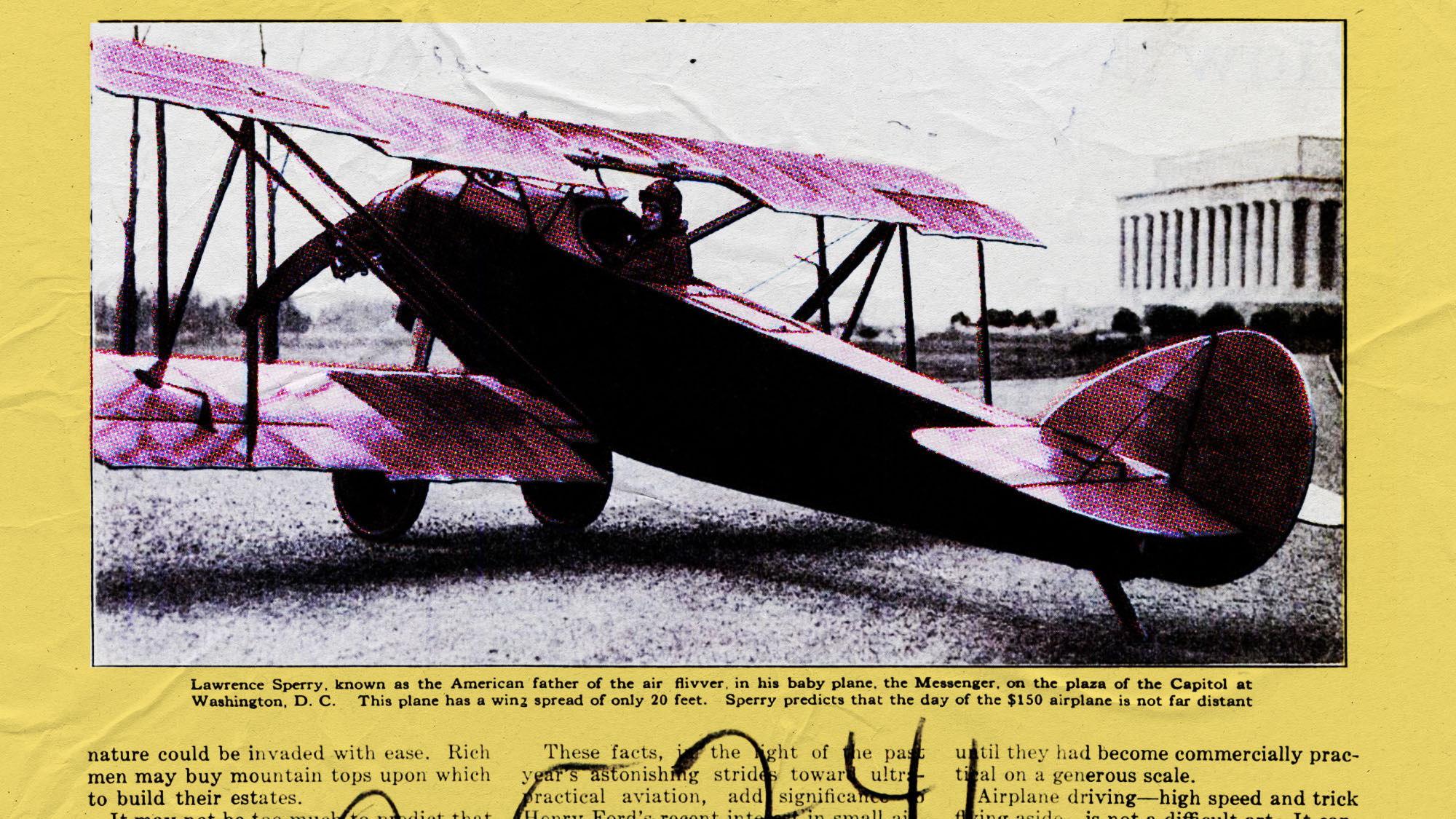
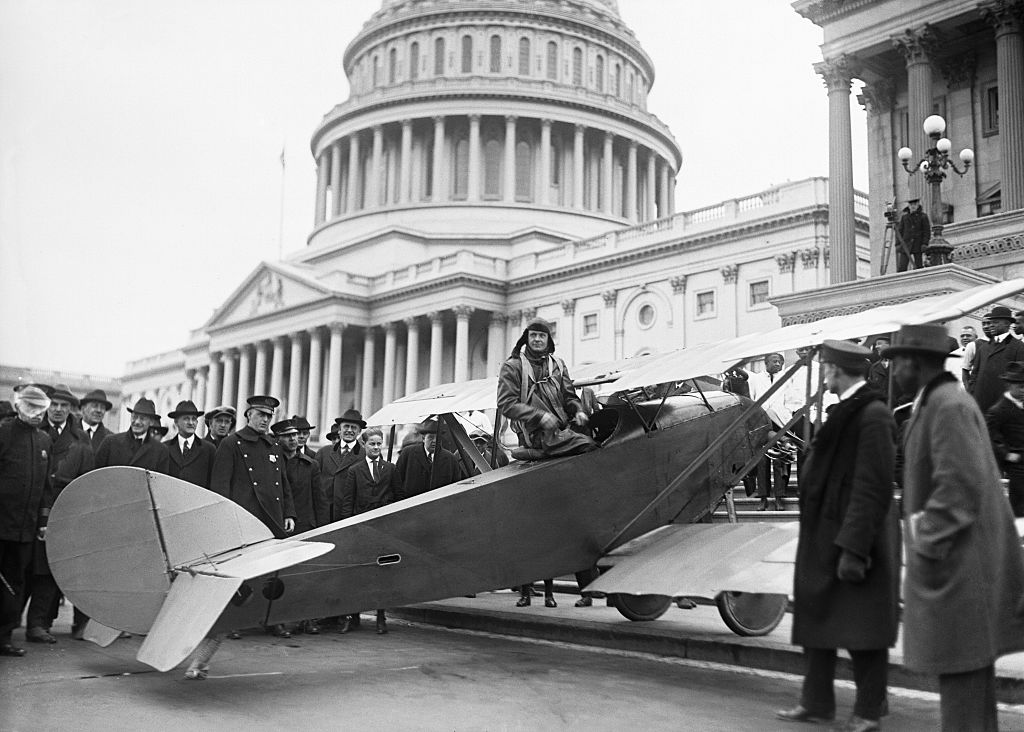
Later that year, on March 22, he brazenly landed his plane at the steps of the U.S. Capitol as part of a publicity stunt for his new low-cost plane, the Sperry Messenger, which Popular Science predicted might soon be as commonplace as an automobile.
From self-flying planes to pilotless drones
In 1916, driven by the needs of World War I, Sperry partnered with his father and with other inventors, such as Peter Hewitt, inventor of the mercury vapor lamp, and Charles Kettering, a prolific inventor with 186 patents ranging from an electric cash register to electric automobile starter, to build an aerial torpedo, or guided missile, leveraging Sperry’s automatic stabilizer. Together they built the Kettering Liberty Eagle, or “Bug,” a miniature aircraft with a torpedo-shaped body and small biplane wings, designed to deliver a bomb on a one-way trip. Sperry argued for landing gear so that the mini-plane could drop the bombs and return—just like a modern drone.
But with war raging the additional engineering complexity of a round trip would add time to the schedule that the team did not have. The “Bug” met with limited success, running up against radio-control and location-sensing obstacles that the technology of the day just could not solve in time to deliver pilotless missiles before the end of World War I.
Although military funding diminished after the war ended, commercial interest in remote-controlled aviation continued for applications such as aerial photography and crop dusting. In March 1925, Popular Science described the progress of “radiodynamics—or the science of remote control of motive mechanism by means of radio.” In other words, using radio signals to control a machine.
In a July 1925 feature titled “New Pilotless Planes Fly By Radio,” Popular Science shared how French engineers were developing radio-controlled aircraft that would deliver bombs and return to base, anticipating modern drone warfare by a century.
Sperry and others had shown that aircraft could stabilize themselves, respond to remote commands, and even follow simple programmed behaviors. But their autonomous machines lacked location information. Early radio-controlled aircraft had no reliable way of knowing where they were, how far they had traveled, or whether they were drifting off course. Radio signals could command movement, but the same signals could not confirm position.
That missing layer, today known as positioning systems, would take several decades to arrive. Even in 1956, when Popular Science described progress on a pilotless drone, the basic radio-control guidance mechanisms had changed little.
It wasn’t until satellite-based positioning systems became readily available in the 1990s that drones took a leap forward. Modern drones rely on GPS to provide constant, precise location data, allowing aircraft to follow routes, hold positions, and return home automatically. Onboard computers augment that positional information with motion sensors, altimeters, and machine vision.
Once GPS, automated sensing, and advanced communication converged, the pilot finally became optional in practice, not just in theory. Most aircraft today, from commercial planes to military drones, all trace their lineage back to Sperry. Sperry’s century-old autopilot technology still helps aircraft sense their own motion, correct themselves, and obey commands without constant human control.
A disaster in the fog
In December 1923, Lawrence Sperry took off alone in heavy fog over the English Channel, in conditions that would have unnerved even experienced pilots of the era. But Sperry was unusually comfortable flying blind. Beyond his automatic stabilizer, he had helped develop instruments designed specifically for low-visibility flight, including a gyroscopic event horizon indicator that told pilots which way was up when the real horizon disappeared. He trusted spinning metal as much as his own human senses.
Somewhere over the Channel, Sperry vanished. He was just 31 years old. The man who had spent his short career engineering aircraft to fly on their own was last seen doing exactly that—alone in the clouds, relying on the technology he believed could make flight safer, steadier, and someday, pilotless.
In A Century in Motion, Popular Science revisits fascinating transportation stories from our archives, from hybrid cars to moving sidewalks, and explores how these inventions are re-emerging today in surprising ways.
Related 'Century in Motion' Stories
