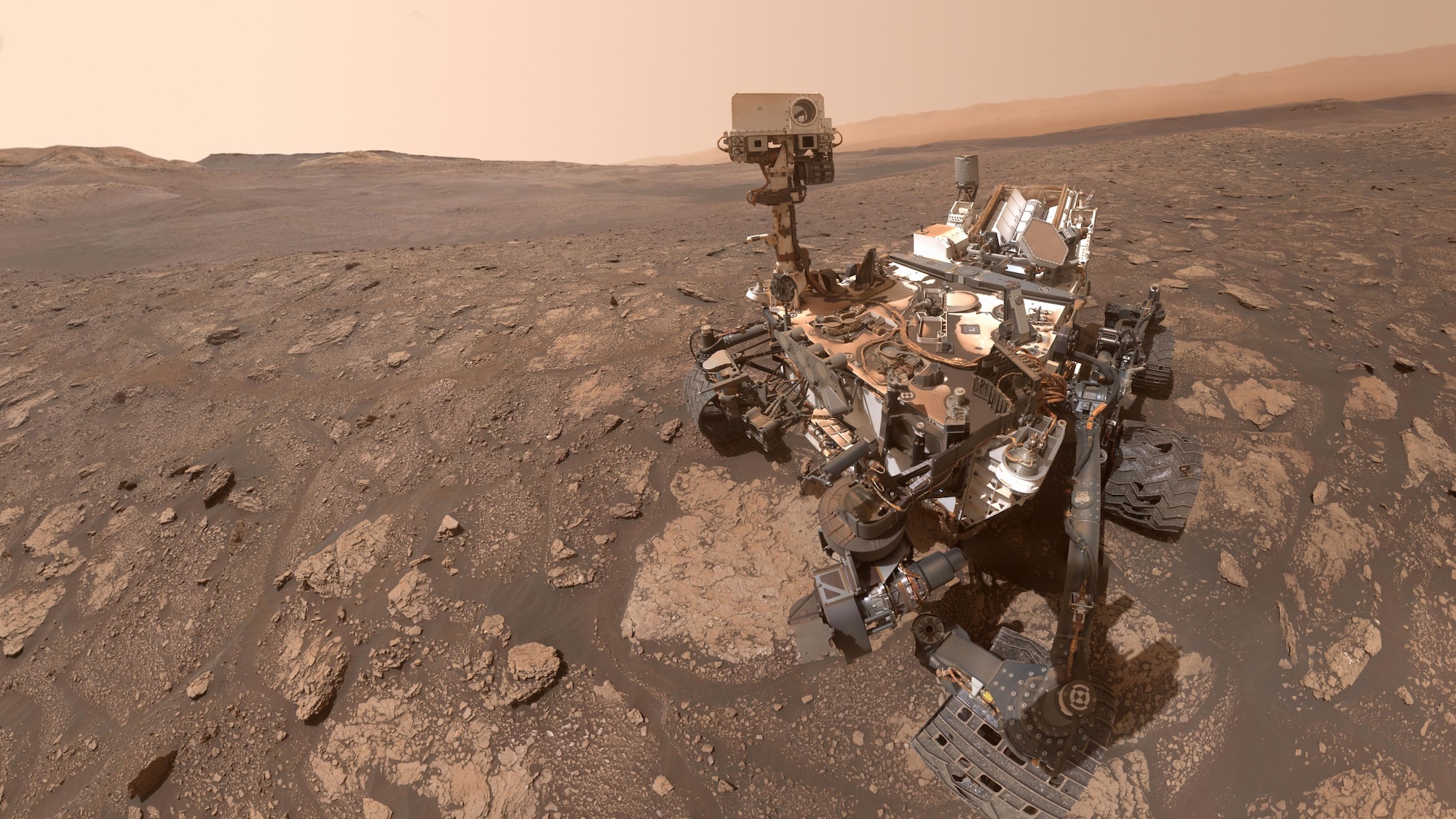
A first-of-its-kind chemical experiment on Mars indicates that our nearest planetary neighbor still preserves remnants of ancient organic molecules necessary for creating life. Although researchers still need to see this type of evidence firsthand, a team writing in the journal Nature Communications on April 21 says that the evidence marks a major moment in the search for extraterrestrial life in our solar system.
The data comes from NASA’s trusty Curiosity rover.Curiosity landed on Mars in 2012 and has been scouring the Red Planet’s surface for evidence of microbial life that possibly existed on the planet billions of years ago.
For this new study, astrobiologists remotely directed Curiosity’s instrument array called the Sample Analysis on Mars (SAM) to collect clay minerals inside the Gale crater in 2020. The team specifically focused on a region called Glen Torridon that has strong evidence that it once held water.
After breaking down the samples, the team identified over 20 notable chemicals, including the first instances of a nitrogen-containing molecule whose structure resembles proto-DNA. Curiosity also flagged benzothiophene, a sulphurous compound that often hitches a ride on meteorites.
“The same stuff that rained down on Mars from meteorites is what rained down on Earth, and it probably provided the building blocks for life as we know it on our planet,” said Curiosity geological scientist and study co-author Amy WIlliams.
According to Williams, researchers are now certain that large, complex organic molecules can remain preserved in the shallow subsurface layers of Mars. Without in-person examinations on the Red Planet, it remains unclear if these compounds came from past lifeforms, from a meteorite crashing into the planet, or through geological processes. While it is certainly not life itself, these compounds may help reveal organisms that existed on Mars billions of years ago.
“It’s really useful to have evidence that ancient organic matter is preserved, because that is a way to assess the habitability of an environment,” said Williams. “And if we want to search for evidence of life in the form of preserved organic carbon, this demonstrates it’s possible.”
Although Curiosity supplied the first sample analysis on another planet, it hopefully won’t be the last. Similar experiments are currently planned for both the Rosalind Franklin mission to Mars, as well as the Dragonfly excursion to Saturn’s moon, Titan.