For as long as humans have looked at the night sky, we’ve wondered what lies beyond Earth—and dreamed up ways of getting up there. These days, powerful rockets carrying tons of fuel are the tried-and-true method of escaping the planet’s gravitational pull and reaching space.
But what if, instead of modern rockets, we went medieval? Could a trebuchet or catapult—the massive siege weapons once used to fling stones at castles—launch a person into orbit? And if so, just how big would one have to be?
The answer requires a little imagination, a lot of physics, and a space-launching siege weapon of truly ridiculous proportions.
What is a catapult?
A catapult is essentially a giant lever used to hurl projectiles. Typically, they have a large, spoon-shaped throwing arm that’s wrenched back, creating tension, and then released, flinging an object over a great distance.
What is a trebuchet?
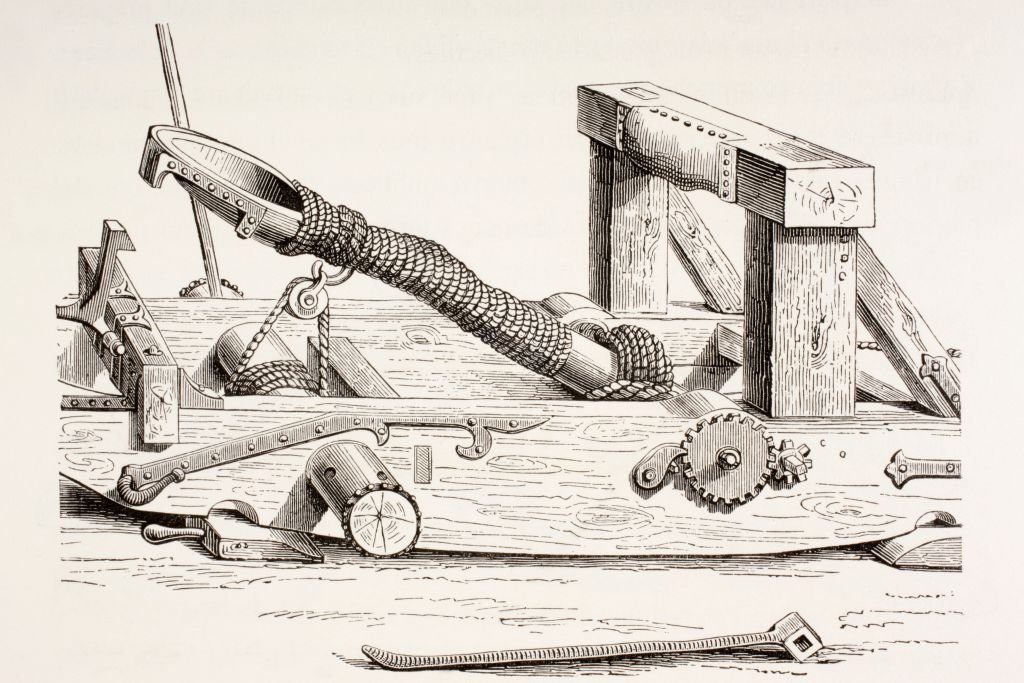
A trebuchet is a kind of catapult that uses a counterweight and gravity to launch projectiles. This machine’s long arm rests on a fulcrum, with a sling or cup for the projectile at one end and a heavy counterweight at the other.
When the arm is released, gravity pulls the counterweight downward, sending the opposite end—and its payload—soaring upward and forward.
Which is more powerful: a trebuchet or catapult?
Trebuchets are typically more powerful than catapults because they can launch heavier payloads over greater distances. So for our purposes, we’ll be focusing on a space trebuchet rather than a space catapult.
How old are trebuchets?
Trebuchets have been hurling heavy objects through the air for centuries. The structures are believed to have originated in China as early as the fifth century BC and eventually spread across Eurasia, becoming a formidable force in medieval warfare.
They arrived in Europe during the 12th century and quickly surpassed simple catapults.
Today, trebuchets are no longer used as weapons. But they remain popular as teaching tools for demonstrating physics principles—and for the decidedly more wholesome pursuit of seeing how far we can fling pumpkins, cabbages, and other projectiles.

Could a trebuchet send someone into orbit?
So let’s crunch the numbers: Could a massive trebuchet really blast a human into orbit? Theoretically, yes. Practically, no.
For help answering this question, Popular Science turned to Frankie Zhu, an assistant professor in space robotics at the Colorado School of Mines in Golden, Colorado. Zhu gamely agreed to do some back-of-the-napkin math to put some numbers to this wildly improbable scenario.
“It just reminds me of a classic physics problem you would encounter in undergrad,” she says.
Before we can get to the heart of the calculations, Zhu says, we need to define some initial parameters. First, because the energy required to send a human into orbit depends on both mass and velocity, we need to know our imaginary astronaut’s mass. Zhu recommends 70 kilograms, or about 154 pounds.
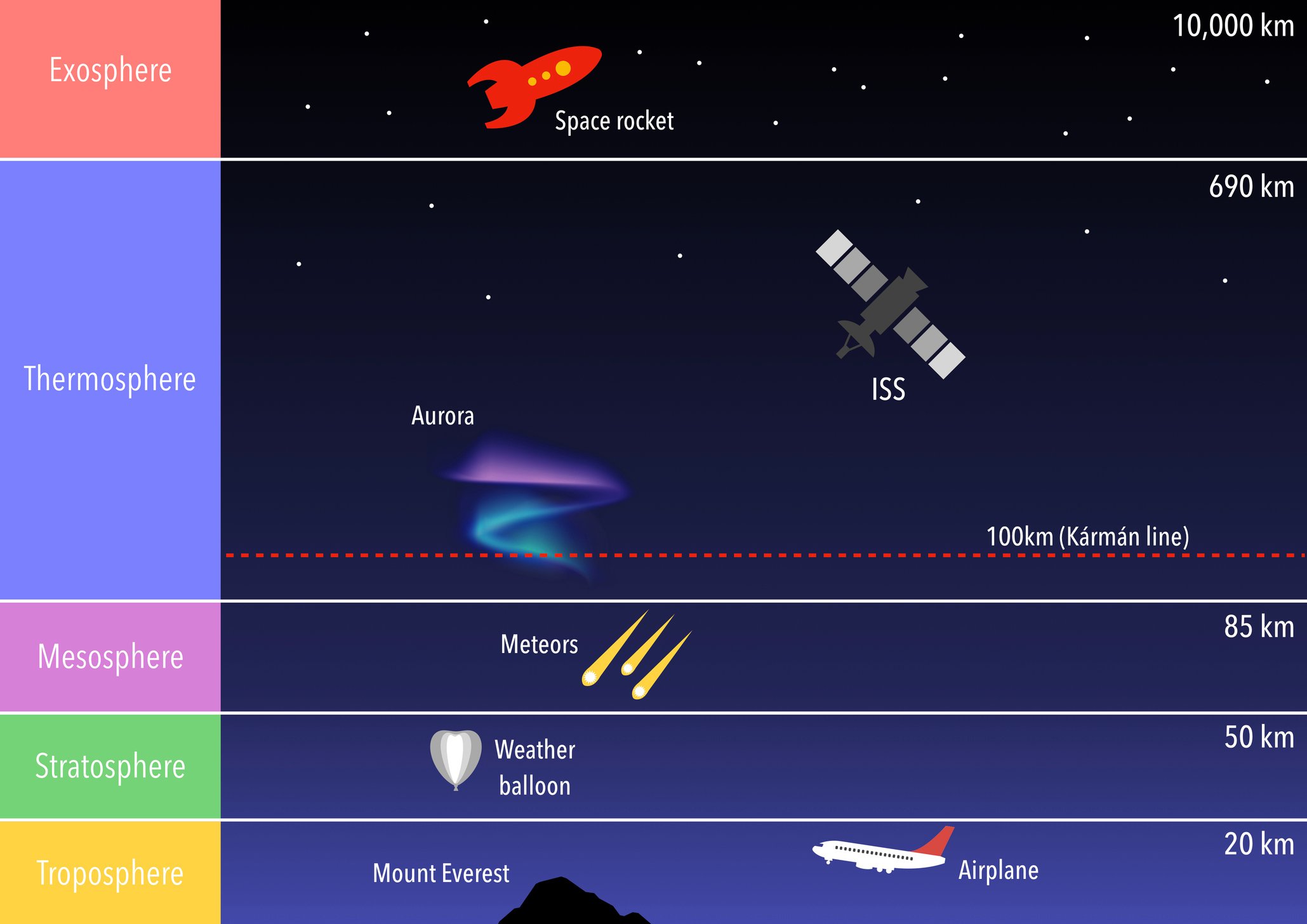
Next, we need to define where space—and, for our purposes, orbit—begins. The conventional boundary is the Kármán line, an imaginary line 100 kilometers (about 62 miles) above sea level that is widely used to mark the edge of space. It’s the point at which Earth’s atmosphere becomes too thin for conventional aircraft to generate enough lift to stay aloft. “An orbit at 100 kilometers would be the lowest energy orbit possible,” she says.
To orbit Earth at the Kármán line—and not plummet back to the ground—a person needs to travel at approximately 7.85 kilometers per second, or 17,500 miles per hour, the same speed the International Space Station travels while orbiting Earth. “Any less and the human would fly up and then come back down in a parabolic trajectory,” she says.
If we assume that the atmosphere doesn’t produce drag on the human as they fly, then the velocity of the person leaving the trebuchet immediately after launch needs to be at least 7.97 kilometers per second, or 17,828 miles per hour. That extra bit of speed accounts for the energy needed to climb from Earth’s surface to the Kármán line.
To launch a human at that velocity, the trebuchet would need to store a massive amount of potential energy—about 2.22 billion joules, by Zhu’s calculations, similar to about 1,200 pounds of TNT. Zhu notes that she’s assuming 100 percent mechanical efficiency, meaning that none of the trebuchet’s stored energy is lost to friction, air resistance, sound, deformation, or the movement of the machine itself.
From here, we can move on to the design of the trebuchet. Based on Zhu’s math, the trebuchet would need a 5,000-ton counterweight—the equivalent of roughly 950 African bush elephants—which would need to drop at least 45.2 meters, or roughly 148 feet.
To turn the relatively slow movement of the massive counterweight into a hypersonic launch speed, the trebuchet would need an extreme mechanical leverage ratio of 379:1, she says. With these figures in mind, the trebuchet’s long throwing arm—the part with the human at the end of it—would need to be about 17.14 kilometers, or 10.7 miles, long.
“That should give you all the physical parameters of the trebuchet, ignoring some physics and human welfare,” she jokes.
Would a human survive the launch?
How exactly would a human fare under these conditions? Fighter jet pilots can survive up to nine Gs using specialized G-suits, physical straining techniques, and intense centrifuge training. But, Zhu says, the “amount of Gs that the trebuchet is going to reach is…definitely past nine Gs. This human is not going to be alive when they make it to orbit.”
Another hurdle? Building the trebuchet. “To design a structure that can handle that amount of mass—the 5,000-ton counterweight—to support that mass and then to make something that large… that would be a humanity feat and a structural feat,” she says.
Related 'Ask Us Anything' Stories
How much trash is on the moon? About 412,000 pounds.
Could you give birth in space?
Why can’t we just launch all of Earth’s garbage into the sun?
What happens to your body when you die in space?
Is turbulence really like Jell-O? Pilots weigh in.
Why do we put seatbacks up for landing? An aviation expert explains.
A more human-friendly option, she says, might be a railgun, which uses electromagnetic forces to accelerate a projectile along a pair of conductive rails at extremely high speeds. To launch a person into orbit, a railgun would also need to be “really, really long,” she says. But because the human projectile could accelerate over a much greater distance and for a longer period of time, a railgun would theoretically offer a smoother acceleration profile—one that’s more amenable to human survival.
“Whereas [with] a trebuchet, the acceleration is going to be impulsive,” she says. “It’s going to be a huge smack at the very beginning if the structure doesn’t flex, if the structure is rigid.”
Beyond the rocket
Rockets have been the standard for launching things into space since 1944, when Germany’s V-2 became the first human-made object to cross the Kármán line. But that doesn’t necessarily mean they’re the most efficient way to get there.
Rockets require enormous amounts of fuel, and all of that propellant has to be carried onboard. In other words, a rocket has to spend fuel lifting not just its payload, but also the fuel it needs to keep accelerating. This makes getting off Earth an inherently energy-intensive—and expensive—proposition.
With that in mind, engineers continue to explore other ways of getting into space, ideally using less fuel and resources. So far, though, most of their ideas haven’t made it off the drawing board—and, after crunching the numbers, Zhu says it’s highly unlikely that trebuchets will ever replace rockets.
“A lot of ideas are fantastical, some are possible, and an even smaller set are economical,” says Zhu.
In Ask Us Anything, Popular Science answers your most outlandish, mind-burning questions, from the everyday things you’ve always wondered to the bizarre things you never thought to ask. Have something you’ve always wanted to know? Ask us.