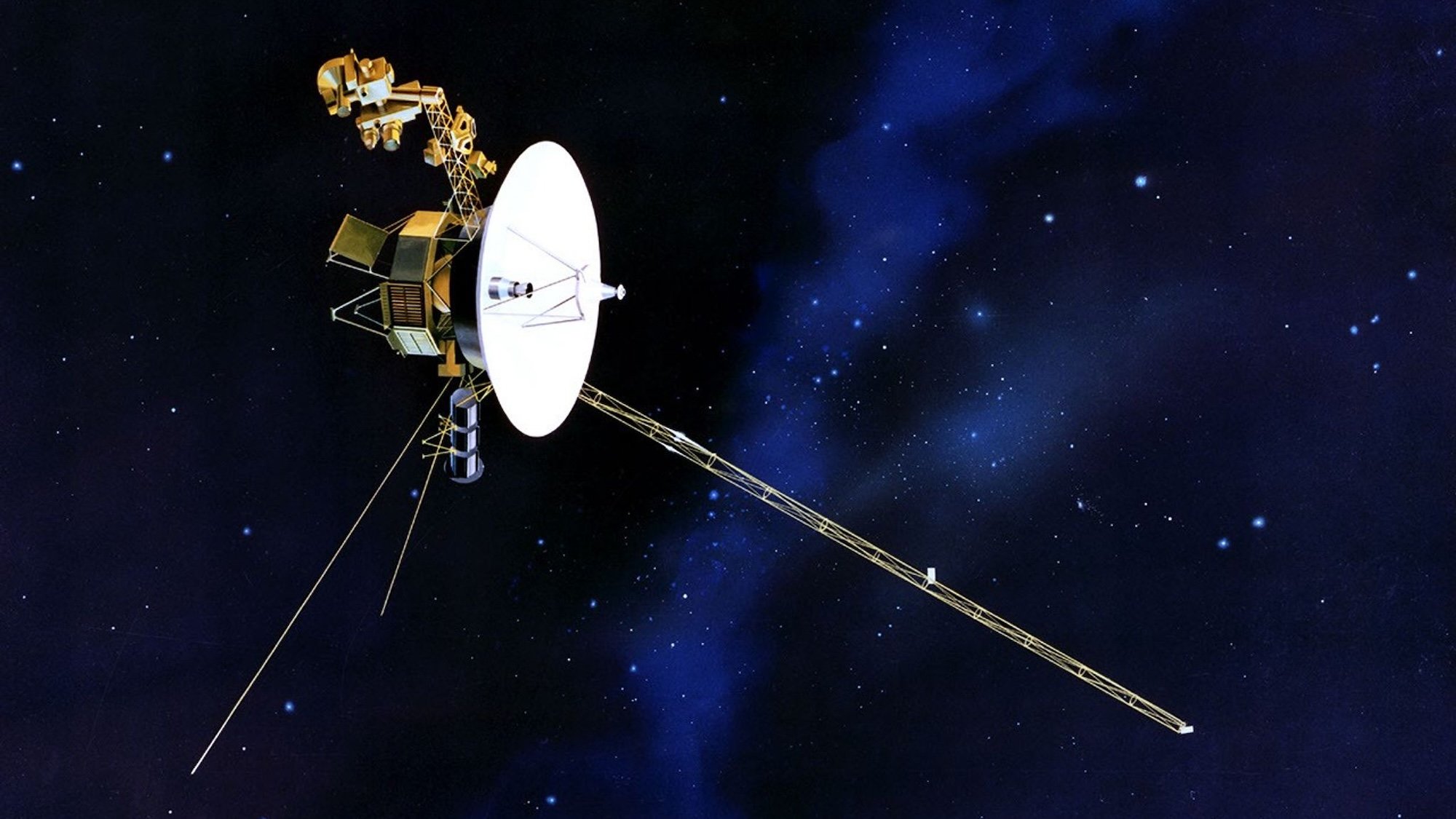
Voyager 2 recently experienced its own “Big Bang” moment, allowing NASA scientists to squeeze a bit more life out of the intrepid space probe. Nicknamed after the universe’s origin story, the process involved powering off selected devices aboard the cosmic traveler, while simultaneously swapping them with less resource-hungry alternatives. At the same time, mission specialists needed to make sure Voyager 2 stayed warm enough to avoid entering a permanent freeze.
Both Voyager 1 and 2 have spent almost 49 years soaring through space. In the process, they’ve traveled further than any other human-made objects have ever gone before. Initially intended to provide never-before-glimpses of the outer planets, they have surprised researchers by continuing to send back remarkable data while sailing further into the unknown.
The Voyagers each draw power from three radioisotope thermoelectric generators, (RTGs) that use decaying plutonium-238 as fuel. These RTGs supplied about 470 W of energy at 30 volts at the mission’s outset in 1977. Because plutonium has an 87.74-year half-life, this means the spacecraft annually lose around four watts of their power. At this point in their journey, Voyager 1 and 2 are running on about two-thirds their original reserves.
NASA began strategically shuttering nonessential equipment in 2024, including Voyager 2’s plasma science instrument. The technology measured solar winds and planetary magnetospheres, making it largely irrelevant since the probe exited the solar system in 2018. Three instruments are still operational aboard Voyager 2—its magnetometer, plasma wave subsystem, and cosmic ray subsystem.
With the successful implementation of NASA’s “Big Bang” hack, Voyager 2 will save enough power to add another year of life to its remaining trio of programs. Given that Voyager 1 is farther away, engineers will next attempt a similar energy swap in the near future. If all goes as planned, it’s possible that at least one instrument aboard one or both of the historic explorers can continue communicating with humanity into the 2030s.
If nothing else, Voyager 2’s sibling is on track to pass a momentous milestone later this year. On November 18, 2026, Voyager 1 will officially have traveled 16,094,799,096 miles—or one light-day—from Earth. It’s a record distance that many of the spacecraft’s designers never imagined possible, and one that likely won’t be surpassed anytime soon.