We may earn revenue from the products available on this page and participate in affiliate programs. Learn more ›
Meze Audio has gotten really good at making gear that looks expensive, feels considered, and, most importantly, sounds inviting rather than insistent. Since breaking through a decade ago with the $349 99 Classics headphones, now in their second generation, the Romanian audio brand has shown a consistent instinct for crafting products that build connection rather than merely make an impression. In 2024, Meze introduced the ALBA, a value-driven $159 in-ear that made another strong case for “audiophile gateway drug” status. The new ASTRU is aimed at listeners ready to move up to something more tuned and tactile: a $899 single-dynamic-driver IEM that keeps the inviting musicality, adds refined machining, and enhances the technicalities for a more grown-up sense of control.
The build
ASTRU’s appeal starts with restraint, of a sort. While plenty of flagship IEMs go busy with hybrid driver arrays and spec-sheet theater, those can bring crossovers and phase challenges. So Meze has gone with one custom 10mm dynamic driver in the ASTRU. That doesn’t mean the engineers didn’t get a bit indulgent, bonding 80 ultra-thin gold layers to a titanium dome on a PEEK base. It sounds lavish, but it’s not ornamental; it’s engineering poured directly into how the driver behaves. The goal is stiffness for speed without splash, bass without bloom, expression unified across the audible range (though the ASTRU extends to 5Hz – 35kHz).
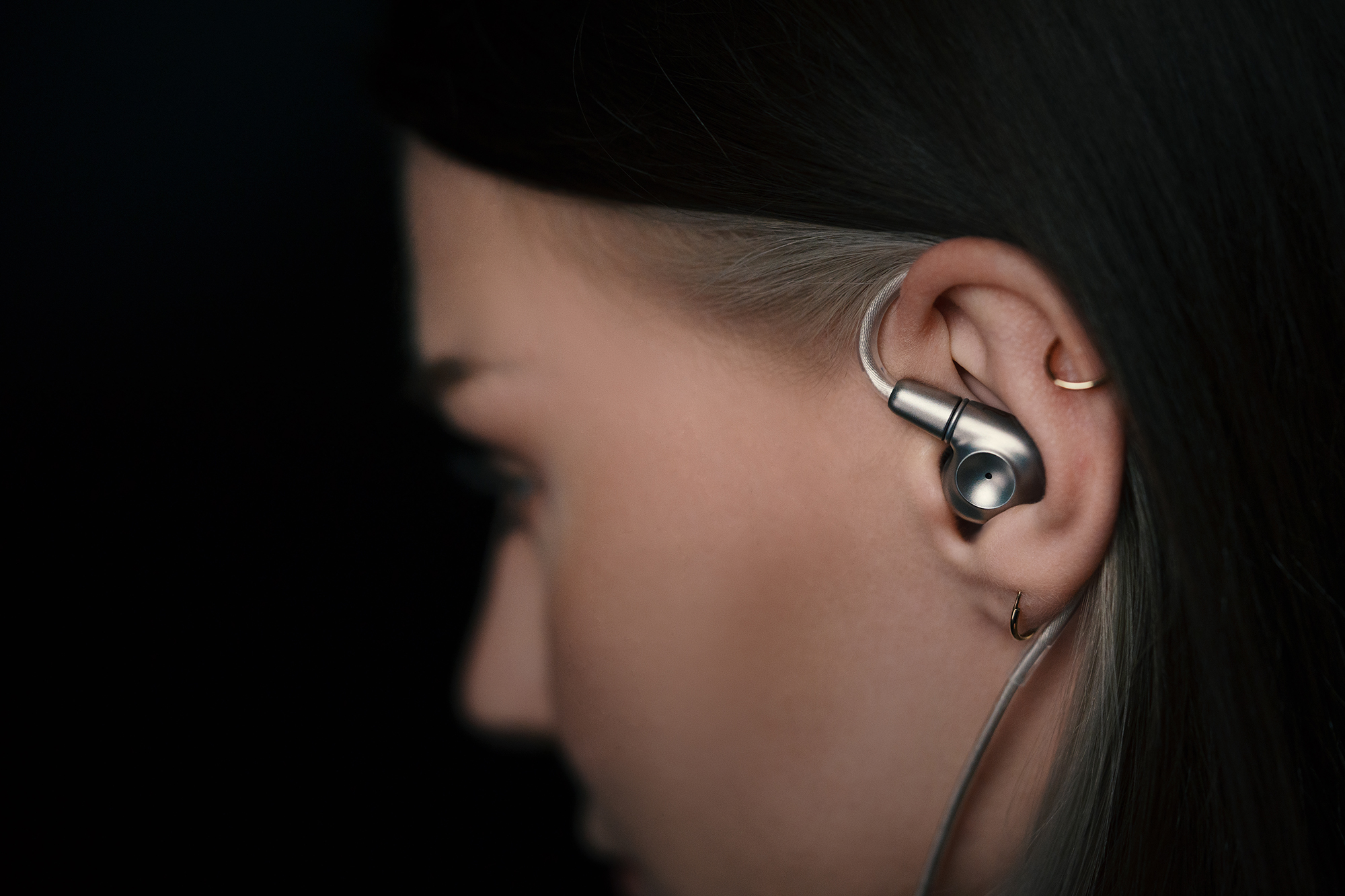
The housing helps deliver that sense of balance. The ASTRU’s compact biomorphic shell is CNC-machined from a solid block of titanium, then finished to a soft satin sheen through a multilayer electroplating process. Each pair takes up to seven days to finish, and the result feels and looks cool in the hand. More importantly, each 13.4g acoustic pathway disappears into the ear. The strategy is a disappearing act that feels less like an object hanging around your ears and more like a sealed little listening chamber tucked inside them. With no flat surfaces or sharp edges, there is less opportunity for reflections and internal standing waves. With an adroitly contoured shape, there is less opportunity to be distracted from the music.
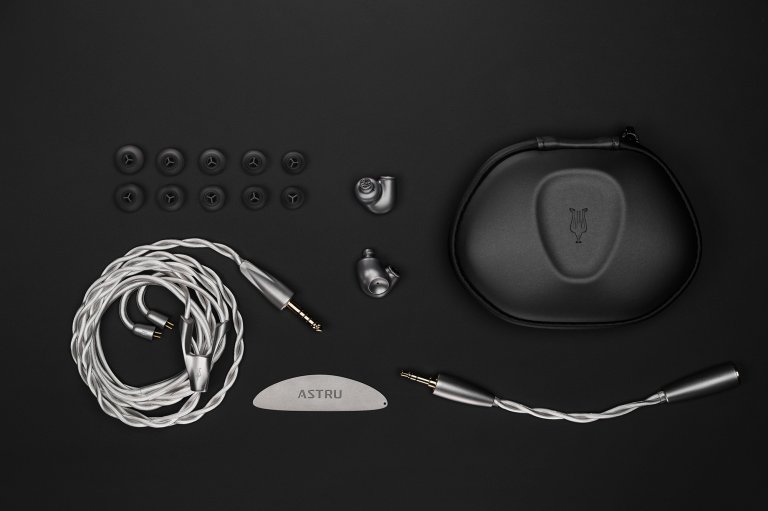
Beyond the smooth, asymmetrical shape, the seamless ASTRU has less in common with the ALBA’s zinc alloy build and more to do with the $1,499.99 Sennheiser IE 900’s precision-milled chamber. A 2-pin silver-plated LC-OFC copper balanced 4.4mm cable (with 3.5mm adapter), PU leather envelope, hard protective pouch, and five sizes of liquid silicone ear tips round out the package.


The sound
And the sound? Very Meze. And what that means is sumptuous, with a natural timbre and innate coherence.
If ALBA was a welcoming handshake, ASTRU offers a firmer grip. It preserves a rich house sound while turning up a finely etched treble. Compared to the ALBA’s gently sloped U-shaped tuning, the ASTRU is more of a supple W. Bass, from well-textured midbass to punchy sub bass, has realistic density. It’s undeniably warm but it doesn’t smear. Midrange, meanwhile, is the money zone. Vocals come through fleshy and dynamic; you can hear the weight and wood of instruments; overall, composure is excellent. Well-executed single-driver sets just deliver when the membrane is light on its feet but controlled under pressure. Nothing feels stitched together because nothing is.
The ASTRU may feel lightly laid back on first listen, compared to the microscopic detail and forensic edge some peers chase. But treble is there, it’s just in focus rather than the focus. The tailored resonance allows for transient extension with air and transparency without turning brittle. Meze knows what sounds good in its warm-neutral accent and doesn’t attempt to copy other brands’ pronunciation. Still, certain materials bring with them certain characteristics, so treble-sensitive listeners may perceive the occasional flash of upper-register tizz from the titanium. But even when leading edges get lively, they never feel fatiguing. The overall tuning remains physical but tastefully dialed in.
The sure-footed stereo field especially flatters atmospheric post-rock, synth-swept sound design, jazz with real room tone, singer-songwriters (really anything vocal-led), and even melodic metal with forgiving masters that build from a slow burn to a surge. A reverberant soundstage plays to immersion over inspection. Imaging isn’t reaching for some grand wraparound illusion, but the presentation is confident and never starving music of its momentum. Comparable to the depth, but not the width, of a full-sized headphone, the ASTRU is persuasive through dynamic swings. And while, at 32-ohm impedance and 111 dB sensitivity, the ASTRU can play off any source, it really needs the power and volume of a DAP or DAC dongle to achieve its most vivid, authoritative expression.


The conclusion
The ASTRU is an articulate, compelling step up from the ALBA, especially for listeners who already know and like Meze’s tonal good manners but crave more texture. It’s a more mature presentation that draws you deeper rather than pushing harder. Of course, it’s $899, which is $749 more than that model. At the same time, it’s competing (favorably) with the Sennheiser IE 900, which is $600 more than the ASTRU, more expansive, but not as resolving in the mids as Meze’s set. Similarly, the $899 Sennheiser IE 600 navigates similar territory but it plays a bit more fast and loose with tonality. There are some hybrid sets in the $400 – $500 range with somewhat similar sonic personalities, but they don’t offer the elevated build, ergonomic fit, and lucid presentation.
Both the ASTRU’s beautifully hewn shells and its resounding voicing are eminently livable. These IEMs are comfortable enough to vanish, refined enough to engage. While not the most clinical or cavernous in imaging, the ASTRU is a lovely, low-profile IEM for audiophiles who want clarity with character and put a high value on elegant materials. Whether commuting with a proper source or deskbound and ready to reach even higher up the reference-meets-romantic scale, ASTRU offers purposeful detailing that seduces rather than coerces.