Bald eagle Jackie ‘more feisty’ during feedings, still in critical condition

Injured internet-famous bald eagle 26-519 (aka Jackie) remains in stable, but critical condition. According to the Ojai Raptor Center’s most recent update, she is receiving round-the-clock treatment and the team is working to pinpoint the underlying cause of her illness.  

After the team saw some improvement following a blood transfusion, she experienced a setback on July 25, when her blood values declined. 

“Since then, she has improved once more. She is eating on her own, her energy and alertness have noticeably improved, and she has become much more feisty during feedings,” the center writes

One encouraging sign is her packed cell volume (PCV), which measures the percentage of red blood cells in the bloodstream.Jackie’s PCV has increased from 8 percent before July 25 to 16 percent on July 27. These numbers are still below normal, but the center calls them an “encouraging” improvement. 

“Despite extensive diagnostic testing and consultation with experienced wildlife veterinarians, we still do not have a definitive diagnosis,” the center explains. “Cases like this can be incredibly complex, and we will continue adjusting her treatment as new information becomes available.”

Back in Big Bear Valley, nonprofit Friends of Big Bear Valley (FOBBV) is also monitoring a sub-adult eagle that likely battled with Jackie. The young eagle has been spotted near Jackie and her partner Shadow’s habitat near Big Bear Lake.

According to Dr. Peter Sharpe, the conservationist and bald eagle expert FOBBV spoke with, the male eagle is about 3.5 years old. Typically, bald eagles reach full maturity at age five. In some rare cases, they can be ready to mate and lay eggs by age four. Sharpe believes it is still too early for this sub adult eagle to be looking for a mate and/or a place to nest. 

Shadow also showed defensive behavior against the sub-adult for several days while this year’s eaglets, Sandy and Luna, were at the nest. However, even though Sandy and Luna’s vocals have possibly been heard in the area, they have not been on camera since July 23. With so many other young eagles congregating in the area, the vocals may or may not be Jackie and Shadow’s offspring. 

“If Sandy and Luna have indeed left on their life’s journey, their timing is completely normal. At the Big Bear nest, previous eaglets have generally dispersed at around four weeks after fledging,” FOBBV writes. “It is not confirmed [that] Sandy and Luna have left the area, we can only observe and time will tell.”

This is a developing story and we will continue to provide updates. In the meantime, viewers can monitor FOBBV’s livestream.


Jackie and Shadow’s 2026 babies: Everything you need to know

It’s been another roller coaster nesting season for Jackie and Shadow, a pair of internet-famous bald eagle parents living in San Bernardino National Forest in Southern California. After two of their eggs were destroyed by ravens in January, Jackie and Shadow laid two new eggs that have successfully hatched.

Chick 1 hatched on April 4 at 9:33 p.m. PDT, while Chick 2 followed on April 5 at 8:30 a.m. Their large nest in Big Bear Valley east of Los Angeles is livestreamed 24 hours a day by nonprofit Friends of Big Bear Valley (FOBBV) and has captivated millions. 

On May 1, FOBBV announced the chicks’ names: Sandy and Luna.

How long will the chicks stay in the nest? 

Chicks usually stay in the nest until 10 to 14 weeks of age.

What challenges do the eaglets face?

Before leaving the nest, the chicks face threats from other birds of prey, including hawks, ravens, other eagles, and owls. Inclement weather can also present challenges for the chicks. In 2025, a March snowstorm resulted in the death of one of Jackie and Shadow’s three chicks.

During fledging, only 70 percent of eaglets survive. One of the greatest threats is from cars that can injure or kill the birds while they scavenge for food on roadkill. 

Who are Jackie and Shadow? 

The pair first got together in 2018 and successfully raised chicks in 2019 and 2022. However, their eggs failed to hatch in 2023 and 2024. Only 50 percent of eagle eggs successfully hatch, so this pair has already beaten the odds.

What happened to Jackie and Shadow’s 2025 eaglets?

In 2025, Jackie laid three eggs that all hatched in early March. On March 13, a strong snowstorm dumped up to two feet of snow and battered the nest with strong winds. Only two of the chicks were visible on the live cam when the storm passed by the next morning. FOBBV later confirmed the passing of one of the chicks. The two surviving chicks were later named Sunny and Gizmo after 54,000 names were submitted by fans.

What happens after chicks fledge? 

Young eagles usually fledge–or leave the nest and fly–when they can flatten their wings and have feathers capable of flight. This typically occurs when the birds hit 10 to 14 weeks of age. Males also tend to take their first flight a little sooner than females. 

According to FOBBV, fledglings from Southern California have been spotted as far south as Baja California, as far north as British Columbia, and as far east as Yellowstone National Park.

About 70 percent of bald eagles survive the fledgling stage. FOBBV does not tag their eagles, so it’s not possible to follow the chicks’ journeys after they flee the nest.

How can I help Jackie and Shadow?

FOBBV accepts donations to support its conservation efforts in the area. The organization recently reached a goal of raising $10 million to purchase land around Big Bear Lake in the San Bernardino Mountains. A $5.5 million donation from Anna and Greg Brockman pushed the fundraiser to its goal ahead of a deadline. Greg Brockman is the co-founder and President of OpenAI, the company behind ChatGPT. Before the Brockmans’ donation, more than 25,000 donations had raised almost half of the necessary funds.

You can help the rescue organization nursing Jackie back to health by donating to Ojai Raptor Center’s Bald Eagle Recovery Campaign.

Disclosure: Ziff Davis, Popular Science’s parent company, filed a lawsuit against OpenAI in April 2025, alleging it infringed Ziff Davis copyrights in training and operating its AI systems.
Ancient Egyptian god of magic is sometimes a bird, sometimes a baboon. Now we know why.

Why do ancient deities appear as certain animals? In the case of an ancient Egyptian god named Thoth, the relation to its animal might be related to moonlight. Thoth was a god of magic, writing, wisdom, and the moon, and frequently appears either as a baboon or with the head of a large bird called an ibis. But we don’t really know why. 

Recent work has tracked the roots of Thoth’s Egyptian name back to “bright/white thing” in North African linguistic terms and made associations with the bright white feathers of African sacred ibises, several of which have been found mummified in several ancient Egyptian burials. Furthering this line of research, a team of scientists has now investigated the colors of both animals and found that they both reflect light very similar to moonlight. 

“We examined the two species of baboon accessible to ancient Egyptians, P. anubis [Papio Anubis] and P. hamadryas [Papio hamadryas], along with T. aethiopicus [Threskiornis aethiopicus], and found that the grizzled hair of P. hamadryas and plumage of T. aethiopicus have spectral profiles indistinguishable from moonlight,” the authors wrote in a study recently published in the journal Time and Mind

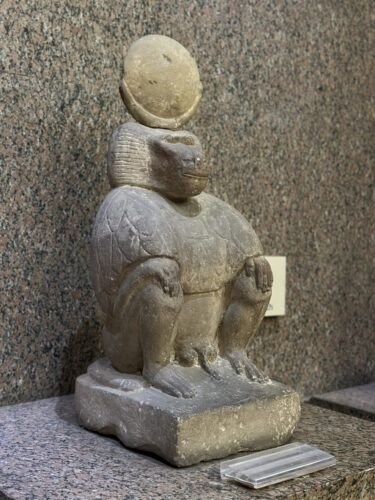
a statue of an ancient egyptian god depicted as a baboon
A statue of the god Thoth depicted as a baboon. Image: Catherine Hobaiter.

The team measured the light wave frequencies reflected from the animals using an approach called spectroscopy. With this technique, researchers can avoid depending on subjective color perceptions. They ultimately found that the colors reflected by both hamadryas baboons and sacred ibises are just like moonlight, adding credence to the theory that these animals were made godly because of it. 

“Why would two such different animals be used to represent one deity? Most other Egyptian deities are represented by just one type of animal. Ancient Egyptians were familiar with at least three species of ibis, but they chose the white one for embodying Thoth. They were also familiar with two species of baboon, along with vervet monkeys and patas monkeys, but again they chose the silver-white species,” Catherine Hobaiter, a primatologist at the University of St Andrews and lead author of the study, said in a statement. “So, sacred ibises and hamadryas baboons are different in many ways, but one thing that unites them is their moon-like colour.” 

Many African cultures today dislike baboons, according to the statement, mostly because these primates destroy crops. Ancient Egyptians, however, went as far as to deify them, perhaps because they are moonlight-colored. 

Toothy human ancestor may have traveled in all-male packs

A set of 1.4 million year old footprints indicate that one of our extinct evolutionary ancestors was both larger and more social than we thought. The footprints belonging to a long-deceased hominin called Paranthropus boisei were found preserved on a lakeshore in northern Kenya and, are described in a study published today in the Proceedings of the National Academy of Sciences.

Neanderthals (Homo neanderthalensis) and Homo erectus are some of the most well-known archaic humans, but they are far from the only examples. Dozens of other hominins are documented around the world, including more obscure variants like strong-jawed Paranthropus boisei. Much of the anatomical information about P. boisei has been gleaned from a handful of skulls and teeth, leaving vague details about overall size and physiology. Once thought less-developed than other members in the family tree, researchers now understand that P. boisei was likely advanced enough to wield tools with a gorilla-strength grip.

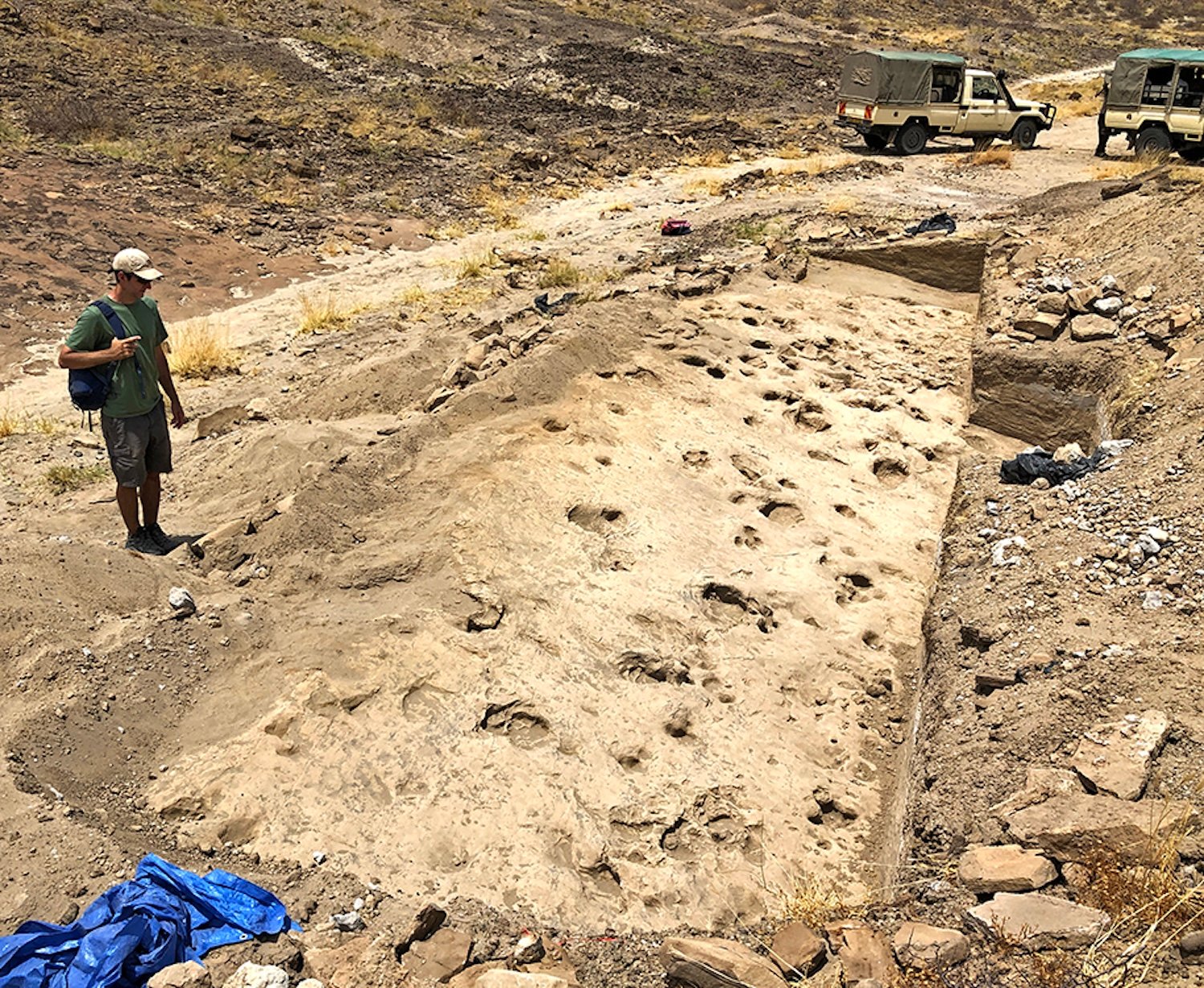
Overview of the excavated track surface with a mix of deeper hippopotamus and antelope
footprints and shallower hominin tracks visible
Overview of the excavated track surface with a mix of deeper hippopotamus and antelope footprints and shallower hominin tracks visible. Credit: Kay Behrensmeyer / Smithsonian

Some of the most invaluable knowledge about P. boisei comes not from body parts, but the imprints they left behind. In 1978, a team led by Smithsonian National Museum of Natural History paleontologist Kay Behrensmeyer discovered preserved P. boisei footprints along Lake Turkana in northern Kenya. Behrensmeyer returned multiple times over the years to the site known as GaJi10, uncovering more tracks from P. boisei, as well as ancient antelope, hippopotamuses, and other large animals. In total, researchers inventoried 21 footprints left by eight hominin individuals dating back to the Early Pleistocene about 1.43 million years ago. Meanwhile, a separate nearby pathway yielded tracks from both P. boisei and H. erectus, proving that the two hominin species shared the same habitat for hundreds of thousands of years.

“We can’t say how the two different hominins interacted on the mudflats, but we know they were both here at this time,” Behrensmeyer said in a statement.

Experts long believed P. boisei to be stockier than relatives like H. erectus, but these footprints tell a different story. Based on gait patterns and anatomical measurements, it now seems P. boisei was relatively the same size as its fellow hominin.

“The sizes of the footprints indicate human-like body sizes—up to 6 feet tall and around 165 pounds,” explained Kevin Hatala, an evolutionary anthropologist at Chatham University in Pennsylvania and a study co-author.

The imprints’ distribution and dating also suggest the archaic humans sometimes traveled in groups. In one instance at GaJi10, eight mostly adult male P. boisei walked together near Lake Turkana without children or females. This implies a much more complex social structure—one with males that frequently competed for mates, but also collaborated in times of need.

“The special thing about footprints scientifically is that they preserve an instant in time,” said Behrensmeyer. “They also allow people to relate to these fossils much more easily than an isolated piece of bone or jaw.”

Information isn’t sterile. It’s stranger than you think.

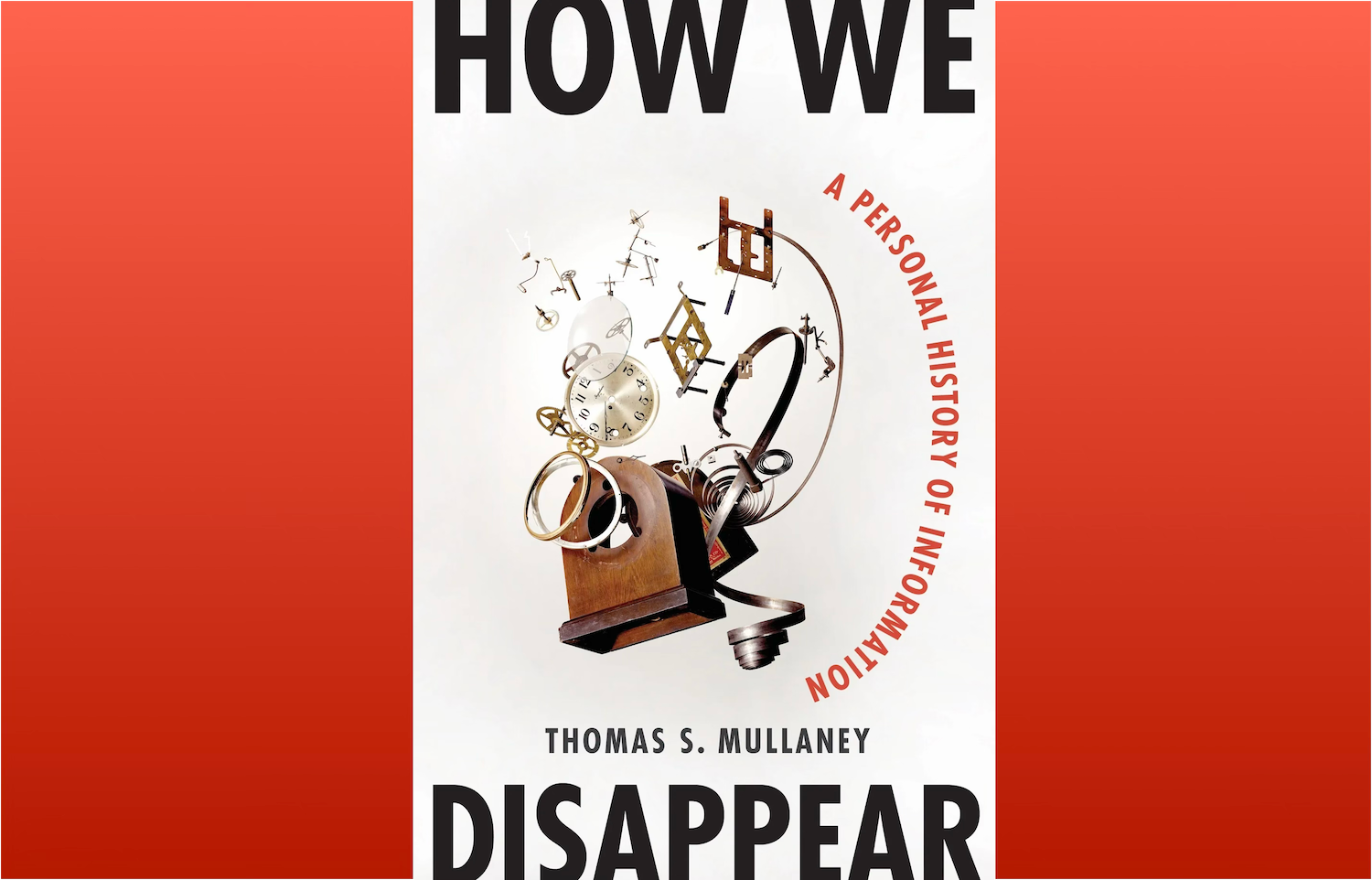
Excerpted from How We Disappear: A Personal History of Information by Thomas S. Mullaney with permission of W. W. Norton & Company, Inc. All rights reserved. Copyright © 2026 by Thomas S. Mullaney.


What is information?

It’s a word we’ve become inured to—and unimaginative about. “How much information,” we ask, “can this hard drive store?” Or “The average person has more information at her fingertips than ever before,” we remark. Information, it would seem, is some kind of ethereal fluid, quantifiable like water or gasoline.

Narrower still is our use of the term information technology. This phrase summons to mind devices and machines: laptops, flatscreen TVs, QR codes, ChatGPT. Sleek things. For history lovers, perhaps our picture expands to include the book, telegraphy, braille, radio, and other IT systems from the pre-computing era. Either way, an information technology is some kind of object, tool, or machine, and information is the liquid-like stuff it channels, stores, retrieves, or produces.

This clinical understanding of information derives in large part from the work of Claude Shannon, the brilliant mathematician often called the father of the modern information age. In The Mathematical Theory of Communication, his groundbreaking 1948 work, Shannon defined information with breathtaking precision and elegance. Information was something transmitted: a message sent from a source to a destination over a channel. Full stop. Shannon’s information was indifferent to semantic meaning—it could be anything from a string of random digits to a love letter. The core question pertained to “the reliable transmission of messages through noisy communication channels.”

Shannon is perhaps best known for introducing the concept of entropy into information science, transplanting it from physics as a way of quantifying information. Specifically, Shannon’s goal was to quantify the uncertainty of any given message. He asked: how many binary, yes-or-no questions would it take to determine the contents of a given message, with each symbol in that message being represented by a coin flip? The more unpredictable a message, the more guesses it required, and thus the costlier it was from the standpoint of a communications system.

How We Disappear book cover on orange background
How We Disappear is available now. Credit: W. W. Norton & Company, Inc.

Consider two five-character sequences, the first being random, and the second being a common English word: “XQZJP” and “LIGHT.” Now imagine trying to deduce the content of these messages through a series of fifty-fifty brute-force guesses. Since the first sequence is a random assortment of letters, each character has an equal chance of being any of twenty-six letters in the English alphabet. With a binary, coin-flip question splitting the total number of possibilities by half each time, it would take an average of 4.7 coin flips to figure out each individual letter—or an average of 23.5 to figure out the entire message. For Shannon, “XQZJP” is high entropy because it’s high in uncertainty.

As devotees of daily Wordle puzzles know well, however, the word light is not random. It obeys certain kinds of statistical irregularities of the English language. When the letter l is found at the beginning of a word, for example, it is far more likely for the next letter to be an i. rather than a b or an x. On account of the relative predictability of English, it takes on average only 1.5 coin flips to determine any given symbol, or just 7.5 yes/no questions to figure out the word “LIGHT”—far fewer than the 23.5 required for the random string. “LIGHT” is low entropy, because it’s low in uncertainty.

It’s impossible to exaggerate Shannon’s impact on our contemporary world. By reducing the concept of information to an abstract, quantifiable measurement—what he termed entropy, or the measurement of uncertainty—engineers could at long last approach the core elements of modern telecommunications— encryption, transmission, error correction, compression, and more—as a formal science built atop the foundations of mathematical certainty. By today, every compressed file, every streamed video, and every encrypted message relies on Shannon entropy to ensure that information is transmitted as efficiently and reliably as possible, minimizing wasted space while ensuring the arrival of the message intact. His work laid the foundation for the digital age.

There was a conceptual cost to Shannon’s precision and sterility, however—a cutting-room floor littered with the deleted scenes of information technology history. Simply put, information technologies aren’t sleek or clean—and they never have been. They’re viscous, messy, and strange.

Let’s play a guessing game. I’ll describe one thing or another, and you try to figure out what it might be.

“Rag-and-Bone Men” scour an early modern European town in search of the foulest of prey: dirty underwear. Heaping the grime-encrusted linens on their carts, they slog them to one of the many riverside workshops that dot the landscape. They’re tossed into noxious vats of oatmeal-like sludge and allowed to ferment. The grease, the feces, the urea, and fiber steep for days, workers shredding the sludge with razor-sharp knives. After a while, another team pours this creamy filth into rectangular frames, crisscrossed with wire filaments, pressing out the excess liquid, and adding the rendered fat of animals.

We know this as paper.

Woodsmen slog through a dense jungle thicket, hatchets sharpened and at the ready to bring goliaths to their knees: hulking, eighty-foot trees, their trunks as wide as grown men. Collapsing to the ground, millions upon millions of these giants will have their arteries opened by ax-blow, bleeding out a tiny quantum of gummy blood on the forest floor: gutta percha, it was called in Malay, a natural bioplastic. This is the woodsman’s bounty—he will get paid today. Half a world away, vats of forest blood are crowbarred open by factory workers, who slosh it up and down the surface of thick, braided, veinous metal cords, long nervous cables that will be coiled into immense spools, loaded onto colossal oceangoing ships, and laid like hemispheric extension cords across the pitch-black, underwater face of the planet. Filament by filament, this vast, diaphanous, bathymetric web will soon pulse with electricity, carrying messages between generals, stockbrokers, newspapermen, and lovers, all at a speed just shy of light.

We know this as telegraphy.

A family of four gathers around a small, rapidly-vibrating sliver of crystal, one whose job is to snatch a particular voice or song from the ether, plucking it from a cacophonous sea of otherwise inaudible sounds. The crystals are mined by laborers toiling in conditions approaching slavery and then refined by wizards of precision wielding saws made of diamonds. Still other sorcerers scan the skies and take daily measurements of the atmospheric orbs that encircle the Earth—layers of sky that expand and contract in tune with the sun and the seasons. The sorcerers send coordinates to the music makers, instructing them exactly how loud they need to sing, and the exact angle at which to crane their necks in order to ricochet their voices off the sky to reach all of those crystals in all of those living rooms.

Radio, we call it.

Hunters shimmy up still other trees to harvest the encrusted defecation of an industrious bug—the female of the Laccifer lacca Kerriidae family, living in the forests of India, Thailand, and Burma. The bulbous excretions are crushed, purified, and mixed into a rigid black substance capable of holding a spiraling coil of engravings whose complexity would make the Rosetta Stone seem like wallpaper by comparison.

The phonograph.

How did something as unruly as information, then, come to be portrayed as pristine, mathematical abstractions? If information is strictly “something communicated,” where does all that bug shit and dirty underwear go? Even before we communicate a message across channels, the question remains to be answered: how do human beings put information in formation in the first place? How do we categorize the immense repertoire of stuff that we humans use to store, send, and organize meaning? Egg whites, fish glue, flour paste, candle soot, spermaceti, rubber bands, binder clips, highlighters, correction fluid, masking tape, scratch-off cards, talking dolls, bone records, third-base coaches…

Everywhere one looks, information is far stranger than we give it credit for.

______________

Thomas S. Mullaney is a historian, teacher, curator, archivist, and songwriter. Author of How We Disappear, Mullaney is Professor of History and UNESCO Chair in Digital Futures at Stanford University, a Guggenheim Fellow, and former Kluge Chair at the Library of Congress. He is Director of Stanford’s Science, Technology, and Society Program, and also directs SILICON, a Stanford Presidential Initiative advancing endangered, at-risk, and digitally disadvantaged languages worldwide. How We Disappear is his eighth book, and first with a major trade press.

Smell of death could help trap invasive, cow-killing screwworms

Humans are evolutionarily wired to despise certain smells for a good reason. Some distinctly disgusting odors like rotting flesh are often a byproduct of bacterial infection, something we generally hope to avoid as a species. But while these unappealing scents may revolt people, other creatures are irresistibly drawn to them.

“We use these bacterial cues to stay away from certain things—to not eat spoiled meat, for example,” Jessica Metcalf, a microbial ecologist at the University of Colorado, recently explained. “The insects are using them for a different reason. They’re like, ‘Yes, bring it, that smells like a great place to lay eggs.’”

Metcalf is currently focused on an insect whose fondness for stinky, unhygienic hotspots is once again causing problems in the United States: the New World screwworm blowfly (Cochliomyia hominivorax). The screwworm is attracted to open wounds in any warm-blooded animal, and this is particularly a problem for livestock including cattle, sheep, and goats. Eggs laid in these injuries will spawn maggots that feed on living tissue, often turning deadly for their hosts.

Ecologists effectively eradicated screwworm populations from the continental U.S. by 1966 using sterilization techniques developed during the mid-20th century. Unfortunately, the pests resurfaced in southern Mexico in 2024, and funding cuts overseen by the Department of Government Efficiency (DOGE) eliminated plans to combat the fly’s return. Texas confirmed the first new cases of screwworm infestation in the U.S. in over 50 years in June. Within weeks, observers confirmed additional examples in livestock and dogs elsewhere in the state, as well as in New Mexico.

The initial step in fighting the screwworm is monitoring for new outbreaks, and the easiest way to keep tabs on the insects is through baited lures. Many popular setups rely on scents produced by the bacteria in rotting meat. Unfortunately, screwworms are not the only organism drawn to the odor. A closely related, less dangerous, and more common blowfly called the secondary screwworm will also find their way into the traps, making it difficult for conservationists to accurately keep an eye on their targets.

Unlike the New World screwworm, its blowfly cousin prefers to dine on dead meat. Knowing this, Metcalf’s team is designing improved traps packed with tailored bait that mirrors bacterial odors only emitted in living tissues. To do this, they are identifying the specific volatile organic compounds that only entice New World screwworms.

It’s not only a host’s bacteria that attracts the bugs. Screwworms carry bacteria that infects their hosts and then signals fellow screwworms to join in on the meal. By pinpointing those microscopic organisms, Metcalf and her colleagues are further customizing their lures to not only draw screwworms, but divert even more of them away from livestock. The strategy hinges on the same science used by forensic investigators to determine a person’s time of death.

“It turns out we can also leverage decomposition ecology, which relies heavily on blowflies and their bacterial partners, to improve surveillance and control of the New World screwworm,” said Metcalf.

Although not yet nearly as widespread an issue as it once was, these and other methods are needed to keep the screwworm’s resurgence not only limited, but brief.

“Because we had been working on the relationship among insects, bacteria and animal decomposition for the last 15 years…we were well set up to tackle this problem,” she added.

This instrument turns the hum of your electronics into music

The jet-engine whine of a hairdryer is a sound most people run from. But listen to the right frequencies, Alexandra Fierra says, and something else surfaces: motion, rhythms that shift and repeat, musical textures that undulate like waves in the ocean. “There is a movement of energy in there that if you could hear it, it actually can be very elegant,” she says.

Most of us never hear it, because the sound is not really sound at all. It’s the electromagnetic field the motor emits, invisible and restless, radiating from nearly everything electric in your home—what we would normally encounter as interference. Fierra built an instrument to interpret it.

Eternal Research Demon Box

See It

That instrument is the Demon Box, a $999 desktop device from Fierra’s Brooklyn-born, now LA-based company, Eternal Research, that launched this year after a Kickstarter campaign raised more than $111,000. It picks up the electromagnetic fields radiating from everyday electronics and turns them into sound, along with the control signals that can drive synthesizers, modular gear, and stage lights

The name and the marketing of the Demon Box lean into the occult—“part science and séance”—but Fierra’s actual pitch is closer to the opposite of mysticism. The magic, she argues, is that all of this is genuinely there, and you can learn to hear it.

The idea of listening to EMF is older than the Demon Box. Since the late 1970s, the German artist Christina Kubisch has used induction coils to convert the fields around us into sound, and her ongoing Electrical Walks series hands participants headphones that make a city’s invisible electrical activity audible. Since then, affordable portable devices such as the open-source Elektrosluch have helped bring electromagnetic listening to a wider audience. Fierra views the Demon Box as the next evolution of that idea, moving beyond simple field monitoring to become a spatialized listening device and an expressive instrument in its own right.

Deconstructing guitars years ago, Fierra built her own high-powered version of the same idea and then kept going. When people told her someone had already done it, she took that as a prompt. “What does 30 steps beyond that look like?” she remembers thinking. “One of the Achilles’ heels of capitalism is that sometimes when you get a product that sells, you stop innovating.”

Here is the plain version of how the Demon Box works: Inside its triangular enclosure sit 33 small inductors, arranged across three channels, that act like antennas for the electromagnetic fields around them. Bring a magnetic object near them, and the box senses the field; the signal can come out as audio, as control voltage for a modular synthesizer, or as MIDI to trigger other instruments and visuals. The move that makes it an instrument rather than a meter is phase. 

“If you bring multiples of these together and everything is out of phase, you create this third thing,” Fierra says. That thing is new rhythms and shifting amplitudes born from the interference between pickups. 

A guitar pickup, in comparison, aims to capture one string cleanly and treats everything else as a problem. “We didn’t invent any of the parts,” she says. “We just arranged them in a way that was purposefully completely unique.”

The fun lies in what you point the Demon Box at. The obvious targets have motors: power drills, electric toothbrushes, anything that whirs. Then Fierra realized she didn’t need power at all. A permanent magnet has a field the box can read, and so does the voil coil in a Bluetooth speaker or the inductor coil buried in a cellphone, which sings as you move it past the sensors. Two magnets together make a third pattern as their fields collide. 

A close-up of the Eternal Research Demon Box knobs and sliders with a devilish drill poised above it on a red background
Eternal Research

Every magnet has a different shape and therefore a different voice, and Fierra likes to hold a sheet of magnetic field viewing film over them to see the fields directly. Her instinct is a kind of inversion, less about transforming the noise than, as she puts it, “becoming a better listener to the details.” 

Hold a fluorescent light over the box, she says, run it through effects, and “it becomes this huge, beautiful drone.” A violin is hard, she notes, because everyone wants to play it like a violin. Nobody expects anything of a hairdryer, and that is exactly the freedom.

Fierra came to all of this sideways. She grew up in a Pennsylvania Dutch community where, she says, “if you couldn’t do it yourself, you couldn’t do it.” And she describes herself as a former Luddite, dismissive of technology that struck her as “adversely inhuman.” She wrote on a typewriter and refused to buy an iPhone, until she reframed the whole category. “A synthesizer is just like a new type of hammer or a new type of saw,” she says. 

Fierra started piano at 30, and at 42 she treats that late start as a license rather than a limit: She came up outside the traditional music world, with no inherited sense of how things are supposed to be arranged.

Invention runs in Fierra’s family, and it hides in plain sight. Her great-grandfather, J.I. Rodale, started an electrical-connector company with his brother in 1923, then used the proceeds to build the publishing house behind magazines like Organic Gardening and Prevention. His daughter Ruth married Joel Spira, who invented the first solid-state dimmer and built it into Lutron, the Pennsylvania lighting company Rodale himself helped seed by giving the couple space to set up shop. 

The dimmer is the object Fierra keeps returning to, precisely because you forget it is there. “That’s how good design is to me,” she says. “It’s just there.” It is a fair description of what she wants from the Demon Box, too: quiet, nuanced work on a signal most people never think about.


Fierra Ex Machina performs at Rite of the Demon: Summer in San Francisco—Eternal Research’s synesthetic retelling of the Oracle of Delphi through live-scored music, dance, and film—joined by electronic music pioneer Suzanne Ciani.


That instinct, rearranging familiar parts rather than inventing new ones, is why Fierra reaches past electronics to the orchestra for her real lineage. She points to Stravinsky’s The Rite of Spring, which pushed the violin out of front and center, spreading the coloristic spotlight across the orchestra. 

“The Demon Box is in a way a legacy of The Rite of Spring,” Fierra says. “It just changed the orientation of things.” Even the odd count of 33 inductors, arrived at around the 17th prototype, follows a rule she repeats like a mantra: “There’s an ounce of the arbitrary in any worthy endeavor.”

So what about the demon? Fierra is content to let people enjoy the occult flavor, but says that is not her true meaning. Hers is the older sense of the word: the daemon, a muse and a guide rather than anything to do with good and evil. It is, she says, “the source of inspiration demon that comes to you in a dream and says, I’ll go further, there’s more out there.”

That is the whole project, really. Stand in a forest, Fierra says, and it is all alive, all energy and principle and motion, and that is already astonishing without anything supernatural added. “Even reality is magic.” 

The Demon Box just hands you a way to hear a little more of it. Which means that the next time your hairdryer whines, the fluorescent light buzzes, or your phone hums against the table, there is a real case to be made that your ordinary, irritating, electrified world has been singing all along. You only had to listen.

Bird droppings were a foundation of modern agriculture and American empire

This article was originally featured on The Conversation.

The closure of the Strait of Hormuz, through which roughly one-third of the world’s fertilizer normally passes, has made clear that access to nutrients for crops remains as strategically important in the 21st century as access to oil.

As an environmental historian, I study how fertilizer transformed the modern world. That history is about more than scientific innovation or agricultural progress. It also reveals the hidden costs of modern food production, including the brutal treatment of workers and the expansion of imperial power.

Even before the Iran war began, Russia’s invasion of Ukraine had disrupted natural gas markets and the global trade in nitrogen fertilizerssanctions on Belarus had unsettled global markets for potash, one of agriculture’s principal sources of potassium; and China had restricted phosphate exports in an effort to stabilize domestic prices.

Even further back, long before synthetic fertilizers transformed farming in the 20th century, farmers increasingly relied on a scarce and geopolitically contested resource: seabird guano. Here is how bird droppings reshaped global agriculture and helped build an overseas empire for the United States.

The first Green Revolution

During the 19th and early 20th centuries, fertilizer companies shipped millions of tons of dried bird excrement from islands in the Pacific and Caribbean to farms across Europe and North America. Rich in nitrogen and phosphorus, guano transformed agricultural productivity at a time when expanding populations and industrializing societies demanded more food than traditional farming systems could produce.

Guano became the first fertilizer commodity traded on a truly global scale. For centuries, farmers had sustained soil fertility by recycling locally available nutrients, including animal manure, crop residues and human waste. Those nutrients circulated within largely closed ecological systems linking soils, crops, livestock and people.

As industrialization accelerated during the 19th century, the local nutrient cycles that had sustained farming for centuries began to unravel. Expanding cities drew food from increasingly distant farms but returned few nutrients to the countryside. Instead, material that used to fertilize farms accumulated in urban streets, rivers and sewers, while rural soils grew steadily poorer with each harvest. Farmers searched for new ways to replenish depleted fields as they struggled to feed rapidly growing populations.

For millennia, millions of seabirds, including guanay cormorantsPeruvian boobies and pelicans, had nested on rocky outcrops along South America’s arid Pacific coast. With almost no rainfall to wash away their nutrient-rich droppings, guano accumulated in towering layers. Islands that appeared barren were, in fact, among the world’s richest natural sources of fertilizer.

And since at least the 13th century, Indigenous farmers along Peru’s Pacific coast had understood the extraordinary resource stored on the Chincha Islands 13 miles offshore.

European scientists began to appreciate this fact only after 1804, when Alexander von Humboldt carried samples of Peruvian coastal guano to Europe, where scientists demonstrated its unusually rich nitrogen content. Commercial interest in guano surged in the 1840s after agricultural chemists – most notably Justus von Liebig – demonstrated that crop growth depended on replacing nutrients removed from the soil. Peruvian guano suddenly appeared not as an exotic curiosity but as an extraordinarily concentrated natural fertilizer.

European and North American agricultural journals hailed guano as a miraculous remedy for exhausted soils. Wheat farmers in Britain, sugar beet growers in central Europe, tobacco planters in Virginia and cotton cultivators across the American South all embraced the new fertilizer. Farmers who had long relied primarily on local sources of fertilizer increasingly depended on nutrients transported thousands of miles across the world’s oceans.

This new global trade in agricultural nutrients marked the first Green Revolution. Decades before synthetic ammonia transformed agriculture, millions of tons of naturally accumulated nitrogen and phosphorus crossed oceans from remote ecosystems to the world’s farms. For the first time, agricultural fertility itself became a globally traded commodity, laying the foundations for the chemically intensive agriculture that emerged after World War II.

The hidden costs of fertilizer

Contemporary observers commonly compared the guano deposits on the Chincha Islands to cliffs or small mountains. When commercial extraction began in the 1840s, workers were not simply shoveling loose bird droppings. Centuries of accumulated guano had been compressed by its own weight into a dense, cementlike mass that had to be hacked apart with picks, crowbars and iron bars before it could be shoveled into sacks.

As the global abolition movement brought the Atlantic slave trade to an end, employers increasingly turned to debt peonage and indentured labor, systems that occupied the uncertain terrain between slavery and freedom. Agricultural productivity in Europe and North America depended not only on the long-distance transfer of nutrients but also on the equally consequential transoceanic movement of workers around and across the Pacific Ocean.

Peru’s Chincha Islands became notorious for the brutal exploitation of Chinese indentured laborers recruited through the so-called “coolie trade.” Thousands worked beneath an unforgiving sun, hacking hardened guano into pieces while breathing caustic clouds of ammonia-laden dust that burned their eyes and lungs. In 1854, after British ship captains reported appalling conditions on the Chinchas, the British foreign secretary, the Earl of Clarendon, wrote: “I have read with horror and disgust the details therein contained of the cruelties practised on the unfortunate Chinese labourers employed in the export of guano.”

Guano and empire

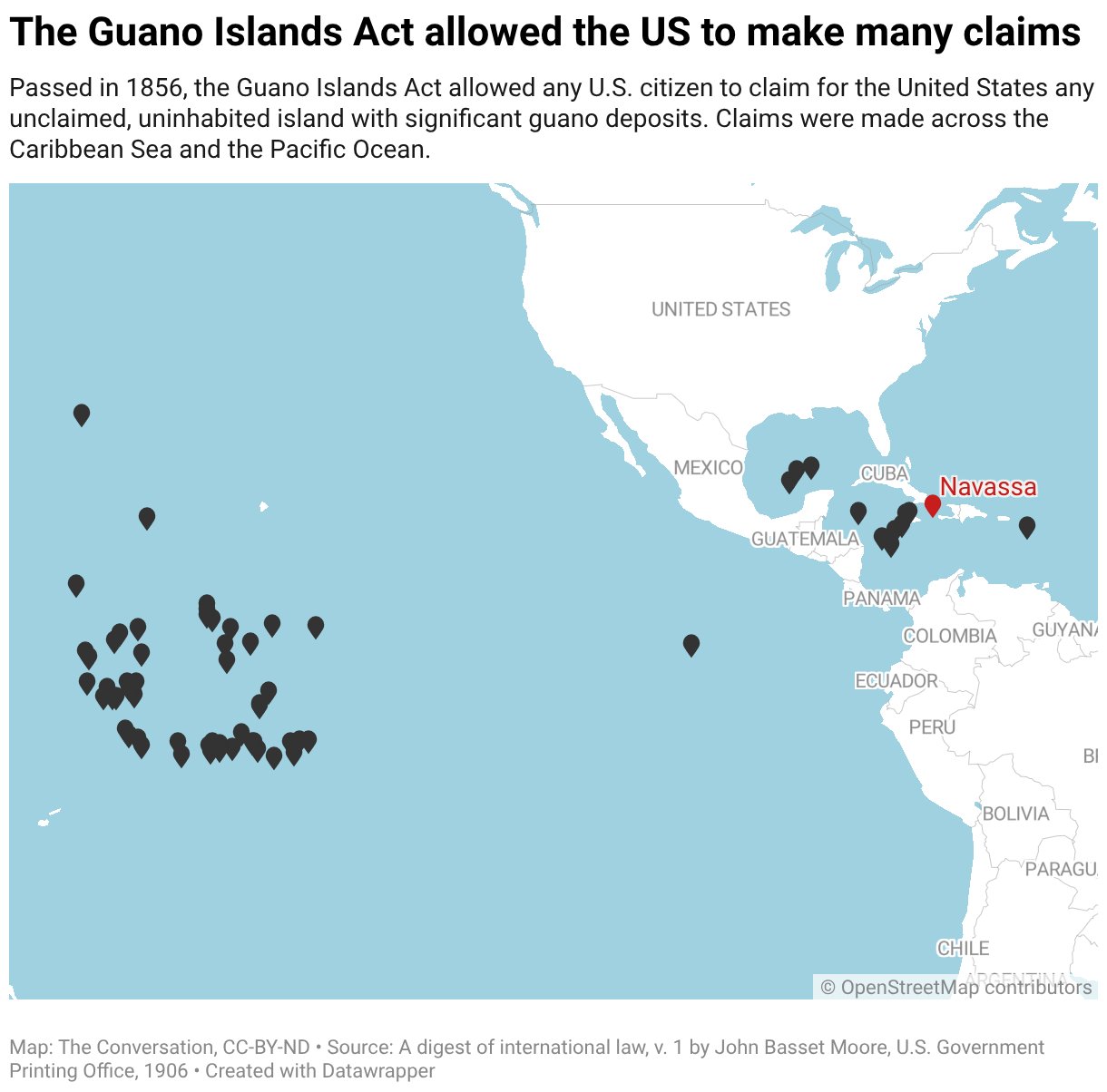
Faced with increasing fertilizer demand, governments began to treat guano as a strategic resource. American policymakers worried about dependence on Peruvian supplies, prompting President Millard Fillmore to urge federal action to secure reliable access to fertilizer. Congress responded with the Guano Islands Act of 1856, authorizing U.S. citizens to claim unoccupied guano islands in the name of the United States. The law transformed a quest for fertilizer into a new mechanism of American territorial expansion.

Over subsequent decades, dozens of islands across the Caribbean and Pacific entered the expanding orbit of U.S. power because of their valuable fertilizer deposits.

map of guano island act

Few places illustrate this history more clearly than Navassa Island, a remote limestone outcrop between Haiti and Jamaica and the subject of my upcoming book. From the 1860s onward, American companies transformed Navassa into an industrial mining colony that supplied guano to farms throughout the eastern United States.

Black workers, recruited primarily from Baltimore, excavated guano amid conditions of unrelenting heat, dust and isolation. Their rations consisted of little more than herring, maggot-infested biscuits and salted beef. The island’s hierarchy reflected the emerging racial order of the Jim Crow era. The miners were overwhelmingly Black, while their overseers were white men. To reconstruct the workers’ experiences, I draw on their diaries, correspondence with friends and relatives, and interviews with their descendants.

On Sept. 14, 1889, years of resentment erupted into violence. That day, 137 Black miners rebelled against the Navassa Phosphate Company’s 11 officers. By evening, five white supervisors were dead. The U.S. Navy dispatched the steam-powered warship USS Kearsarge, which carried 18 Black workers to Baltimore to stand trial for murder.

The following year, the case reached the U.S. Supreme Court. In Jones v. United States, the justices upheld the federal government’s authority to prosecute crimes committed on the island. The court reasoned that a nation could exercise legal authority over territory maintained through “actual, continuous, and useful possession,” even when that occupation served only a particular business, such as “working mines.” The ruling confirmed American jurisdiction over Navassa. Read in the context of the uprising that produced it, however, the decision illustrates how resource extraction, racialized labor and the expansion of federal power had become intertwined.

Several defendants received death sentences, but pressure from Black civic organizations and other supporters helped persuade President Benjamin Harrison to commute those sentences in 1891. The case therefore tells a story not only of racial violence and exploitation, but also of Black legal activism and community mobilization during a period often remembered largely for racial repression.

Lessons from the Guano Age

Agricultural abundance has long depended on far more than fertile soil. It has relied on distant nutrients, global shipping networks and the workers whose labor connected remote islands to farms around the world.

Guano did more than fertilize fields. It created a global agricultural system whose supply chains stretched across oceans, depended on distant workers and were vulnerable to geopolitical disruption. From the Chincha Islands to the Strait of Hormuz, the history of fertilizer reminds us that the world’s food supply has long rested on fragile connections between remote places.

Premature baby giraffe keeps beating the odds after emergency C-section

A baby reticulated giraffe (Giraffa reticulata) at Tanganyika Wildlife Park in Kansas continues to beat the odds following an emergency C-section. The baby girl named Milani is officially standing up, laying down, and even pooping on her own, milestones that seemed almost impossible following her tenuous entrance into the world.

Milani’s story

Earlier this month, veterinarians performed an emergency C-section on Milani’s mother Virtue. The mother’s organs began shutting down while she was still pregnant, and there was no way for veterinarians to save her. But there was still a chance that her unborn calf could survive. The team carried out a terminal cesarean section—an operation in which the mother does not survive. Virtue was sedated, the calf was pulled out, and then she was humanely euthanized. 

“Every giraffe neonatal specialist and veterinarian we consulted told us they had never heard of a premature giraffe delivered this way surviving. And yet… She took her first breath,” the wildlife park wrote in a social media post

Mother giraffes usually give birth while standing, and the newborn’s fall (which can be up to six feet down) triggers its first breath and helps break the umbilical cord. The calf then usually stands up within five to 20 minutes and nurses within the first hour. Without its mother’s first milk, called colostrum, the calf doesn’t have its own functional immune system. This lack of immunity was Milani’s main problem in those first few days. 

Round the clock care

The calf is now being taken care of around the clock. The team is giving her plasma to fill in for her lacking maternal antibodies, a managed feeding regimen, in addition to consistent bloodwork, temperature, hydration, and glucose monitoring. She also has at least two people with her all the time. 

The park has been providing updates on social media, with one revealing that shortly after her birth they had to stabilize the calf’s temperature and give her supplemental oxygen.  

On July 25, the park announced that her name is Milani, which means “new birth” or “new era,” 

The name also honors Mili, the giraffe whose donated plasma helped save her life. The zoo’s giraffe herd has also been taking turns peeking in on her.

“Part of having and caring for animals is losing them, but it’s rare that you get the opportunity to save one at the same time. It’s incredible to see people come together to do the unthinkable,” Matt Fouts, Director at Tanganyika Wildlife Park, said in a statement earlier this month. “Our team and all the experts we have consulted have fully embraced our Refuse to Lose core value and invested their time and talent to give this calf the best chance of survival.” 

Build better Claude AI workflows with this $13.99 online course

TL;DR: This Claude AI Professional eDegree includes more than 100 lessons, hands-on projects, and lifetime access to help you master prompting, coding, and automation for $13.99 (Reg. $159).

If you’re still using Claude as a glorified chatbot, you’re only scratching the surface of what it can do. This Claude AI Professional eDegree teaches the prompting techniques, integrations, and automation workflows that can turn Claude into a practical productivity tool. For a limited time, you can get it on sale for $13.99 (reg. $159) with code COURSE30.

Many people use Claude to answer questions or summarize documents, but that’s only the beginning. And besides, there are other AI models for that. As AI tools become a bigger part of everyday work, knowing how to write better prompts, automate repetitive tasks, and integrate Claude into your workflow can be just as valuable as knowing the tool itself.

Learn how to get more out of Claude

Rather than focusing on theory, the program focuses on practical skills you can use in your day-to-day right away. Across four courses and more than 100 lessons, you’ll learn how to write more effective prompts, use Claude for coding and debugging, connect it with productivity apps, and build AI-powered workflows that help cut down on repetitive work.

You’ll also complete hands-on projects, from creating marketing workflows and AI assistants to building websites and business automation systems. Instead of simply watching demonstrations, you’ll leave with experience applying Claude to real-world tasks.

What you’ll learn:

Effective prompting techniques for better Claude responses
AI-assisted coding and debugging workflows
Workflow automation, integrations, and plugins
Real-world projects using Claude for productivity and business tasks
A professional certificate upon completion

Whether you’re a developer, freelancer, entrepreneur, or simply someone who relies on AI every day, this course focuses less on what Claude can do in theory and more on how to put it to work. And because it includes lifetime access, you can revisit the material as Claude continues to evolve and receive upgrades and new features.

Normally $159, you can get the Claude AI Professional eDegree for just $13.99 with code COURSE30.

StackSocial prices subject to change.

_

Inside image for build better claude ai workflows with this online course Stack Commerce sponsored deal
Stack Commerce

Claude AI Professional E-Degree

See Deal

Stop putting off that Windows 11 Pro upgrade — it’s only $9.97 through 8/2

TL;DR: Get Microsoft Windows 11 Pro for $9.97 instead of $199 and add advanced security, remote access, and built-in AI assistance to a compatible PC through Aug. 2 at 11:59 p.m. PT.

Upgrading your operating system can be a smart and satisfying investment, especially when it comes at a fraction of the usual cost. This Microsoft Windows 11 Pro deal makes it even better: A lifetime license is currently $9.97, down from $199, through Aug. 2.

That 94 percent discount matters for anyone building a PC, replacing an old machine, or setting up a dedicated work computer. Windows 10 reached the end of standard support in October 2025, making a supported operating system increasingly important for security updates and long-term compatibility.

For anyone replacing an aging PC, that makes advanced Windows features easier to justify without committing nearly $200 upfront today.

Pro features offer more control over your PC

Windows 11 Pro includes the familiar Windows interface, Snap Layouts for organizing open apps, improved virtual desktops, and Microsoft’s built-in security tools. The Pro edition also adds features aimed at professionals, power users, and small businesses. This OS has a 4/5 rating on PC Magazine and TechRadar, too.

BitLocker can encrypt a drive to help protect its contents if a laptop is lost or stolen. Remote Desktop lets users access a compatible work PC from another device, while Hyper-V supports virtual machines. Windows Sandbox provides an isolated environment for opening unfamiliar files or testing software without immediately exposing the rest of the system.

For compatible PCs, paying $9.97 for Windows 11 Pro is a notably low-cost way to secure a fresh installation or equip a secondary workstation with Microsoft’s more capable operating system.

Get Microsoft Windows 11 Pro for $9.97 through Aug. 2 at 11:59 p.m. PT.

StackSocial prices subject to change.

_

Inside image for stop putting off that windows 11 pro upgrade its less this week Stack Commerce sponsored deal
Stack Commerce

Microsoft Windows 11 Pro

See Deal