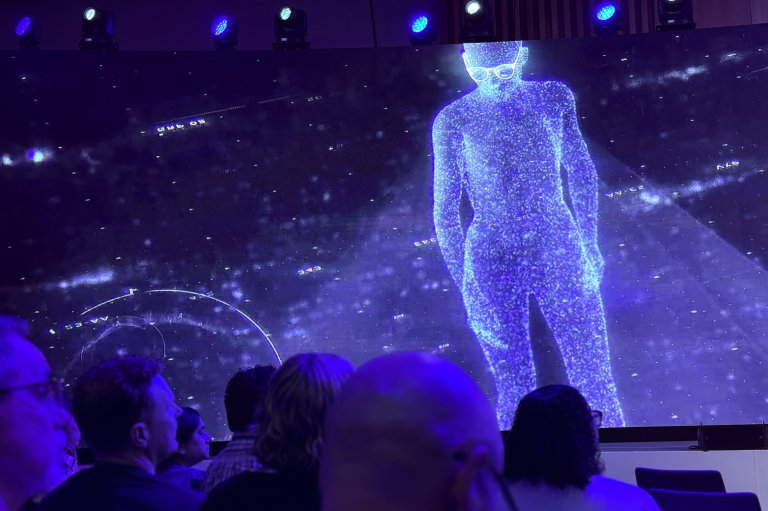
Anna Salamon Battles The Pink Robots courtesy of Stuart Fox

Ray Kurzweil's concept of the Singularity rests on two axioms: that computers will become more intelligent than humans, and that humans and computers will merge, allowing us access to that increased thinking power. So it only makes sense to begin the conference with discussions of those two fundamental concepts. No one disputed the emergence of intelligence beyond our own, but they did give me plenty of reasons to worry about how that process might take place.

According to Anna Salamon, a former NASA researcher who now works for the Singularity Institute for Artificial Intelligence that hosts the conference, artificial intelligence greater than our own is inevitable and dangerous. Salamon argued that biological brains have finite intellectual capacity. Just as a goldfish can't appreciate opera and a cat can't learn quantum mechanics, so too will humans soon confront problems beyond the comprehension of our slimy, mortal brains.

She believes we will create super computers to solve those problems for us. Just as relatively weak human muscles can work together to create stronger lifting machines like cranes, relatively stupid human brains can design vastly more powerful computers minds. Unfortunately, Salamon worries that if humans and AI have divergent goals, we could find ourselves in competition with the AI for resources to achieve those different goals. And when you compete with something vastly smarter than yourself, you lose. She stressed that assuring humanity and AI have the same goals requires a level of care and responsibility greater than even our stewardship of nuclear weapons technology.

To head off the Skynet take over, Salamon advocates starting now to ensure that positive, human assisting missions get hardwired into the basic architecture of artificial intelligence.

But according philosopher Anders Sandberg, the nature of artificial intelligence development may complicate the embedding of those fail-safes. Sandberg believes that engineers have to base their first attempts at AI on the only current example of natural intelligence: the human brain.

And if the first artificial intelligence has to take the form of a human brain, it has to take the form of a particular human brain. Sandberg noted that the first artificial brain, as copy of a specific human brain, would necessarily contain elements of the personality of the test subject that the artificial brain copied. Personality traits that could become locked into all artificial intelligence as the initial AI software proliferates.

Based on my experience with people who volunteer for scientific tests, this means the first artificial intelligence will most likely have the personality of a half stoned, cash-strapped, college student. So if both Salamon and Sandberg prove right, I think avoiding destruction at the hands of artificial intelligence could mean convincing a computer hardwired for a love of Asher Roth, keg stands and pornography to concentrate on helping mankind.

Take home message: as long as we keep letting our robot overlord beat us at beer pong, we just might make it out of the Singularity alive.

And remember to check back soon for more Singularity Conference 2009 updates.

Want to learn more about breakthroughs in electronics, medicine, nanotech, and more?
Subscribe to Popular Science and enter to win $5,000!

7 Comments

Amazing headline. That popped up in my RSS reader and I laughed out loud...

Religion and politics.

Something we probably mutually agree we do not want to be set as a standard against us.

yeah. If you were a AI, how much in resources would it be worth to keep humans alive? Seems that the human interaction with the machine would eventually lead to our downfall, as the machine sees flaw after flaw in everything that is supposed to be good about us, and that it would only be time before ours and the AI needs are at odds. A machine would come to that quickly, just from tv.

yeah. If you were a AI, how much in resources would it be worth to keep humans alive? Seems that the human interaction with the machine would eventually lead to our downfall, as the machine sees flaw after flaw in everything that is supposed to be good about us, and that it would only be time before ours and the AI needs are at odds. A machine would come to that quickly, just from tv.

why that posted twice, I do not know.

OMGosh dude no way you have GOT to be kidding me!

RT
www.complete-privacy.net.tc

Nothing against Anna Salamon, but she appears not to have taken notice of anything Ray Kurzweil, or many of the other Singularity specialists, have been saying for years, namely that:

As artificial intelligence develops, we humans will develop with it. We will augment our own minds as we augment the capabilities of machines and computers.

This is not either/or, it is both/and. We already incorporate technological advances into our minds and bodies today: cochlear implants inside our heads, artificial hearts in our chests, hip and knee implants in our legs, lenses going into our eyes.

There are scientists who have implanted devices into other kinds of primates, which have allowed those animals to control objects outside of their bodies by their thoughts alone.

This is basic stuff for someone presenting at The Singularity Institute. If you like, call it "technological symbiosis", just like the symbiosis (cooperation) that exists between and among living creatures, a key feature of evolution. (Competition is only half of the story of evolution. See "Darwin's Blind Spot" for an excellent analysis of symbiosis in evolution.)

It's not independent, it's co-dependent--change the mindset and suddenly you change the possibilities.


Download Our iPhone App

Stay up to date on the latest news of the future of science and technology from your iPhone with full articles, images and offline viewing


Grab the Tech Buyer's Guide iPhone App

Carry everything you need to make a smart buy on HDTVs, cameras and 14 other product categories right in your pocket


Follow Us On Twitter

Featuring every article from the magazine and website, plus links from around the Web. Also see our PopSci DIY feed


Become a Fan On Facebook

Share links with friends, comment on stories and more


February 2010: Renovating America

Innovative fixes for five of the country's biggest infrastructure messes, plus a look the quest to read the human mind, the LCD screen that might finally kill paper dead, and the world's scariest science.

Read the issue here.

Popular Science Photo Pool


Share your photos in the Pop Sci pool at www.flickr.com!