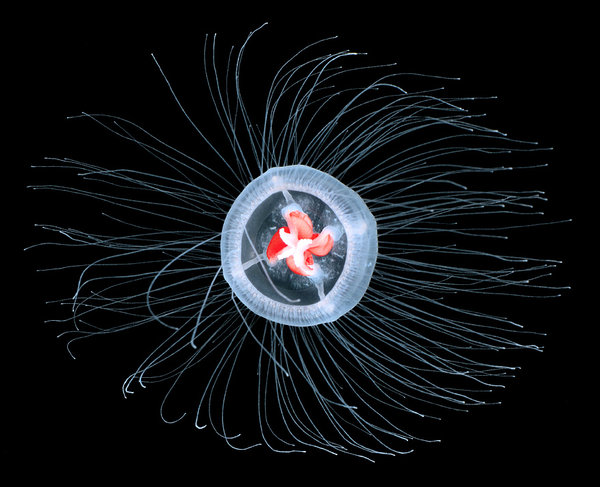
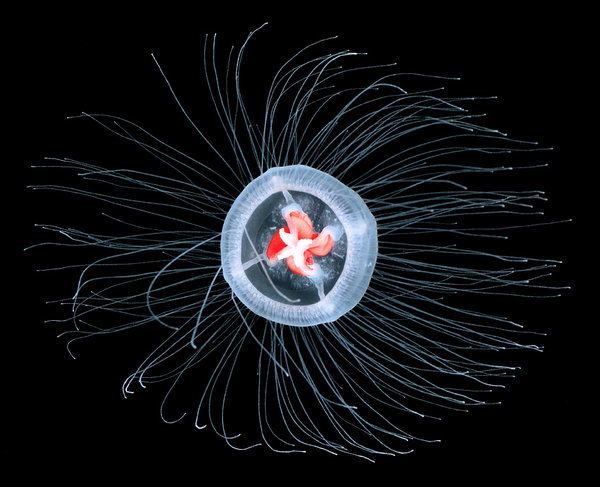
Let's start with the oldest-living animal of all, and one of the strangest in the entire animal kingdom: Turritopsis nutricula, otherwise known as the immortal jellyfish. You might think that this animal's common name is poetic, that perhaps it lives for a few hundred years, impressing generations of scientists--but you'd be wrong. Its name is literal: Turritopsis nutricula is biologically immortal.
The immortal jellyfish can theoretically live forever, thanks to a process that is believed to be unique, called transdifferentiation. It has the ability, at any stage in its life, to completely transform back into a polyp, its earliest stage of life. You can imagine it like the mythical phoenix, an immortal bird which is repeatedly reborn as a chick. The immortal jellyfish doesn't die; it merely regenerates its cells in a younger stage, then ages naturally again.
That doesn't mean all Turritopsis nutricula are immortal; the species is a small invertebrate in the ocean, and is susceptible to all of the nasty things that can befall such creatures, whether that's being eaten or succumbing to disease. But it is biologically capable of immortality. The New York Times Magazine ran a great article about the immortal jellyfish last year--highly recommended reading.
great story!
"Smart people doing dumb things"
The sad thing about the huge lobster "George" is that the PETA folks were so excited to have the small victory of setting him free that they failed to cut loose the rubber bands securing George's claws - which probably condemned him to death because those are the primary tools for defense and for securing food for his "little hands" to feed itself with.
They may have been unaware of the need for the rubber bands, having never had to prepare lobster themselves, but it should have been obvious - they used two on each claw.
"Condemnation without investigation is the highest form of ignorance"
~Albert Einstein