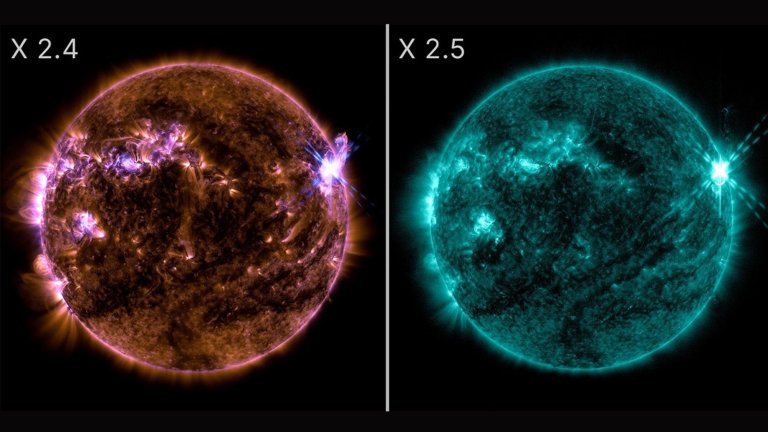
It’s a long-standing mystery of physics: “You don’t expect a star that’s hot in the middle to get hotter as it goes away from the surface,” said NASA project scientist Joe Gurman, who works on the Solar TErrestrial RElations Observatory (STEREO) mission. But somehow the sun’s surface, around 11,000 degrees, is cool compared to the superheated corona, which reaches millions of degrees. What brings this extra warmth to the sun’s atmosphere?
In January, scientists said they may have an answer: Plasma fountains called spicules, like those seen here, that shoot up from the chromosphere. That’s an area just above the sun’s surface.
The plasma fountains are as long as Earth and last a few minutes, but a newly observed class of spicules lasts about 100 seconds, moving 186,000 miles per hour. The Solar Dynamics Observatory and the Japanese Hinode spacecraft (meaning “dawn”) were able to catch them in action.
Scientists at Lockheed Martin’s Advanced Technology Center, the National Center for Atmospheric Research and the University of Oslo, Norway, published a paper on the spicules in the journal Science.
They found that the heated spicules likely occur often enough to continuously replenish the corona, but there are still plenty of questions — the interface between the surface and the corona is still pretty poorly understood. An upcoming NASA mission scheduled for launch next year will provide some answers (keep reading to find out more).
This is very interesting! Thanks so much for the great info.
Jessica Lee Guida
Digital Marketing Strategist
lotus823 - Integrated PR/SEM Agency
Follow Me: @lotus823_Jess
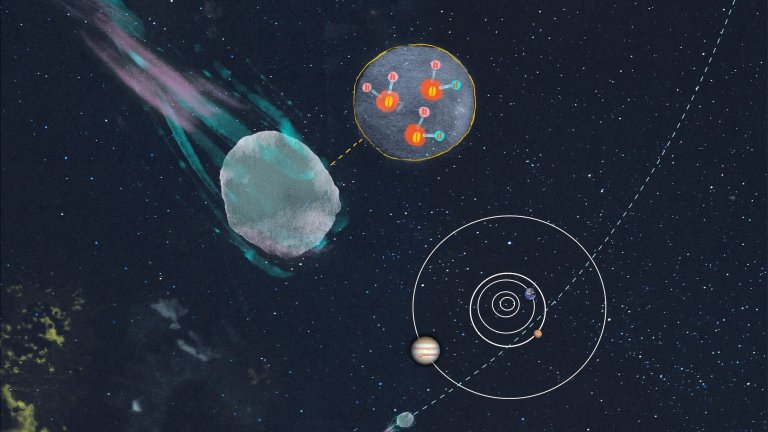
So, according to the caption to image 3, apparently radioactive decay is not constant. Hmm, if the radioactive decay of various radioactive substances can change, how can we assume that the decay rate for Carbon-14, Potassium-40, Uranium-238, and so on are constant? If decay rates are now known to change, doesn't that throw a lot of doubt on radioisotope dating methods?