Astronomers knew 3I/ATLAS wasn’t a local comet not long after first spotting it in July 2025. As only the third interstellar object ever detected in our solar system, it offered researchers a rare—and brief—opportunity. With the right timing and equipment, scientists around the world could examine a cosmic visitor who possibly formed under far different conditions than those experienced in our own region of the galaxy.
3I/ATLAS is now sailing away from Earth and our solar system itself, but astronomers have already learned a wealth of information. The fastest comet ever recorded is covered in ice volcanoes, and emits a dusty trail of methanol and cyanide in its wake.
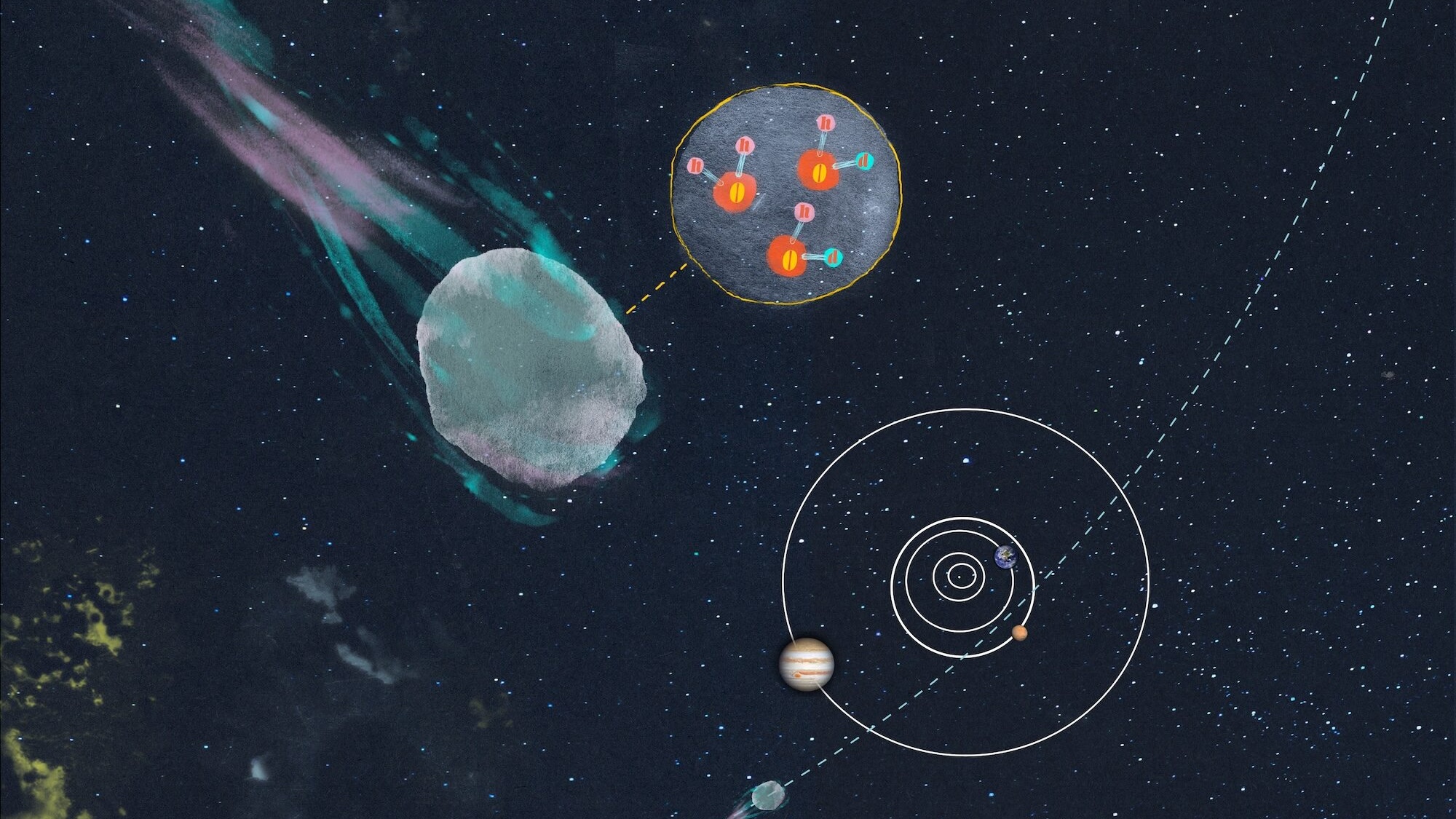
Earlier this month, the European Space Agency confirmed that 3I/ATLAS is also spewing the equivalent of 70 Olympic swimming pools’ worth of water every day. However, the exact type of water isn’t often seen here on Earth.According to astronomers at the University of Michigan (UM), the hydrogen in the comet’s H2O contains one extra neutron, which technically makes it an isotope called deuterium. The rarity isn’t simply a strange quirk—it indicates 3I/ATLAS originated somewhere much colder than the solar system.
“Our new observations show that the conditions that led to the formation of our solar system are much different from how planetary systems evolved in different parts of our galaxy,” Luis Salazar Manzano, a UM astronomer, said in a statement.
The co-author of a paper published today in the journal Nature Astronomy, Manzano explained that 3I/ATLAS contains 30 times the deuterium seen in other comets, as well as 40 times the amount that exists in Earth’s oceans.
“The amount of deuterium with respect to ordinary hydrogen in water is higher than anything we’ve seen before in other planetary systems and planetary comets,” he added.
Measuring subatomic particles in a comet millions of miles away required some of the most sensitive tools available. Manzano and colleagues utilized equipment at the MDM Observatory in Arizona, while also collaborating with astronomers at the Atacama Large Millimeter/submillimeter Array (ALMA) in Chile. Thanks to ALMA, the team could separate standard and deuterated water in the comet, then get accurate ratio estimates between the two. It’s not only impressive—it’s the first time anyone successfully accomplished the analysis on an interstellar object.
So what does a lot of deuterium mean, exactly? For one thing, 3I/ATLAS’ birthplace was much colder than conditions that created our solar system—less than 30 degrees Kelvin, or -387.67 Fahrenheit. The region likely also experienced much lower levels of radiation.
“Gas-phase and ice-grain deuterium enrichments occur through chemical processes that operate at low temperatures (<30 K) pointing towards an origin in the prestellar molecular cloud or in the outer parts of the protoplanetary disk,” the study’s authors wrote.
Since the Milky Way galaxy is a vast place, it may not come as a huge surprise to learn other locations exhibit different formative environments. But as astronomer and study co-author Teresa Paneque-Carreño explained, you can’t base science on assumptions—even when they sound ironclad on their own.
“This is proof that whatever the conditions were that led to the creation of our solar system are not ubiquitous throughout space,” said Paneque-Carreño. “That may sound obvious, but it’s one of those things that you need to prove.”