
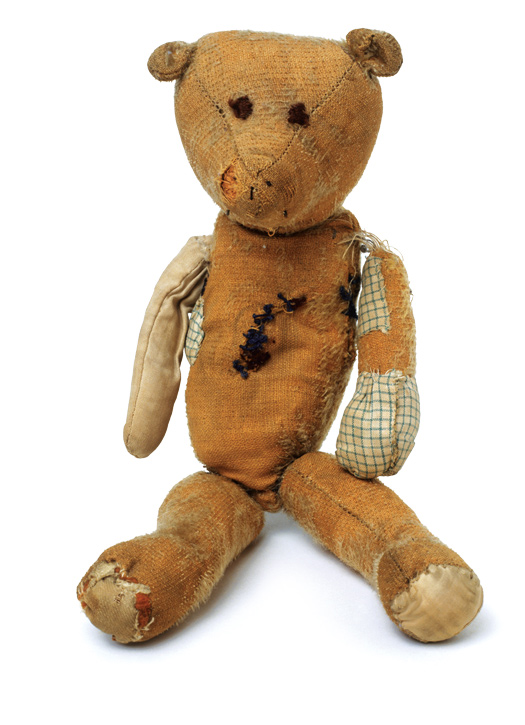
The National Toy Hall of Fame awarded “oldest toy” to the stick. Edward Bleiberg, a curator of Egyptian art at the Brooklyn Museum, says that Neolithic balls made from mud are probably out there, but in any case it would be difficult to determine if they were playthings.
In 2004, archaeologists dug up a 4,000-year-old stone doll head in the ruins of a village on the Italian island of Pantelleria. That the head wasn’t found in a ceremonial ground made it different than most ancient human figures and suggests that it was probably a toy. It had curly hair and was buried with miniature kitchenware. Bleiberg says that archaeologists have found many wooden dolls in Egyptian tombs that date back just as far, but most of those figures were found engraved with reproductive symbols, and probably weren’t for play.
Games might be older than dolls. In ancient Egypt, senet, a board game that looks like backgammon, appears in wall drawings from around 2686 B.C. Egyptian kids might not have played senet, but they did play something like jacks around the same time—throwing rocks in the air and picking up pieces of clay before they fell back to earth.
Have a burning science question you'd like to see answered in our FYI section? Email it to fyi@popsci.com.

Five amazing, clean technologies that will set us free, in this month's energy-focused issue. Also: how to build a better bomb detector, the robotic toys that are raising your children, a human catapult, the world's smallest arcade, and much more.


Online Content Director: Suzanne LaBarre | Email
Senior Editor: Paul Adams | Email
Associate Editor: Dan Nosowitz | Email
Assistant Editor: Colin Lecher | Email
Assistant Editor: Rose Pastore | Email
Contributing Writers:
Rebecca Boyle | Email
Kelsey D. Atherton | Email
Francie Diep | Email
Shaunacy Ferro | Email
What is a toy, but a projection of our imagination towards the physical world? So then it would be our ability to have an imagination and to dream about our world about us to be the original toy!
..........................................
See life in all its beautiful colors, and
from different perspectives too!
Imagine this: If I apply and am successfully give a patent on what I just said above, just think, the whole human race can pay me for having the patient and they using their own imagination.
Just so you know, I think the concept of patients is just silly. To think I or you can be the originator of an idea and everyone else has to pay me for its use.
A how old is the COSMOS? The ability to be original has long since gone.
..........................................
See life in all its beautiful colors, and
from different perspectives too!
Ah Space the last freeloader? No just one among many, many, many freeloaders all feeling that patents (or as our cutsey Space-brain would have it patient).
This fellow is one of so many who AFTER an invention is made claim it is obvious and feel they have a right to have the idea without paying for it.
For most of man's cultural history that is exactly what happened. If you were stupid enough to spend time and resources creating a developing a new thing and it was simple enough to copy why it was copied and all cultures claimed it (spaghetti/noodles, firearms, arrowheads, throwing sticks, wheels).
So Guilds were developed and steps in making important things were hidden. Thus the development effort could be rewarded perhaps forever. Today we still don't know how to make certain Damascene steels or Greek fire or thousands of other "secret" formulations left to special groups which in the middle ages formed Guilds in Europe.
Furthermore these hidden secrets were not available to incorporate into improvements and other inventions that could benefit all of society. So in the Netherlands, England, France and in America a patent system emerged so that for a short period inventors could trade their secret for a temporary monopoly. After the monopoly time everyone could use the idea. Suddenly technological society began to accelerate at a very high rate and the technically competent cultures dominated the earth. Like it or not this is the world we live in.
A typical time or patent life is 20 years. Unfortunately for most inventors it means that truly new things rarely make much of a return for their inventors since it can easily take 20 years to develop and reasonable market. Case in point the the touch screen such as that used on the ipad and iphone was invented in the mid-seveties and had passed into the public domain by 1995 when its use just began to grow. Apple pays no royalty at all for its touch screens to the original inventor.
Oh and I'm sorry to say this but your IDEA Space is not an invention of any kind.
attoman,
I know it's not an invention, duh! You missed the point of the second commentary completely.
..........................................
See life in all its beautiful colors, and
from different perspectives too!
A toy in fact is anything which is not used for required activity but is rather used for play.
Chimpanzee babies can be seen to use toys that are in fact tools in the hands of other, older chimps. Indeed older chimps can use these same tools in a toy way and so for a time they are toys.
The toy is specifically a property of the action of the being that employs it.
Therefor there is no reason to believe that toy did not precede tool. Certainly sharp edged rocks skipped ponds before they cut skins.