
Physicists at the University of Geneva in Switzerland have devised a new kind of quantum experiment using humans as photon detectors, and in doing so have made the quantum phenomenon of entanglement visible to the naked eye for the first time.
For those that need a primer, entanglement is that strange quantum phenomenon that links two particles across distances such that any any measurements carried out on one particle immediately changes the properties of the other--even if they are separated by the entire universe. Einstein called it “spooky action at a distance.” And indeed it is weird.
Nicolas Gisin at U. of Geneva noted that Italian physicists had previously done an interesting thing with entangled photons. Rather than entangling just a few as experimenters usually do, the Italian team had entangled a pair of photons and then amplified one of them to create a photon shower containing thousands of particles, all linked to the single other photon from the original pair. That is, there was one “microscopic” photon, and a shower of “macroscopic” photons, all tied together at the quantum level.Gisin realized that while the naked eye can’t see a single photon, it can certainly see thousands. So he used a setup similar to the Italians’, but rather than putting a photon detector in front of the macroscopic photons he put himself and his colleagues there. The beam of photons produced by the amplifier would appear in one of two positions in their darkened room, depending on the polarization state given to their microscopic single photon. Time after time, when the human results were tested against photon detectors, they got a positive result.
It may sounds like a bunch of scientists sitting in a dark room looking at blinking lights, but it represents the first time quantum entanglement has been directly observed with the naked eye.
Sort of. The Swiss team also found that what they were looking at wasn’t necessarily macro-micro entanglement. Even when they deliberately broke the quantum link between micro and macro and then ran their “human detector” experiment, they still got a positive result. This is due to the imperfection of detectors (even human ones) and a loophole in what’s known as the Bell Test (which, in a nutshell, is used to measure entanglement) that’s negligible in small quantities of photons but grows along with their quantity. This introduces a degree of uncertainty (for a better explanation of this, click through the Nature link below).
What the Swiss team does know is this: when they started, they had two entangled photons. Even though flaws may have been introduced in the amplification process, they could still “see” the effects of entanglement. A new method is being devised by the original Italian researchers (who also detected this flaw in their research) to verify micro-macro entanglement with lasers. Unfortunately, humans can’t be used as detectors for these experiments, as the highly focused beams of light would be the last thing those humans would see.

[Nature]
Five amazing, clean technologies that will set us free, in this month's energy-focused issue. Also: how to build a better bomb detector, the robotic toys that are raising your children, a human catapult, the world's smallest arcade, and much more.


Online Content Director: Suzanne LaBarre | Email
Senior Editor: Paul Adams | Email
Associate Editor: Dan Nosowitz | Email
Assistant Editor: Colin Lecher | Email
Assistant Editor: Rose Pastore | Email
Contributing Writers:
Rebecca Boyle | Email
Kelsey D. Atherton | Email
Francie Diep | Email
Shaunacy Ferro | Email
Quantum Entanglement seen with the Naked EYE!
Well... not reaaaally but we wanted you to read the article anyways
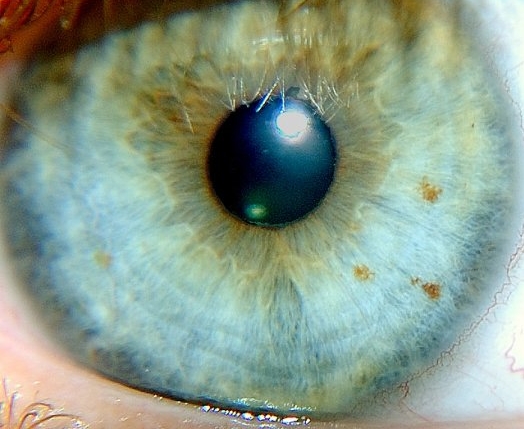
are those freckles on that eye?
that's only one reason why not to stare at the sun.
It's so odd, strange. I just feel like someone is watching me, huh?!
"entanglement is that strange quantum phenomenon that links two particles across distances such that any any measurements carried out on one particle immediately changes the properties of the other"
No... there is no 'change' in the entangled particles... measuring one allows you to know the state of the other before you observe it, it does not allow you to change the state of the other one in any classical sense.
Very interesting. Maybe the effects they were witnessing were from the previous event, when the photons were entangled. Effects of entanglement can happen over great distances in space, why not time?
What? entangled naked people in a dark room seen for the first time...? seriously?
@Ancient Astronaut
Entanglement does happen over time. its called the butterfly effect. andything you do today will have an effect on tomorrow.
@joefizzle Effecting other objects in space/time and quantum entanglement are two vastly different things.
if quantum entanglement effects can be observed over distances in space, it would be logical to assume the effects would observed over distances in time as well, since space and time are one "fabric" (space/time). I was just curious if they had considered anything like that.
@Ancient Astronaut Yes, I do believe they've considered it. If I remember correctly, it was on popsci a while ago.
I wonder who's eye that is and if he uses iris scanners as a security measure, if he does he's not secure any longer. ;)
I spy with my little eye, something I think I saw...
Will this allow communication at faster than light speeds??
@TonyB
I would like to agree with you but then we would perhaps both be wrong. The accepted theory in quantum mechanics is that a particle is in both states until it is measured. Only then does it randomly resolve to one state (never before)! It doesn't seem logical, having kind of a backward feel to it. Many scientists don't like it, grudgingly having to accept it based on the evidence and mathematical agreement (Einstein being a famous example).
Now, if you entangle that first particle with another, the second particle will also 'resolve' to the same state when you measure the first one. The spooky part being that the distance between them is irrelevant. This is thought to occur almost (if not) instantly and therefore potentially much faster than the speed of light if done over large distances.
However, it is also generally believed that no communications based on such a system are possible. Then again, many things that did seem impossible turned out not to be ... it would be pretty cool to have instant communication!
@TonyB
Google "The Heisenberg Uncertainty Principal" and you'll see that your previous comment completely violates this... which is accepted by most (if not all) physicists.
The eye can sense a single phonton. That was published well in the past and can be found in Guyton's:
Human Physiology and Mechanisms of Disease by Arthur C. Guyton (1992) p.373,
Textbook of Medical Physiology (many editions), Arthur C. Guyton,
and a recent review:
Optimization of Single-Photon Response Transmission at the Rod-to-Rod Bipolar Synapse, Physiology, Vol. 22, No. 4, 279-286, August 2007
Perhaps a more refined explanation clear up this discrepency,if it's important.
If my current theory holds,quantum entanglement could be affected by gravitational lensing.
A possible explanation as to the physicists observing the 'macro' photons after they 'broke' the quantum link:
"anatomists have found that in most areas of the cortex for every fiber carrying information up the hierarchy there are as many as ten fibers carrying processed information back down the heirarchy.
your mind operates via prediction. perception is not a process of passive absorption, but active construction. when you see, hear, or feel something the incoming information is always fragmentary and ambiguous. as it percolated up the cortical hierarchy each area asks, is this what I expect? is this what I predict? does this conform to what I already know in this case? so your brain is constantly comparing incoming information to what it already knows or expects or believes. as higher areas make sense of input-the information is fed back to lower areas to confirm that what you believe is happening is really happening.
but in many cases it goes beyond mere confirmation and the back fed prediction or belief actually alters the upward flowing information to make it conform. the fact that the info travels backward down the cortical hierarchy all the way from higher, mentally sophisticated regions into lower levels of basic sensory processing means your predictions and beliefs can work against you. they do this by interfering with your ability to see things afresh or even notice major contradictions between your expectations and what is actually present to your senses."
The Body Has a Mind of Its Own: How Body Maps in Your Brain Help You Do (Almost) Everything Better
Sandra Blakeslee (Author) Matthew Blakeslee (Author)