
The jury is still out, but skepticism permeates the scientific community

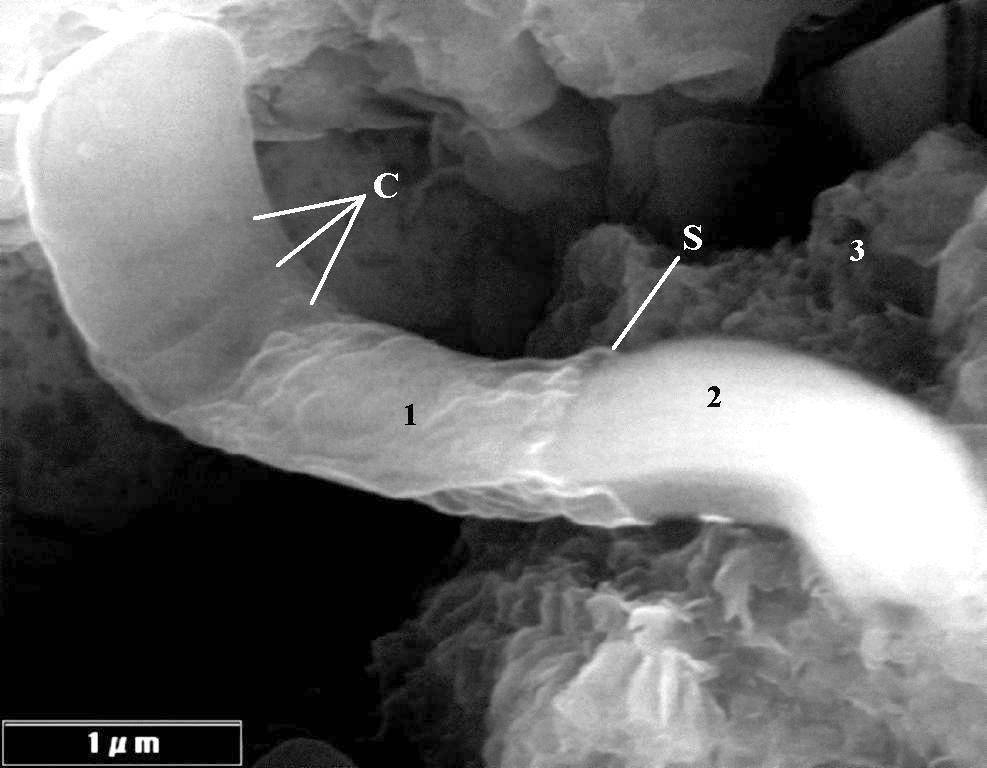
Alien Microbe Fossils? This tube, found in a meteorite that fell to Earth in 1864, is similar in size and shape to the giant bacterium Titanospirillum velox. A NASA astrobiologist claims it is the remains of an alien microbe. His claim is controversial, to say the least. R. Hoover/Journal of Cosmology

Did a NASA scientist find fossilized alien microbes embedded in a 146-year-old meteorite? As this claim emerged over the weekend, the answer from the scientific community so far appears to be something between “Um, what?” and “No.”

Saturday afternoon, the Journal of Cosmology, which has made a name for itself by publishing provocative papers about controversial topics, sent out a mass press release announcing a new paper by the award-winning astrobiologist Richard Hoover, who studies extremophiles at NASA’s Marshall Space Flight Center. He described filaments and other structures inside a rare type of meteorite that look like some unknown form of cyanobacteria.

As several others have pointed out, this is not the first time Hoover has made this claim, and similar arguments have been made before, including this paper by NASA astrobiologist David McKay (which Nature's Great Beyond blog notes is not cited by Hoover).

As scientists began reacting to the announcement, some have been more charitable than others. Bad Astronomer Phil Plait said he was extremely skeptical, and “we are a long, long way from knowing whether the claim is valid or not”; at NPR, astrophysicist Adam Frank said it’s not proof, but “not disprovable either.”

On the other hand, biologist and blogger PZ Myers called it “garbage,” wondering why it was getting any attention at all:

“I'm looking forward to the publication next year of the discovery of an extraterrestrial rabbit in a meteor. While they're at it, they might as well throw in a bigfoot print on the surface and chupacabra coprolite from space. All will be about as convincing as this story.”

Rosie Redfield, who was one of the first to critique NASA’s controversial arsenic-eating-bacteria paper, declared “Executive Summary: Move along folks, there's nothing to see here.” And over at MSNBC, Alan Boyle talks to David Morrison, senior scientist at the NASA Astrobiology Institute at Ames Research Center, who said “Perhaps the publication came out too soon; more appropriate would have been on April 1.”

For its part, the Journal of Cosmology has invited commentary from 100 scientists, and is publishing them on its website. MSNBC's Boyle hits the highlights so far, while noting that they’re not in chronological order — is the journal publishing only some of the commentaries?

The J of C is edited by Rudolf Schild, a professor of cosmology at the Harvard-Smithsonian Center for Astrophysics who has written almost 300 scientific papers. It has been drawing skepticism since at least last fall, showing up on discussion boards and in the science blogosphere. Critics say its website looks like a student’s science project; Myers said it looks like it was “sucked through a wormhole from the 1990s.” But the editorial board includes some impressive names.

Many other scientist bloggers have asked why such a potentially groundbreaking paper would be published in an open-access online journal, instead of a prestigious publication like Science or Nature. And that’s when it starts to get weird.

Schild sent another press release addressing that question, saying it was “tantamount to school-yard taunts by jealous children.” The journal claims to be the victim of a conspiracy by NASA, the American Association for the Advancement of Science, Nature and other organizations. At Wired, David Dobbs tries to make sense of it all.

Weirdness or not, Hoover’s claim is certainly an extraordinary one. But as Carl Sagan once said, extraordinary claims require extraordinary evidence. It seems unlikely that this evidence will fit the bill, at least as far as the mainstream science community is concerned.

16 Comments

Father?

I love how scientists are so open minded these days.

@NoOneYouKnow - Science isn't actually about being open-minded. It's about being rational and systematic. Professional science is also about being responsible. Releasing "findings" like this in the absence of review or validation isn't any of those things. Nobody is saying this is impossible. They're saying that the evidence as presented is not compelling and that making grand conclusions given meager evidence is fundamentally irresponsible.

Does anybody realize what it would mean if this sort of thing is actually real? It would mean that not only was this planet "fortunate" enough to be just right for life to develop, but that a rock that also contains life flew through the vastness of space and happened to land in the same exact spot!

Just consider for a second that when entire galaxies collide, it is rare that stars collide because there is so much space between them.

@QuintusFlaccus,

Well put.

One cannot prove extra-terrestrial life on a terrestrial rock, reguardless of origens. Any life on any rock on the planet is terrestrial, even if never seen before.

Even if you find life in a space rock that is unlike any other life on the planet, can you prove that it is not simply the discovery of a pre-existing life form from this planet that has contaminated your space rock?

Life on this planet is very good at being places it should not be - and if man can get to it, so can other hardier forms of life.

Now, if this non-Earth originating rock was collected in space and had life upon it, then you can begin to discuss extraterrestrial life.

First the Mars rock, now this. More and more evidence are coming in that show that we aren't alone, at least the very microscopic invaders that are showing up on our doorstep via outer space. This video here may show that we found life at the Phoenix Lander site.

www.youtube.com/watch?v=zhfSjJeQf58

One segment of that video shows a maggot like movement of an object about the size of a large bacterium in a Petri dish and another one shows a scorpion like object moving around taken by The Phoenix Landers Microscopic imager.

The huge problem with verifying life from outer space is that we are so skeptical about finding it we will find the smallest excuse to deny it...

Ron Bennett

@QuintusFlaccus Yes, well put. But while I would argue that the scientific community has been guilty of accepting insufficient evidence before, I wish to stay on topic.

Science is first and foremost dependent on reason. Would you agree? A lack of reason can make you incredibly gullible or it can make you shut tight as a clam. Every scientist i have ever met (or heard enough on TV to learn how they think) exhibits the ladder trait -showing a complete lack of reason and in many cases arrogance (most teenagers show the former, for comparisons sake).

You might argue differently, and before I start ranting i would love to hear your input!

So hard to find a decent intellectual these days :P

@QuintusFlaccus, you are absolutely correct, it's completely irresponsible to release findings without providing adequate research. However I would like to make a sub-point that doesn't necessarily follow from the arguments presented in this article or from the discussion in these comments. That point being that open-mindedness is very relevant to science not for drawing conclusions from the processes of the scientific method (which of course would be missing the point of empirical testing of a hypothesis) but for being willing to accept that we do not and cannot know everything (or more specifically that we do not possess the faculties to know whether or not we know everything given that it is even possible to do such a thing), e.g. Galileo being open-minded enough to study and release findings which supported the Copernican System (many people immediately refused his findings without consideration) instead of just dropping the whole idea due to it being considered an affront to the church and therefore and affront to god. So even though the goal of science is to be objective we all still suffer from the human condition and must keep an open mind in order to move passed our convictions in light of new plausible conclusions. My only point being that open-mindedness does in fact have it's place in science, just not when it defeats the purpose of The Scientific Method.

@Oakspar77777: Actually it takes more than 146 years for something to fossilize. So, if these formations were proven to be fossilized bacteria, then it would be pretty safe to say that it's not from Earth. And it's "origins" and "regardless"

@michaelgorby you're assuming life is relatively uncommon. If it were real, then either we would be very fortunate or life would be more common in the universe than you think.

@NoOneYouKnow You are by no means an intellectual. Your logic is flawed, and your argument is...almost purely opinion. Go watch Fox for a bit...so you don't have to think too hard, because claiming a higher degree of intelligence than you exhibit is arrogant and...I feel sorry for you.

@QuintusFlaccus Well put indeed! Even I could understand that!

Its a real disappointment that someone would take advantage of the optimistic, or naive hopes of the masses by casually tossing out an idea as though it were fact. The idiot in me wants to believe the notion of extraterrestrial life...but until SUFFICIENT evidence surfaces, to prove beyond a doubt, that life exists...well...Sense prevails until such a time. After which I'll be blissfully stupid with joy, should life indeed be found.

As a quote from my favorite shitty movie goes..."if it is just us... seems like an awful waste of space."

But optimism is...impractical.

@NoOneYouKnow

I just wanted to interject, and note that historically science has been very unacceptive of many theories and revelations, despite the overwhelming amount of evidence. Check into Plate Tectonic theory and dark matter, and thats only to name a couple of modern theories. Even further back into history you notice that almost nothing was accepted by any scientist until posthumously.

@ShaydeStar I would enjoy hearing a factual response instead of your biased opinion. Thank you for proving my case.

I'm sorry you disagree with my "opinion", as you put it (though I am unsure how observations can be classified as opinions).

Fox, XD. Good one. No i don't watch news at all really, the media is far too biased these days, and historically we Americans have gotten in trouble for trusting such sources -think of the Spanish American War, to name one event.

@Biznick Thank you for pointing this out, it really is the flip side of my first argument. Again, a lack of reason or the willingness to use it can lead to both gullible acceptance and childish denial. Reason, as Cicero states, is the divine gift that separates us from the beasts of creation, without it we are nothing more than what many scientists would insist -animals.

Has anyone one every thought, maybe, just maybe...it was the earth bacteria that it resembles in every way?

@Oakspar77777: yeah i'm gonna have to go ahead and agree with CClaudio21, if the rock can be proven to be a meteorite and it is indeed 146 years old then anything fossilized inside it was inside it long before it arrived here...


June 2013: American Energy Independence

Five amazing, clean technologies that will set us free, in this month's energy-focused issue. Also: how to build a better bomb detector, the robotic toys that are raising your children, a human catapult, the world's smallest arcade, and much more.


Online Content Director: Suzanne LaBarre | Email
Senior Editor: Paul Adams | Email
Associate Editor: Dan Nosowitz | Email
Assistant Editor: Colin Lecher | Email
Assistant Editor: Rose Pastore | Email

Contributing Writers:
Rebecca Boyle | Email
Kelsey D. Atherton | Email
Francie Diep | Email
Shaunacy Ferro | Email

circ-top-header.gif
circ-cover.gif
bmxmag-ps