Thirty years ago, NASA scientists noticed that two of their spacecraft, Pioneer 10 and Pioneer 11, were veering off course slightly, as if subject to a mysterious, unknown force. In 1998, the wider scientific community got wind of that veering—termed the Pioneer anomaly—and took aim at it with incessant, mind-blowingly detailed scrutiny that has since raised it to the physics equivalent of cult status. Now, though, after spawning close to 1000 academic papers, numerous international conferences, and many entire scientific careers, this beloved cosmic mystery may be on its way out.
Slava Turyshev, a scientist at the Jet Propulsion Laboratory (JPL) in Pasadena, Calif., and Viktor Toth, a Canada-based software developer, plan to publish the results of their strikingly comprehensive new analysis of the Pioneer anomaly in the next few months. Their work is likely to bring a conclusion to one of the longest and most tumultuous detective stories of modern astrophysics.
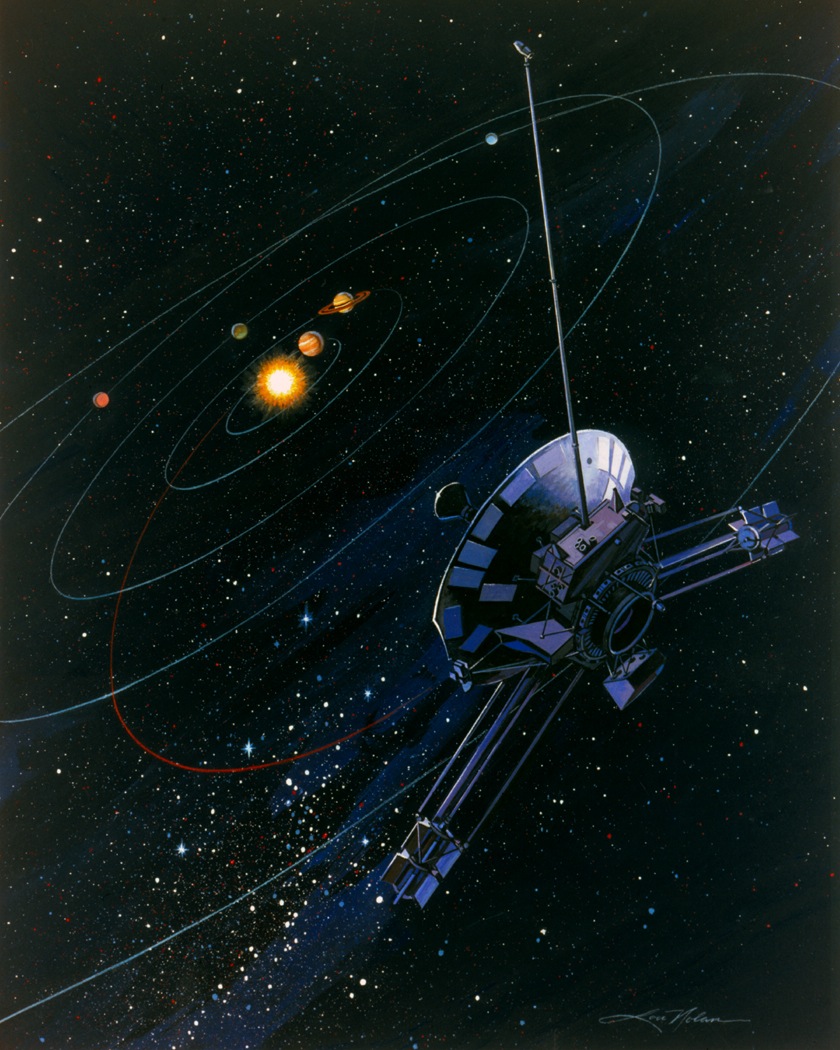
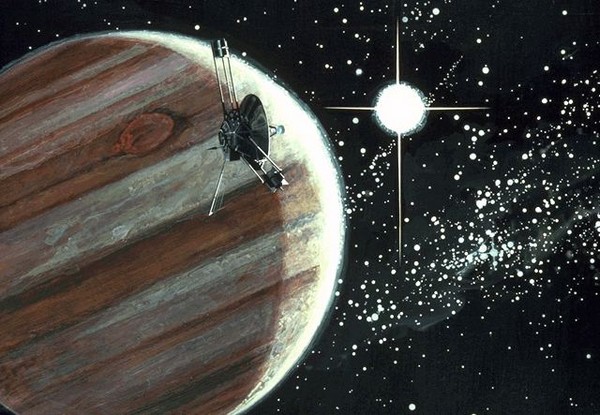
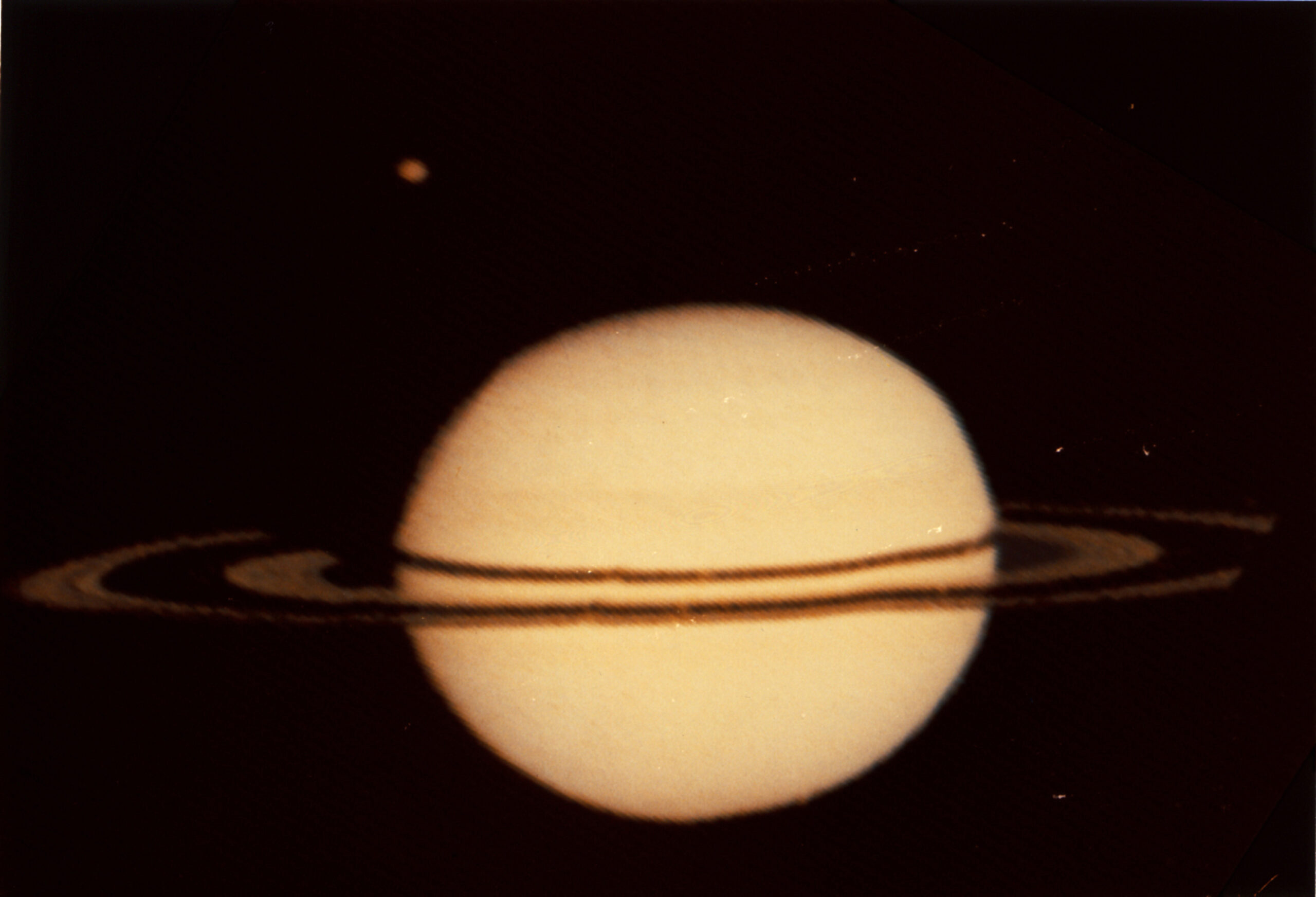
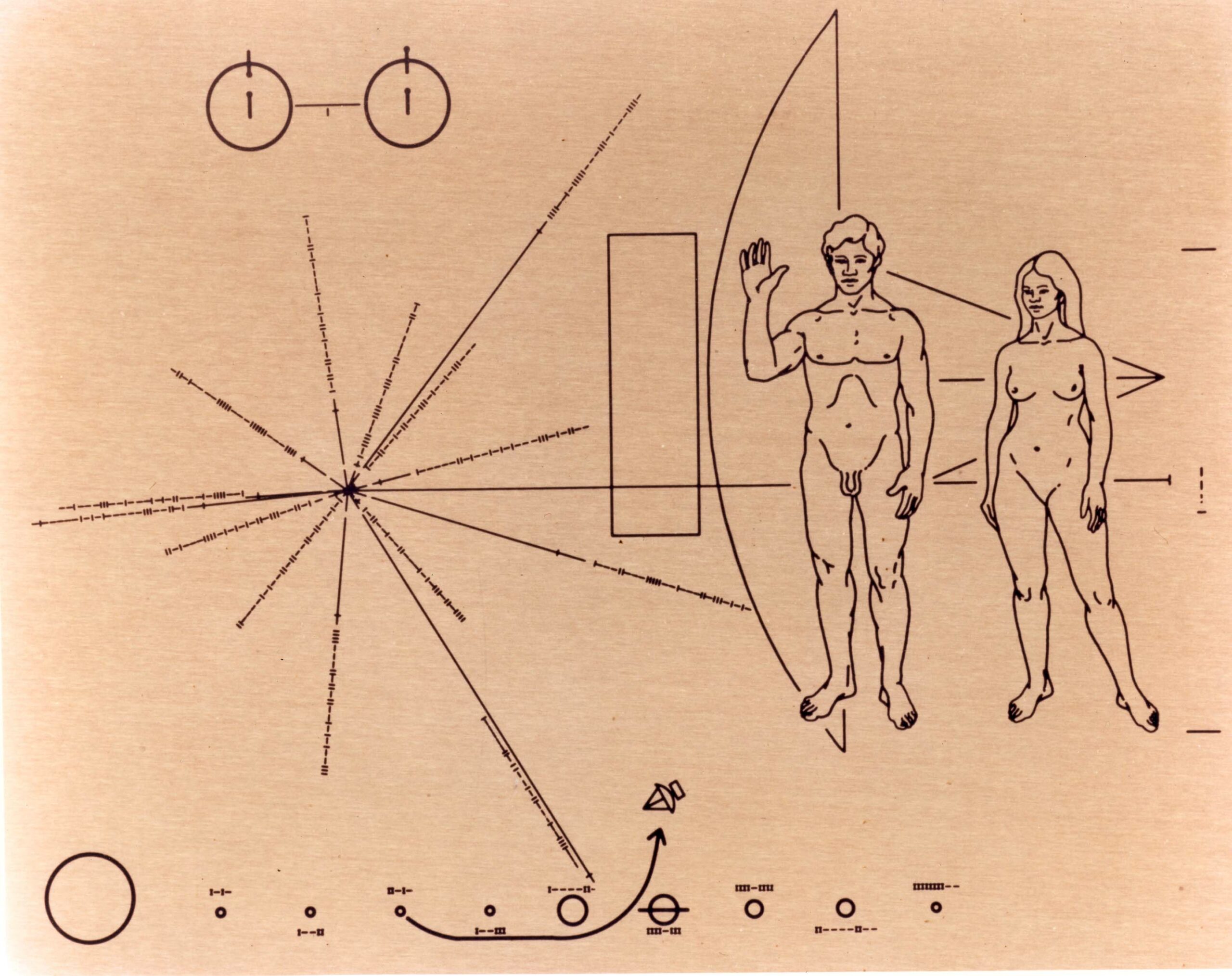
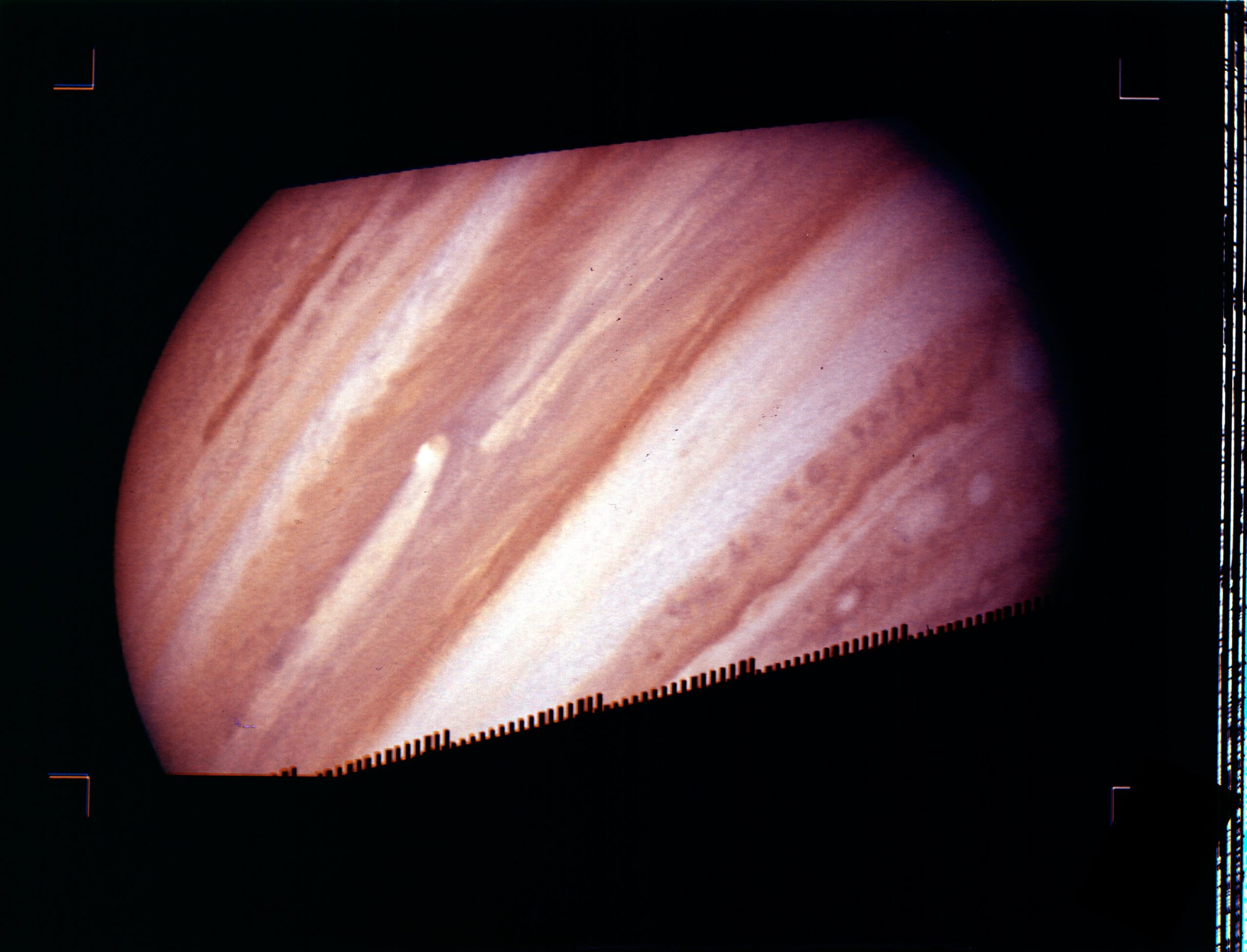
NASA launched Pioneer 10 in the spring of 1972 and Pioneer 11 one year later. The spacecraft’s joint mission was to gather information about the asteroid belt, Jupiter, Saturn (in the case of Pioneer 11), and their moons. As they hurtled past those various celestial objects, the probes measured previously unknown properties of their atmospheres and surfaces; they also photographed Jupiter’s Red Spot and Saturn’s rings up close for the first time. Then, after completing their “flyby” missions in the mid-1970s, the Pioneers kept going. Carrying identical plaques depicting a man and a woman, the atomic transition of hydrogen, and the location of our planet within the galaxy—a message to aliens—the probes became the first manmade objects ever to plunge beyond the solar system into the inconceivable cold and dark of interstellar space.
JPL scientists continued Doppler tracking the Pioneers far into deep space. They sent and received a continuous stream of radio transmissions to and from both Pioneers, logging the velocity of each everywhere along its trajectory. An astronomer named John Anderson led the analysis of the Doppler ranging data. He and his team intended to use the data to study subtle gravitational effects in the outer solar system, far from the overwhelming influences of the sun and larger planets. It was thought, for example, that the Pioneers might oscillate in tune with low-frequency gravity waves.
Of course, in order to detect such curiosities in the motion of the spacecraft, the scientists needed to know exactly what to expect in the first place; this required the construction of an algorithm of truly staggering complexity. Contributing factors to the predicted Doppler shift included: the deceleration experienced by the Pioneers as they struggled against the gravitational pull of the sun, planets, moons, asteroid belts, and comet clouds, the positions and thus gravitational fields of which move constantly; the tiny push on the spacecraft by the sun’s radiation, which weakened with time as the spacecraft moved progressively farther away, and also changed as the angle of the spacecraft changed; the increase in the delay time between the bounce of a radio wave and its reception back at Earth as the spacecraft grew more distant; the gravitational drag on the radio waves from the sun; the additional frequency shift in the radio transmissions caused by the rotation of the Earth… and the list goes on. Anderson synthesized that headache’s worth of cosmic influences into a single algorithm. But unfortunately it didn’t seem to work.
In 1980, he noticed a small discrepancy between the Doppler shifts he expected to receive based on his algorithm and the actual, measured shifts of the radio signals coming from the spacecraft. Their expected and actual motions weren’t quite matching up. As they moved outward against the gravitational pull of the sun and planets, the spacecraft were, of course, slowing down. But the problem was they were slowing down too much. Each year, both of the spacecraft were a few hundred miles farther behind where they should have been on their respective paths, according to the algorithm. That isn’t much in the context of space travel, to be sure, but it isn’t trivial either. The constant, extra acceleration amounted to 8.74 x 10⁻¹⁰ m/s2 directed toward the sun– a factor ten billion times smaller than the acceleration due to gravity, but still, undeniably, there.
Anderson’s first reaction was to think his algorithm must have been missing something. Some tiny influence on the motion of the spacecraft must not have made it into the mathematical mix. A few years of thinking and discussing led him and his immediate team to the conclusion that the anomalous acceleration must have been caused by “outgasing” – fuel dripping from the thrusters, exerting a recoil force against the spacecraft as it dripped. Since by that point the craft were cruising through interstellar space without propulsion, the scientists thought the fuel drops would soon finish dripping and the effect would go away. But perplexingly, it didn’t: Over the next decade, the spacecraft racked up billions of frequent flier miles–but thousands less than they should have.
In 1994, Anderson received an email out of the blue from Michael Martin Nieto, a cosmologist at Los Alamos National Laboratory near Santa Fe, NM. Nieto had lately become interested in alternatives to Newton’s inverse square law for gravity, including a new theory called MOND (modified Newtonian dynamics), and so he contacted Anderson to find out how sure NASA was about the strength of gravity based on their observations of the motions of spacecraft. Anderson replied that, as a matter of fact, gravity didn’t seem to be working right for the Pioneers.
When Nieto read the exact value of the small, anomalous acceleration experienced by Pioneers 10 and 11, he almost fell off his chair. (In typical physics-speak: “My office had a hard floor and my computer chair had wheels, so when I arched my back in a “wha?” reaction the chair started rolling.”) There was a profound cosmic coincidence afoot: As Nieto immediately noticed, the value of the Pioneer anomaly almost exactly equaled the so-called “cosmic acceleration”—the speed of light ‘c’ multiplied by the Hubble constant ‘H’—suggesting the anomaly’s cause lay within the foundation of physics.
Right then and there, Nieto signed on to work with Anderson at JPL, got a major investigation of the Pioneer anomaly off the ground, and has spent most of his energy studying it ever since. Why? “The Pioneer anomaly could be the first evidence that gravity deviates from an inverse-square dependence,” he said recently. “It could be huge.”
Slava Turyshev, who had just arrived at JPL from Moscow, soon joined Anderson and Nieto. Together with three others they launched a detailed investigation of all the available Pioneer Doppler data. At the same time they also checked out data from other missions, and found tentative evidence of anomalies in the trajectories of Ulysses and Galileo as well. [NOTE: Only the Pioneers, Ulysses and Galileo float freely. All other NASA spacecraft are three-axis stabilized: They exert gas thrusts in three directions to keep themselves on track, and these corrections erase any small divergences in motion. All four of the non-three-axis-stabilized craft seemed to the JPL scientists to be diverging.] In 1998 they announced their findings to the world in a can-of-worms-opening article in Physical Review Letters.
Mayhem followed. “1998 was a very interesting year, because right when we made the Pioneer anomaly known, there was the discovery of dark energy,” Turyshev explained. “So basically we realized that the universe accelerates because of dark energy, and people were ecstatic, saying, ‘look, we see something very exciting in the solar system, and maybe we need to modify gravity and all of that will go away, and Einstein and Newton will be, you know, dethroned.'”
Small anomalies in celestial motion have led to upheavals in physics before, after all. It was the famous “anomalous” precession of the perihelion of Mercury that helped prove Einstein’s theory of general relativity in 1915. In 1998, comparisons to that historical precedent undoubtedly raised the profile of the Pioneer anomaly, as well as the profiles of many “outsider” theories that tried to account for it. Of these, one example is the aforementioned MOND, which posits that gravity does not follow an inverse square law at great distances from a massive body, but something slightly different. Hundreds of physics papers published since 1998 assert that MOND offers a viable explanation for the Pioneer anomaly.
Hundreds more hypothesize that the presence of huge quantities of as-yet-undetected “dark matter” pervading galaxies’ outskirts might be exerting a frictional drag force on the Pioneer spacecraft and slowing them down.
Yet another horde of physicists picked up on the coincidence Nieto had noticed four years earlier, when he almost fell out of his chair. In the context of the contemporaneous discovery of dark energy and the accelerated expansion of the universe, it seemed highly significant that the value of the Pioneer anomaly equaled that of the cosmic acceleration. Perhaps, scientists thought, NASA had been measuring the cosmic expansion of space for years!
More conservative physicists pointed out quite rightly that if dark matter or MOND were causing the anomalous acceleration of the spacecraft, then they ought to affect the motion of the outermost planets as well, yet nothing of the kind is observed. In their opinion the Pioneer anomaly was either nonexistent (i.e. the JPL scientists had misinterpreted the Doppler data) or it derived from plain old equipment malfunctions. The most likely culprit was deemed to be heat emission on board the spacecraft.
A Thermal Anomaly?
The plutonium inside the Pioneer’s generators gave off 2,500 joules of thermal energy per second at the height of its powers. Some of that heat got converted into electricity and ran the instrumentation. The rest simply radiated into space. If for whatever mechanical reason the heat radiated out from the generators unevenly, the extra heat radiating in one direction would exert an unbalanced recoil force, causing the spacecraft to accelerate. In fact, as the physics community was quick to point out, just five percent more heat radiating in one direction than the other would cause a recoil force large enough to account for the Pioneer anomaly.
Duly noting that point, the JPL team spent the next few years investigating all heat-related evidence. They came back with their verdict in 2002. Heat: not guilty. For one thing, they said, as the plutonium inside the generators decayed, the heat they gave off decreased, and so if heat were its cause then the anomalous acceleration of the spacecraft ought to have lessened with time as well. But it didn’t – it seemed constant. Secondly, the generators were positioned quite far from the body of the spacecraft on the ends of long poles. From that remote distance, they calculated that very little heat would hit the spacecraft and exert a recoil force – an order of magnitude too little to cause the observed effect. Third and fourth, there was the tentative evidence offered by Galileo and Ulysses, both of which employed quite different power systems from that of the Pioneers.
Their arguments persuaded hordes of physicists, who began vying with great gusto for the thrones of Einstein and his non-relativistic assistant Newton. At conferences and meetings in Germany, Switzerland, the United States, and elsewhere around the world, they pronounced from the podiums such theories as: The anomaly really reflects a cosmic acceleration of time itself! The anomaly shows that Riemannian geometry, from which Einstein’s spacetime is built, is incomplete! We have discovered a new force! The solar system is expanding! The solar system is a hologram! String theory dimensions are tugging on the spacecraft! The lively joust of ideas—or as Viktor Toth describes it, “wild speculation”—has not died down since.
Back on Earth
Viktor Toth’s hobbies include old computer games, unsolved math and physics problems, data processing, outer space, and vintage electronics equipment. Smack dab in the center of the Venn diagram linking all of those things lies the Pioneer anomaly, and so it isn’t surprising that Toth ended up where he is now: in the thick of it. Skeptical from the outset, Toth began by conducting an independent analysis of the publicly available Pioneer Doppler data using his home computers in order to see for himself whether an anomaly actually existed. (By all accounts, Toth’s data-handling skills are phenomenal, and he seems politely suspicious of everyone else’s. “A lot of the shall I call it ‘homework’ doesn’t get done,” he said.) After constructing his own algorithm of celestial influences, processing the data in light of it and confirming that there really and truly was a discord between the two, he then set out to discover why – again, with little regard for past analysis.
In particular, he didn’t think the study completed by Anderson and his team in 2002, which dismissed thermal effects as the cause of the anomaly, was even close to thorough enough. “The realization that there was never a proper, detailed thermal analysis of the Pioneer spacecraft, well that was of course a huge motivation for me,” he said. “I mean let’s get something done, you know?”
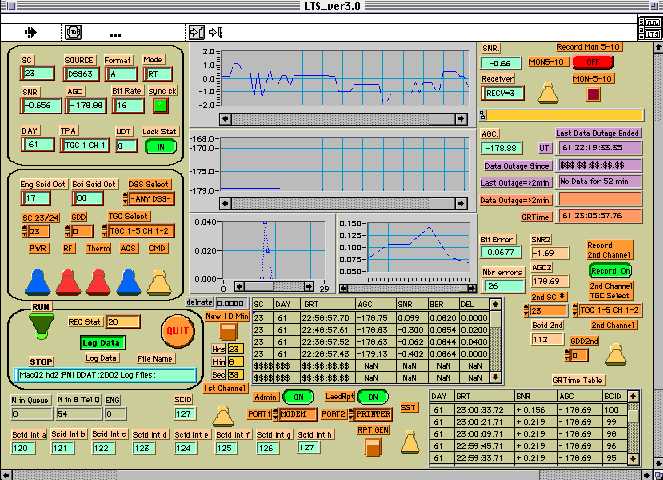
In search of a more complete data set to work with, Toth started corresponding with Turyshev at JPL. They agreed that an analysis was needed of the Doppler data spanning a much longer period of time than the decade-long segment analyzed previously. “The Pioneers were launched on punchcards back in the 70s,” Turyshev explained. “Then they used Fortran, then C, and now we use C++, so we needed to get all that older data converted to modern navigational software.” Alongside the Doppler data, they also decided to analyze the telemetry data from the spacecraft, which Turyshev described as “housekeeping information” collected by 114 sensors covering the surface of each Pioneer and transmitted back to Earth during radio communications. Most importantly, the telemetry data contained information about the temperature everywhere on each spacecraft at every moment for the entire duration of their missions.
It was 2005. Toth drove down from his home in Ottawa and met Turyshev for the first time, at Ames Research Center, where all the old data was stored. When they arrived, they found large dumpsters parked outside the building’s entrance. All 30-plus years of Pioneer Doppler data and corresponding logbooks were due to be thrown out in two weeks. Funding at Ames was skeletal at that time, and it couldn’t afford to archive anything. “When we realized that things were that bad, we were yelling and screaming and dancing and smiling and cheering, and all that led to a little funding left given to the guys at Ames so that they would be able to archive all the materials and all the project information,” recalled Turyshev. “It was very exciting.” As for the telemetry data, most of it was long gone from Ames at that point, but fortunately a retired Pioneer mission control engineer named Larry Kellogg happened to have saved all of it. In hopes of someday building computer simulations of the Pioneer missions and streaming them online, he had copied all the old files onto his laptop before retiring and leaving Ames. When the logbooks got tossed, a former colleague dug them out of the dumpster and sent them to Kellogg as well. Kellogg met up with Toth and Turyshev in the Ames parking lot and handed everything over.
Then their work began in earnest. How did Turyshev feel about Toth’s criticisms of the analysis done previously by him and his JPL team? It seems he agrees that mistakes were made. “If we knew in 2002 what we know today, we would have done the analysis in a slightly different way,” he commented. “In the meantime people spent years studying this. Now, I feel responsible for bringing closure.”
Five years have passed. Using the telemetry data, the two scientists created an extremely elaborate “finite element” 3-D computer model of each Pioneer spacecraft, in which the thermal properties of 100,000 positions on their surfaces are independently tracked for the duration of the 30-year mission. Everything there is to know about heat conduction across the spacecraft’s surfaces, as well as the way that heat flow and temperature declined over time as the power of the generators lessened, they know. The results of the telemetry analysis? “The heat recoil force accounts for part of the acceleration,” said Turyshev. They wouldn’t tell me how significant a part. (Turyshev: “We’d like to publish that in the scientific literature.”) But according to Toth, “You can take it to the bank that whatever remains of the anomaly after accounting for that thermal acceleration, it will at most be much less than the canonical value of 8.74 x 10⁻¹⁰ m/s2, and then, mind you, all those wonderful numerical coincidences people talk about are destroyed.”
But the results of thermal simulations don’t stand alone; after all, they show a decline in thermal acceleration over time, and in the past, the Pioneer anomaly was always believed to be constant. The simulations must match up in time with the Doppler tracking data, the analysis of which is not yet finished. Multiple conversions over the years severely corrupted the Doppler files, and it took two years to read them. More time was spent locating some crucial logbooks (found in the mementos of another retired mission control person). Additional time was spent accounting for the way 30 years of earthquakes had shifted the locations of antennas that received Doppler data from the Pioneers. Actual analysis of the data finally began one year ago, and Toth and Turyshev expect to publish their results in about six months.
I asked for a sneak peek. “Though the constant acceleration idea is a valid model, we have begun to see that it is equally valid or a better yet if we assume that there is some decay – that the acceleration is slightly decaying with time,” said Toth. Furthermore, he told me, he and Turyshev have been re-addressing the question of which direction the anomalous acceleration points in. It may not be sunward after all, as was always assumed. And a non-sunward acceleration would suggest a non-gravitational cause. “Our results are very suggestive, but I want to wait until we’re completely finished before saying anything more about it. There is a community of physicists interested in the Pioneer anomaly, and I have become quite aware of how desperately sensitive this thing can be.”
After decades spent thinking, arguing, hoping, and in the words of Turyshev, “making a career off of it,” these scientists’ interest in the Pioneer anomaly has, understandably, accumulated psychological baggage; in the case of many of them, a cloud of emotional investment has formed around the core of objective scientific inquiry. And clouds obscure things.
“Is the Pioneer anomaly just caused by the spacecraft? You get a cross section of feelings if you just declare it,” said Larry Kellogg, the engineer who rescued the telemetry data. “That’s why Viktor and Slava are being very careful about what they’re saying right now. If they ever come to the point where they say, ‘we’ve proved beyond the shadow of a doubt that the spacecraft were just heating up and pushing backwards,’ then you can bet that all the people who’ve ever said anything are going to say something else.”
For Nieto, who stands solidly among the ranks of the “people who’ve ever said anything,” this will be the case. “I encourage their work,” he said, “but I’ll be skeptical of the results. And of course, they won’t be entirely sure either. We might just argue back and forth forever.”
Other physicists are more combative. “Heat? That’s simply not the right explanation. They are wrong,” commented Johan Masreliez, an independent researcher in Washington who supports the expanding spacetime model of cosmology, for which it is crucial that the value of the Pioneer anomaly equals c times H. “But then I’m biased,” he added.
In April, Turyshev and Toth published a comprehensive 165-page review article on Arxiv.org called, simply, “The Pioneer Anomaly” to set the stage for the forthcoming publication of their reanalysis. The review begins with two historical anecdotes of obvious pertinence. One is the story of the anomalous precession of Mercury’s perihelion, the seed that 60 years later blossomed into Einstein’s general relativity and the end of physics as it stood. The other is a lesser-known tale of anomalous celestial motion. Around the turn of the 19th century, astronomers noticed that the distant planet Uranus had a funky orbit; it deviated from the path prescribed for it by Newtonian gravity. “Some prominent astronomers suggested that perhaps Newton’s laws break down at great distances from the Sun,” wrote Toth and Turyshev. Speculation of that kind lasted until 1846, at which point another distant planet was discovered right where it needed to be to perturb the orbit of Uranus in just the way it was perturbed. That planet was Neptune, and “Newton’s law was safe.”
Though Turyshev’s and Toth’s results can’t possibly hope to be as rock solid as a new planet, by the sound of things, they themselves have become convinced of the thermal cause of the anomaly, and the sanctity of Newton’s law. “Let me tell you this,” said Turyshev, as I begged him for details about the analysis. “Physics as we know it worked well.”
NOTE: As a few readers have pointed out, we ran another story this week recognizing Voyager 1 as the first spacecraft to leave the solar system, while this article gives the honor to Pioneer 10. To clarify, there are two definitions of “leaving the solar system” in play here. Pioneer 10 passed the orbit of Pluto in 1983, and so in that sense, left the solar system. Though the Voyagers got launched after the Pioneers, they travel faster, and thus overtook the Pioneers in the 1990s. Voyager 1 has just reached the edge of the heliosphere, another boundary of the solar system.