
It has a jet engine’s roar but not the accompanying whine-just an ear-shattering thunder. And the airplane is far too small, like a Volkswagen with a semi’s air horn. It blasts down the runway, climbs steeply, and then hurtles away from the crowd lining the fences at Las Cruces Airport in New Mexico, dwindling rapidly into a clear October sky. The roar fades, disappears. The plane, dubbed the EZ-Rocket, sails through a turn, wings back toward the spectators. Rick Searfoss, the Air Force-trained test pilot and former space-shuttle commander at the controls, glides in silence until he relights one of the two isopropyl-alcohol-powered rocket engines. He banks left, blasting through a high S-curve at 160 mph to come back around parallel to the runway, and swings the rocket’s faint blue exhaust toward the cheering crowd. These people have come to the first annual commercial- spaceship expo, the 2005 X Prize Cup, to see the next generation of rocket vehicles, and they aren’t disappointed. But no one’s having as much fun as Searfoss. “Let me just tell you, it’s a kick in the pants,” he exults after landing.
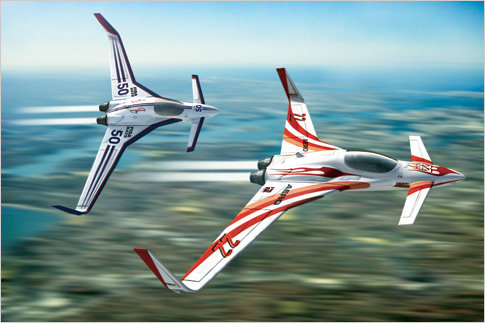
Soon, if all goes well, 10 rocket-powered planes like these, only bigger and faster and belching 10-foot-long orange and yellow flames, will speed around a two-mile long, 5,000-foot-high racetrack, competing for a $2-million championship purse. That’s the vision of space entrepreneur Peter Diamandis and former Indy Racing League team co-owner Granger Whitelaw, co-founders of the Rocket Racing League (RRL). The duo formed the League last year with the idea that automobiles tooling around a flat, oval racetrack are so last century. The RRL plans to debut the first of the bigger, badder rocket planes, called the X-Racers, at the 2006 X Prize Cup this October and to fly up to 10 of them in races around the country in 2007, leading to a championship race at the 2007 X Prize Cup.
Diamandis and Whitelaw hope to draw Nascar and IndyCar-size crowds and home viewers. They’ll be watching on major network shows sponsored by top corporations. Of course, it all depends on raising millions in start-up capital, attracting team owners willing to pay just under a million bucks per X-Racer, building the airplanes, and, perhaps hardest of all, convincing sports fans to spend money on yet another event competing for their attention. A tall order by any estimation.
But Diamandis has built a career on making the impossible happen. His $10-million Ansari X Prize for the first private spaceship helped blast space travel out of the realm of big government programs and into the private sector. Now he wants to make spaceflight affordable to the average citizen. “I am one of those guys who grew up loving space and always feeling like it was just out of reach and being made impersonal,” he says. “My mission in life is to make space a personal experience.” For Diamandis, working toward that much loftier goal, the Rocket Racing League is just an intermediate step, one that will use a sporting event to propel rockets into the mainstream.
Ramping Up
To launch this venture, Diamandis turned to Whitelaw, who was a venture capitalist as well as an auto-racing pro. He and Diamandis became friends in 2000, when Diamandis joined a technology think tank co-founded by Whitelaw called TrendSphere. Soon afterward, Whitelaw took Diamandis to his first auto race, the Indy 500, and that night, in animated discussion, they sketched out the ideas behind rocket racing. But it wasn’t until after Burt Rutan’s com-pany, Scaled Composites, won the Ansari X Prize with SpaceShipOne in 2004, and Diamandis had established the X Prize Cup, that he and Whitelaw got down to work in earnest.
Their challenges were legion-creating not only a new racing league but an entirely new class of racing is
a once-a-century undertaking. They needed to develop safe, reliable rocket technology for the aircraft, establish truly competitive racing for the “skytracks,” develop new ways for spectators to experience the races, and convince fans and sponsors to buy into the idea.
First things first, though: Get some rocket planes. Fortunately, they had a head start in a rocket-powered airplane built by XCOR Aerospace. Based in Mojave, California (like Scaled Composites), XCOR was working on a suborbital spaceship of its own and had rocketized a homebuilt Rutan design, the Long-EZ airplane, as a technology demonstrator-the EZ-Rocket. Soup
it up with a more powerful, longer-
running rocket engine, change the fuel to kerosene for a bright orange-and- yellow exhaust plume, give it the
ability to rapidly refuel at pit stops, update it with a state-of-the-art GPS race-navigation system, and you’d have an IndyCar of the skies. An X-Racer.
Diamandis and Whitelaw brought XCOR into their new venture and hired Searfoss, already employed as XCOR’s test pilot, as their chief pilot. The team decided on a Long-EZ-based aircraft from small manufacturer Velocity
Aircraft in Sebastian, Florida, as the airframe for the X-Racers. Though larger than the Long-EZ, the Velocity planes are also pushers, with the prop in the rear instead of at the front. Replace the engine and prop with a rocket motor, and it’s perfect for the X-Racers.
There was just one problem: The engineers at XCOR didn’t know if a viable rocket racer could even be built. “We were afraid we might have a law-of-physics problem,” admits XCOR president Jeff Greason-specifically, a niggling concern about the feasibility of refueling the rockets rapidly enough to turn them around four or more times during a single hour-long race. The success of the Rocket Racing League depends on the X-Racers landing and making pit stops, just like their four-wheeled counterparts. Diamandis and Whitelaw figure the X-Racers should spend less than 10 minutes at a pit stop, and preferably no more than 5. Greason had to laugh when he heard that; the EZ-Rocket ordinarily needs two to three hours of prep time between flights, including half an hour to 45 minutes just to load the liquid oxygen (LOX) that the rocket fuel needs to burn.
XCOR chief engineer Dan DeLong and his team had been considering the LOX-loading problem for years. They saw rapid refueling as a key to lowering the cost of spaceship operations, the goal of most of the space entrepreneurs, and they had already considered many possible solutions. They will be helped in this case by the fact that X-Racers making pit stops will have tanks pre-chilled by their first loads of LOX-
tanks holding cryogenic liquids like LOX take longer to fill than other tanks because the first liquid hitting the tank walls boils like water on a hot skillet-but the rest of XCOR’s plan to reduce load times calls for using a new, proprietary device to fill the vehicle’s tank.
Last October, XCOR engineers ran a test on a spare EZ-Rocket tank on the tarmac just outside the company’s hangar at Mojave Airport. The tank filled with 250 pounds of liquid oxygen in 50 seconds. As far as Greason knows, that’s never been done before.
The X-Racer’s increased fuel requirements presented another challenge-delivering fuel under pressure. Since the Velocity aircraft isn’t designed for pressurized tanks, the X-Racer’s rocket would have to be pump-fed. Pump-fed rockets typically use high-speed turbopumps to force the kerosene in at velocities similar to pressurized tanks, but, at a million dollars a pop, a turbopump was out of the question. Instead XCOR tested a new reciprocating piston pump. Though less complex and less expensive than a turbopump, it delivers fuel in spurts, like a bicycle pump squirting air into a tire. DeLong and his team designed an accumulator that would build up pressure in a separate chamber and deliver it to the engine in a steady flow. DeLong and his engineers recently set up the piston pump on a bench on the XCOR shop floor and ran water through it to simulate rocket fuel.
The system performed very well, and with the two biggest engineering dilemmas resolved, Greason felt confident enough to sign off on building the RRL’s planes. Diamandis and Whitelaw were off to the races-almost.
Thrill Rides
Next comes the question of how to make the races competitive for the pilots and engaging for viewers. What no one wants is airplanes screeching around together for 15 minutes and then all pitting simultaneously.
The answer is a staggered start-the pilots will take off in pairs a few minutes apart. They’ll be competing against the clock for the best overall time but racing to maneuver around one another to keep their times low. With up to 10 X-Racers planned for the early RRL races, several of them will have their engines lit at any given time, taking off, climbing, and roaring through high-G turns at up to 230 mph. Each plane’s 1,800-pound-thrust rocket engine will blow through its fuel in four minutes of total burn time, requiring at least four landings for pit stops during each hour-long race, with up to 15 minutes of flight time between stops. The pilots will stretch their flight time by gliding when possible and reserving rocket boosts-each lasting between 5 and 30 seconds-for crucial moments like passing other racers.
Managing their planes’ energy, Searfoss says, will be a big part of the strategy. But during those four minutes of boost time, the plane’s high thrust-to-weight ratio will give it acceleration like that of an F15, which should make things exciting for the pilots.
Searfoss and fellow Rocket Racer and world-class aerobatic pilot Sean Tucker will help select those pilots. They will have no trouble finding recruits, according to the RRL’s business development manager, Michael D’Angelo. “We have received inquiries from retired fighter pilots, astronauts, aerobatic pilots and automobile race-car drivers who also happen to fly jets,” he says.
Will They Come?
Perhaps the Rocket Racing League has the technology, the engineering talent, the financial backing (from Whitelaw, Diamandis and other partners) and the right stuff to get the venture off the ground. But will it fly?
Whitelaw and Diamandis insist that rocket racing will have more in common with auto racing than with the comparatively invisible air races, such as the annual Reno Air Races, which are more of a niche sporting event. They plan to put together racing teams along lines similar to IndyCar and Nascar, with ownership open to anyone who can pony up the fees (about a million dollars per team per year) and meet RRL standards. And, of course, they’ll try to attract corporate sponsors.
All of which depends on drawing from the millions of fans who make auto racing a major industry. Doing so, however, could be the RRL’s biggest hurdle. “All auto-racing series try to capitalize on the relationship that people have to their cars because they drive them,” says Indy Racing League executive vice president Fred Nation. “All of us probably feel in some ways, â€Well, I can do that.’ ” Never mind that few fans could successfully compete in an auto race-the point is that they can imagine themselves in the driver’s seat and experience the races vicariously. That will be harder to do with Rocket Racing, since most people don’t fly planes. Also, Nation says, “Auto racing gains part of its appeal from the risks the drivers take. You can clearly identify with the risks that auto-racing drivers take because you can see that it’s close. In the Indy Racing League, they’re wheel-to-wheel. What is really close, I would imagine, for rockets or airplanes, may not appear that close.”
And that disparity points up the central struggle of the RRL. Like the emerging commercial spaceflight industry in which it hopes to play a part, it’s being formed by visionaries groping for ways to make their dreams pay their own way. Tourist spaceships that will fly wealthy fellow dreamers into space, such as those to be built by Scaled Composites for Virgin Galactic, have the potential to succeed. Rocket-powered race planes that can’t reach space might face a more difficult challenge, because they will have to appeal to the broader audience of fans who may not be so starry-eyed. But there’s only one way to find out if the plan will work. Gentlemen, start your rockets.
Michael Belfiore, who lives in Woodstock, New York, is writing a book about commercial spaceflight.
