
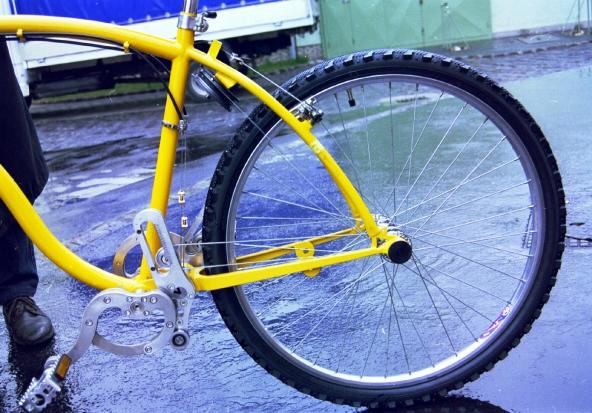
Meet the Stringbike

Chainless Bike The new Stringbike uses steel wires instead of a chain. Hungarian Ambiance

A Hungarian design team has unveiled a new chainless bike, powered by steel wires, that easily disassembles and can be organized for touring or racing.

The “Stringbike” uses two steel cables attached to pulleys, which move on swinging kidney-shaped discs as you pedal. The discs replace a traditional round gear system, and you can install different discs depending on your needs, according to the Web site Hungarian Ambiance.

The position of the pedals determines the position of the discs, so that they swing in opposition — one is always pulling the bike forward, and the other lags behind. This allows a continuous transmission change, which could help a rider navigate winding streets, because you can more easily control the transmission without having to shift gears. This video demonstrates the concept.


Unlike a typical 10-speed with a derailleur, you won’t feel any slippage when you shift gears — higher or lower gear is obtained by higher or lower placement of the pulleys.

The wires can even be set asymmetrically, which would provide a different weight load on each leg because one would have to work harder than the other. This is impossible with a traditional geared bike, but it could be useful for training or for riders with injuries, as Hungarian Ambiance points out.

The Stringbike, developed at bike-maker Schwinn Csepel Ltd., is also more convenient for those without racks — both wheels come off quickly and cleanly, because there are no chains or derailleurs to align. Bike commuters won’t have to worry about chain grease soiling their khakis, either. And because there are fewer components, it could eventually be cheaper to produce than traditional bikes.

Plus, it looks cool, meaning the Stringbike could be the hipster set’s next obsession. At least it’s more functional than the ubiquitous fixie.

[Hungarian Ambiance

20 Comments

Good old American ingenuity......oooops.....you said Hungarian. Well it's still an ingenious idea. And it's going to make some Hungarians very, very rich.

There are other kinds of chain-less bikes already.
(Search Wikipedia for "Chainless bike")
I think the hydraulic type is best tech.

Look at the way the cams on the pedals push and rub the other cam like things, and you say it doesn't need grease and doesn't heat up. I bet you could fry an egg on the heat that'll produce.

More functional than a fixie!? Please. Have you ever ridden a fixed gear? Nothing is more down-to-basics, easy to use and repair, or fun to ride than a fixed gear. And one look at that Hungarian Rube Goldberg machine confirms it. I've commuted by fixed gear for four years and nothing gives me a faster, easier, more powerful command of the road than mine. If I blow a tire, I can have it patched up in no time. 10,000 bike messengers can't be wrong!

Eerschr, you are tough, most people aren't as tough as you and need a little gear ratio to get going on a flat surface, forget about hills, even I when I was a bike used a ten speed not a fixie

The wires, even braided cables, will work-harden and snap. They'd do better with chains or even, not so well, with belts.

Reminds me of a '63 Tempest my dad had for a while. It used a cable drive shaft to propel the car.

You be good or I'll snip your strings!

Along with the issues other posters have mentioned, the mechanical efficiency of this bicycle is half that of a chain driven bike. You can only pedal on the down stroke here - this might work for the casual rider, but anyone who rides more than just once in a while soon discovers that pedaling in a full circle is more efficient, better, easier, more environmentally friendly, easier to get dates with, etc. Oh, btw, a wax-based lubricant takes care of the 'grease' canard. And a little rain and slush and street grime will make anyone dirty if they touch their wheels.

I'm not convinced.

I noticed there is a second short video after the first one.

Notice that right behind the seat post and running down near the peddle area, there are two more cables that look like they run-up to the handlebars, but I don't see the brake mechanism or the brakes on the wheels, so I don't know why the run down toward the crank bearings unless there is some sort of brake built into the crank?

Anyway, in the short 2nd video they seem to rise as the peddle moves. So is it one long wire-string from one pedal wrapped around the read hub, up the seat-post and over to the second pedal?

I' need to see a few more drawings on this and maybe an actual working bike in person.

The bike seems like an unecessary complication to a splendidly simple machine, and I wouldn't think of riding that thing with laced shoes or with long pants.

If you snap a cable in the back country, how are you going to repair it? With a chain tool, you can shorten the chain a little and get back on the road.

However, it's a pretty trick idea for forward motion. Just make it practical.

Wow! That looks needlessly complicated and ugly.

Gates carbon belt drive like on the Trek District or Raleigh XXIX or many other mainstream bikes. It's chainless, requires no grease, runs in mud/grime etc. just fine, works with existing wheels/crank arms, lasts for thousands of miles, and best of all ridiculously simple.

Hands down a better option than that monstrosity!

This technology only has half of the gear range of a conventional bicycle and less that which most riders would demand at a minimum. Further the back wheel is extremely weak laterally due to the spokes being crowded into the center by sting spools on each side. This design has vastly more bearing cartridges than a conventional bicycle, even more than a full suspension bicycle has pivots. The argument that the bicycle has increased ground clearance is somewhat ridiculous given that the design would be easily destroyed by sand and mud. A chained bicycle also has more bearings if you count every link however these bearings are cheap and when sand and mud destroy them, they can be easily and cheaply replaced.

Very bad research, we are selling such bikes on behalf of a taiwanese industrie for about 12 years already and there does not exist a hungarian nor a US patent or developer. Being this of no importance at all but important to know or to learn that sales and production of such bike did no work that good you might expect. US and European bike industries blocked so did the glorious political smart bunch. May this example show you why you never get to see whats really possible.

throw it on a leccy !
www.thekpv.com
The hybrid electric kinetic powered vehicle

Nice contraption, I just can't figure out how the cable is rewound on the rear wheel hub! In my simple-minded way of thinking the hub, or rather both left and right hubs must work like ratchets and a spring has to rewind the cable on the hubs. This spring (spiral I presume) must be extended with each forward pedal stroke, hence providing a resistance to the pedalling motion. Intuitively this might be a greater force than the conventional chain friction. Also the pulley that impels the lever and runs in a groove inside the torque disk will have significant friction. I fear a rapid wear out of both, pulley and disk. How the springloaded double hub system would allow for easy rear wheel exchange, really beats me?

WOULD YOU LIKE TO HAVE PATENT?

GREAT BUSINESS OPPORTUNITY FOR CYCLE MANUFACTURERS AROUND THE WORLD

I HAVE DEVELOPED NEW DRIVING MECHANISM FOR BICYCLE/RICKSHAW HAVING FOLLOWING ADVANTAGES OVER CONVENTIONAL SYSTEM.

I AM READY TO SELL THE INVENTION ALONG WITH PATENT RIGHTS / COMMERCIAL DEVELOPMENT & SELLING RIGHTS ON MUTUALLY AGREED TERMS & CONDITIONS.

IN CASE YOUR COMPANY IS INTERESTED, PL. CONTACT ME. MY MOBILE NO. IS +919424140739.

ADVANTAGES OF NEW DRIVING MECHANISM
BY- R. P. NAIK

1. Both legs can drive simultaneously: Due to independent nature of driving both of the legs can be utilised for driving simultaneously whenever required. This will help in dead start or accelerating with high load at step gradients or rough tar rain etc.

2. Continuous driving torque: The driving force on the rear wheel (s) will be a continuous one. As soon as a leg finishes its driving stroke the other leg will start its driving stroke and hence virtually there will be no time of zero torque.

3. More force than driver’s weight can be applied without fatigue: The backrest provided will give support to driver in such a way that by utilizing reaction from backrest, the driver can put on force more than his own weight whenever required.

4. No stress in portion above the waist: Due to same backrest, there will be no stress developed above the waist and back pen and hand tension will be eliminated.

5. More angle turned by thighs & knees ensure more force available when required: Due to position of seat and paddle, the angle turned through by thigh and knee for any stroke of driving will be more than corresponding angle in case of ordinary cycle (rickshaw) hence there will be more work done available per driving stroke of the paddle.

6. Crippled persons can use their able leg: The same system of driving can be utilised for handicapped person’s tricycles. In these, the handicapped person can use his able leg along with his hand for driving the tricycle. If the amputation of a leg is below the knee; than he can use even his stump as well as his able leg for driving with the help of suitable padding and paddle modification.

7. Easy adaptability for existing manufacturers: Once this system proves its utility and is accepted for increased speed /load carrying capacity of rickshaw, the existing cycles or rickshaw manufactures can easily convert to this design without altering many of their facilities.

8. Gear arrangements: Suitable gear arrangements will enhance speed / load carrying capabilities tremendously.

I AM READY TO SELL THE INVENTION ALONG WITH PATENT RIGHTS / COMMERCIAL DEVELOPMENT & SELLING RIGHTS ON MUTUALLY AGREED TERMS & CONDITIONS.

IN CASE YOUR COMPANY IS INTERESTED, PL. CONTACT ME.

FOR ADVANTAGES OF NEW SYSTEM PLEASE CLICK DOCUMENT NO. 13731738 ON "scribd.com". [CYCLE MANUFACTURERS INTERESTED IN JOINT PATENTING WE CAN REAP BENIFITS TOGETHER].

At least one plus I see - my trouser leg won't get in the chain. Construction is simpler, there is less chance of breakage, simpler gear. No need to oil. You achieve increased attention of the opposite sex, possibly with the help of this thing you will find your sole mate. Everybody would pay attention and want to take pictures. Transmission can be switched even while standing, with no risk to break the gear. The chain will not fly down. Also, they say it's simpler to turn pedals. So it's very comfortable.

Popular Tags

Regular Features


June 2013: American Energy Independence

Five amazing, clean technologies that will set us free, in this month's energy-focused issue. Also: how to build a better bomb detector, the robotic toys that are raising your children, a human catapult, the world's smallest arcade, and much more.


Online Content Director: Suzanne LaBarre | Email
Senior Editor: Paul Adams | Email
Associate Editor: Dan Nosowitz | Email
Assistant Editor: Colin Lecher | Email
Assistant Editor: Rose Pastore | Email

Contributing Writers:
Rebecca Boyle | Email
Kelsey D. Atherton | Email
Francie Diep | Email
Shaunacy Ferro | Email

circ-top-header.gif
circ-cover.gif