
You Built What?!
Marcus Kayser's Solar Sinter project turns the desert's resources into bowls

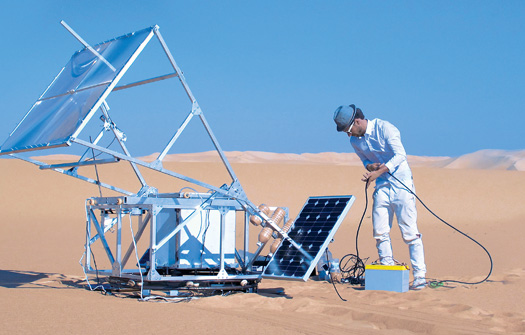
On Balance To keep the giant lens from tipping the whole printer over, Kayser filled water bottles with sand and affixed them to the arms near the solar panels as counterweights Amos Field Reid

When design student Markus Kayser wanted to test his sun-powered, sand-fed 3-D printer, he knew the gray skies outside his London apartment wouldn’t do. So he shipped the 200-plus-pound contraption to Cairo, Egypt, flew there himself, and haggled with officials for two days to get it out of customs. A few small “tips” and 11 hours of driving later, he finally made it to the Sahara. But soon the mercury hit 104 degrees, his components nearly overheated, and he was forced to improvise.

The idea for the printer first came to Kayser a few months earlier. He wanted to find a project in which the sun did more than just power a device. He researched possibilities online, talked to physics professors, and learned about a process in which sand, heated to its melting point, cools into solid glass. With enough sun, a large lens and an ample supply of sand, he figured he might be able to produce glassware.
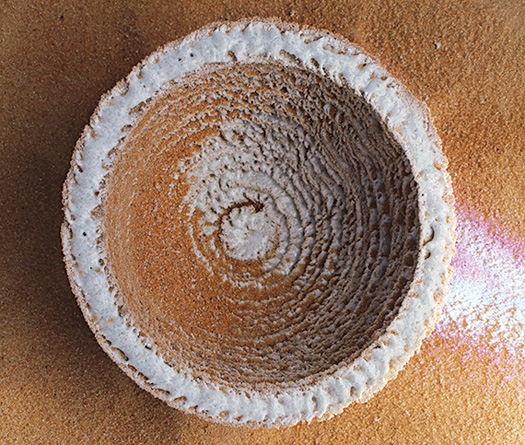
Solar Art: Markus Kayser’s homebuilt 3-D printer created this glass bowl out of heated sand from the Sahara  Amos Field Reid

For the printer to work efficiently, the focal point of the lens would have to be trained right onto the surface of the sand. He knew the sun would move and the focal point would shift during the process, so he ordered a single 4.5-foot-wide lens and built a motorized frame for it. The central sandbox, in which the objects are printed, shifts in all directions, and the entire machine rotates around its center. Two aluminum arms, holding the lens at one end and solar panels at the other, can pivot from straight overhead down to a 45-degree angle to chase the sun. directed by a CAD design from a connected laptop, the printer uses the concentrated beam of sunlight to slowly trace an object into the sandbox layer by layer. The sun melts the sand, which cools into glass.

When the electronics began overheating, Kayser cut open a soup can, sliced and bent its sides into fan blades, attached the creation to a spinning DC motor, and aimed it right at the circuit board. The sun melted only the sand, and, after more than four hours, he printed a glass bowl, and later several sculptures. He admits they’re not perfect; he says he could have used more-complicated optics. But, he adds, perfection wasn’t the point: “This is about showing the potential."

How It Works

Time: 8 weeks
Cost: $3,500
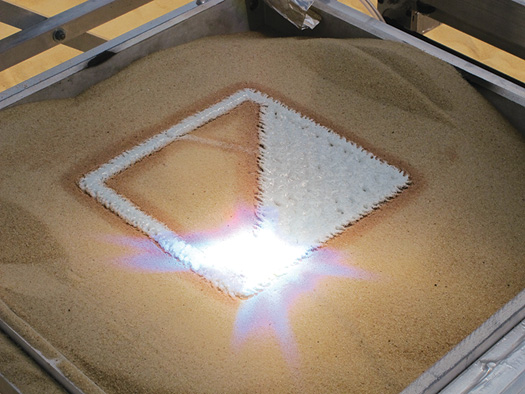
Focal Point: After all the layers are done, Kayser digs the object out of the sandbox  Amos Field Reid

TRACKING

Kayser attached a cylindrical sun tracker to the frame perpendicular to the lens. When the sun is directly in line with the lens, it shines straight through an opening in the top of the cylinder. As the sun shifts, the light comes in at an angle, creating shadows within the cylinder. Sensors inside detect the shadows and feed the data on their position to Kayser’s computer, which directs the motorized frame to adjust to properly align the lens.
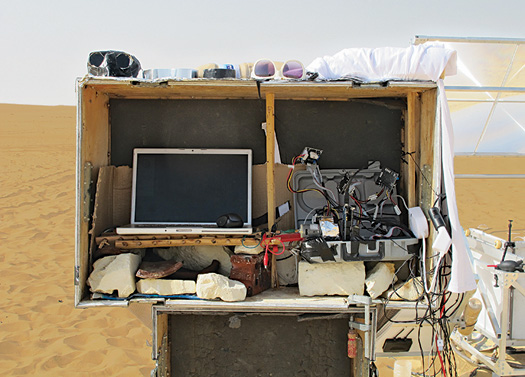
Control Panel: The printer’s motors, the electronics, cameras and a laptop all run on batteries charged by the solar panels  Amos Field Reid

PRINTING

Kayser first designs the object he wants to print in a CAd program. His computer sends instructions to the printer, which works from the bottom up. After a layer has cooled into glass, he adds more sand to the sandbox in the center of the machine and flattens it out, and the printer begins heating the next layer. Kayser’s first major piece, a bowl, took about four and a half hours to print.

POWER

Two photovoltaic panels, one on either side of the machine, keep the printer powered. since the panels are attached to the same arms as the lens, they also benefit from the sun tracking, which ensures that they always get direct light.

Want to read more articles like this, plus tips and tricks, home hacks, DIY projects, and more? Subscribe to Popular Science today, for less than $1 per issue!

16 Comments

If this can be refined and automated, this could mean real potential for the otherwise barren landscape of the Sahara. This is exciting!

This little solar 3D printer could be the beginning of making bricks in the desert and roof shingles, all without the use of water.

This thing is awesome! So cool to see this kind of tech being developed. VERY COOL!

These few objects we see in this article now, perhaps 100 years in the future will be worth millions as we all live in glass houses and learn not to throw stones!

With the news I'm hearing about this technology, it stands to reason that a prediction could be made that this technology may be the next revolutionary front runner in exponential advancement trends in technology.

The first thing was aircraft. The next thing was computers. This stuff will be competing with robotics in terms of exponential development.

"The person is smart. People are dumb, panicky, dangerous animals and you know it. Fifteen hundred years ago everybody knew, the Earth was the center of the universe. Five hundred years ago everybody knew, the Earth was flat, and fifteen minutes ago you knew we were alone in this universe. Imagine what you know, tomorrow."
-- Tommy Lee Jones as Agent K, Men In Black, 1997

Bubba your s/n may change but your comments don't

Something that bothers me is the rigid layers. The thing is made of solidified molten sand, now sand it or put it in a tumbler.

xalar,
Ptsss, ptsss, hey buddy! I have a secret. This is a prototype invention he hurried and brought to the desert as fast as he could. He was excited and wanted to see if it was possible. Now he can go back to the lab and further develop it. It’s a baby prototype. Give the guy some slack. I think it’s an awesome invention!

Where did i see this before?

I think I saw it on TED talks at some point.

What if someone puts a few of these on the moon to first build bricks and then anneal them together via robot? A moon base could be built before any human actually lands there, mostly from materials right on hand.

Pi * R^2? Pi are round, cornbread are squared

Steve J's death got me thinking. I'm a Boomer, the generation before me was called the "Greatest Generation" by lots of notables. I think that my generation and the newer ones are greater than that for the following reason:
Jobs and Gates built the computer revolution in their garages for god's sake. Minds like these used to be a "Once a Generation "kind of thing and look how many innovators and designers and inventors they've turned out. Once there was a Leonardo,a Newton, an Einstein etc.,now we have (or had) Jobs, Gates, Hawking, and guys like this that build inexpensive machines that produce something out of (practically) nothing.
Ladies and gentlemen, I rest my case.

"What if someone puts a few of these on the moon to first build bricks and then anneal them together via robot? A moon base could be built before any human actually lands there, mostly from materials right on hand."

Or, on Mars!

Great Idea, humble beginnings. Maybe in twenty years we will have a Navy of Solar powered Sea cleaning bots, that will slowly build another copy of itself (Sans Computer and Software) out of the tons of garbage floating in the Pacific Ocean. A 100 meter sailboat built from waste products and programmed to sail to Cuba or China. Could we build a robot to make a 3D Congressman that was honest or poor? How about a new Washington Monument built from solar melted 2 liter soda bottles. (to replace the one we built to represent our future hopes and dreams.) Well silicone in microchips is mostly sand,,,gee maybe the world wide net will be built by robots in America, and sold to the biggest demographic group (Illegal aliens in America) for use in Chinese manufactured home computers. Remember kids "An APPLE a day, ,,keeps the Commies away. Alex Ingram

BUT

this guy has been doing this for a LONG LONG time... a little late to the party POPSCI...

what next, an article on how new and great the chevy volt is... LOL

I had to check the date on this to make sure it wasn't a glitch this came up as "recent"

last discussion on this was at a demo like a year ago.. .it was about automated house & building construction.. a robot to supply the sand and a big one of these working in teams to "print" the walls and roof of the structure... urn it on and walk away.. wait.. and BOOM a town is born!

easy made refugee camps... industrial, everything... could even do more imaginative things out in space if the environment allowed it.

cheers, eh

a four hour ashtray, lol, but seriously folks. this is truly amazing, so if you can turn sand into a bowl, which is converting existing matter from energy, a good start, but whomever turns engery into solid matter from non-existing matter wll be the one whom deserves the 77 virgins, keep up the good work,

Popular Tags

Regular Features


June 2013: American Energy Independence

Five amazing, clean technologies that will set us free, in this month's energy-focused issue. Also: how to build a better bomb detector, the robotic toys that are raising your children, a human catapult, the world's smallest arcade, and much more.


Online Content Director: Suzanne LaBarre | Email
Senior Editor: Paul Adams | Email
Associate Editor: Dan Nosowitz | Email
Assistant Editor: Colin Lecher | Email
Assistant Editor: Rose Pastore | Email

Contributing Writers:
Rebecca Boyle | Email
Kelsey D. Atherton | Email
Francie Diep | Email
Shaunacy Ferro | Email

circ-top-header.gif
circ-cover.gif