Gray Matter
To create beautiful electrical-charge patterns like this, you could use a giant particle accelerator. But shag carpeting will also do just fine. Watch how Lichtenberg figures are made in our amazing video

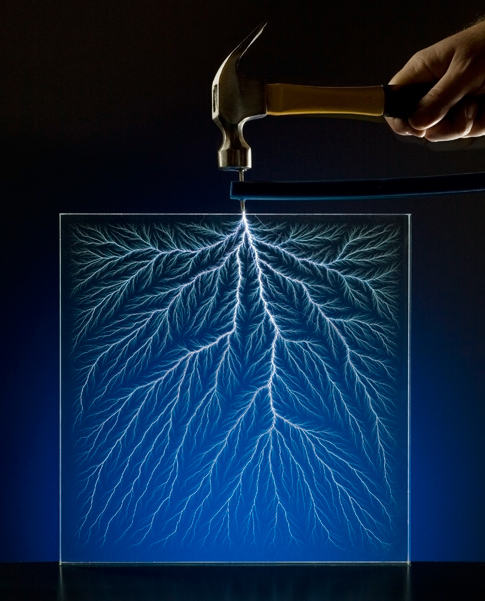
Lightning Trigger A Lichtenberg figure being created by a tap from a nail. In just a few hundred nanoseconds, electrons trapped in plastic exit suddenly as a bright, branching spark. You can buy the resulting figures at teslamania.com. Mike Walker

There are many unusual things to see around Newton Falls, Ohio—the Wal-Mart with hitching posts for Amish buggies, the Army base with helicopters and tanks proudly arranged on hills—but I was here for the most unusual thing of all: the local Dynamitron. I was here to make frozen lightning.

The Kent State Neo Beam facility’s Dynamitron is a four-story-tall, five-million-volt particle accelerator much like a tube TV, only bigger. (Yes, tube TVs are domestic particle accelerators.) Both Dynamitrons and TVs use high voltages and magnets to slam electrons into a target. In a TV, that’s the phosphor screen; in this Dynamitron, it’s usually plastic plumbing components being hardened by the beam. But when I joined the team of retired electrical engineer Bert Hickman and physicists Bill Hathaway and Kim Goins, the product was Lichtenberg figures, lightning bolts permanently recorded in a block of clear acrylic.

With the Dynamitron—rented for the day—adjusted to around three million volts, it blasts electrons about halfway through half-inch-thick pieces of acrylic sheet. The plastic is a very good insulator, so it traps the electrons inside. Coming out of the machine, the blocks don’t look any different, but they hold a hornet’s nest of electrons desperate to get out.

Water Flows Like Electricity: The day of the project, this Lichtenberg figure formed naturally as water drained through ice near the author’s home.  Mike Walker
Left alone, the electrons will stay trapped for hours, but a knock with a sharp point opens a path for them to make a quick escape. Electrons gather from all parts of the block, joining up to form larger and larger streams of electric current on their way toward the exit point. As the charge leaves, it heats up and damages the plastic along the branching trails it follows, leaving a permanent trace of its path. If you could see inside a thundercloud in the nanoseconds before a bolt of lightning emerged, you would see the same kind of pattern. The bolt doesn’t just pop up fully formed; it has to gather charge from all over the cloud.

You can create similar, if less permanent, Lichtenberg figures using toner powder from a copier or printer and any common source of static electricity [see below]. This is how German scientist Georg Christoph Lichtenberg first did it in the late 18th century (he used powdered sulfur), which at the time represented one of the great discoveries in the history of electricity. Today, the figures are a great way to learn about electrical discharge—and can make a cool souvenir from an afternoon with a very expensive machine.

Drawing a Charge: Toner powder reveals a discharge pattern recorded in static electricity when dusted on an acrylic surface, just as it shows words and images recorded in static electricity on a photocopier drum.  Mike Walker

Make a Lichtenberg Figure

Create a Lichtenberg figure out of fine dust, just like Lichtenberg himself did in 1777

  • Place a sharp metal point so it touches the center of a sheet of insulating material. (Lichtenberg used resin made from tree sap; today, clear acrylic works well.)
  • Use a Wimshurst machine [shown above], a Van de Graaff generator, or vigorous shuffling on shag carpeting to build up static electricity, and then touch the metal point with your finger or with the machine’s electrode to discharge it. This forms a pattern of stranded charge on the plastic. The Lichtenberg figure is there; you just can’t see it.
  • Blow photocopier toner over the surface. It will stick to the static electricity, revealing a beautiful Lichtenberg figure. Lichtenberg’s discovery ultimately led to the invention of photocopiers and laser printers, where the charge is laid down in patterns of words and images.

Like what you see? For more Gray Matter, subscribe to our Gray-Matter-only RSS feed here or see the full list of projects at popsci.com/graymatter. And for Theodore Gray's one-of-a-kind periodic table poster, head to periodictable.com/posters

Want to read more articles like this, plus tips and tricks, home hacks, DIY projects, and more? Subscribe to Popular Science and enter to win $5,000!

17 Comments

Cool and beautiful!
How long could the bock trap the lighting ?

Where can I get the blocks?

I agree, this is a very cool experiment. As to how long the acrylic can hold the image, permanently. If you mean how long the lightening flashes, I would imagine until the block is grounded, the flashes would persist.

I would imagine that on could generate a fair amount of income selling these Lichtenberg figures.

How much does it cost to rent a Dynamitron for a day?

How long does it take the 3 MEV charge to load on the plexiglass from the Dynamitron?

there are many lichtenberg figures on the ice near my home and they are not drain holes. They are merely the first places that the sun melts the ice, usually caused by something dark at the center which heats up and starts the melting. I have 40mg of pix if pop sci is interested.

phoenix9860, I think that you don't mean 3 MeV (million electron volts), which is a really small amount of energy.

do you realy need the toner? ( dont think you do)

kardelen133 (not verified)

Hi ALL
Jeter has one of the best instincts of any player in the game. Consider the 03 NLCS against Oakland, when he threw Giambi out at home because he was in foul territory between home and first. There is no explanation for his being there than instinct, and not everyone could have made the relay, either. Even Red Sox fans should be able to appreciate that - Nomar does! halı yıkama ankara temizlik şirketi istanbul nakliyat ankara nakliyat evden eve nakliyat
thanks.

1

getting http://www.Bebo.com/cheapV8 "> cheap viagra it http://www.Bebo.com/OnlyT7 "> cheap cialis of http://www.Bebo.com/propositI "> buy viagra online about http://freeiq.com/johny "> buy zoloft was http://freeiq.com/soma1 "> buy soma turn me

http://www.bebo.com/buyalevec is realy ncie to say i am great and the site is great thx you much

why not it is really good from your side
http://www.bebo.com/BuyViagraA9 Buy Viagra Arizona
so what is the reason
http://www.bebo.com/OnlinePrescripT Online Prescription Tramadol
very nice
http://www.bebo.com/DrugInformatioT Drug Information Tramadol

turkortam

from sasdasfasf, asddfadasf

uuuuuuuuuuu

Anonymous-B

from Bellevue, wa

well if you want to buy one Mr. Gray linked to this site from his. http://www.capturedlightning.com/frames/interesting.html

wow, that was really nice.

Maxson
-----------
www.emailextractor14.com/
www.emailextractor14.com/?page_id=121

çizgi film izle www.cizgifilmclub.com

Popular Tags

Regular Features


Download Our iPhone App

Stay up to date on the latest news of the future of science and technology from your iPhone with full articles, images and offline viewing


Grab the Tech Buyer's Guide iPhone App

Carry everything you need to make a smart buy on HDTVs, cameras and 14 other product categories right in your pocket


Follow Us On Twitter

Featuring every article from the magazine and website, plus links from around the Web. Also see our PopSci DIY feed


Become a Fan On Facebook

Share links with friends, comment on stories and more


February 2010: Renovating America

Innovative fixes for five of the country's biggest infrastructure messes, plus a look the quest to read the human mind, the LCD screen that might finally kill paper dead, and the world's scariest science.

Read the issue here.

Popular Science Photo Pool


Share your photos in the Pop Sci pool at www.flickr.com!