
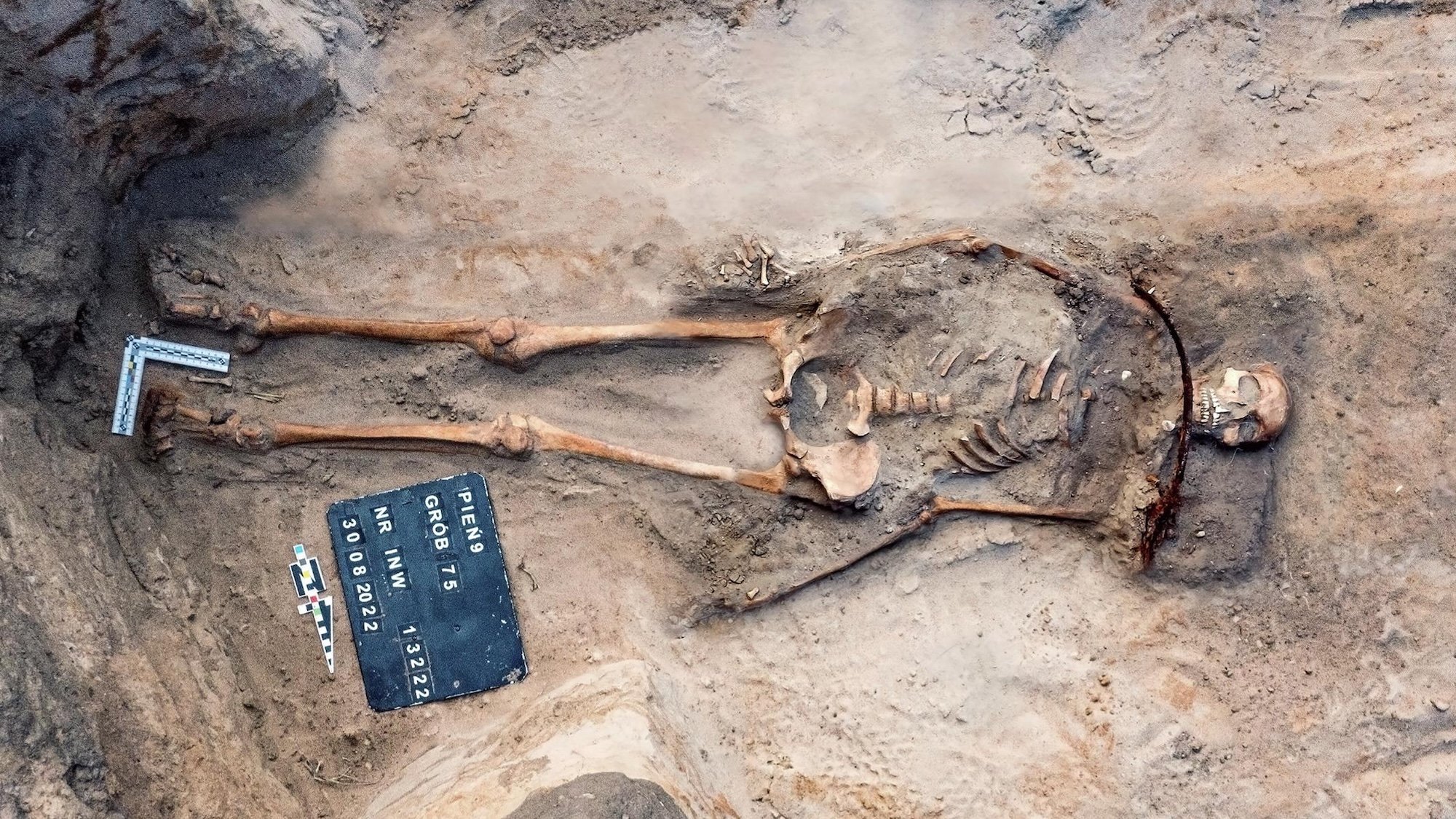
The excavation of an over 400-year-old grave in Poland revealed a burial scene that, although macabre, was likely orchestrated in the hopes of protecting local villagers. In the town of Pień about 60 miles east of Kraków, archaeologists discovered the 17th century remains of a young woman interred with booby-traps to prevent her from returning as a vampire.
Researchers from Poland’s Nicolaus Copernicus University described their findings in a study recently published in the Journal of Archaeological Science: Reports. First discovered in 2022, Grave 75 contained the body of a 17 to 19 year old woman who likely died sometime between 1620 and 1674 CE. DNA analysis indicates she possessed a rare maternal lineage that traces back to Scandinavia, yet remains almost nonexistent in more modern Slavic regions. Despite this genetic anomaly, examinations of her childhood teeth showed she was raised near Pień.
Archaeologists were immediately surprised by the scene inside her grave. Disrupted soil inside the burial plot suggests someone briefly dug up the body before it even finished decomposing. They then rearranged her arm towards the northeast, placed an iron sickle across her neck with the blade angled to her throat, and attached an iron padlock to her left big toe.
Both the sickle and the lock are traceable to historic folk rituals intended to combat supernatural or demonic forces. Archaeologists note that Polish-Lithuanian communities in the 17th century often blamed disease, famines, and other disasters on the recently dead—meaning this woman may have become a scapegoat for recent calamities.
However, she likely wasn’t an ostracized peasant. Thin metallic threads composed of gilded gold and silver wires that were once part of a silk cap were found near her skull. The inclusion of such a lavish accessory indicates that the young woman came from a wealthy family, although fears about potential malevolent powers didn’t stop people from taking post-burial precautions. Her status also appears to contradict hints about her health, since her nitrogen and carbon levels point to periods of malnutrition.
Meanwhile, a green stain on her neck and palate bones is likely tied to a copper-containing object or medical treatment intentionally placed deep in her mouth or nasal cavity near the time of death. Even the grave’s location suggests that a wealthy life couldn’t always guard someone against supernatural suspicions. The Pień cemetery where she is buried doesn’t appear on historical maps, and its location outside the village near a crossroads implies it functioned as a false cemetery—a site reserved for a community’s shunned individuals.
While grim, this scene illustrates the complex intersections between faith, superstition, community, and wealth within rural European life during the 17th century. But if it’s any consolation, the falsely accused vampire at least got to keep her head.
