
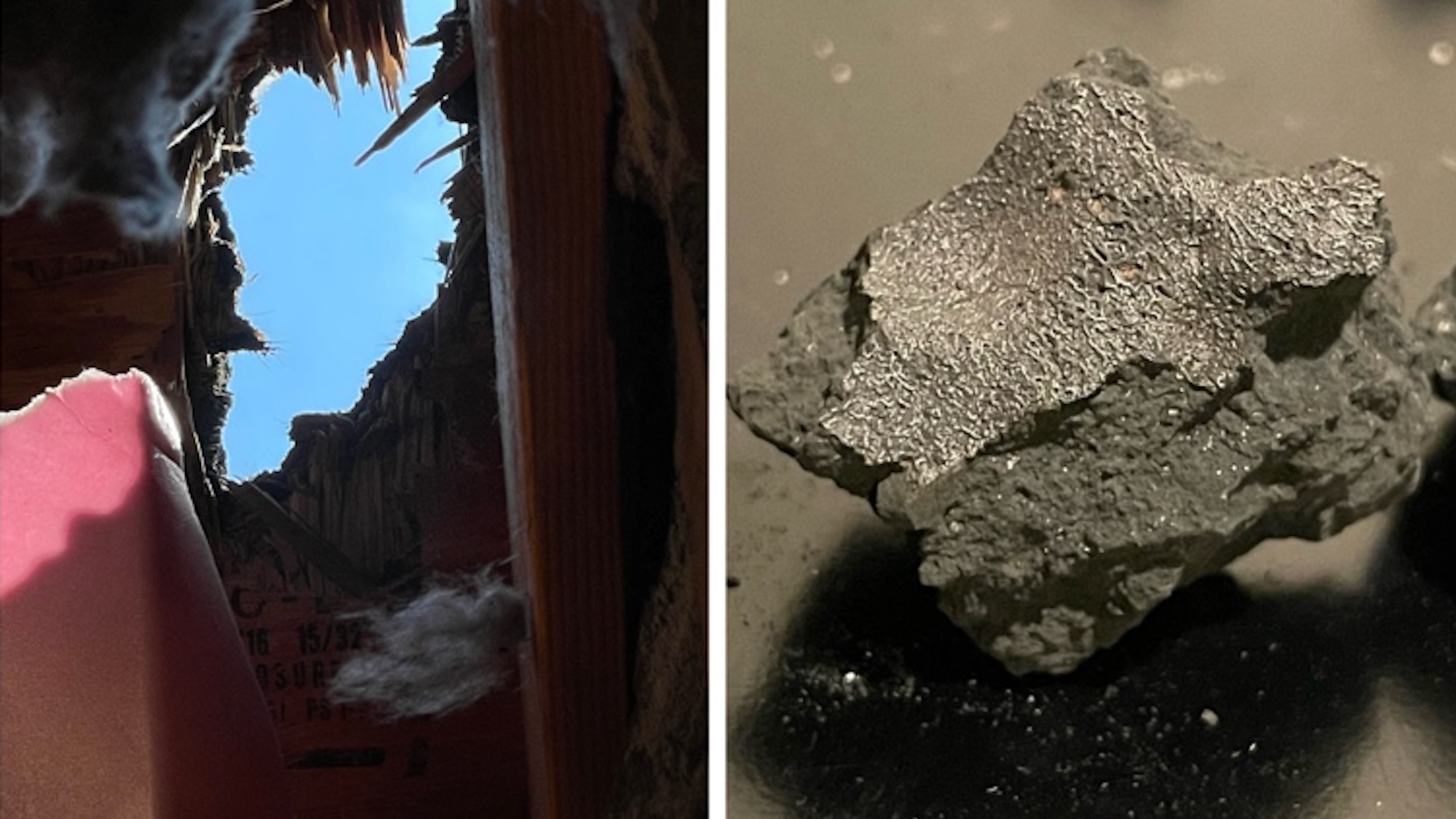
Exactly two years ago tomorrow, an unexpected visitor startled a homeowner in Hillsborough, New Jersey. When a loud crash disrupted his morning on July 16, 2024, the man rushed towards the source in his bedroom. Inside, he discovered a chaotic scene—and a large hole in the ceiling.
“I smelled a strong sulfur-like odor and saw many black fragments along with debris and black dust that covered my bed, carpet and surrounding areas,” the man recalled.
Thinking quickly, he documented the surreal situation and stored the rocky fragments in glass jars using aluminum foil and disposable gloves. News outlets and corroborating witnesses soon confirmed the culprit: a daytime, suitcase-sized meteor had entered Earth’s atmosphere at a speed of 32,000 miles per second. Cameras in Connecticut, Pennsylvania, and New Jersey all recorded the event as it soared over the Northeast, while at least 16 people reported experiencing a shockwave as the space rock quickly disintegrated about 22 miles above Earth. Doppler weather readings even flagged a lengthy trail of pebble-like fragments as they rained down on Staten Island and parts of New Jersey. And according to the data, the largest fragments would have landed around Hillsborough.
After months of careful analysis, astronomers at the SETI Institute, NASA, and the American Meteor Society have published their findings on the interstellar specimens in the journal Science Advances. Not only is the meteorite extremely rare, it contains traces of the same vital chemicals that helped form organic life on Earth.
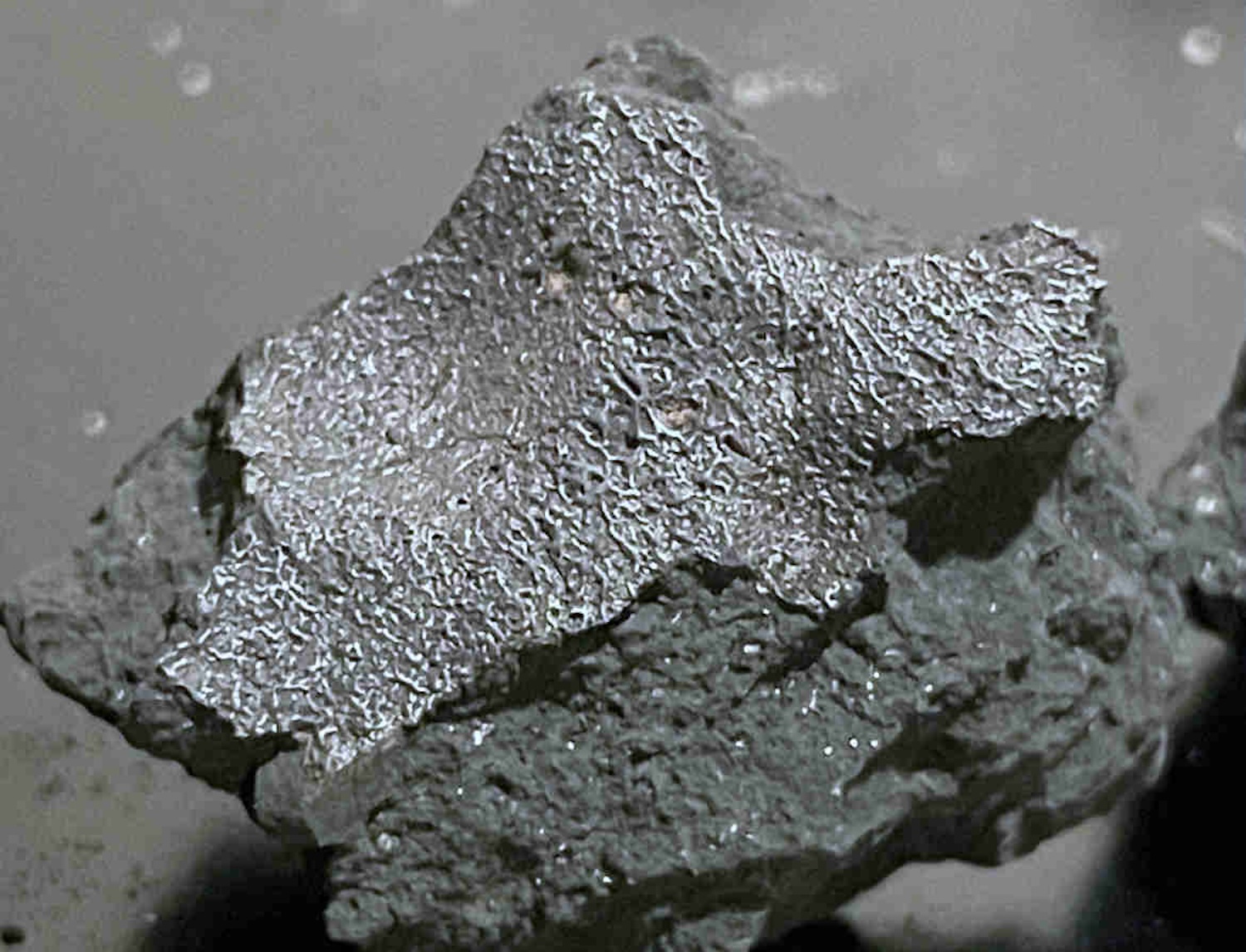
“A forensic study of the fragments revealed that they contained preserved bits from near the surface of a primitive asteroid where it experienced concentrated salty fluids—a process not previously known from this type of proto-planet world,” Peter Jenniskens, a study co-author and SETI and NASA astronomer, explained in a statement.
Researchers initially determined the Hillsborough remnants belong to one of two types of primitive meteorites known as CM-type carbonaceous chondrites. After observing that the fragments had been more significantly altered by ancient water while still part of their parent asteroid, the team realized the pieces technically couldn’t classify as a CM1 or CM2. Instead, they belonged to an intermediate type of meteorite with an understandable name—a CM1/2 carbonaceous chondrite. While the New Jersey incident was the 22nd observed CM-type meteorite atmospheric entry, it was only the second CM1/2 event ever witnessed on Earth.
“Thanks to the homeowner’s quick reaction, these are the most pristine CM1/2 meteorites we know of,” Jenniskens added.
The Hillsborough meteorite also contained miniscule, salt-laden fragments that point to their original location on its parent asteroid. Prior to breaking away, the space rock likely formed near the asteroid’s surface, where liquid water evaporated and subsequently concentrated various salts. Similar salt levels in briny fluids can preserve the chemical compound phosphate in a solution, which may then kickstart chemical reactions between minerals and organic materials. Basically, the salts inside the Hillsborough meteorite strongly resemble those needed for life to first develop on Earth.
“Isotope studies of carbon and nitrogen suggest that primitive carbonaceous chondrites, including CM-types, delivered organic matter to the early Earth,” said study co-authors Queenie Chan and Nana Ogawa. Chan is a cosmochemist at Royal Holloway University in London, while Ogawa is a biogeochemist at the Japan Agency for Marine-Earth Science and Technology.
Technical University Munich organic mass spectrometry specialist Phil Schmitt-Kopplin added, “A high fraction of compounds were the product of organic chemistry with minerals.”
Schmitt-Kopplin cautioned that researchers still aren’t sure if the meteorite’s compounds formed through brine chemistry or earlier impact processes. Regardless of how they formed, the meteorite’s components are classified as organo-metallic compounds on Earth that are vital to life. They exist in animal blood, and help plants make food through photosynthesis. If all that weren’t enough, the Hillsborough meteorite also featured a variety of amino acids critical to life.
Despite the property damage, the New Jersey meteorite fragments are a rare reminder that asteroids aren’t always desolate, inert rocks. Many contain complicated chemistry and organic matter—and it’s those features that likely kickstarted life on Earth billions of years ago.
