
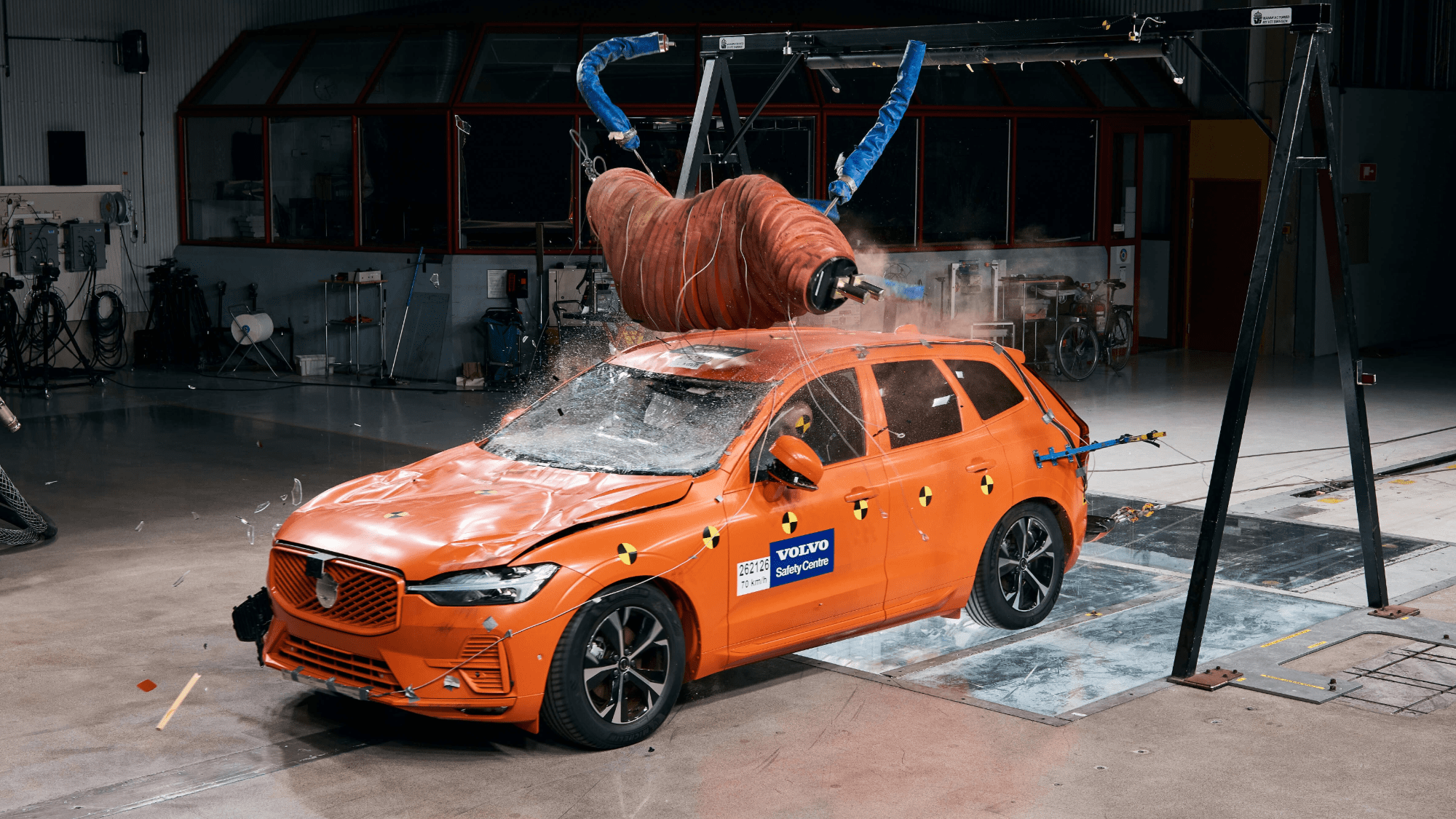
Anyone growing up in rural or suburban areas probably has a story of a family member colliding with some animal scurrying across the road. In the United States alone, an estimated one to two million cars slam into large animals every year. But there’s one creature in particular that poses a greater risk than others: the massive, long-legged moose. The threat that these hairy tanks (some can weigh over 1,500 pounds) pose to drivers is so great that Volvo, a brand synonymous with safety, built their own life-sized rubber replica. For years, they’ve been sending cars barreling toward this headless moose doppelganger in the name of science. The results have led to important innovations in car safety design, and no shortage of gnarly slow-motion crash footage. Volvo shared some new crash footage with Popular Science, showing how their design choices protect drivers even during head-on moose collisions.
In the video, an orange Volvo XC60 can be seen driving in a dimly lit test room, presumably to recreate low-visibility conditions on a dark night. The fake rubber moose sits just ahead of its path, propped up by four blue peg legs, its body held together by wires and supported by a metal frame. In slow motion, the car approaches the moose at 43 miles per hour and makes contact. The dummy’s legs buckle after making contact with the front bumper, and its hefty torso immediately slides across the hood. It then slams into the windshield, crumbling the glass but not breaking through.

The body then glides over the top of the windshield and starts flipping through the air over the roof. Its entire frame spins multiple times like an Olympic figure skater before finally crashing down on the pavement behind the car. The wreckage looks intense, but it could have been much worse. The car’s sloped front design meant that the moose’s full force didn’t come crashing through the windshield. And while certainly shaken up, the driver and passenger (also test dummies in this case) likely could have walked away without being struck by shattered glass or a protruding antler.
“Real-world traffic crashes form the foundation for our safety research,” Lotta Jakobsson, Volvo Cars Senior Technical Specialist, tells Popular Science. “Since 1970, Volvo Cars has systematically collected and analyzed data from real-world crashes involving Volvo vehicles to better understand the occurrences and priorities for safety improvement. Large animal impacts have been an essential part of those crashes, providing valuable insights for design improvements even before the development of a moose crash test dummy.”
Why moose are uniquely hazardous
Though roadside encounters with moose are a concern in parts of the northern U.S., they are far more common in Sweden, Volvo’s home country. To put that in perspective, moose population density is about 3.5 times greater in Sweden than Alaska. That translates to lots of crashes. Swedish government statistics estimate there are around 5,000 moose collisions in the country every year.
Moose collisions are particularly dangerous due to the animal’s beach-house-shaped anatomy. While smaller or rounder animals may roll underneath a car, the moose’s long, stilt-like legs are the first to make contact in a crash. Its unusually high center of gravity means that the bulk of its body comes barreling straight toward the driver, like a guided missile. And unlike hitting a tree or another car, impact with a moose typically doesn’t cause the car to decelerate fast enough to trigger airbags. Suddenly, a driver is faced with the possibility of being crushed by a mammal the size of a grand piano—and its massive antlers. While moose antlers are not quite as pointy as a deer’s, they can still easily gore a human.

Volvo has a long history of dealing with moose collisions. They began testing the impact of moose strikes on their cars in the 1980s, though it was a much less high-tech operation back then. Their test subject was reportedly a moose cadaver. Needless to say, that was a messy affair.
Those grisly trials eventually led to the first generation of moose dummies, which were mostly bundles of strong electrical wire and a wooden beam for a spine. Engineers eventually replaced them with a version made up of 20 impermeable compartments of high-pressure hoses containing water. The current dummy, dating back in part to 2001, is constructed from 116 rubber discs connected by steel parts all held together by a frame of wires and supported overhead by a separate metal structure. The dummy (sometimes referred to as a “moose manikin”) weighs 793 pounds, or roughly the average size of a smaller adult moose. In addition to the physical dummy, the moose also has a “digital twin” which engineers use to conduct computer simulation models. It’s not exactly the spitting image of the real thing, though. In the images and videos shared with Popular Science, the moose dummy is missing its iconic head.
“The head and antlers are not part of the current test design,” Jakobsson said. “The purpose of the dummy is to serve as an impactor and to reproduce the most safety-critical aspects of a vehicle-to-large-animal crash, where the front of the vehicle first strikes the animal’s relatively light and slender legs, followed by the heavier, higher-positioned torso impacting the windshield, A-pillars and roof structure. The focus is on representing the typical body shape and overall motion of a large animal during a collision.”
Battered moose dummies lead to safer car designs
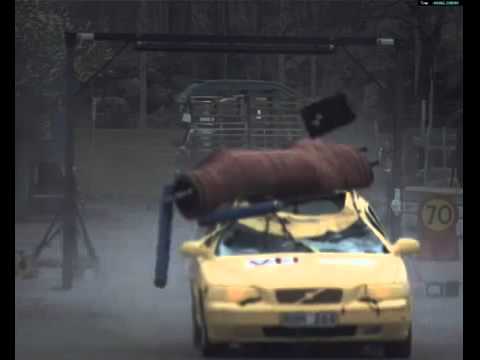
Slamming cars into fake moose has led to meaningful design change at Volvo over the years. Earlier crash test footage shows crash test dummy drivers getting absolutely pulverized on impact. In older vehicles, the sharper-edged shape of car fronts meant that occupants were essentially crushed following a run-in with a moose at high speed. Volvo engineers took those lessons and used them to design newer car models with an emphasis on extra-strong A-pillars roof beams, and windshield retention. a header meant to shield occupants from dangerous debris. They also strengthened roofs and the “overall structural integrity of the occupant compartment” so that they wouldn’t collapse on passengers when the moose’s body landed on top.
Those design decisions have led to measurable safety improvements. An independent 2018 analysis from Car and Driver compared Volvo models made between 1999–2006 with those made between 2007–2015, and found that the newer models had a 36 percent reduction in windshield deformation following collisions.
Still, the best way to avoid getting hurt by an animal in the road is to simply avoid hitting it in the first place. To that end, Volvo and many other carmakers have developed animal detection systems that use radar and other sensors to spot animals, especially at night when the human eye might miss them.
It’s easy to take for granted just how far car safety has come in a relatively short period of time. Prior to the 1960’s and 1970’s, federal rules mandating basic safety requirements like seat belts and airbags were virtually nonexistent. And that free-for-all had a real impact. Between 1965 and 1973, an estimated 50,000 people died in car crashes every year Volvo was actually the first carmaker to introduce the now ubiquitous three point safety belt in 1959. Since then it’s often led the charge in advancing other car safety features, from side airbags to blind spot monitoring.
