
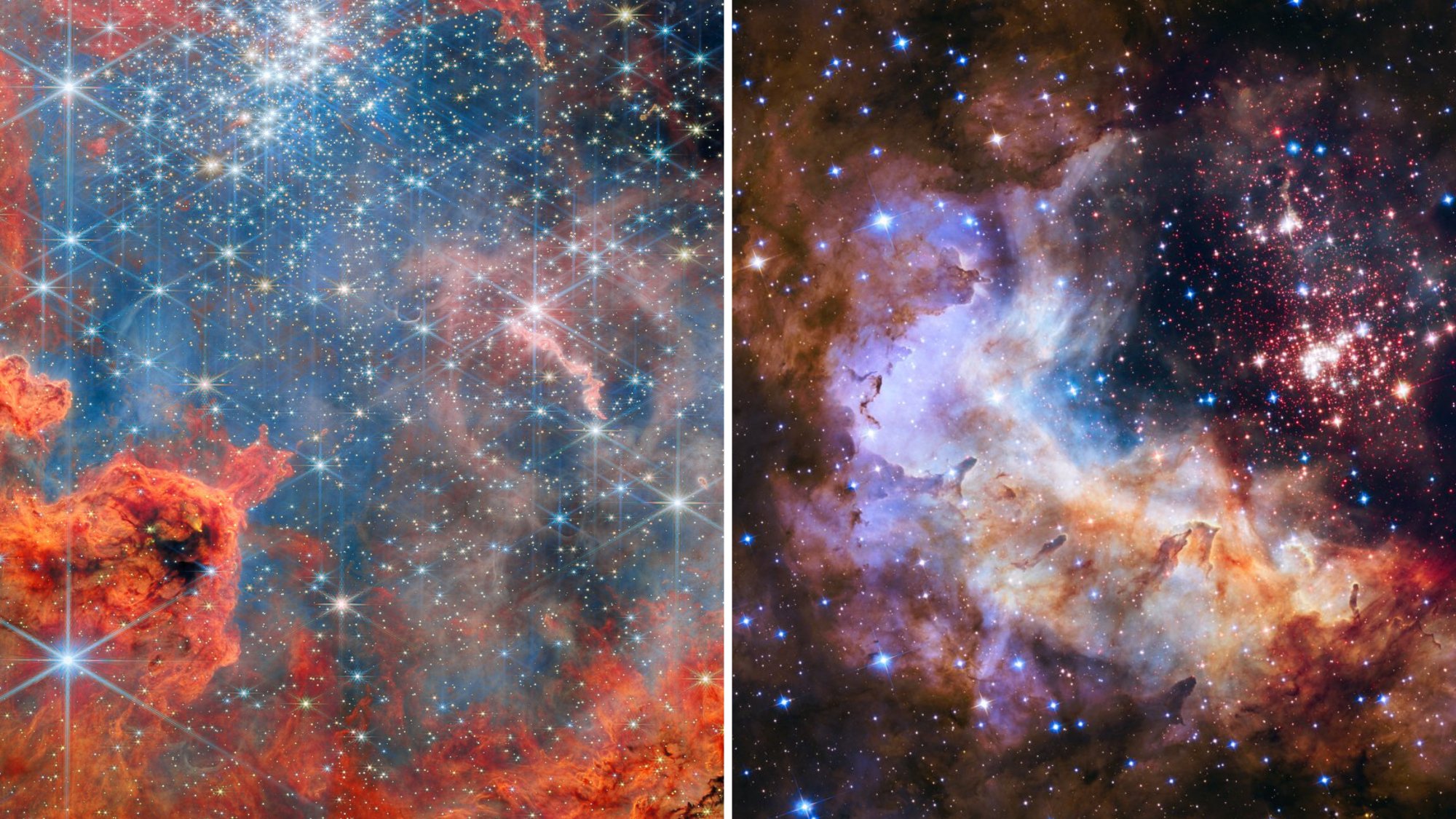
In 2015, NASA celebrated the Hubble Space Telescope’s 25th year in orbit by releasing one of its most stunning images to date—a colorful star cluster in the constellation Carina known as Westerlund 2. However, a lot can change in a decade. In January 2023, the HST’s observational capabilities were overtaken when the powerful James Webb Space Telescope imaged the same star cluster. While the HST is still a powerful piece of equipment, the European Space Agency decided to showcase its heir’s technological leaps by closing out 2025 with a new, even more detailed glimpse at Westerlund 2.
The billowing, vibrantly visualized formation located 20,000 light-years from Earth were imaged using the JWST’s Near-InfraRed Camera (NIRCam) and its Mid-InfraRed Instrument (MIRI). Westerlund 2 is estimated to stretch between 6 and 13 light-years across, and features some of the galaxy’s hottest, brightest, and most massive stars. To fully appreciate the difference between what HST and JWST can see of the cosmos, the ESA also uploaded a slider tool to allow viewers to shift between both images of Westerlund 2. While all of the brightest stars are apparent in 2015’s glimpse, the newer look reveals hundreds of additional, dimmer stars in the background.

Westerlund 2’s young stellar objects are ejecting powerful waves of radiation in all directions, twisting and entangling the large, surrounding gaseous clouds. Although the closer, bright stars immediately stand out from their companions, hundreds of tiny points of light reveal some of their younger siblings. Around them, the thicker plumes of red and orange gas also intermingle with the thinner blue and pink threads to depict a dynamic and highly active stellar nursery.
The JWST’s latest look at Westerlund 2 is more than simply a pretty picture. The data also includes the nebula’s total population of brown dwarf stars, some of which are as small as 10 times the mass of Jupiter. Astronomers can now begin studying how these stellar objects’ surrounding discs form over time, as well as how planets arrive in such huge star clusters.
