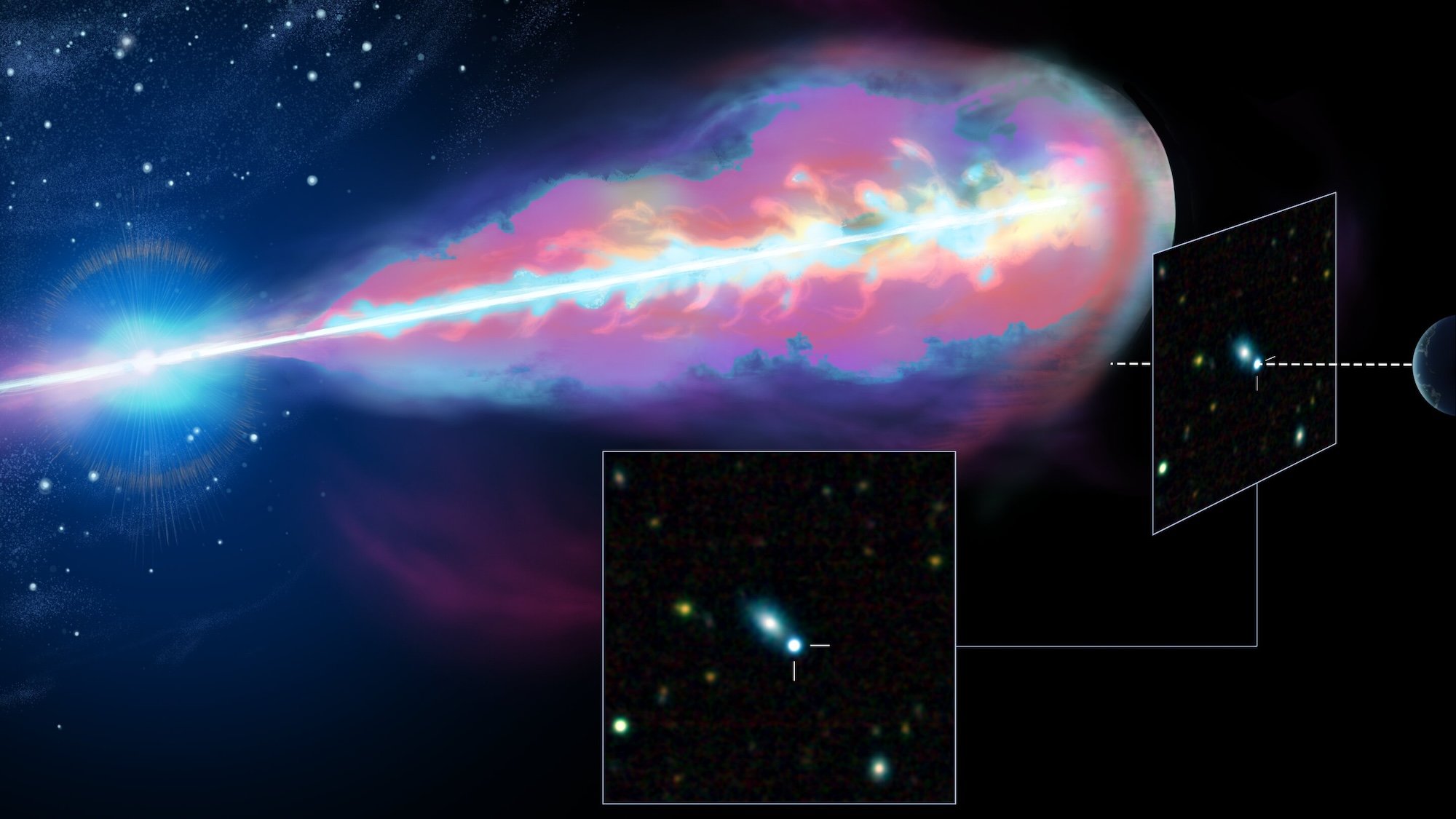
A gamma-ray burst (GRB) that has confounded astronomers is one of the brightest cosmic light shows in the past 20 years. Although the cosmic explosion first appeared inexplicably weak, researchers now believe it actually shot about one billion years’ worth of solar energy into the cosmos through a beam no thicker than a pencil.
“We see hundreds of GRBs every year, but the oddballs are the most informative ones,” said Roberto Ricci, a radioastronomer at Italy’s National Institute of Astrophysics.
Ricci and his colleague’s findings are detailed in a study recently published in The Astrophysical Journal Letters. On March 10, NASA’s Fermi Gamma-ray Space Telescope observed a burst later classified as GRB 260310A. Gamma-ray bursts most frequently occur in the aftermath of a massive star’s collapse. When this happens, powerful jets of matter launch into space close to the speed of light. These jets collide with cosmic gas, which generates afterglows seen across visible light, radio waves, and X-rays.
While GRB 260310A’s flash of light lasted less than one minute, astronomers noted it seemed to produce strangely little energy. This changed within only a few hours, as GRB 260310A’s afterglow brightened so much that it briefly outshone its host galaxy. A few weeks later, the GRB’s X-ray emissions brightened again and then remained observable for months.
“At first, I thought another X-ray source was contaminating our observations. But the brightening really came from the afterglow,” recalled study co-author and astronomer Yu-Han Yang.
Further observations using an international array of observatories and telescopes later confirmed a supernova had indeed prompted a GRB. Early signs indicated that its jet was pointed away from Earth, but while the gamma-ray readings were comparatively basic, both its visible and X-ray measurements ranked among the top one percent in brightness. GRB 260310A also fell within the top five percent for recorded radio brightness. After reviewing the data, astronomers finally realized what was happening.
“We looked at it from a side angle,” explained Yang. “As the jet slowed down, its light became visible over a wider range of angles, allowing us to probe the jet’s shape, from its outer edges toward its inner core.”
Yang compared most GRB observations to looking directly at a flashlight. Although the light is brightest from that perspective, the beam may appear dimmer if it is viewed from further away. Most GRB modeling is calibrated from events detected from a direct vantage point, but GRB 260310A was different.
“This burst gave us a chance to look beyond that glare,” said Yang.
Astronomers theorize that GRB 260310A may have originated from a jet featuring a very narrow, energized core encompassed by wider, slower outflows. If true, the early afterglow hypothetically traces back to the jet’s wings, while the brightening X-ray phase came from the thin core.
Although it took a moment to decipher, GRB 260310A offers a rarely seen window into a gamma-ray burst. Such opportunities are rare, but the team hopes to find more in the near future using even more powerful tools like the recently completed Vera Rubin Observatory.
“We could explain individual features of this burst, but fitting them all into the same picture proved much harder,” added Ricci.