A permanent lunar base will require structures resilient enough to withstand everything from cosmic radiation and micro-meteorites to moonquakes. There are plenty of building materials to choose from on Earth, but they all come with a catch: transportation storage aboard spacecraft is limited, and each additional pound of cargo will quickly ramp up costs. Engineers have spent years experimenting with ways for future astronauts to source local lunar ingredients, including fine moon dust known as regolith. Unfortunately, most require various binding ingredients that must still be sent from back home.
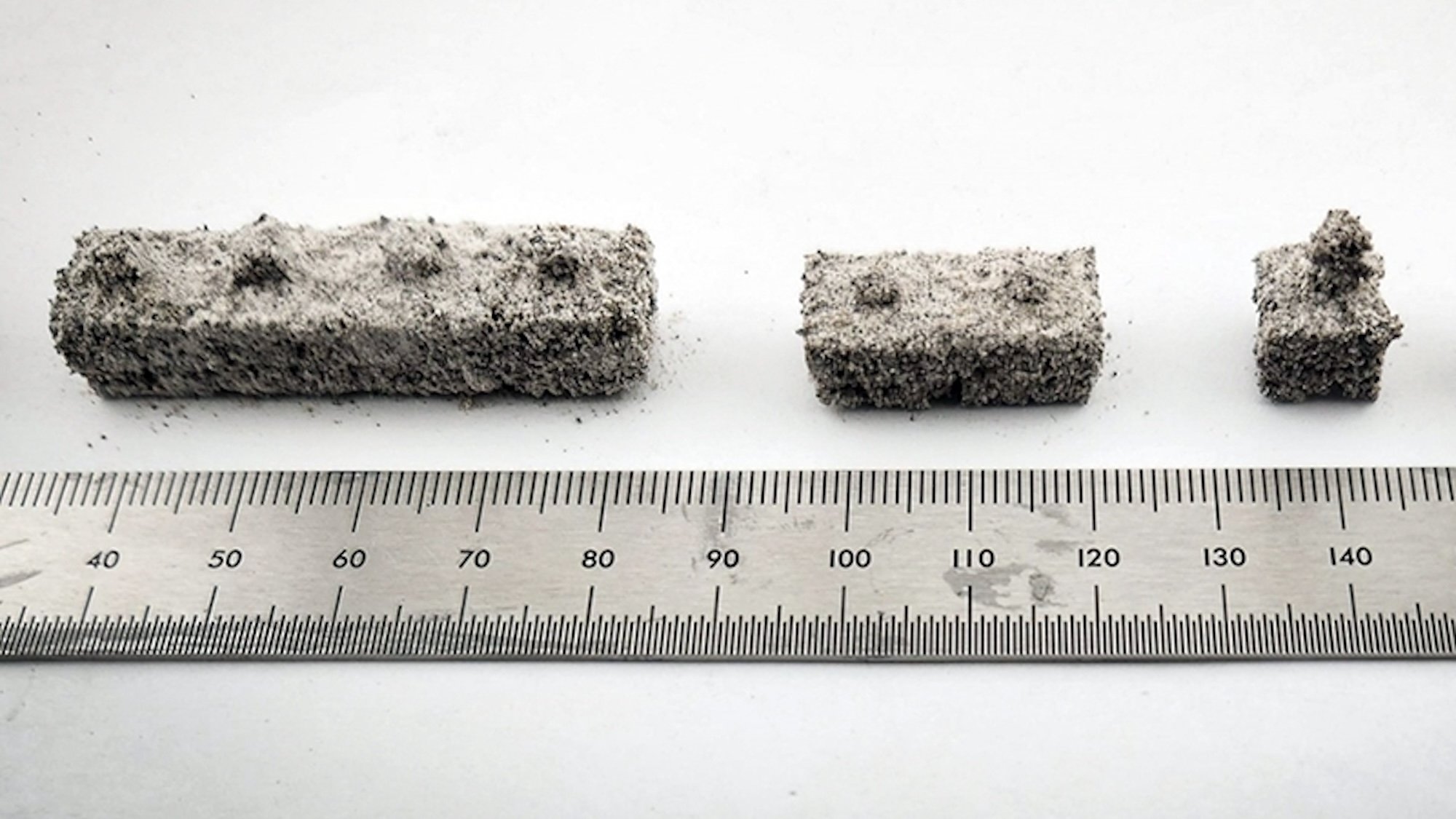
A college student at the University of Arkansas (U of A) recently had a different idea. In a collaboration with U of A mechanical engineer Wan Shou, Cole McCallum harnessed a specialized method of 3D printing to manufacture LEGO-esque bricks from lunar dust, no binding required. (These aren’t to be confused with LEGO’s actual lunar bricks mockups). Their results published in the journal NPJ Advanced Manufacturing indicate the bricks could be a promising material to investigate as humanity readies itself for a return to the moon.
Lunar regolith is a tricky material. Unlike Earth’s dirt, it doesn’t contain any amount of organic matter. It’s just loose, sharp-edged particles generated by billions’ of years of asteroid and meteor impacts. This means that moon dust can’t bind on its own and requires at least some secondary ingredients.
While an undergraduate at the U of A, McCallum wondered if a specific type of 3D printing called laser powder bed fusion could offer a workaround. In this technique, fine powder is placed on a flat bed, then exposed to a highly powerful laser beam that fuses each microscopic particle together in a process called sintering. The tray bed lowers down to allow another layer of sintered powder, then repeats the steps until a single, solid block is created. Regolith fits the mold perfectly, so to speak.
“There’s nothing else it’s binding to. The regolith powder is binding to itself,” McCallum said in a university profile.
McCallum and Shou didn’t have access to actual lunar material, so they obtained Lunar Highlands Regolith Simulant (LHS-1), a commercial material that replicates the moon dust collected by Apollo astronauts during the 1960s and 70s. They ultimately settled on two shapes, one that resembles a cross and another that looks like the letter “H.” The researchers then 3D-printed tiny prototypes measuring a few centimeters wide that they could connect like LEGOs to construct larger structures.
There are still some important caveats to this sintered regolith strategy. McCallum’s blocks are much more porous and weaker than materials containing binders. Additional research is needed to see how the approach works in a vacuum or microgravity, two inescapable hurdles to living on the moon.
“These structures we’re making can be self-supported. But I would be hesitant to say our process could be used for something that’s supporting other loads at this moment yet,” said McCallum.
That said, his demonstration that even a basic framework for lunar base bricks is achievable solely with regolith may offer a promising direction for mission engineers