We may earn revenue from the products available on this page and participate in affiliate programs. Learn more ›
Baltimore speaks before anyone at Under Armour gets to say a word.
Driving along the seams of the Baltimore Peninsula, the city does what it does so well, giving off stubborn grit and industrial sprawl. Pulling off I-95, freight trucks, not tour buses, share the road with me. Like much of the city, it’s a waterfront neighborhood (re)shaped by salvage and second acts. Formerly known as Port Covington, it’s not a full-on reinvention, but it’s definitely hard-won reclamation. Warehouse bones, fresh glass. Muscles learning new memories. And appropriately home to the Under Armour campus and its five-story office and performance center, a Lighthouse with glazed-curtain-wall façade shining under the adjacent stadium’s lights.
That a former Sam’s Club building now houses parts of R&D, rapid prototyping, materials testing, biomechanics, and quick customization facilities makes a weird kind of sense. It speaks to what the company and its products represent: resilience turned into result. As Kyle Blakely, Senior Vice President, Innovation, Design Studio, Development, & Testing, puts it, “We’re in Baltimore. We’re scrappy … we’re here to work.”
Under Armour has been here in Baltimore since 1998, when the young company moved its HQ from a Georgetown rowhouse back to founder Kevin Plank’s home turf. It’s been here in the Baltimore Peninsula since 2024 (though construction began in 2016), because it’s the perfect expression of practicality and polish.
I’m here, a thankfully uneventful drive from my home base outside Washington, D.C., to see how company mythology built on a sweat-soaked shirt and a locker-room solution has scaled into a global sports brand still focused on athlete-first, advantage-focused gear. In particular, I’m here on the, well, heels, of a marathon shoe tuned, step by step, around the work that women’s course-record Boston Marathon winner Sharon Lokedi is actually putting in on her way to the podium.
_____________
The scripture of Under Armour starts, as sports success stories often do, with discomfort. A football player in 1996, sick of wet cotton, obsessed with moisture management. HeatGear, ColdGear, and AllSeasonGear followed soon after. Footwear came later, starting with football cleats in 2006. In June, the world will be thinking about global football boots, aka soccer cleats. Today, however, we’re talking about a fast-running ecosystem, from daily Pace pairs to Elite race-day supershoes. What all of this has in common is an obsession with reducing how bodies are annoyed by the inevitable. There will always be heat, moisture, impact, pressure, slippage, noise, fatigue. There will always be physics in every stride. Every day at Under Armour is a day to ask what if much of that can be, well, sidestepped.
Informing this latest battle against irritation is Lokedi. She won the 2022 New York City Marathon in her debut at the distance, wearing a World Athletics-approved prototype of the UA Flow Velociti Elite’s next iteration. She then finished second in Boston in 2024, won Boston in 2025, wearing a finished Velociti Elite 3 that made its retail debut later that year, took second place in New York in 2025, and will return to the Boston Marathon as defending champion on April 20, 2026.
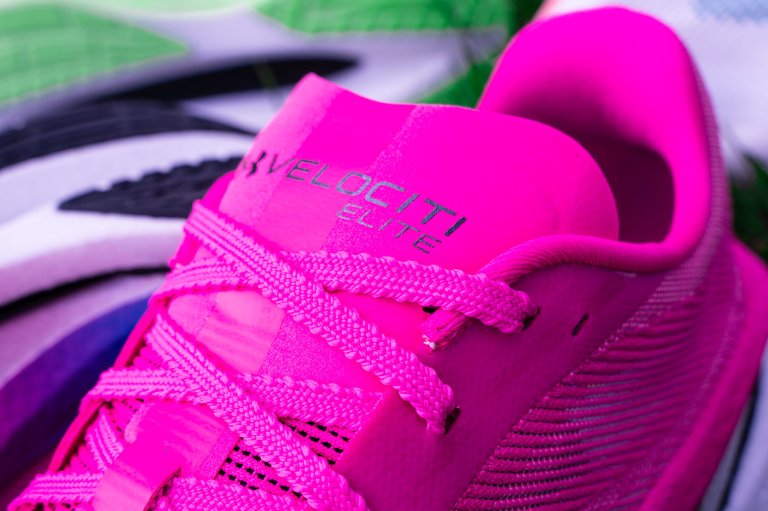
“In dreaming up my return to Boston, the Under Armour team opened the door to my thoughts on shoe design,” says Lokedi in a statement. “Being part of the process from start to finish on the Velociti Elite 3, from the testing to the color [shown above], was so fun! With our uniforms being a bit more subtle, I wanted pops of color on my feet.”
Full-length carbon plates, breathable uppers, durable outsoles. All these contributed to Lokedi’s breakout run of results. Of course, Lokedi’s a runner operating at the edge of what’s possible. But that doesn’t mean what Under Armour learns from her can’t be translated into products for the rest of us. And that’s why I’m here, beyond the signed wall of athlete names, the flagship Brand House full of product waiting to be tried on, and the music echoing throughout the stadium as it’s primed for an event. I’m here to learn how to develop a shoe that won’t get too wet, too hot, too heavy, too unstable, too loud, too mushy, too dead. I’m here to learn what a shoe can do based on what you’re doing to a shoe. I’m here for the kind of speedrun I prefer: the one where you learn how the learning works.


A few minutes in, and it becomes clear how the phrase “the stack” does double duty here. In running-shoe terms and Under Armour org charts, it’s the platform that addresses tactile problems. From foam chemistry to plate geometry, it’s all about addressing pressure and reaction force. Beyond materials, it’s a method focused on moving forward in short bursts and sustained capacity that add up to finishing strong.
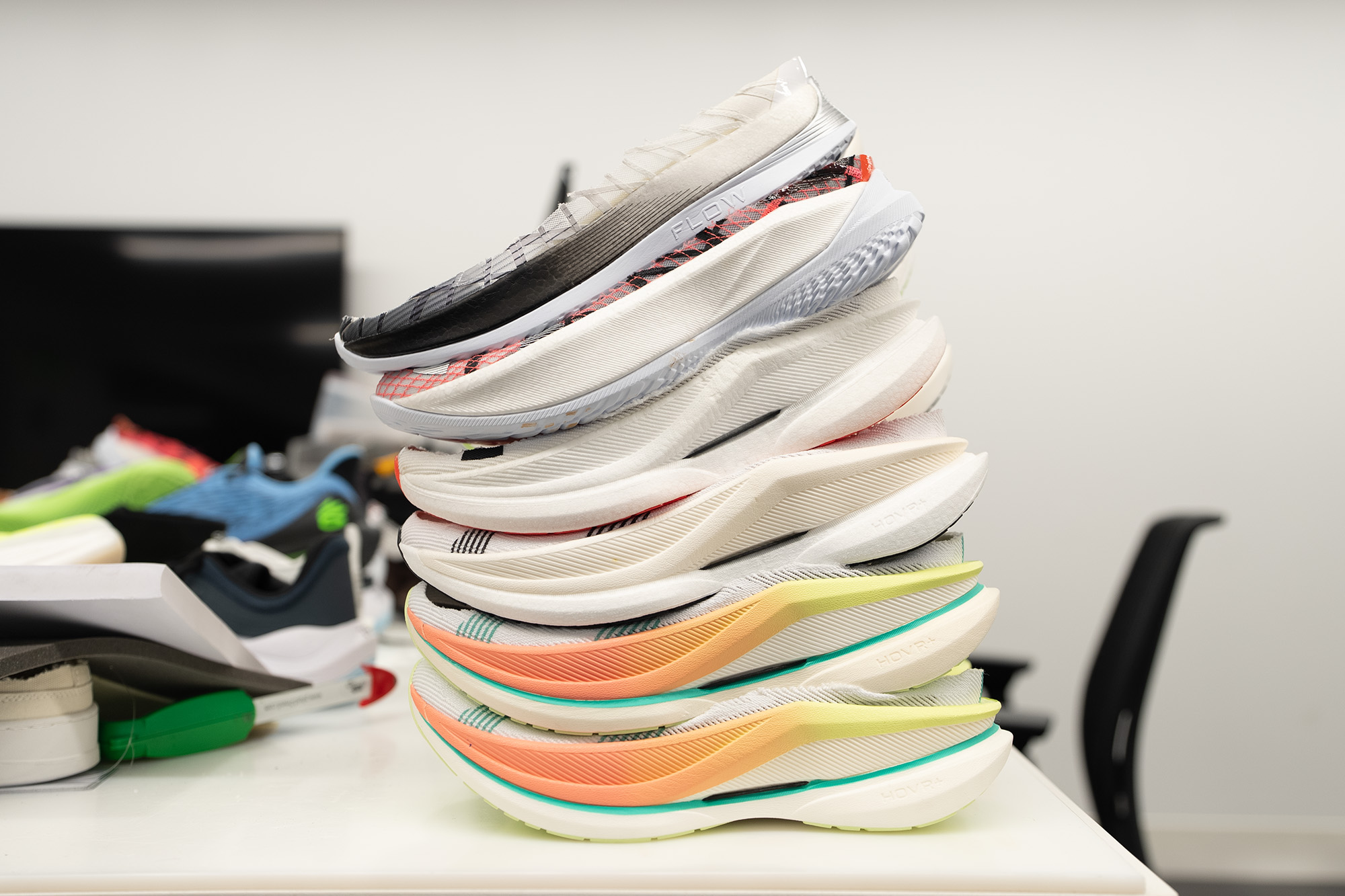
Over a table showing off the many Velociti iterations, Adam Bayer, who leads the innovation lab’s prototyping and testing operations, talks about how Under Armour used to operate more like a skunkworks. Historically, he explains, the approach was closer to “let’s find a cool technology and figure out how to put that into a product.” Now, he says, the team, split across Baltimore and Portland, Ore., starts with “what are the things that have nagged you, bugged you that we can help solve.”
It sounds like a PowerPoint slide until you see it enacted in square footage. Athlete intelligence brings in grievances. Materials teams work at the fiber, the foam, the polymer level. Mechanical testing starts breaking things before muscles and tendons have to twist and turn. Then, biomechanics find out what happens when an actual body gets involved. All in the service of building backward toward a solution. Bayer describes the newer version of the organization as “much more connected,” no longer operating “in more of a vacuum,” and the shift matters because the company wants to understand much earlier “where is this going to land.”
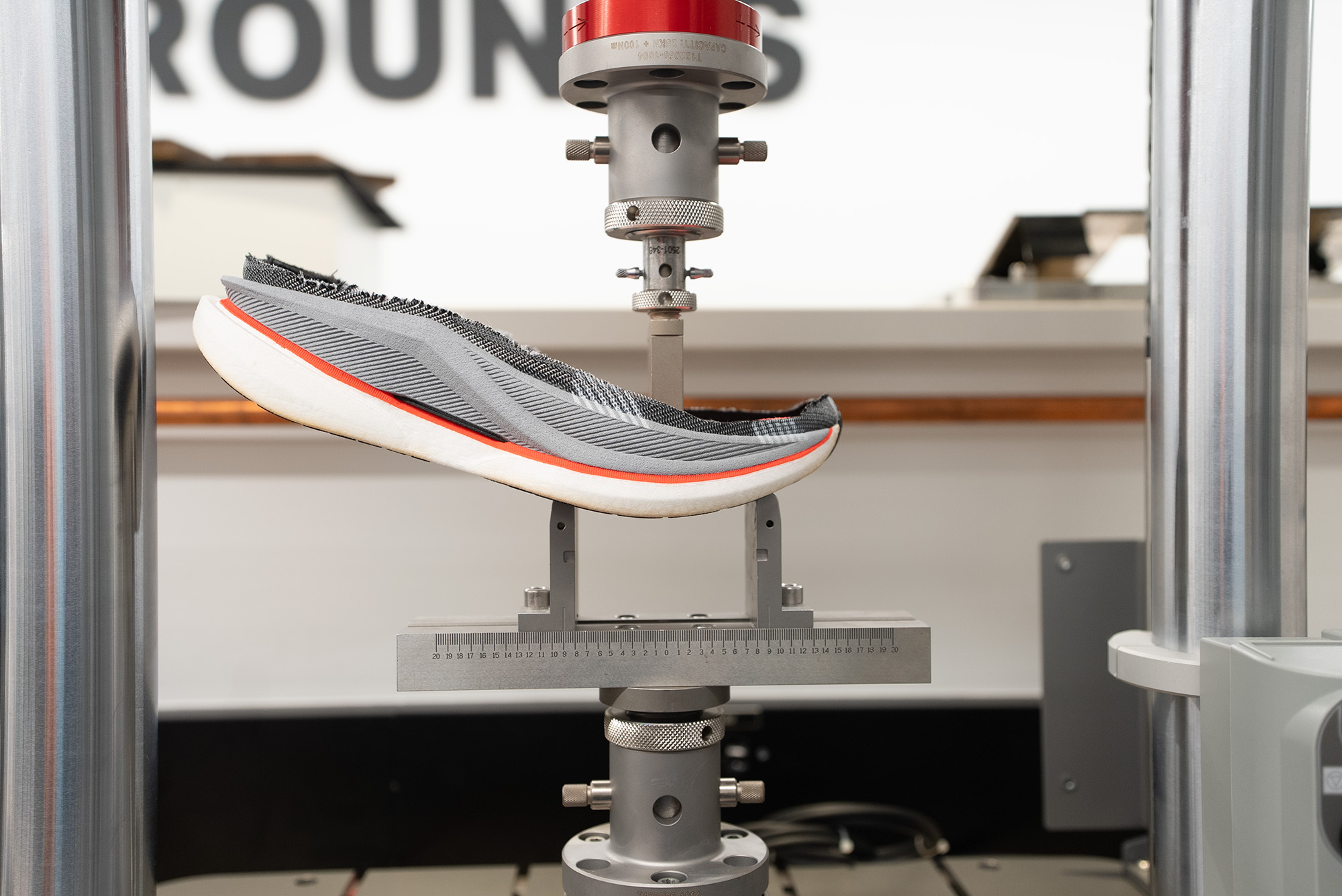
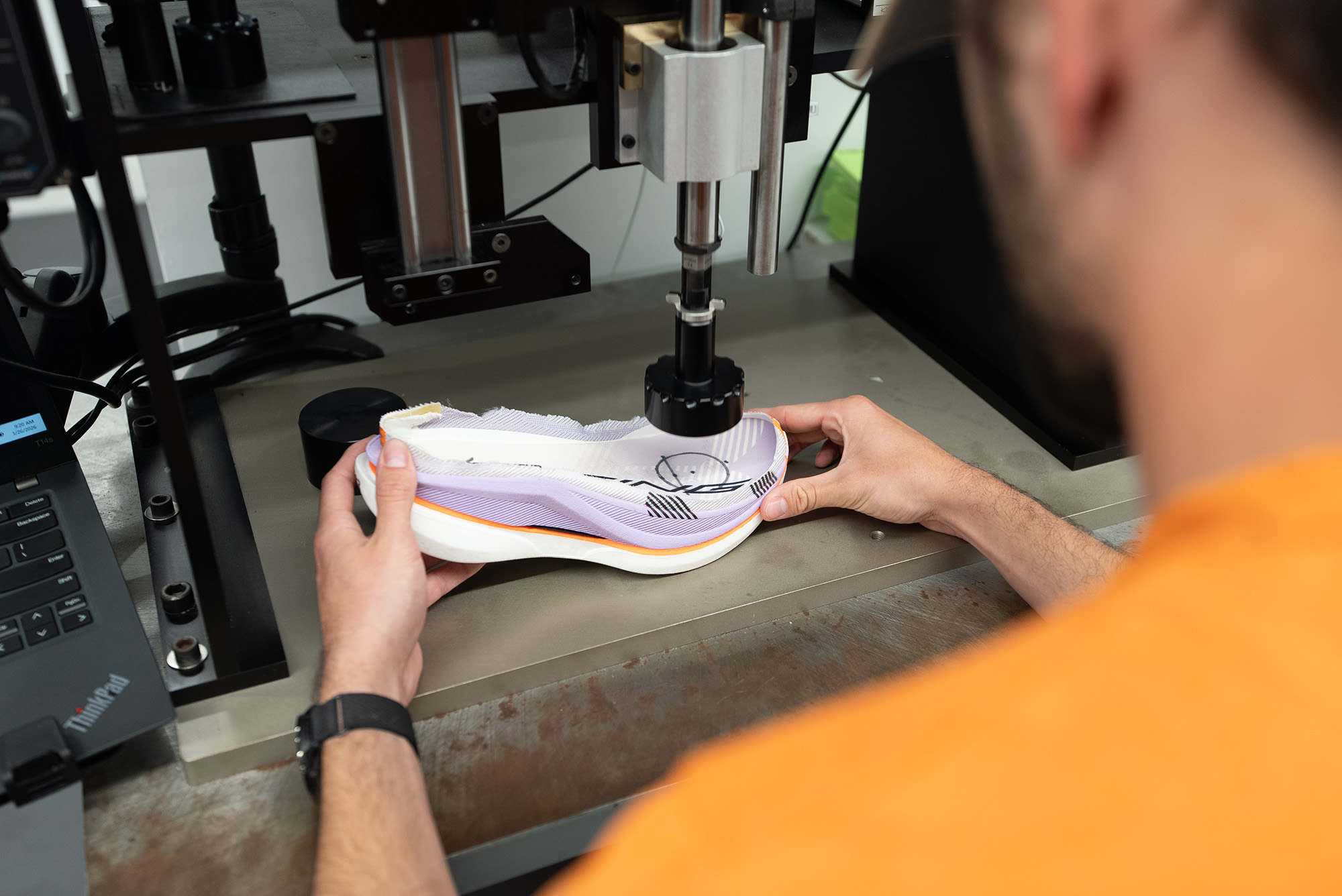
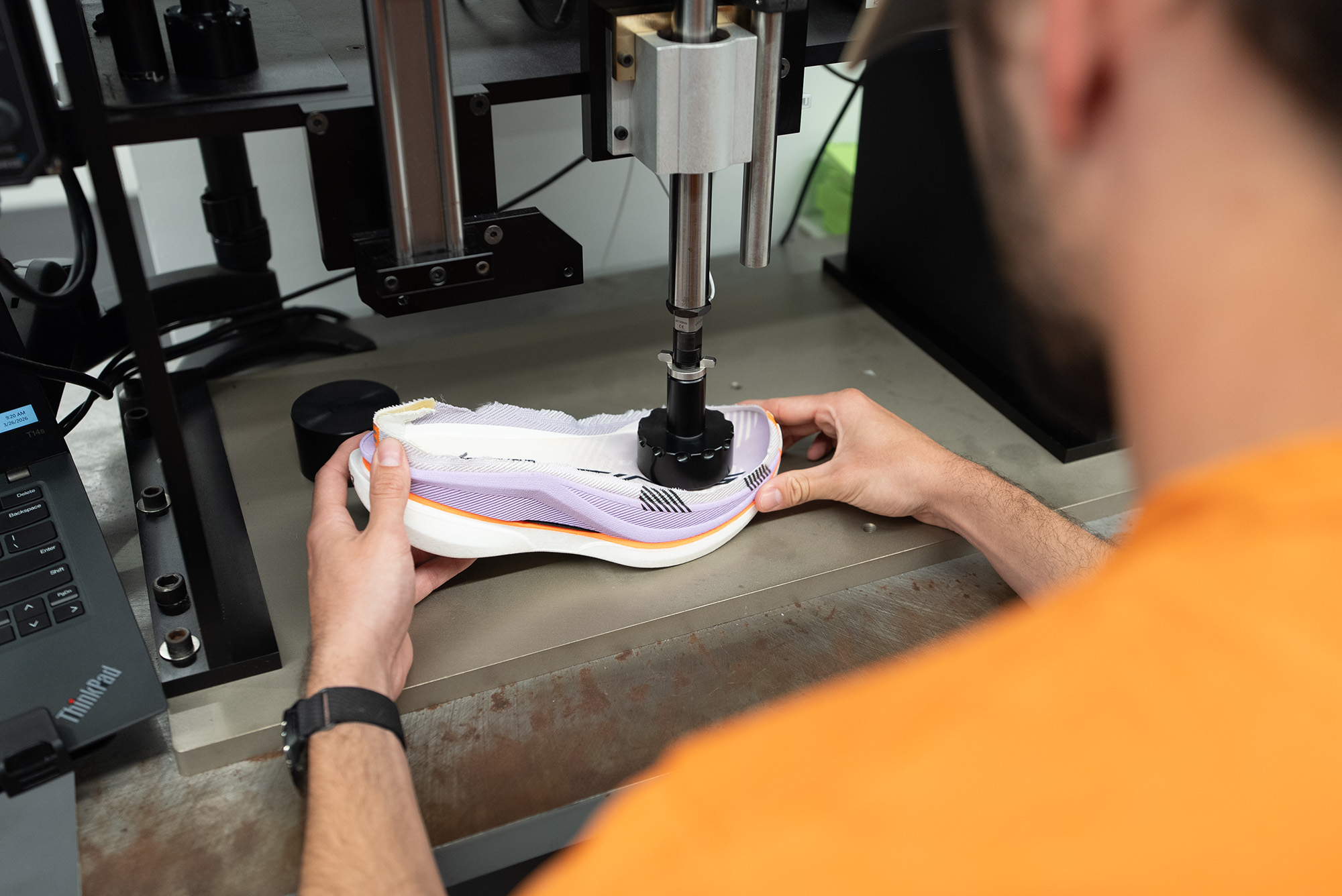
“We never get it right the first time,” Bayer says. But that’s not a lament so much as an operating principle. Tom Luedecke, senior director footwear innovation in Portland, starts talking in the language that matters here, revealing how 3D printing and CNC cutting are a big part of hastening the chain of decisions so things can more quickly become behaviors to analyze. He talks about using “additive and subtractive” methods. For instance, the plates under Lokedi’s feet in Boston in 2024 were cut in-house so prototypes could be made in two days. He also describes the process as a sort of Pandora’s box: solve one problem and out crawls another. A softer shoe loses stability. Fix the stability, and you lose a lively feel. Add bounce, and maybe the roll is wrong. The Velociti line didn’t have one big breakthrough so much as a series of increasingly compounding ones.
In the process, concept can become sample, sample can be corrected in days, not months. It doesn’t matter if something looks smart if it measures dumb. The stack sits between Lokedi and the pavement. But the stack is also the layers of prototypes that have to die and all the handoffs that have to take place long before something can be laced up. As Luedecke puts it during another part of the presentation, “just because it goes into the market at a certain time doesn’t mean you stop the project,” because “there will be a version two.”
Blakely confirms this shift in internal logic, where innovation teams aren’t just tasked with solutions. They’re brought in earlier and tasked with shaping the questions. No one team does everything, and no one team gets to stay too precious about its portion of the process.
Blakely’s word for it is “alignment,” because involving designers, developers, scientists, testers, commercialization, and controlled testing sooner and more synergistically means no more getting to the finish line and then having to explain what the benefits of any isolated components are or how they could scale. There is no miracle technology, just good project management. It’s not a sexy answer, but it rings true.
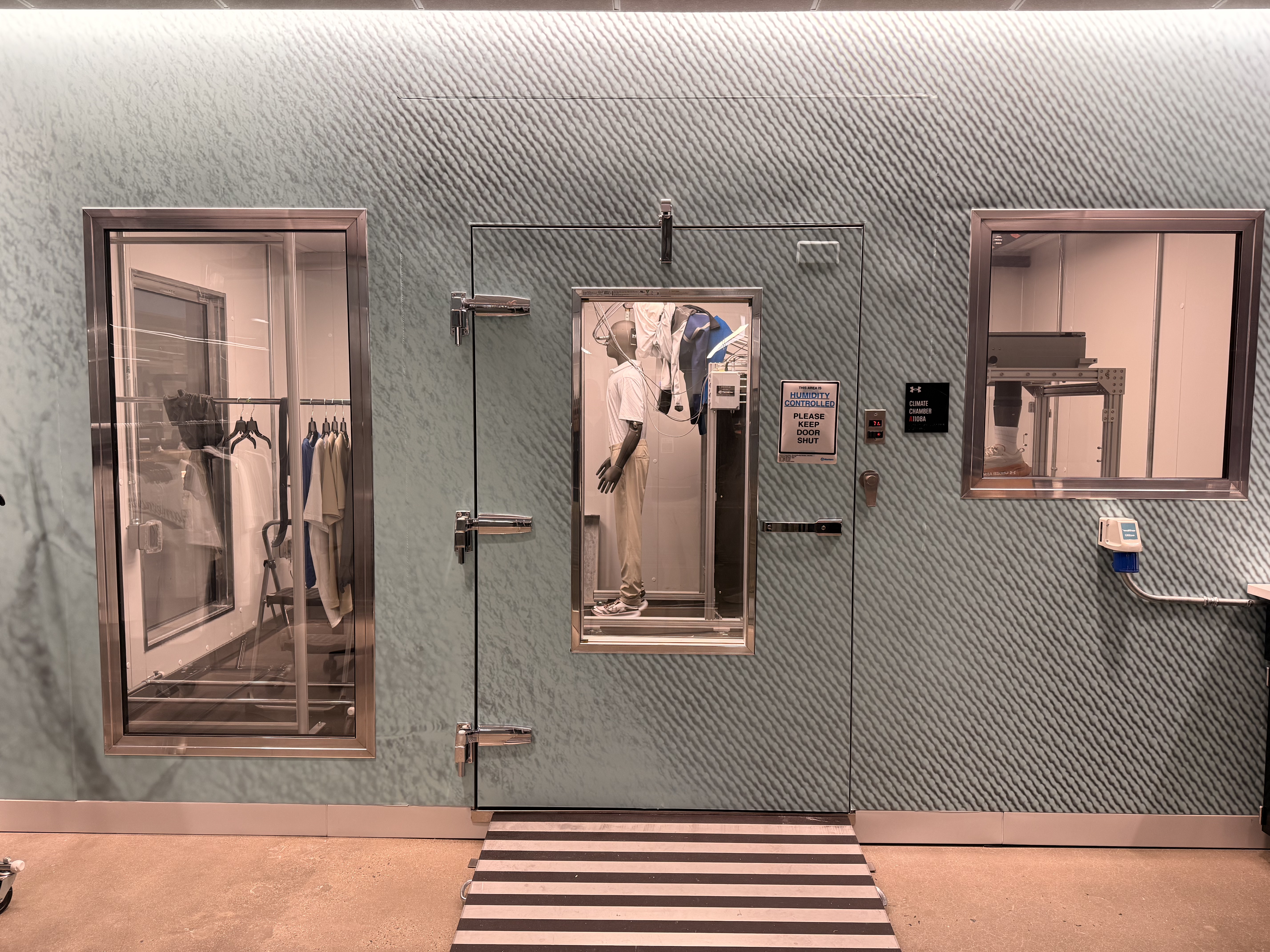
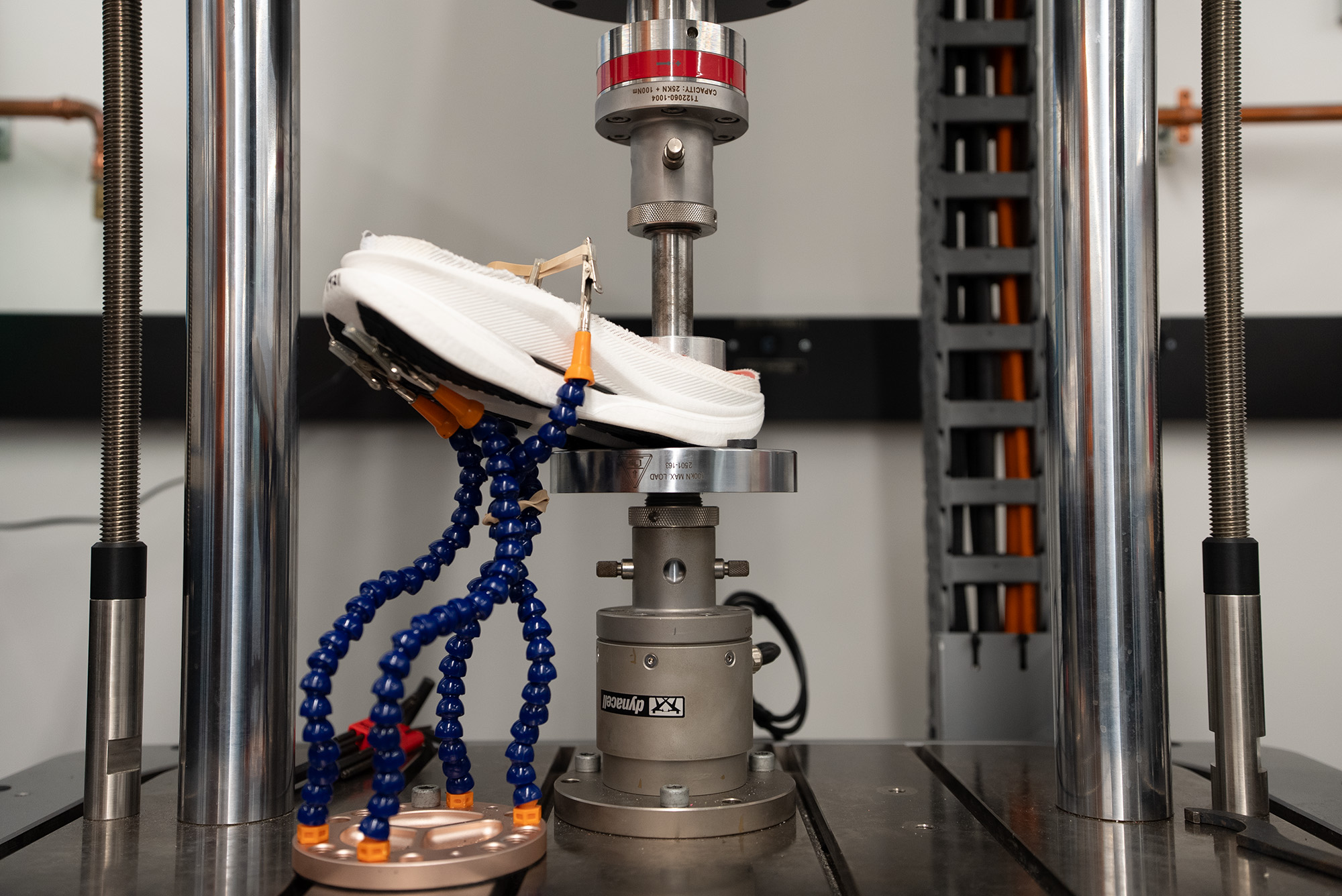
We leave the makeshift showroom, pass a thermally regulated unit with a sweating mannequin for testing apparel, and enter the Proving Grounds, which is a space calibrated to be far less forgiving than any road or runner will ever be. It’s temperature-controlled, humidity-controlled, and variable-controlled. It’s the one space in the complex that sees the entire lifespan of a product, from proof-of-concept experiments three to five years out to the final validation stages when something’s almost market-ready. This is where cushioning and impact protection, torsional stiffness and tread orientation have to survive a gauntlet of dozens, no hundreds of machines. It’s a room of expensive skepticism.
It also has to survive the graveyard. Bradford Eagan, who manages mechanical testing, greets us and introduces us to his favorite display. It’s a shelf of dead ends and partial victories that lead to something like the Velociti Elite 3. There are shoes that borrowed parts from other categories, like a Frankenstein build with a Velociti Wind upper on a Curry basketball shank, just to learn what a plated UA marathon shoe might strive to be.


Between the piles of might have been, never were, and what the next model may actually be are so many parts that failed in interesting ways. “We quite literally turn things into piles of dust,” reflects Eagan. For instance, a programmable rig helped quantify how the Velociti Elite behaves over 26.2, not just fresh out of the box. The Proving Ground can simulate mile after mile of punishment without burning time or burning out runners. It tests the thickness, density, compression, and recovery of what is “essentially a little mini mattress with these foam slabs,” way before they make it into a finished shoe, describes Eagan.
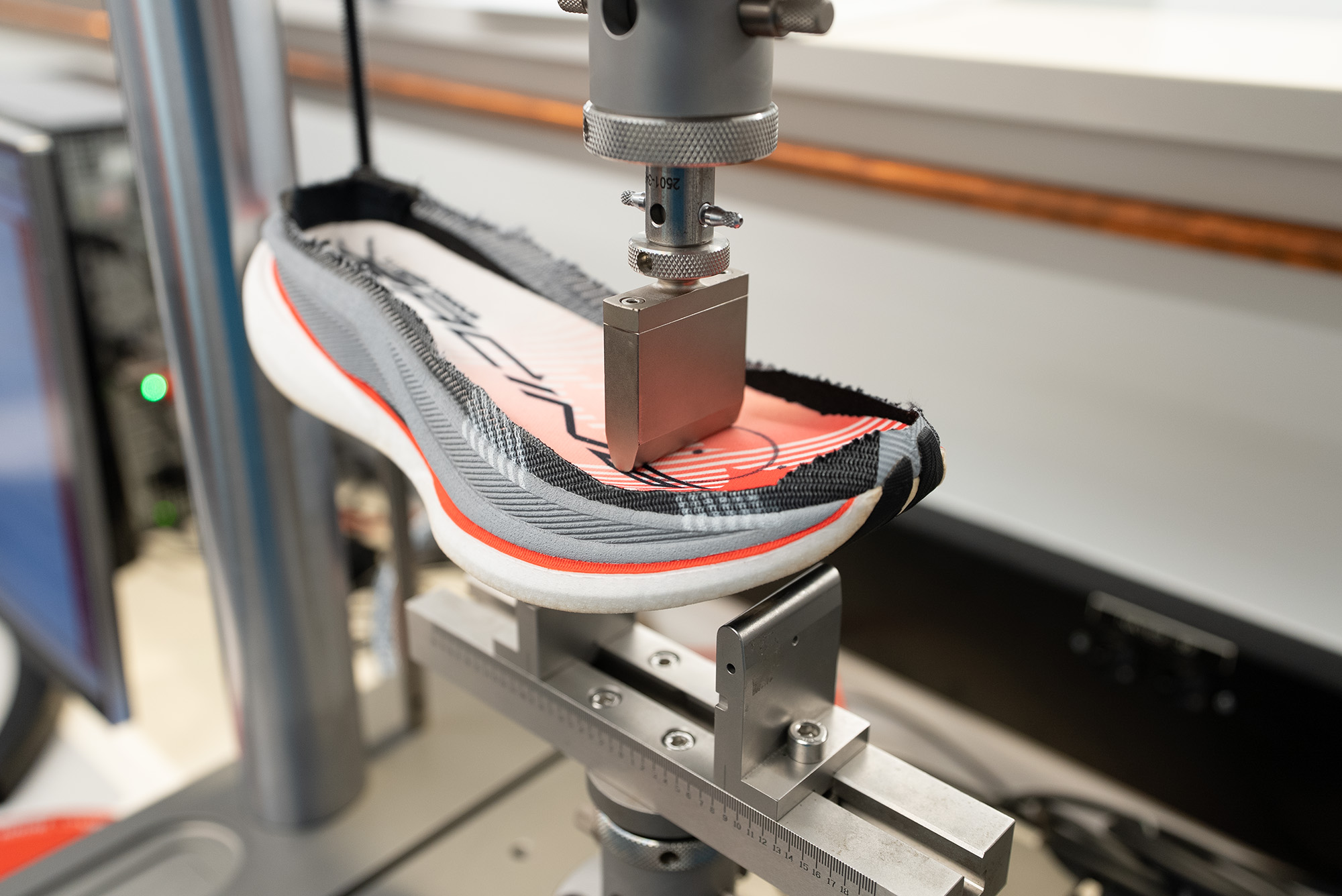
Testing, however, is not from blindly borrowed generic industry standards. Screens track how cushioning changes over simulated race mileage using custom in-house methods. After Lokedi came through the lab for a session on a high-intensity, sensors-rich analysis system [shown below], the team was able to copy and paste her specific impact gait, strike pattern, and more into a repeatable problem, replicating the load she puts into shoes but also the recovery time between steps. To do that, you have to need a complete map of each action’s consequences.
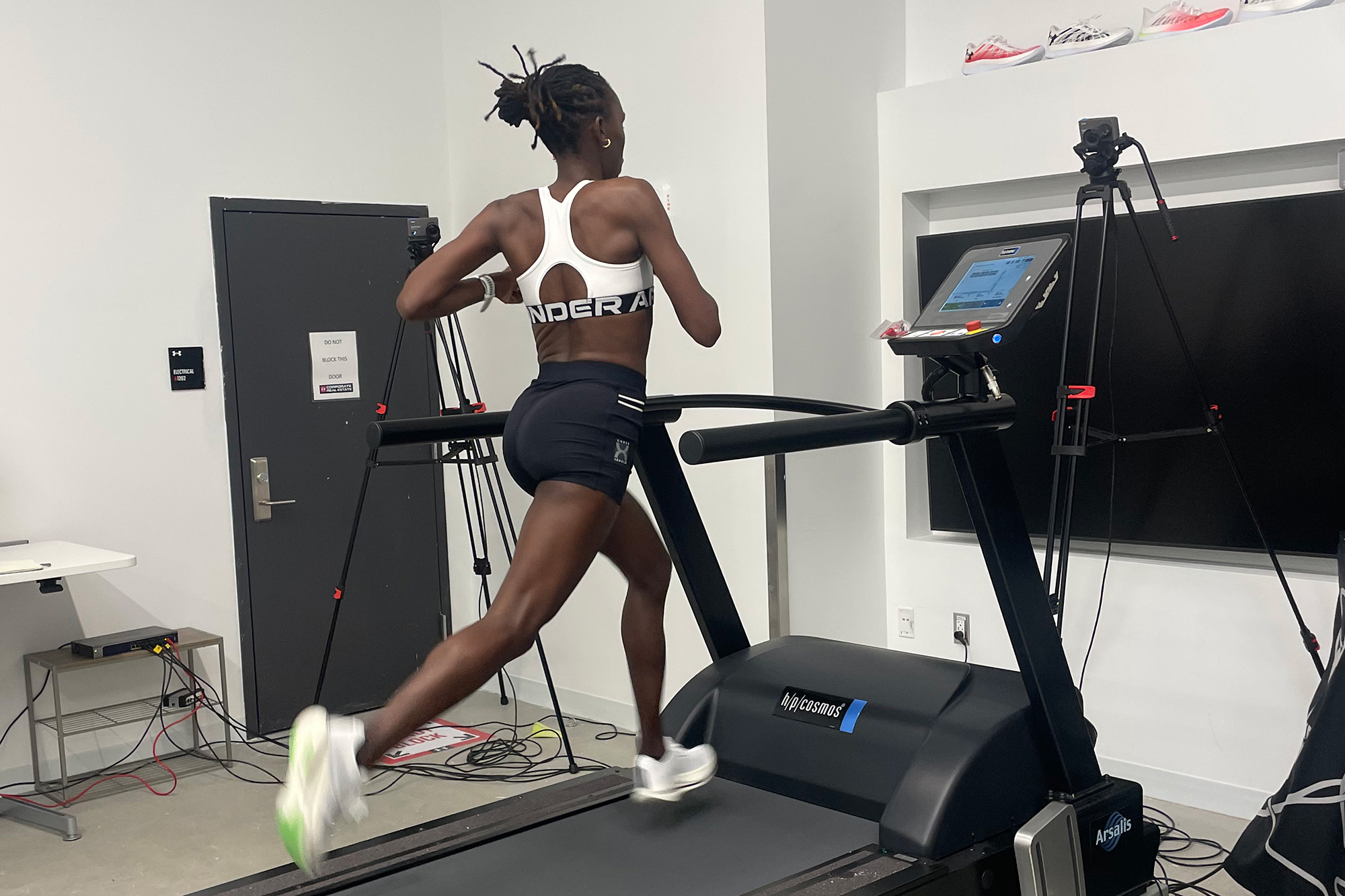
That’s where the sports biomechanics researchers come in, to translate those details. Sam Guadagnino, who spent years working out of Portland before moving to Baltimore to expand functions at HQ, describes the job as understanding human movement well enough to do more than politely accommodate it. “We ask how can we amplify their performance,” he says. The office may drown in metrics, but that’s in order to determine which are actionable. And, after crafting with Lokedi in mind, UA wants to be able to generalize for consumer models without flattening what made the capture so useful.
The Velociti 3 is the encapsulation of the Under Armour process playing out: identify the problem, build with different materials, measure performance changes, and then confirm that an athlete can detect the difference. And because nobody at UA seems interested in waiting months to discover what goes wrong, the prototyping and quick customization side of things sits just a few walls away from the labs.


Fabric can be woven, cut, embellished. Uppers, accessories, and apparel can go through five, six, seven iterations in a week instead of waiting in line at a factory sample room 12 time zones away. Iffy ideas don’t travel very far before somebody can fix or nix them. In the Proving Grounds, Ian McFarland touched on this house logic. His corner of the lab reinforces the point that footwear keeps making. Turf abrasion, cooling, waterproofing, fiber shedding may test different specifics, but the concept stays the same: Better products start with better questions, and better questions sometimes require building your own tests.
Bayer describes the infrastructure to 3-D scan and quickly construct as an accelerator, but the gain isn’t just speed for speed’s sake. Ella, the company’s third employee and original seamstress, is still on site alongside machinery moving at industrial speed. The benefit of institutional knowledge and cutting-edge machinery, when called upon, is compressing the feedback loop to keep any one insight from hardening into someone else’s problem.
But a race shoe can’t rely on results alone to make it desirable. That’s where Yassine Sadi, Under Armour’s VP of Apparel Design, steps in. His challenge, he says, is to “honor the technology” while making it look good, because “you have to balance science and beauty.” On a shoe, tooling has to be carved in a way that “gives space to the tech and gives it a place to actually shine,” says Saidi. The stack needs to look like the reason the shoe exists, while carrying the branding as confidently as it does the runner.
That helps illustrate how so much of the current Under Armour footwear design language is about integration rather than ornamentation. Saidi talks about the Halo trainer to illustrate making the logo functional within the design, using it as a technical element focused both on visual lines and making the upper and sole move more smoothly rather than just dropping it on top as a declaration.
Saidi reaches back to the older logic of Adidas stripes and Puma’s formstrip as lateral support elements, not initially as branding. That led to asking a useful reverse-engineering question: If the Under Armour mark were a technical element, how would it behave on the shoe? Even in models that are not pure performance products, the exercise is to build the identity into the structure, into the lines, into the way the form carries force. In the running category, where every cutout, curve, and bit of exposed geometry already suggests some kind of claim about propulsion, comfort, or control, that approach keeps the visuals from drifting too far from the engineering.
“That’s still science,” says Saidi, who points to architecture and concept cars as recurring points of reference, especially in ways they are “futuristic, super fast, super low,” which speaks to why the footwear makes speed seem visible even before you feel it.
Blakely, for his part, offers the executive version of why this matters. Under Armour can, he says, play “the foam race” or “the upper race” like everyone else. And sometimes win there, too. But he’d rather the company “run our own races” to make performance, perception, and presentation line up early enough that the shoe reached the finish line with results that speak for themselves. He is particularly blunt about what does not interest him: products that are novel but not practical, nor accessible, nor “perceivable.”
“I don’t want our innovations to be Instagram posts,” Blakely says. The practical principle runs back to one of his favorite examples, an old Tottenham Hotspur jersey project where Under Armour arrived thinking it was building the fastest-drying shirt on the planet, only to be told that in a 90-minute match, the drying doesn’t matter until it’s all over. The better question to answer became how to make a jersey stay light and breathable at full saturation, a line of thinking that Blakely says still proliferates lines years later. After my time in Baltimore, that feels like the right read: Under Armour seems less interested in winning a single race than picking the big ones worth planning.