
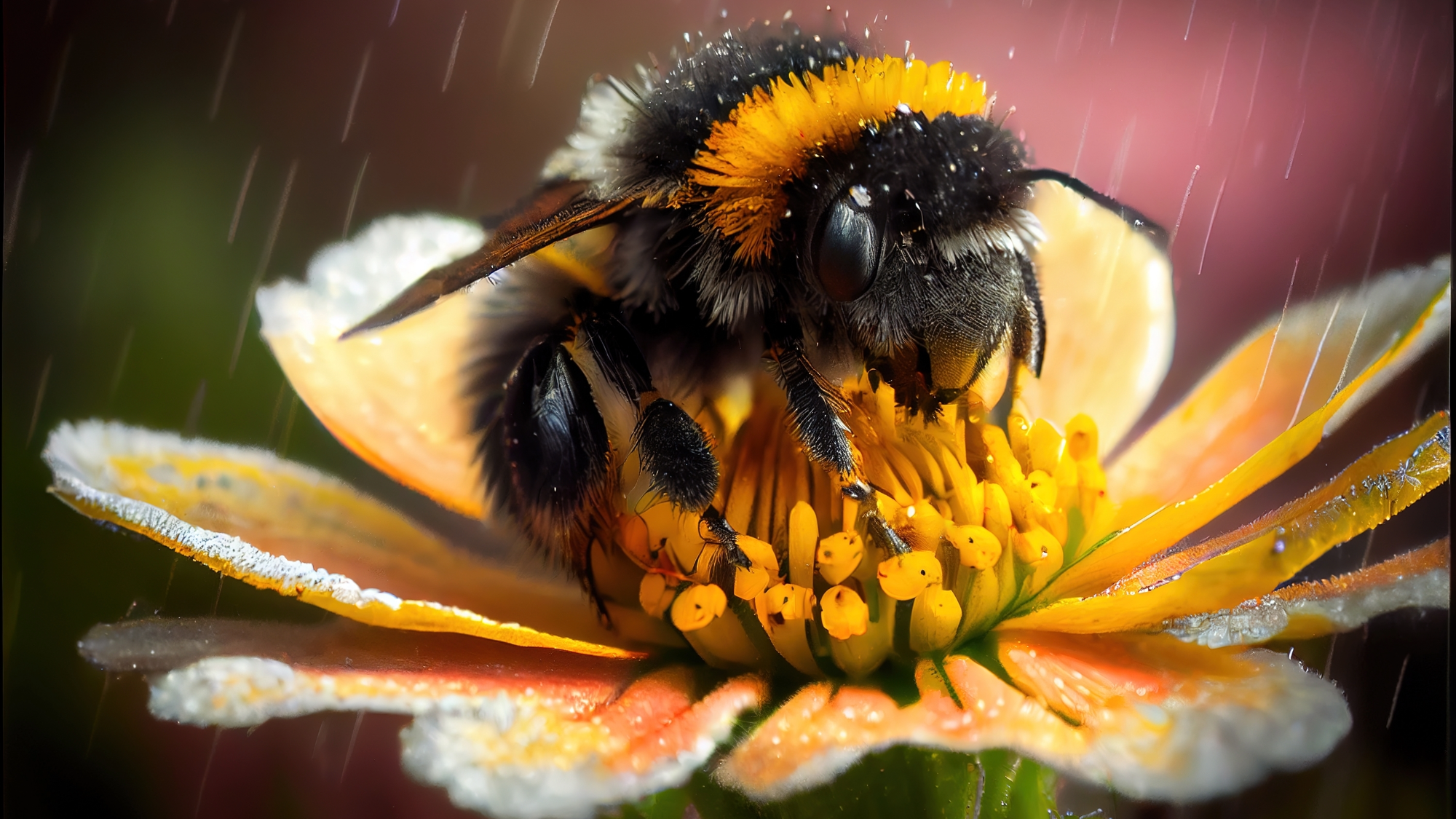
While every bumble bee colony has a queen, the process for becoming that queen bee may be a bit more democratic than monarchical. The worker bees appear to select which baby will be queen one day, according to a new study published in the journal Insect Biochemistry and Molecular Biology.
The key to this selection process lies in the juvenile hormone. This hormone in insects is responsible for their development, molting, and eventual reproduction. When the team gave the juvenile hormone to worker bees, they passed it along to all of the larvae in the colony through feeding. The more juvenile hormone the larvae received, the more likely they were to become queen.
According to the team, this is the first study to show that bumble bee caste is determined by the workers and shifts our understanding of bee colony dynamics. Instead of a top-down hierarchy, the colony appears to be a more decentralized system, where the caregivers and workers can alter the future of baby bees.
Less like Mean Girls?
Understanding the fate of the bee larvae is key to understanding their social behavior. Their whole system relies on a division of reproductive labor—some females will reproduce, while the others help.
“Since all these females share the same DNA, it’s a striking example of how the same genotype can produce very different forms,” Etya Amsalem, a study co-author and entomologist at Penn State, said in a statement. “It’s also a practical question since bumble bees are important for pollination, so knowing how to produce queens could improve commercial breeding and management.”
In addition to their different social roles, queen bees and worker bees are also very different physically. Bumblebee queens are larger, live longer lives, and will reproduce. Worker bees are smaller in stature and do not reproduce or live as long.
While it was clear that hormones were involved in how workers determine the queen, the exact mechanisms behind it were more vague.
“A single female egg in bumblebees holds the blueprint for two completely different life paths: the giant, reproductive queen or the small, sterile worker,” added study co-author and postdoctoral researcher Seyed Ali Modarres Hasani. “We wanted to understand what triggers the change in the female life trajectory, when does it happen and who controls the process.”
A matter of hormones
In the study, the team used three worker bees and a cluster of larvae. They applied juvenile hormone at different doses and times, and administered it either to workers or directly to larvae. They then traced the hormone’s movement, measuring larval mass and recording which individuals became queens or workers.
“Every colony will produce many new queens at the end of the season,” Amsalem said. “These queens will leave the colony, mate and go into winter diapause, and then each queen will start a new colony in the next spring. In that sense, producing as many queens—and males—at the end of the season is the ultimate purpose of the colony.”
When the juvenile hormone was applied directly to the larvae, not only did they not turn into queens, but the worker bees ended up eliminating most of these larvae.
When the workers were treated with the juvenile hormone, they put it into the food that they make for the larvae. These larvae then ingested the hormone, and were heavier and much more likely to become queens.
“We also determined that larvae are only sensitive to this hormone on days seven and eight of their development,” Hasani said. “By tracing the juvenile hormone, we saw that the workers pass the hormone into the food they make from nectar and pollen.”
Queen development and the colony’s future
These results suggest that queen production is linked to how the colony progresses through the summer’s warmer months until it eventually collapses in the fall.
“Bumblebee workers do not reproduce when the colony is young, but they can activate their ovaries and produce males as the colony ages, which causes an increase in juvenile hormone levels,” Amsalem said. “As a result, over time, they feed larvae more of the hormone. When enough workers do this simultaneously, usually towards the end of the season, larvae receive doses that are high enough during the critical window to develop into queens.”
These results could help improve bee colony management at a hormonal level, explain how complex insect societies evolve, and how hormonal signals interact to shape colony structure.
