
This article was originally featured on Knowable Magazine.
The first time Marcela Cosarinsky saw a nest of Atta vollenweideri leaf-cutter ants, it was the late 1990s and she was in an Argentinian grassland studying termites. Local children showed her a mound of earth nearly broad enough to park a Jeep on, crowned with chimney-like tubes. She was shocked that insects could build something so huge.
“It was like a mystery for me,” says Cosarinsky, a biologist retired from the University of Buenos Aires. Leaf-cutter nests can be both vast and intricate, decked out with multiple chambers and turrets. Yet these astonishing structures emerge without blueprints or plans; there’s no mastermind who oversees nest construction. “They don’t have architects,” Cosarinsky says. “They don’t have a hierarchy to tell them what to do.”
Leaf-cutter ants are best-known for forming long, wobbling lines of green as they transport freshly cut bits of leaves or grass across neotropical landscapes. They feed these plant fragments to masses of fungus that they cultivate inside the nests, some of which are among the largest and most complex built structures in the animal kingdom.
To try to understand how these nests come together, Cosarinsky — like many researchers who have studied leaf-cutter ant nests — teamed up with Flavio Roces, a behavioral scientist at the University of Würzburg in Germany who is the world’s lead detective in the mystery of the missing architects. Roces and his colleagues have shown how ant builders respond to simple cues to make key decisions. Today, a picture is emerging of how those decisions interact to produce a metropolis.

The OG ant farms
Ants first developed agriculture tens of millions of years ago. Those primeval farmers have since diverged into some 250 species, most of which feed their fungus dead plants, insect droppings and other detritus. But one elite lineage figured out how to supply its fungus with fresh-cut morsels from living plants. These were the first leaf-cutters, and their innovation allowed them to build on an industrial scale. Today, leaf-cutters comprise around 50 species that make their homes in diverse warm-weather habitats from Texas to Argentina.
Queens are the first builders of any nest. Virgin queens fly from their nests of birth en masse, carrying pellets of fungus in their mouths. They mate with males in the sky, then search for places to land.
“On those days, there’s a rain of these new queens covering the entire landscape,” says evolutionary biologist Ulrich Mueller of the University of Texas at Austin. “All the colonies in any area are synchronized.”
The queen digs a tunnel with a chamber at the end, then in some species seals herself inside to lay eggs and start her fungus garden. Choosing the right location and depth for her tunnel will be crucial for her colony’s survival.
Her dilemma is that she must conserve her energy until her offspring are old enough to take care of her, while also reaching an environment that is suitable for the ants and their fungus. If her initial chamber is good enough, her babies will have fungus to eat. But if the chamber is lacking, her nascent colony may perish.
In experiments with the species Atta sexdens, Roces and colleagues found that most queens died in the first nine weeks after sealing themselves in their nests. And in 2022, a Brazilian team found that, in experiments, Atta sexdens queens dug deeper nests and were more likely to survive in shaded, moist soils than those digging in denser, drier soils.
In one of Roces’ favorite studies, he and former student Kerstin Fröhle found that queens from the species Atta vollenweideri base their decisions on time and distance. In optimal conditions, queens dig to a depth of about one foot. If they haven’t reached that depth within about 20 hours, they give up and create a chamber wherever their tunnel ends. Roces thinks they measure their tunnels using their own body movements, the way a person might measure distance by counting steps.
Once her chamber is complete, the queen’s role in nest construction is over. From that point on, the shape of the growing nest is determined by the decisions of her offspring.
To understand those decisions, you need to know about the fungus: a pallid, spongy species called Leucoagaricus gongylophorus that requires constant coddling. It must be warm but not too warm, bathed in humidity and protected from high levels of CO2.
Leaf-cutter ants are exquisitely attuned to these factors; they possess the rare ability to sense absolute levels of CO2, and their temperature sensitivity approaches that of a pit viper. When they feel conditions become unsuitable, they move their fungus and brood. (The immature ants live among the fungus, so gardens are also nurseries.) In the Sonoran Desert, for example, Acromyrmex versicolor descends to deeper, moister chambers in the dry season, says Mueller.
And some species living in colder regions of South America don’t even dig subterranean nests. Instead, they tend a fungus garden at ground level and cover it with insulating thatch made of plant fragments. Roces and his colleague Martin Bollazzi, an entomologist at the Universidad de la República in Uruguay, found that the thatch keeps nests warmer than the soil. The ants open holes in the thatch when they feel it getting too warm and close them when it gets cold or when humidity levels fall.
Variation in nest types can exist even within a species. For example, Acromyrmex lundii colonies dig small underground nests in warm environments but build thatched nests when it’s cold. In one of their earlier projects together, Bollazzi and Roces found that A. lundii worker ants prefer to dig in soil close to 77 degrees Fahrenheit, the ideal temperature for the fungus. If the soil warms up, the ants move to a cooler spot. If it cools, they stop digging.
Construction of the compound
Studying A. lundii has also helped illuminate how underground structures emerge. The ants dig more tunnels as their population increases, but they don’t enlarge chambers unless there is fungus inside. They dig around the mass of fungus as it grows, maintaining just enough space between it and the chamber walls for an ant to walk around.
So how do they “decide” where to start a new chamber? Ants seem to deposit fungus and larvae wherever they find the best conditions, which may be in the middle of a tunnel. Roces and his former student Daniela Römer simulated this by offering A. lundii workers a forked tunnel with one branch containing a pile of larvae. Ants excavated more than twice as much dirt from the tunnel with the larvae, leaving a rounded, chamber-like cavity.
“They don’t decide, ‘I will dig the chamber in this place,’” says Bollazzi, who, with Roces, details leaf-cutter nest-building in the 2026 Annual Review of Entomology. “They start digging chambers around objects, fungus gardens or larvae, because they need more space. And then, as a result, you have a nest that is composed of tunnels and chambers.”
Roces thinks the larvae attract ants to the site, causing crowding that’s the trigger to dig. Indeed, crowding can inspire digging even without larvae or fungus, as Roces shows in a new, unpublished study. When he and his colleagues orchestrated traffic jams in a narrow section of tunnel, Atta laevigata workers expanded the tunnel until the traffic speed returned to normal, apparently responding to the rate at which they encountered other ants.
The most unusual architectural innovation among leaf-cutters arguably belongs to A. vollenweideri, the species Cosarinsky saw in Argentina with her young guides. These ants build extensions known as turrets around tunnel openings on top of their mound. Some are shaped like volcanoes, while others look like huts built by a swamp witch, perforated by a hodgepodge of windows.
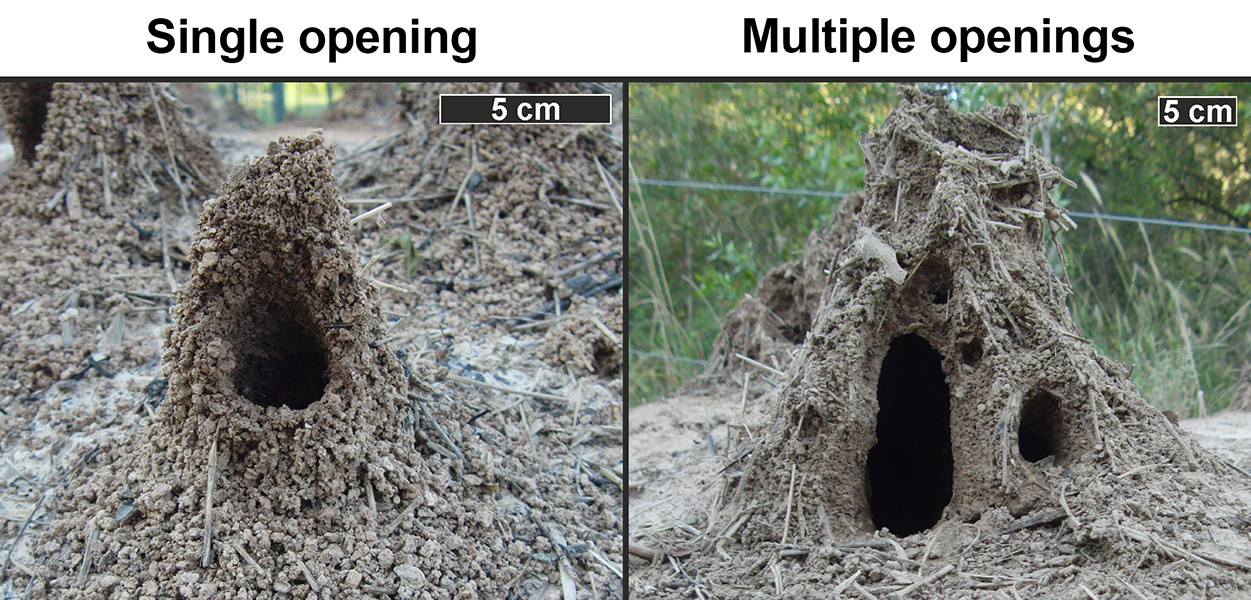
The turrets form part of a ventilation system, and Roces figured out how it works a quarter-century ago. Wind speeds up as it blows over the mound, creating an area of reduced pressure on top. This draws air out of the uppermost holes, creating negative pressure that sucks in air through holes at the mound’s base. Turrets increase this effect by raising the highest openings even higher.
A. vollenweideri ants need good ventilation because they nest in clay-rich soils that tend to trap gases. Both ants and fungus produce CO2, and while ants can breathe air with CO2 concentrations as high as 8 percent and suffer no ill effects, their fungus cannot.
Roces has multiple papers on A. vollenweideri turrets, and he hasn’t tired of them yet. His discoveries help to explain how the shapes get so bizarre: Ants decide how many “windows” to build based on the concentration of CO2 flowing out through the tunnel under the turret.
CO2 also guides decisions about where to build the turrets, according to Roces’ latest turret project, which is not yet published. In experiments, individual ants prefer to build around nest openings that are expelling more CO2. They also like to build where this outflowing air is more humid — unless they find a turret already in progress around the drier opening. In that case, they contribute to their nestmates’ project.
“This is indirect communication through the structure they are building,” says Roces. He compares it to the way children work together on a sandcastle, even before they can speak.
The algorithms ants use to make decisions synergize in ways we’re still struggling to grasp. An Atta laevigata nest may have more than 7,000 chambers strung along tunnels like fruit on a branch, reaching depths of more than 20 feet. Some chambers, used by the ants as garbage dumps, can be large enough for a person to stand in.
And yet Roces doesn’t think the ants have mental maps of their own homes.
“If we could ask an ant at a given point, ‘Do you know where you are in the nest?’ the ant may probably say, ‘I have no idea, but I respond to what I need to respond to in the moment,’” he says. Appreciating the grandeur of the nest as a whole is likely beyond them. That part is up to us.
This article originally appeared in Knowable Magazine, an independent journalistic endeavor from Annual Reviews. Sign up for the newsletter.