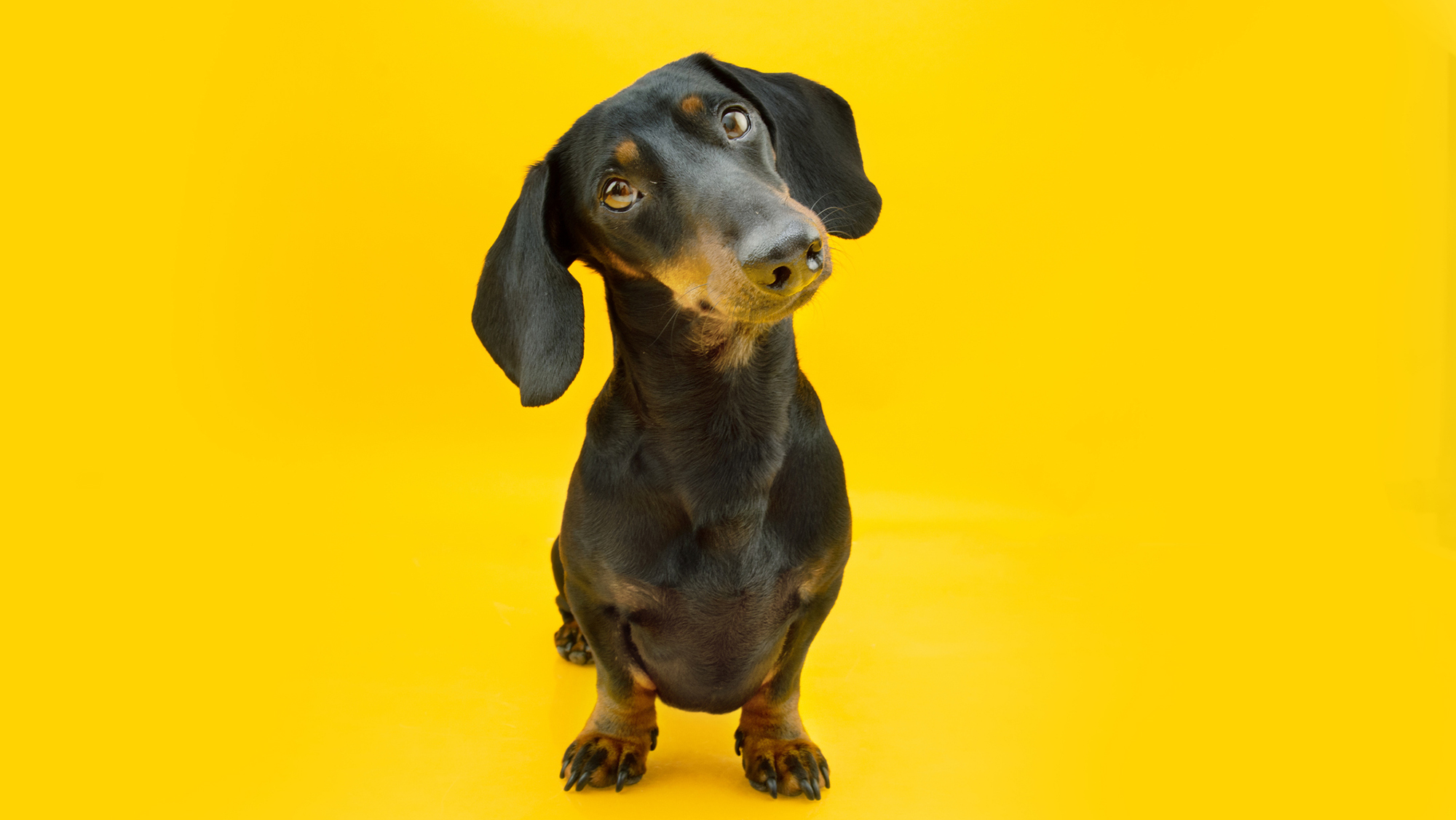
There are countless TikTok videos that go like this: Someone says something to their dog, the dog’s head swings to one side, with ears up and eyes on the owner. Whoever’s filming can barely hold the camera steady because it’s just too dang cute. Whether it’s online or in person, we’ve all seen dogs tilt their heads—and yet scientists don’t know why they do it.
“Dogs are singularly situated to be sentinels [mirrors] of the human experience,” Courtney Sexton, a postdoc at Virginia-Maryland College of Veterinary Medicine who studies human-dog relationships, tells Popular Science. The head tilt, she argues, is a window into one of the most striking of those adaptations. Unlike cats, hamsters, or even our closest primate relatives, dogs have developed the ability to parse human speech in ways that mirror our own.
Dogs have spent roughly 20,000 to 30,000 years living alongside humans, according to Sexton—long enough to develop processing systems for human speech that are very similar to our own, a dog brain imaging study suggests. It turns out that adorable tilt may be triggered when a dog is trying to make sense of what you’re saying, not just that you’re saying something.
When a dog tilts their head, they might be using their brains like we do
MRI brain images from the same study show that dogs activate the left hemisphere of their brain when processing familiar words—regardless of the tone they’re spoken in. Whereas unrecognized words said in a specific or familiar tone of voice activate the right side.
A 2025 study examining dog head tilts, on which Sexton is a co-author, adds to that picture. Researchers had 103 dog owners film their pet dogs under four conditions: resting, the owner making eye contact with the dog in silence, listening to neutral and unfamiliar speech (the owners talked about ancient Egyptian civilization, a topic most dogs don’t encounter regularly), and finally, responding to familiar words delivered with warmth and excitement.
The head tilt appeared far more often under that last condition than any other. The dogs weren’t just reacting to noise—they were responding to the sense that someone was talking to them.
Related 'Ask Us Anything' Stories
Are some dog breeds really easier to train? Not really.
Why your dog gets so excited to see you
Why do dogs lick humans? It could be a sign of affection.
Do dogs dream? The answer might make you appreciate your pup even more.
Do cats and dogs remember their past?
“It was very clearly a response,” says Sexton. The dogs were engaging in some kind of “communicative exchange” with their owner, she says.
The direction of the tilt mattered too. Most dogs leaned to the right. The brain processes sensory inputs contralaterally, so the left hemisphere handles inputs from the right side of the body, and vice versa.
A rightward tilt may mean the dog is engaging the left hemisphere to process what it’s hearing. That’s where language processing happens—in dogs as well as in humans.
Nailing down what tilt direction means for the brain is still a hypothesis, however.
Male dogs tilt more—and further right
Male dogs in the study tilted more overall, and with a stronger rightward lean than females. But just because male dogs tilt more doesn’t mean they understand more—it may just reflect a difference in how each sex uses the brain for language processing.
In humans, men tend to process language using primarily one side of their brain. Women, on the other hand, “tend to process things a little bit more bilaterally,” Sexton says—drawing on both hemispheres at once. Dogs, it seems, follow the same pattern.
Only around 40 of the 103 dogs in the study actually tilted, so the sex difference should be treated carefully, Sexton says.
Surprise might also play a role
Not every dog tilts their head as a response to language. Sexton’s 2025 paper notes that in another study on canine facial expressions, dogs also tilted their heads when a jack-in-the-box startled them, suggesting the behavior might not be exclusive to language contexts. This raises the question of whether this is really about language, or just about novelty.

One possibility Sexton raises is cognitive offloading, the idea that a physical gesture can help the brain reset before processing something new. Think of the slow exhale or the furrowed brow people get when they’re working something out.
But the 2025 study found that dogs tilted their heads almost exclusively in the social-language condition—not during other conditions, even surprising ones. Sexton doesn’t think cognitive offloading is the full explanation, though she hasn’t ruled it out.
Dogs don’t tilt their heads just to be cute
In studies, people rate head-tilting dogs as cuter. But Sexton is skeptical that the behavior is being performed for that effect. Your golden retriever isn’t calculating that a sideways look will earn them a treat, she says.
The cuteness question does point to something real, though—just not about a dog’s tilt specifically. Over the course of domestication, dogs developed what biologists call “neoteny,” where adult dogs retain juvenile features with their large eyes and soft facial proportions reminding humans of babies. This is not accidental.
Babies are entirely dependent on adults, Sexton points out. The more dependent and helpless they are, the cuter they need to be. It’s evolution’s way of ensuring adults stay invested, Sexton says. Dogs acquired that same toolkit over millennia of living alongside us. The tilt looks cute because we’re wired to respond to it. But that’s only a byproduct.
They are processing, they’re thinking, they’re responding, Sexton says. The head tilt is the outward sign of that. It’s not just cute. It’s a dog actually trying to work out what you said.
“By and large, we’re just scratching the surface of understanding how dogs’ minds work,” she says. “The more that we can understand about their behavior, the better [pet-human] partners we can be.”
In Ask Us Anything, Popular Science answers your most outlandish, mind-burning questions, from the everyday things you’ve always wondered to the bizarre things you never thought to ask. Have something you’ve always wanted to know? Ask us.