
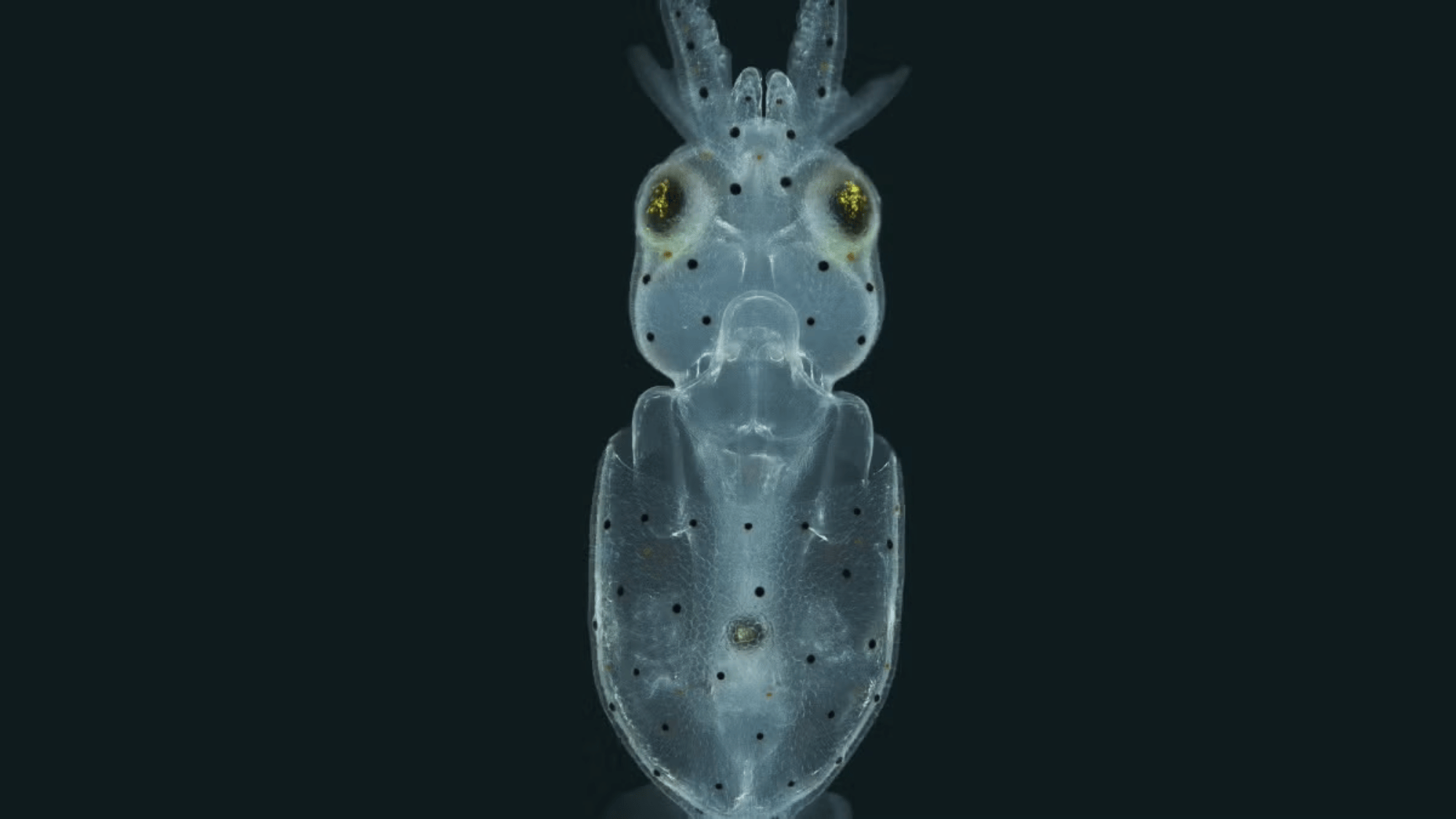
Squid skin behaves a bit like a large, 10-armed human ear. While scientists at Case Western Reserve University were probing these enigmatic cephalopods, they discovered that squid have significantly more hair cells than was previously known.
Hair cells are cells with bundles of hair-like protrusions, and researchers already knew that squid had them on their heads and arms. Now, it looks like the invertebrates have hundreds more of them all over their bodies, with potential insight for understanding human hearing.
“Squid are cephalopods with a diverse population of hair cells on the surface of their bodies, which may yield insights not only into how these fascinating animals detect water movement to survive, but also into how hearing and deafness occur in humans,” Brian McDermott, a biologist and co-author of a quid study recently published in the journal Current Biology, said in a statement. That’s because these squid hairs are similar to those inside the human ear, which enables us to hear things.
McDermott (who investigates hair cells) and his colleagues used an imaging technique called light sheet microscopy to probe the cells. During this process, a thin sheet of light lights up one plane of a specimen at a time and researchers can produce detailed 3D images while minimizing tissue damage. Their work also included the first full-body mapping of lateral lines (features made up of hair cell clusters) on squid.
Understanding these hairs have implications for our own ears. Human hearing involves sound vibrations moving to a snail-shaped organ in the inner ear called a cochlea. The cochlea is filled with thousands of hair cells, each of which has a collection of small hair-like features called stereocilia, or cilia. The length of cilia depends on where they are found. If they are in areas where low pitches are detected, the cilia are longer. If they are in high-pitch areas, the cilia are shorter. This positioning helps orient each cell to a specific sound frequency.
When the sound vibrations reach the cochlea, the cilia move. The hair cells then transmit the signals to the brain via the nervous system, where the messages are turned into meaningful sounds. Marine animals such as squid and octopuses feature similar cilia bundles on their bodies. Their survival appears to depend on detecting various frequencies of water movement, akin to how human ears pick up on sound pitches.
In other words, squid skin appears to behave like a human ear. This new research even suggests that squids regulate the length of the hair bundles to tune the hair cells to various frequencies, similarly to human ears. The hair bundles in fish lateral lines, on the other hand, are all the same length. So by studying squids, researchers could learn more about human hearing.
“Often, when a child is born deaf or a hearing person loses their hearing, it is the hair bundle that has been damaged,” McDermott concluded. “So, studying the squid’s hair bundle holds promise for understanding how hearing loss occurs.”
