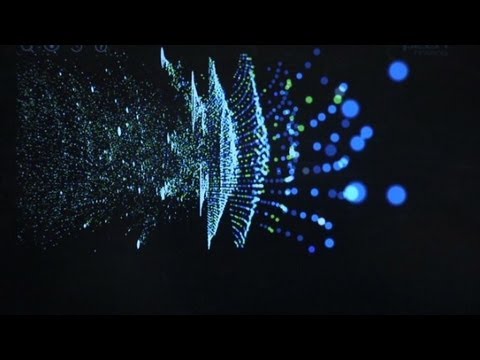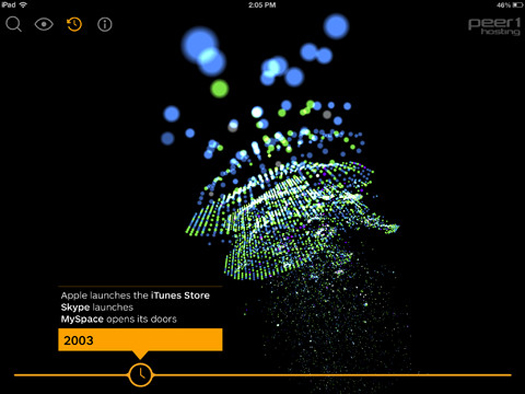
Peer 1 Hosting has been trying to explain what the Internet looks like since 2011, when they created an infographic map of the Internet showing networks and routing connections across the world. Now they've visualized the web in a zoomable Map of the Internet app for iPhone and Android that lets you explore connectivity in a more hands-on way.
Using data from CAIDA, The Cooperative Association for Internet Data Analysis, the app shows 22,961 autonomous system nodes and the 50,519 connection that link them, both from a global view and a network view. Exploring it is a little like being lost in space, surrounded by floating lights and colors.
You can search for particular companies or domains and perform traceroutes to see how data moves between them, or you can also watch the Internet evolve over time. A timeline at the bottom pinpoints important years in the history of the web, like the launch of Wikipedia or last year's SOPA blackout, and lets you explore how connectivity has increased over the years. Based on current data, they even predict what the Internet landscape will look like in 2020.
In the blog post announcing the app release, the company says they think of the map as "an educational tool that represents the Internet’s evolution from 1994 to present day." Unless you already know a lot about networks and autonomous systems, it might more disorienting than educational, but at least it's fun to play with.
You can check out CNN Money's video overview for more:
140 years of Popular Science at your fingertips.
Each issue has been completely reimagined for your iPad. See our amazing new vision for magazines that goes far beyond the printed page
Stay up to date on the latest news of the future of science and technology from your iPhone or Android phone with full articles, images and offline viewing
Featuring every article from the magazine and website, plus links from around the Web. Also see our PopSci DIY feed
For our annual How It Works issue, we break down everything from the massive Falcon Heavy rocket to a tiny DNA sequencer that connects to a USB port. We also take a look at an ambitious plan for faster-than-light travel and dive into the billion-dollar science of dog food.
Plus the latest Legos, Cadillac's plug-in hybrid, a tractor built for the apocalypse, and more.

Online Content Director: Suzanne LaBarre | Email
Senior Editor: Paul Adams | Email
Associate Editor: Dan Nosowitz | Email
Assistant Editor: Colin Lecher | Email
Assistant Editor:Rose Pastore | Email
Contributing Writers:
Rebecca Boyle | Email
Kelsey D. Atherton | Email
Francie Diep | Email
Shaunacy Ferro | Email
before I looked at the draft which said $4840, I have faith that...my... mom in-law woz like actualy making money in their spare time on their laptop.. there dads buddy haz done this for under 14 months and a short time ago cleared the dept on their place and bought a brand new Lotus Elise. read more at........ BIT40.ℂOM
I would have to do a lot of mind numbing drugs to think that's what the internet looks like. That just plain looks lazy. The likeness of the internet could be a 3-D streaming reality without too much imagination. Well, some imagination. Stuff like ULF being used by subs. Deciding how to do the layers. Deciding what to do with internet connected, computer controlled facilities like Oak Ridge National Laboratory-now that's gotta be a weirdly cool looking group of emmisions. Some that we have no idea what they actually do look like.
Can they make a version for desktop or laptop? Some people (like me) don't use mobile platforms very often.