
It's surprisingly hard to find safe drinking water on Earth--this on a planet covered in water. A new project by Lockheed Martin hopes to change that, and do it cheaply. Using a graphene filter, Lockheed hopes to transform salt water into drinking water by the end of the year.
The timing couldn't be better. Ending water scarcity is one of the United Nations's millenium development goals. But it is a daunting task: while there’s enough freshwater for everyone on earth, it isn’t very evenly distributed, and untangling that distribution is a Herculean feat. For the 44 percent of the world’s population that lives within a hundred miles of coasts, technology that can convert salt water into fresh water is an important alternative.
Desalination--that process of removing salt from water to make it drinkable--has been used for thousands of years. One problem: Removing salt from seawater is less efficient than starting from freshwater, and significantly more expensive. When a country relies on desalination to get most of its water, it’s usually because it has a tremendous amount of oil money and no other good options. Costs are coming down, but gradually, and major desalination attempts remain prohibitively costly for much of the world. One of the grander attempts in recent history is the Beijiang Power and Desalination Plant, which has a price tag of $4.1 billion.
Ancient methods of desalination involved crude filters and capturing steam from boiling water, a practice which today has been improved on an industrial scale. But, again, the energy costs are enormous--it's one thing for ancient sailors to boil water on a ship at sea to get them through the day, it's another thing entirely to provide for the daily water needs of hundreds of thousands of city-dwelling people. Some desalination plants still start by boiling saltwater in a large chamber. Once that steam has lifted away from the salt, it is cooled at the top of the chamber and condenses, draining out into tanks for further filtration. Energy is required to both boil and cool the same water, making the whole process pretty inefficient. An alternative and more popular method for large-scale operations is reverse osmosis. In reverse osmosis, water is sent through filter after filter after filter at high pressure, hoping to remove more and more salt each time. Getting water through these filters is the most energy-intensive part of the process, and the thinner the filter, the less pressure you need.
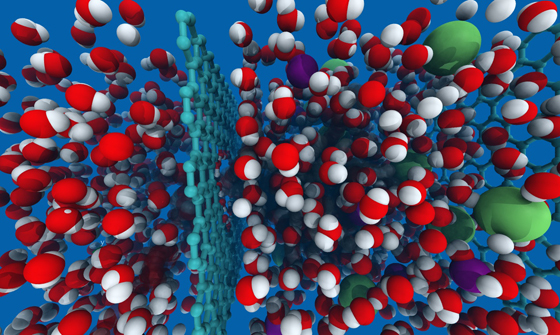
Lockheed’s proposed desalination project filters through graphene, a material already touted as a modern marvel. A thousand times stronger than steel, it's also just one atom thick. Last July, Popular Science covered its potential use in water filtration. Passing seawater over tiny pores, just one nanometer wide, the filter will let water molecules through, while blocking out the atoms that make salt. These filters are a much less energy-intensive option, and much better at filtration. Lockheed expects to have a prototype filter available by the end of 2013.

Five amazing, clean technologies that will set us free, in this month's energy-focused issue. Also: how to build a better bomb detector, the robotic toys that are raising your children, a human catapult, the world's smallest arcade, and much more.


Online Content Director: Suzanne LaBarre | Email
Senior Editor: Paul Adams | Email
Associate Editor: Dan Nosowitz | Email
Assistant Editor: Colin Lecher | Email
Assistant Editor: Rose Pastore | Email
Contributing Writers:
Rebecca Boyle | Email
Kelsey D. Atherton | Email
Francie Diep | Email
Shaunacy Ferro | Email
Hmm. But won`t the holes in the material get ever more clogged up by the larger molecules. Greatly increasing energy needs and making it useless/impractical to operate.
In the image the larger molecules generously and conveniently stay away from the graphene. A 'proposal' is nice. But to turn that into a working, an affordable and a large scale applied product is something else entirely. I have seen far to many business ideas in newspapers and magazines that never reached the light of day let alone turned a profit. I hope they can make it though. Eureka!
Wouldn't it be something like the filter in your dryer? I assume that when deemed full they would replace the filter. Possibly being able to clean and re-use the old ones [which would probably be dependent on the cost of the filter compared to the cost of cleaning one...
Could this be used to clean polluted water?
Phase 2 will be a project to figure out what to do with all the leftover salt.
I quit working at shoprite and now I make $35h - $80h...how? I'm working online! My work didn't exactly make me happy so I decided to take a chance on something new… after 4 years it was so hard to quit my day job but now I couldn't be happier. Heres what I do,..business6.MEL7.Com
Green Matrix- Many desalinization plants already use reverse osmosis via filters, much like the ones in a fish tank. However, they are very energy intensive. This one is simply a better filter, to be exchanged/cleaned when it gets clogged. No infrastructure to the plant would be required. They would just find themselves with cheaper electric bills..
@Greenmatrix, no,it would not get clogged up with salt. Keep in mind how small the holes are. In fact, if you looked at it, it would just look like a piece of paper. You could not see the holes. Salt is big. Many times bigger than the holes and so could not get into them. It would be like a flat surface. As long as the water was agitated, the salt would just move a long.
This reads really promising to bring clean water to the world. I hope it just not a good read to be forgotten about and actually does become true!
I recently saw a DIY project on YouTube where a man used a projection TV screen to create a device that concentrated the sun's rays to 2000 F. He melted metal and boiled a large container of water is seconds. So why again to we need wood, coal, etc. to heat water to make steam in order to purify water?
This would be great for also filtering out viruses for more contaminated water. The main question is how many microns can this filter out or what size can they be made to? Viruses in water tend to be smaller than Sea Salt. Viruses are extremely small (0.005 - 0.3 Microns). So I wonder if this is something that is possible :)
How about using the pressure of the Ocean to push water through these filters? Create a large reservoir next to the ocean that is lower than the water table. Use an underground tunnel to connect reservoir to the ocean. Line the inside of the tunnel with these Graphene filters. Additionally, you could line the tunnel with a spiral shape to keep the water circulating which would help keep the salt from building up on the screens. Rinse and Repeat... endless fresh water, for one time expense of build-out.
How about a bottle with a filter placed in the middle. Fill up the top half, wait a little while. Unscrew the top half and drink from the bottom. I think the Preppers would all buy these for the end of the world.. :)
Just about everything the article says about modern desalination plants using distillation is flat out wrong.
Contrary to what the article states; there is no need to use additional energy to condense the steam. Quite the opposite, in fact. The energy released by condensation is transferred to the next unit of salt water. In a large-scale desalination plant, a kilogram of steam (the initial steam, that does require energy to heat), can eventually produce up to 16 more kilos of fresh water. The theoretical limit is much higher; but a 16:1 production is not only attainable in practice -- it's the norm.
The article is also dismissive of the combined power and distillation plant being built by China -- mentioning the capital costs, but not the long-run average cost of production (the appropriate measure). Combined thermal power and distillation plants use what would be the "waste" heat from the generation process to desalinate water by distillation. In other words, as an add-on to an generating plant, it's uses very little new energy.
Furthermore, in discussing whether or not desalination is cost-effective; you need to compare that process with the alternatives. For instance, if your alternative involves using dams, reservoirs, and hundreds of miles of pipelines (as in S. California); desalination is actually cost-effective.
1.) Since the sodium and chlorine ions of salt water are smaller than viruses, viruses, prions, bacteria, and protozoans would be filtered out.
2.) What to do with all that salt? Why not feed the reject brine, (salt saturated) into a chemical plant where sodium, potassium, magnesium, chlorine, bromine and iodine can be extracted from the concentrated brine?
So then, what would be a condition by which acids could begin bonding with the graphene? As to the cleaning of the filters, will they use infrared laser? Are the edges of a sheet of graphene bonded with something? Do any of the 5-10 million assorted types of organisms in seawater eat carbon; and if so, could any of them actually eat a hole in a graphene sheet? In desalination, we often take our seawater right off the top where the most organisms live; discounting those near the bottom or actually in the sediment. This filter system lets them use less heat, which will kill less organisms.
These are the types of revolutionary technology (if the concept is true and accurate) that we a species CANNOT put patents on if we want to save the human race. Patents would mean that Lockheed Martin has a literal monopoly on this very specific type of desalination; but it would still be a monopoly. If this became practical enough to use all over the world for very cheap, we might as well make it free. But wait, there's energy needs and energy isn't monetarily free? Not yet, but energy is truthfully free. Energy is everywhere, and beyond that, energy is quite literally everything in the universe; it will take money to initially discover how to spread free energy technology of course, that's just our current paradigm. But once we have it to enough people we can tell people how to make it themselves, individually. Without a choke hold on power-resources by huge global corporations the cost of nearly everything in the entire world will go down because the energy to drive the system will be free. Then we can learn how to achieve nigh-perfection on creating abundance instead of a system that runs on scarcity and perfectly distribute everything that everybody needs for free with the structure of complete industrial automation calibrated to supercomputers. I'm not saying it would be easy to set up this system, I'm just saying that this is one of the probably thousands of ways we could be a better species to itself and the planet.
The units are self cleaning while they are running. Some water is pushed past the graphene and pushes the salt out an exit port. This is put back in the salt water and the process is on going until it is turned off. Then it has to be flushed out by desalted water. Graphene is 1000 times stronger than steel and has little reaction to salt. Heck of a deal for someone that lives close to the oceans or wants to set up a resort on an island with no water, or ships. Lockheed will make a ton of money on these units. Google Lockheed about ocean mining of rare metals. This is a 60 billion dollar project that is underway also.
When I was a child,I was afraid that we run out of fresh water.
@SocialAnomoly:
Perhaps your proposals would work on the planet, where you live.
On this planet, they would only guarantee that: innovation grinds to a halt; we spiral into abject poverty; resources are wasted; and the environment is destroyed.