
Feature
Sky Captain and the World of Today

Skeleton Crew Worldwide Aeros Corp.

"Some kids wanted to be firefighters,” Igor Pasternak says. “I always thought about blimps.” Pasternak grew up in Lviv, Ukraine, near a weather station. When he was six, he convinced the Soviet meteorologists there to let him launch one of their balloons. “I was hooked,” he says. “I wanted to build airships.”

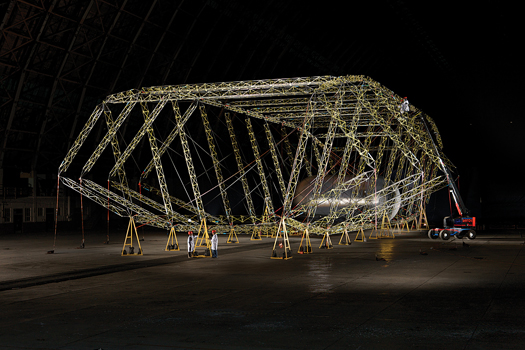
We are standing in the vast wood-beamed hangar where one such vessel, a 400-foot-long “variable buoyancy functional cargo airship” called the Aeroscraft, is being assembled. The looming aluminum and carbon-fiber skeleton, not entirely unlike a half-completed Death Star, is the prototype for what Pasternak says will be a new and better kind of flying machine: one that can carry substantial cargo to any place on Earth. The reason there are so few blimps flying today, he says, is that “no one has improved the concept. I am solving a problem more than a century old.”
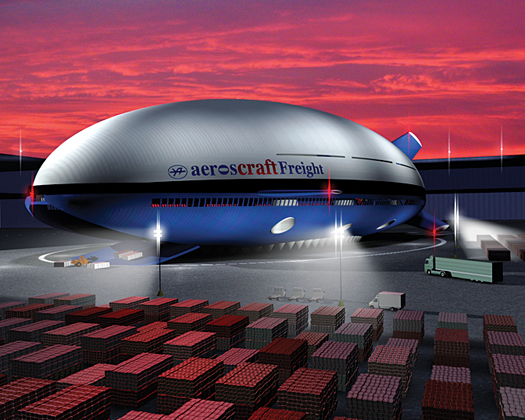
Aeroscraft's Airship:  Worldwide Aeros Corp.

Pasternak is wearing a T-shirt that says Ballast Control Matters, which pretty much sums up that problem. “Blimps fly with buoyancy,” Pasternak says. “But when the blimp is empty, if you don’t hold it down, the ship flies into space. I realized we could compress the helium inside special chambers and give the ship more or less lift.”

Hot-air balloons are completely at the mercy of the winds, and even dirigibles (a general term for all steerable airships) still require ground crews—guys with ropes and ballast. If Pasternak’s variable-buoyancy system works, the pilot will be able to maneuver in all directions, vertically and horizontally, with no external assistance. He will be able to go anywhere and land anywhere, and take a very big cargo along with him. “Then you have progress,” Pasternak says.

Revolutionizing transportation with airships is an old idea but a persistent one, and it’s usually the military that brings it closer to reality. More than a century after George Griffith described armed conflict fought with “war balloons” in his popular novel The Angel of the Revolution, the U.S. military was considering the merits of transporting materiel with airships. In 2005 Darpa, the Pentagon’s experimental branch, initiated Project Walrus and set about finding a contractor to build a “hybrid ultra-large aircraft” that could transport 500 tons of cargo at least 12,000 nautical miles. Pasternak’s Aeros got the biggest contract of the project. (“There is only one solution,” Pasternak had explained to the Los Angeles Times, “and we have that one solution.”) But in 2010, the Pentagon chose not to renew Project Walrus, a fate not uncommon to airship schemes.
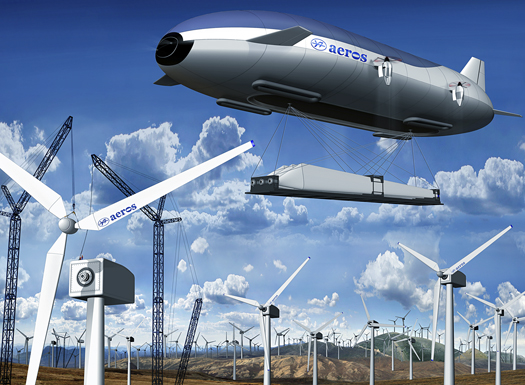
Continental Drift:  Worldwide Aeros Corp.

Builders around the world nonetheless continue to investigate various ways to get airships off the ground. Northrop Grumman, Lockheed and other major aviation companies, alongside such smaller entrepreneurs as Cargolifter and Aeros have all at various times participated in the race to build a commercially viable airship.

Bill Crowder, a logistics expert who is inspecting the Aeros prototype with us today, has been following Pasternak’s efforts for years. Logistics is the industry term for the business of getting the world’s freight and equipment where it needs to go. Imagining the sky filled with Titanic-size dirigibles induces “the giggle factor,” Crowder now says, craning his neck up toward the frame, but that doesn’t mean it’s not a good idea. And in fact, a ship like this could stay in the air for a week and then deliver a substantial payload—a 50-ton crane, say, that’s needed in the Arctic.

Pasternak launched Worldwide Aeros Corp. in Ukraine in 1987 and at first made just unmanned “aerostats,” small tethered blimps. He moved the company to the U.S. shortly after the collapse of the Soviet Union and, in a moment of détente, became the lead Pentagon contractor for the development of lighter-than-air vehicles. Aeros is the biggest seller on Earth both of aerostats and manned blimps—its customers include the U.S. Department of Defense and authorities in several foreign governments—but all of that, Pasternak says, is a means to an end. “I always wanted to build the Aeroscraft,” he says. “I put all the profit of my company into this new ship. Everything.”

Flying Hotels: The first customers for Aeroscraft airships will be cargo companies, but the vehicles could eventually be developed into flying hotels that silently transport guests from New York to Los Angeles overnight.  Worldwide Aeros Corp.

For the moment, his ship is leading the race. Cargolifter went out of business, as did Advanced Technologies Group, the U.K.’s main firm attempting to revive airship innovation. Lockheed and Northrop have fixed their sights on a type of airship that still requires a runway. “None of them have the capability of the Aeroscraft,” Pasternak says.

The widely used C-17 cargo plane can carry 75 tons. The one-off Soviet AN-225 can carry a record-breaking 275 tons. But if the Aeroscraft prototype works and Pasternak completes plans to build an 800-foot model, he will advance the capacity of airborne transportation to 500 tons, delivered anywhere. “This is a lovely sight to a logistics guy,” Crowder says. “I’ve been waiting for something like this for a long time.

60 Comments

Josh Bearman's article quoted Igor Pasternak saying "I always thought about Blimps."

The article goes on to describe a rigid frame that will be the core of the AEROSCRAFT.

Josh goes on the state that "...and even dirigibles (a genral term for all steerable airships)...ropes and ballast.

I beg to differ...! Dirigibles are airships. Blimps are airships. Dirigibles have rigid or semi-rigid frames. Blimps do not have an internal frame ; hence "limp". How a limp airship is referred to as a Blimp is open for debate. Wikipedia offers a couple of scenerios, but no firm answer.

Anyway, the bottom line becomes BLIMPS ARE AIRSHIPS NOT DIRIGIBLES (aka Zeppelins). Pasternak's ship should not be referred to as a BLIMP.

Regards, Chuck

considering the news reports i've seen with strange and unusual cargo having to travel at night thru small towns, they have cases where they need to remove street lights and signs for the cargo to pass, because it's so large. Moving things like power-plant sized generators in one piece is very expensive. I think the show said it was something like $1500/mile. A cargo airship like this would solve alot of problems in the industry of large-item transportation. Once this fellow gets his system working, there will definitely be a market for the services.

In fact, engineering civil projects are limited in some respect by the engineers ability to transport the design. so with a delivery vehicle in existence like this, imagine now you can precast concrete structures (or whatever) in a factory and just drop in place. Instead of moving the tools and the professional tradesmen to the location and building on-site, you can pre-build a larger assortment of products and simply deliver an already finished product. So this airship idea doesn't just offer a new alternative to moving cargo, it increases the options of what is actually possible, including the design and scope of the product which can be offered.

I think it would be awesome, once I retire to live in a airship as a house, anchored over the sea someplace.

Robot, I would imagine you'd have this guy docked next to you in his own airship:

http://s3-ec.buzzfed.com/static/imagebuzz/web03/2010/6/3/11/stay-thirsty-my-friends-20588-1275579505-37.jpg

---
In space, no one can hear a tree fall in the forest.

This is an extremely obvious solution, but brilliant concept nonetheless. I hope this idea finds a place in the world. It would be amazing if smaller scale versions, such as the cabin space equivalent to a sailboat, were made affordable to the general public, but business-size versions are where the money is at.

In the end, this won't matter, since the world is on pace to run completely out of helium in about 20-25 years at current pace. Right now the US government controls half the planet's helium (which substance cannot be created, and once released is unrecoverable), and they have decided to sell it at rock-bottom prices. While it may now cost $2-$3 for a single helium balloon, in 5-10 years it may cost $100, as the scarcity and importance of this resource finally hit the consciousness of the US government.

With helium rising to those prices, it would cost an extra $1.5 billion or so just for the initial fill-up of hydrogen on the 800-foot model. So I think it very likely that within 10-20 years virtually all airship thoughts will quickly and completely die. Hydrogen is just too dangerous to work with, and we're running out of Helium.

Even though Helium may be one of the most if not the most abundant resource in the universe, we are running out of it on earth and it is becoming more and more expensive. This won't help.

GMarsack,
The picture you suggested as humor eludes being funny. But, I give you points for trying.

Many people in life have boats and enjoy being slightly remote with the ability of adventure. My above comment, was daydreaming a similar adventurous situation with a air ship house.

It would be neat to live aboard an airship, if only just for the weekend tethered offshore, but the real problem of helium availability seems to keep this almost practical idea on the ground. And it's a darn shame! But it's a great day-dream! :)
Guess we have to work harder on those elusive anti-gravity devices. :)

Doctor who Season 2 episode 5, EVERYWHERE.

What the world needs is flubber plain and simple.

I like Pasternak's idea of compressing helium rather than venting it to control buoyancy.Maybe hydrogen could make a comeback,because from what I've read,it wasn't the hydrogen that ignited on the Hindenburg,it was the super flammable skin.
If helium is becoming a scarce resource (I read it escapes to outer space when freed),perhaps when commercial fusion reactors are perfected,they might help supply helium as a byproduct of the fusion reaction.

@Robot, I ment the picture of the guy himself (the kindof guy who would own an airship), but not the text in the picture. That was in bad taste. It was the first picture I found on Google. I should have looked for a better picture.

---
In space, no one can hear a tree fall in the forest.

@marcoreid and, CrypticNerd
I believe your assumptions on the rarity, and limited supply of helium to be false. I believe your views are based off of the present days facts that helium is derived by the majority through the extraction from natural gas. At current even with the proven reserves the helium is epexted to last at least 50 years, but of course there are a substantial amount of un-proven reserves. But even with that fact helium can be extracted and recovered in the atmosphere through fractional distillation(which is the most economical way) by taking the unfilltered air and lowering the temp and increasing the pressure, and then removing the impurities. If the price increases in the same way you believe it will i am sure some company/s will spend the money to invest in better/efficient capture techniques. Or even better space mining. Is capitilism great! God bless it!

does he realize it would take like 4,293,349.46 cubic meters of Helium just to lift 500 tons? i'm not even going to go into the price of that crap, we need it to cool our MRI machines, but i'd like to see the 800 foot balloon with 4 million m³ of volume.. and if i had such a balloon, i would slowly fill it with the 3,979,229.49m³ of hydrogen that it would take to do the same amount of lifting, while being less prone to leakage, cheaper, etc. if i had a balloon that size, i would be collecting so much free hydrogen, while doing useful things where the hydrogen was formerly just a waste/by-product.. it would just float up and find its way into my gigantic balloon. or you could just spend ~ $680,388,555 on that helium, ya rich bastaad.

i think it is time for the world to wake up and realize that the use of Hydrogen as a lifting gas is probably safer than using gasoline in your car, and 'Nuclear'/'Radiation' doesn't mean you get cancer or everyone dies. Betavoltaics: the badass batteries of the future. Hydrogen: it's everywhere, and inside you.. are you going to spontaneously combust? no. that doesn't mean you should deliberately concentrate and inhale, either.. but it isn't just going to randomly go BOOM,. safety/precautions.. grounding/isolation.. i believe in hydrogen as a lifting gas, and more. i had previously believed that if i got really high and filled up some container with the air from that higher atmosphere, it would be full of lighter-than-air gases (fractional distillation). theoretically, it should be possible, but apparently, we need to build a gigantic balloon around earth to contain all of the helium before it escapes into space to be lost forever. ALPHA PARTICLES, man.

GMarsack,
Now worries, I appreciate all your comments. ;)

There may be uses for this but they are still dangerous air crafts.

It is only a craft for fair weather. It isn't like you can land this at any airport either and house it.

I always thought it be fun, if I could have a balloon suit and make myself 90% lighter. Not enough to fly, but to push off and light enough to fly high and gently land. I take my balloon suit to some desert plain and bounce\fly all day long for fun!

When I became tired of a day of play, I let the gas out and be done.

jeditalian,

Ianredneck has it, Helium is not going to "run out," or when it does, it will when natural gas does. The scarcity reflects only our sheer waste of the stuff and the extremely limited production we have currently. Besides, it's not as if we MUST get it from natural gas, it's been possible to synthesize Helium from Lithium or Boron since the '30s. With refinement it could be made more efficient. Not to mention, it exists in our atmosphere naturally and whatever is lost into space is constantly replenished from radioactive decay.

Also, your math is wrong. It does NOT take that much helium to lift 500 tons, and you have to consider that this thing is 40% heavier than air for safety and payload reasons. For instance, the Graf Zeppelin ll was 800 feet long, and it weighed over 250 tons. This was lifted by over 7 million cubic feet(200,000 cu. M) of Hydrogen, but it could have used Helium instead. It contained much less gas than an 800-foot-long Aeroscraft would too, the Aeroscraft is shaped such that it would easily contain several times that volume.

And your math for how much that helium would cost suffers from some serious scaling issues, in addition to the obscene over-estimation for how much helium it would need. The military BD2 airship that was inflated in September is 1.5 million cubic feet, and that cost about $350,000.

In short, Helium is he way to go. But it still needs to be conserved, and not wasted on party balloons.

P.S., Jefro, airships are the safest aircraft ever invented. The only time they ever had problems was when they used hydrogen, and even then they were safer than comparable aircraft. Foul weather is not much of an issue to a Hybrid Airship either, as they CAN in fact land anywhere, on snow, sea or land. They use hovercraft landing systems and weigh hundreds of tons, unlike conventional airships, which are proportionally bigger but weigh nothing, leading to vulnerabilities in foul weather during landing.

This Aeroscraft is extremely promising. Igor Pasternak is one inspiring man. I was stunned that he put all of the profits from his company into the development of the Aeroscraft! Now that's dedication!

I see a bright future for the aeroscraft. They are rapidly building the demonstration model- you can see that they've pretty much finished the rigid internal hull from their pictures on their Facebook page(worldwide aeros corporation), and with the recent purchases in Canada of hybrid airships from both HAV and Lockheed Martin, there's definitely a market for them.

I can't wait to see the first model fly! And it's still only 1/4 as long as the 800-foot model!

I believe that sound waves can induce levitation.

Edgar Cayce predicted large air ships. I expect he was refering to Titanic size.

Sam6032, I don't know about sound waves, but the Graf Zeppelin ll and the Hindenburg were both 803 feet, just barely shorter than the Titanic(883 feet), so this Cayce fellow was right.

sheet. i was thinking 3 ft³ = 1 m³ and something insane about the price of helium. i was thinking about this error earlier while i was away from the internets. new calculations tell me it would only cost $363,646,699 to fill with helium.. sadly, that's about $363,646,719 more than i have. i don't really care to re-estimate my estimates on how much helium it would take to lift 500 tons, i was assuming 500 tons of cargo and leaving out the weight of the craft anyway, 500 tons of lift would be overkill for any purpose i would be building a big floating thing for anyway. i do agree that we should stop wasting the helium on party balloons, when hydrogen is easier to make, more economical, more buoyant/lighter, forms the larger H2 molecule, making it less prone to leakage, and would make parties more entertaining, with people trying to inhale the helium, then trying to do the squeakytalk near aunt edna while she's lighting up her cigarette.. i won't be wasting your helium. hydrogen is far too easy to produce, and i'll be that guy using hydrogen as a lifting gas, using an obscenely over-estimated size of balloon, (just in case i decide to pick up some extra weight along the way, or pump in some O2, and spark it up, instantly converting my lifting gas to hot-air balloon mode/ AKA emergency landing mode)

The global helium stock is already running low:

http://www.guardian.co.uk/science/2012/mar/18/helium-party-balloons-squandered

@J. James - Are you sure you're not actually Igor Pasternak himself (or someone associated with him) posing under a pseudo name? Because you only signed up to PopSci less than 24 hours ago, your only comments are on this story, and you add comments like "This Aeroscraft is extremely promising. Igor Pasternak is one inspiring man." Plus you obviously seem to know quite a bit about airship history, and defensively refute the simple mathematical facts behind our current helium conundrum.

Yes, helium can be synthesized by bombardment of lithium or boron with high-velocity protons. But it is completely and totally non-viable, economically speaking, at any type of desirable quantity outside of a lab. We're talking thousands, or maybe even tens of thousands, of dollars per cubic foot.

The recharge by radioactive decay is so minimal that we'd go through one year's recharge in a few minutes with today's usage rates.

We use it up very fast, and the problem is that it is the ideal element for quite a few things, but once it is gone there is no replacement. If we run out of natural gas, we can burn something else or use wind/solar to get our power. But once the helium is gone, it is gone. And to be clear, I mean we will still have a little or be able to create a little or otherwise obtain it, but it will be so insanely expensive as to effectively be gone. In 2010 a National Research Council report showed that the federally owned helium is going at a deep discount. Congress, in its haste to get rid of all that helium, messed up and set the price too low. So there has been no reason to conserve, even though our biggest supplier (the federal government) is planning to run out of the stuff. In the last 30 years we've gone from the feds storing about 200 billion metric tons to now being down to 80 billion.

The prices of helium for many suppliers have doubled or even tripled in the past 2 years. The days of really cheap helium (due to the federal government's selling it en masse) are coming to a close. Whether it takes 10 years or 40 years to "run out" doesn't much matter, because it will at the current pace. Prices will continue to rise until demand is brought into balance with supply.

As for the amount needed to lift 500 tons of cargo 12,000 nautical miles... let's assume that the craft and the fuel to go that far are only 50 tons. So you need the lifting power for 550 tons. And let's be generous and say that the helium is at 1 atm, not compressed at all, and that we're lifting only at sea level (higher compression and higher elevations would increase the amount of helium needed).

It takes 1000 cubic feet of helium to lift 68.5 pounds at sea level. 550 tons is 1,100,000 pounds, 1,100,000 / 68.5 tells us how many thousands of cubic feet we need, and comes out to just over 16 thousand. So we need 1000 times that, or 16 million cubic feet. Even after the recent price spikes, you can still get helium is major bulk right now for $0.50 per cubic foot, so right now the initial fill-up would cost you 8 million bucks. How much is used up or lost I don't know, but 8 million to fill up once. But if prices continue to rise, even at 20% a year rather than the 75% to 100% a year we've been seeing lately, then in 20 years the price of helium would be $20 a cubic foot, and the same fill-up of the airship would cost $320 million.

The writing is on the wall, and it is just a matter of time before everyone realizes that we don't have nearly as much available Helium as we thought we did, and that it is going to start costing us a lot.

I don't expect Ice Road Truckers to be replaced by Ice Road Blimpers any time soon.

Instead of compressing - decompressing the gas, could one not heat and cool it via heat exchangers, engine exhaust and atmosphere should allow one to do that.
I would love to ride on one over a game reserve, watching the animals from 100 feet in the air, or crossing the Atlantic, watching whales, and polar bears on their ice floes. Close up yet not intruding.
Transporting 500 ton cargoes to any place would give engineers a whole new dimension to work in

@marcoreid
as you can tell by my status i have been here for a few years so no chance of a plant lol, but i still think your idea that helium is a limited supply that no one ever will be able to economically replace is niave. you have even stated that there is a large demand for is beside the ballons for kids. I believe that the law of supply and demand and the fundamentals of capatilism will keep helium as a viable product. If the price is high enough and the demand high enough then someone somewhere will spend time and money to develop a method/process/technology that will allow us to have helium as a product. Atmospheric helium in the He4 form is formed at the rate 3000 tons in the lithiosphere per years. And worse comes to worse space mining. Heck this might be the point at which space minign becomes viable. Find a couple helium rich comets/asteriods and mine them. All not outside the realm of possibilities. As for the rest of the last post i have no idea about. But as too the viablitiy of helium, if you pay enough for it, someone will find it/make it for you.

@African Rover

I too had thought airships would be heating/cooling the helium to ''compress'' it for flight control. More than likely this might be how the compression is accomplished. Sucks about helium though...

The US ARMY LEMV is almost ready to fly and Hybrid Air Vehicles in Blighty who designed and built it, is rather a long way ahead of Aeros in technical terms.
Using a frame in the design is a serious mistake no other sensible hybrid design team has made, as it doubles the cost and makes maintenance and repairs very complex.
For more information on airships or the new hybrid air vehicles see: 3w dot hybridairship dot net

@marcoreid
"Are you sure you're not actually Igor Pasternak himself (or someone associated with him) posing under a pseudo name?"

Amusing conspiracy, but no I am not Pasternak or associated with aeros whatsoever. Just a simple airship advocate.

"Yes, helium can be synthesized by bombardment of lithium or boron with high-velocity protons. But it is completely and totally non-viable, economically speaking"

If you'll remember, I said that this was the 1930's method and that it's certainly possible to make it more efficient and economical. Not to mention you could simply distill the stuff from the atmosphere. It's the second-simplest, second most abundant substance known to man, for goodness' sake. We are merely wasting the stuff because it's being made artificially ubiquitous. With proper regulation keeping most civilian customers(read: party balloons) out of it while there's still natural gas, and proper production techniques once natural gas runs out, it's not going to be a problem.

With regards to how much helium it takes to lift 500 tons, people keep forgetting that helium only lifts 60% of the vehicle's fully loaded weight. Trust me, these people know their own airships a lot better than you or I do. Anyway, the 8 million it would take to fill initially is negligible. Airships are so much cheaper than equivalent-payload jet aircraft($45 mil for a 50-ton lifter HAV 366 airship versus $190 mil for a 30-ton payload A400M) that it really only eats into their margin of cost superiority. After that initial fill, modern airships lose about 10% of their volume a year due to normal leakage. Hybrid Air Vehicles has been using materials to get that down to 3% a year, or so they claim. So after the initial fill, only tiny little top-offs are needed.

And as for helium getting more expensive in the future... Well, we'll see what happens. It's artificially low right now, but as prices start to rise, so will production, and waste will be cut as well. Meaning that the untapped fields will get developed, those that are simply venting it off as they search for other gases will start to capture it, and +90% of the stuff will not get shipped off into party balloons. Who knows, maybe we will be able to develop some way to make distillation of helium and other gases from the atmosphere much cheaper, or learn to synthesize the stuff cost-effectively. I have confidence that this will work. And if it doesn't, there are still other lift gases to consider, helium is merely the best one. Water vapor(steam) has its benefits, as does ammonia, nitrogen(as a weakly buoyant fire retardant), even hydrogen, so long as it's safely tucked inside another non-flammable gas.

I wonder why we don't attach a space craft to one of these and ferry it into space instead of using expensive rockets. Is that a viable option?

Would the female engineer or technician who is assembling this skeleton contraption be offended, if I said, " WOW! NICE RACK!"?

The talk of a new generation of airships has been fluttering around for almost two decades. Unfortunately, aside from a few, small high altitude models built strictly for automated observation, it's just never materialized.

One reason I have heard (read) numerous times is the shortage of helium. It seems that helium recovery/production has fallen way off what it once was during the middle of the last century. Even the variable lift/buoyancy types will require huge sums of this gas and with stocks at an all time low and prices for it at an all time high, the chances of realization start to float away rather quickly.

@marcoreid

J.James was correct with the things he stated. Natural gas is in huge abundance on this planet. Not only can we synthesize it, but natural gas deposits contain helium. In Qatar alone there is over 25 trillion, yes that is trillion, cubic meters of natural gas. Of that it is estimated that 7% of it is helium. When Natural Gas is refined helium is one of the by products. It just needs to be captured. That is just one natural gas field. There are many, many, many more all around the world. Iran, Russia, US, South China Sea, North Sea, Canada, South America, Africa. We are not running out of natural gas any time soon. It is estimated that the Qatar gas fields can produce enough natural gas for the next 420 years alone.

If modern hybrid airships can be proven to work and do it more efficiently than other types of haulers, you can bet you'll be seeing them.

@redoubt

The reason you have not seen much forward progress with hybrid airships is due to technology. Technology and prices for that technology need to be there before it can be viable. Prices for composites are coming down and that is one of the key building materials for hybrid airships. Technology needed to easily fly and maintain them needs to be there as well. We're getting there. It just takes time. So I think it is possible that by 2025 airships will be making a huge comeback.

".....How a limp airship is referred to as a Blimp is open for debate...."

Balloon + limp = Blimp, perhaps ?

Great article.

It appears that there are other beasts in this category of lighter than air vehicles as well.

I hope soon these heavy-lifters become commercially viable.

@redoubt

Airshipgirl has it. Though talk has been bandied about since the '90s, the technology to make airships truly viable in today's world hasn't actually existed for that long. You also have to take into consideration that ever since the Hindenburg disaster, there hasn't been any particular desire to redevelop airship technologies, and it was(and still is, sometimes) considered to be obsolete technology. You have no idea how much that attitude can stymie technological development.

But here we are now. As airshipgirl says and Aeros freely admits, some of the largest boons in airship development have been the leaps and bounds in composite technology. Certainly, the other huge development is the heavier-than-air hybrid airship technology, developed by computers and experimentation, which removes so many of the past difficulties of LTA airships simply at the cost of some of its efficiency, which airships inherently have in extreme abundance anyway.

More to the point, they're finally seeing investment from real market forces. Lockheed Martin has sold derivations of their P-791 hybrid airships to the Canadians, to fly in 2013. Hybrid Air Vehicles teamed up with defense giant Northrop Grumman to make up to 3 hybrid airships for the army, the first of which flies in a matter of days. Hybrid Air Vehicles is also starting construction of 45 hybrid cargo ships, also for the Canadians. Aeros has its Aeroscraft for DARPA, and they've been seeing some interest from private customers as well. A few other companies like Solar Ship have been getting in on it too.

An airship comeback is right around the corner.

@Airshipgirl

There is a difference between what is possible and what is economically feasible. Furthermore, your numbers on helium concentration in the Qatar field are WAY off, by orders of magnitude. I'm not sure where you got your numbers, but it is a widely known fact in the industry that the estimate of helium by volume in the Qatar field is 0.04%, not 7% as you state. Some other reserves around the world have higher percentages, but almost nowhere over 0.5%, and even those are very few. No wonder you think we'll never run out, as you think we have hundreds of times more than we actually have.

In all reality, the most recent USGS estimate of global recoverable helium reserves are 620 bcf (billion cubic feet). Right now we are using 6.5 bcf globally per year. So, naturally you just do the math and think, "great, that's a 95 year supply!" But it's not that simple.

Qatar produced approximately 2,200 Bcf of natural gas in 2007, most of it from the North Field. Based on the estimated helium concentration of 0.04 percent by volume in the North Field, 880 million cf of helium should have been produced by Qatar during 2007. However, only 250 million cf of helium are reported to have been refined over that time period, which means only about 30 percent of the natural gas from the field was processed for helium, which corresponds to a waste factor of 70 percent. If they can process it all at some point, there will still be losses and inefficiencies, so they'll never get to 100% How close they get is a matter of economics.

And you can't just pull out all of the world's natural gas over the next hundred years just to extract the helium. I mean, you can, but it would mean that the price for natural gas would approach 0 and you'd only be doing it for the helium. That would imply that helium is so expensive, that companies would be willing to take a loss on the 99.5-99.9% of the gas coming up out of the ground in order to sell the 0.5% or less of helium. Can you imagine what the price of helium would have to be in order to make that happen?

You also have to account for demand growth, which over the past 20 years has averaged about 4% per year. And if you just do the straight line math, and assume that we can recover 100% of what we currently deem as reserves, with growth until we run out, you end up in 2052, exactly 40 years until we "run out."

But of course the world doesn't go in straight lines. Not all reserves are recoverable, while new reserves may be discovered. The more scarce resource becomes, the higher the price will go, pushing down demand as people look for alternatives in the areas where substitutes for helium are possible. And even though those substitutes may cost more than helium does now, they will be cheaper than helium at some point in the future.

We can never really get to 0, or "run out" anyways. The price chart would move towards infinity as you get closer to 0, without ever touching it. Just like those fun graphs everyone did in high school or college math classes. But the point is not that we need to run out, but that we develop enough scarcity that the price to fill an airship becomes prohibitive compared to some other form of transportation.

Do I think we're going to "run out" in 40 years? No. But I do think the price will (as a general trend, with some short and medium term fluctuations) continue to rise permanently, and that those rising prices will make airships that use helium as the only or the major lifting component prohibitively expensive. Maybe there are substitutes that can help with this, but I just don't see it with helium. Its time is limited, imho.

@Marcoreid

You're right, it will get more expensive, definitely. But, that's largely dependent on things staying the same, and it remains to be seen whether that will make airships prohibitively expensive. Regulating the gas instead of carelessly wasting it on party balloons would go a LONG way towards keeping the gas both cheap and relatively abundant for use in both airships, medicine and science, all of which need it. At the absolute bare minimum, that means repealing the Helium Privatization Act as soon as possible, and implementing regulations proposed by GE(MRI machines use 28% of the helium) and supported by Sens. Jeff Bingaman and John Barraso. In short, either start filling party balloons with hydrogen or whatever or no more party balloons, we can't afford such a frivolous waste.

Of course, this is all assuming that no new reserves are found(which is ridiculous, because according to Wikipedia, "It is estimated that the resource base for yet-unproven helium in natural gas in the U.S. is 31–53 trillion SCM, about 1000 times the proven reserves." Yes, that's 1000 times the proven reserves in the US ALONE) and that existing reserves keep venting off Helium instead of capturing it. It also assumes that in the next few decades we won't be able to simply distill all we need from the atmosphere(it is constantly being lost into space and replaced by new Helium) or synthesize it whole cloth.

I consider the "extracting it from air" thing to be the most likely scenario, if there is an unlikely total collapse of natural gas sources. Helium is a consistent .000524% of the atmosphere, roughly as a third as abundant as Neon, which is also produced by simply sucking it from the atmosphere. You could simply build a machine that purifies helium from air and have it be as permanent an infrastructure for airships as their giant hangars are. Not to mention such a proven, reliable method could help pay for itself by selling off the other non-helium byproducts, as several gas companies already do. Actually, the Neon comparison is rather helpful; the price of Helium varies but it can be around $5-$9 dollars per liter in today's artificially low cost, and Neon is about $2 per liter. According to Wikipedia, "Helium must be extracted from natural gas because it is present in air at only a fraction of that of neon, yet the demand for it is far higher. It is estimated that if all neon production were retooled to save helium, that 0.1% of the world's helium demands would be satisfied. Similarly, only 1% of the world's helium demands could be satisfied by re-tooling all air distillation plants." This could easily work for airships, they only use a miniscule portion of the Helium production anyway and need to be filled initially with a mere 30,000-400,000 cubic meters of helium(20-500 ton lifters, respectively) and they're pretty much set for the rest of their lifetimes. You could have a little fractional distillation plant like the Linde Group uses chugging away next to the hangar, slowly filling canisters with atmospheric Helium for the airships within to be filled with as they are first built, and selling away the rest.

Always defer to facts rather than philosophy.

While building a giant cargo airship may sound like a wonderful idea, the reality is that there is no economic justification for doing so. Getting this airship through FAA certification would require several billion dollars investment and several years' time. Think about Boeing's 787. It has cost around $12 billion so far.

This airship would have limited demand, and would never be able to recoup the massive financial investment required to get it operational.

While it makes for a great PopSci article, financially it's a dead end.

@riff_raff
Really? You claim, incorrectly, that it will cost billions to develop, and THAT'S why it doesn't have an "economic justification"? Ridiculous. By that logic, no one should build aircraft of any kind. You even defeated your own argument with the 787 example! Yes, it cost billions to develop, but THEY'RE STILL BUILDING IT!

Your utterly self-defeating reasoning aside, the actual economic justification for a cargo-hauling hybrid airship is simple: it outcompetes other cargo aircraft, by a mile. Not only are hybrid airships in general roughly a third as expensive as an airplane of equivalent payload(to say nothing of cargo-rotorcraft), they are far more efficient, posses VTOL for aircrane operations, carry huge, outsized cargoes, and perhaps most importantly, they can go places no other aircraft can go, not requiring a runway like a plane nor expensive refueling stops like a helicopter.
---
Always defer to facts rather than philosophy.

@J. James
Here here!

@riff_raff
Just because you haven't used enough imagination does not mean it does not exist. Like the potential capabilities use of this aircraft.

@marcoreid
I believe you are missing a fundamental lesson of capalism. If the demand is high enough and the price is high enough, someone will find a way to make it/find it/provide it to the market. Whether it be some means from the atmosphere, increasing the efficiencies in the NA manufacturing, etc. someone will find a way to make a buck of helium.

I did some more research, to put this "helium shortage" myth to bed. Not only are there extremely significant stores of the stuff in natural gas, the "shortage" we are currently facing is almost entirely artificial, based on lackluster production and lack of recycling, two things that are starting to change. Now, when all the natural gas is gone or has become too expensive, there is always fractional distillation of the atmosphere, which is how all Neon, Krypton and Xenon in the world is obtained, from only 75 fractional distillation plants worldwide.

The cost of using atmospheric fractional distillation to obtain these gases is directly proportional to their relative scarcity in the atmosphere. Helium, which costs $5.77 per cubic meter on the private market(free from the depressed prices of the Helium Privatization Act), is fortunately five times more abundant than atmospherically-distilled Krypton, which costs $40-$65 per cubic meter, and 50 times more abundant than Xenon, which costs $800 per cubic meter. It's been estimated by a Stanford paper that distilling Helium from the atmosphere would cost 280% more than getting it from the ground as we do now, which is why it isn't done. If you do the calculations, the results are that even though atmospheric helium is nearly triple the price, hybrid airships still outcompete other aircraft, even if you add the initial helium fill to the cost of construction. And that's even before the benefits from the lower fuel costs!

The numbers I used were from my previous example, an HAV 366 hybrid airship and a airbus A400M cargo plane. The HAV 366 is 100,000 cubic meters(roughly 75,000 cubic meters is helium, the rest are ballonets). The cost to fill it with 75,000 cubic meters of privatized natural gas helium, added to the $45 million aircraft, is $45,432,750. The total cost if it is filled with helium distilled from the atmosphere is $46,211,700. The 366 has a payload of 50 tons. The cost of a 40-ton A400M? Upwards of $200,000,000. You would have to fill the HAV 366 with rare $800/m3 Xenon gas to hit HALF the price of an A400M!
---
Always defer to facts rather than philosophy.

@J. James

I think we can sit and discuss this until we are blue in the face. Some people have no ability to reason. So when that happens, best thing to is say your piece and move on. Airships will be in our future. Technology is on their side now. :)

Flying hotels indeed could be among other applications.

They got to have a potential market niche. For instance, personally I'd often gladly accept multiple times the travel time if I could comfortably sleep (maybe in a reclining armchair-bed like a hospital bed), browse the internet, and enjoy a flight in a compartment lightweight but semi-spacious (not many kilograms per cubic meter if taking space-age structural design to its true capabilities). That could beat being crammed in conventional airplane seats where a terrible headrest design is standard, keeping one's head just a few inches too forward to allow sleep (short of dangerous levels of sleep deprivation like when you can fall asleep sitting up).

Even an airline flight nominally of a couple hours can take what feels like a whole day anyway, in between driving to the airport, arriving early for airport security, and all else. If one simply goes to sleep overnight in comfort and wakes up at one's destination, then covering a thousand miles overnight may sometimes be just as good, in fact better in ways if a true cruise ship of the skies.

@Airshipgirl
Heh, I agree. In a debate where one or both parties are being disagreeable, it's easy to lose sight of reality. Cargo and surveillance irships are becoming that reality, now. They're being built in numbers now, regardless of shallow concerns about resistance to gunfire and storms, and the availability of helium.

Still, I gained a lot of understanding from this discussion. I had never fully understood just how much of a nonissue the whole "helium shortage" thing was until I researched it for this discussion. It's also amazing how much helium prices could rise before airships lose their initial(direct) competitive edge, to say nothing of things that only airships could do. Helium could cost $2000 per cubic meter(instead of $6) and it would still beat out other aircraft.

@HClark
Flying hotels have already been done cost-effectively back in the '20s and '30s, to say nothing of modern technology. The Aeros ML8XX, the 500-ton lifter, has about 5 times the useful lift of the largest airship ever, the Hindenburg, which itself had more interior space in the passenger decks alone than an entire double-decker Airbus a380. Imagine what luxuries it could carry, particularly with modern materials! The Aeros concepts show a luxury liner with a full ACRE of interior space, with staterooms, bars, restaurants, casinos, and of course gigantic windows.
---
Always defer to facts rather than philosophy.

as Billy explained I didnt know that a stay at home mom able to get paid $7613 in a few weeks on the computer. have you read this webpage NuttyRich.com

I have a few qualms with what this could and couldn't do, but all in all this is a very productive and lucrative idea. Think of it, how much does it cost for an ocean going merchant ship to get to port A to port B? Millions in fuel alone, then there is the manufacturing, the maintenance... Debacle.

The problems with the airliners (coined it!) is that with Helium, there's not enough.
Hydrogen, too explosive (oh, the humanity!)
And all the attempts to recapture helium... apparently they aren't working, or we wouldn't be having so much debate.

@Airship girl (well played with the name), technology is ALWAYS in the way, either it is not advanced enough, or is too advanced that it breaks at the slightest touch, so tech will always be a problem.

Tee system (if it works) could see the revolution in logistics and commerce, as the airliners (again, coined it!) could possibly move inside the jet-stream, allowing much faster travel.

Who needs helium? Just fill the space with emptiness. Vacuum is way cheaper than helium. Lighter, too. Take a big empty bag n stretch it out.

@TeslasDisciple
"The problems with the airliners (coined it!) is that with Helium, there's not enough.
Hydrogen, too explosive (oh, the humanity!)
And all the attempts to recapture helium... apparently they aren't working, or we wouldn't be having so much debate."

Uh, no. It's not too complicated. There are no "attempts to recapture helium" because helium is TOO abundant. It's simple economics. Helium obtained by natural gas is only about a third the cost of helium extracted from the atmosphere, which is why it isn't being extracted from the atmosphere(which is actually extremely straightforward to do, even with Xenon which is 50 times rarer). If Helium were ever to become scarce enough to pass that threefold threshold, it would simply be distilled from the atmosphere instead.

And as I demonstrated earlier, cost is essentially no object because airships don't consume helium in volumes large enough to offset their cost advantages, by a factor of hundreds. So a threefold increase would be negligible.

@Mason73 Vacuum airships are absolutely impossible. It would be like trying to built a typhoon-class submarine out of a single sheet of ricepaper and expecting it to survive at the bottom of the marianas trench. There is nothing strong enough to build it out of that would prevent implosion, let alone light enough for it to even dream of flying.
---
Always defer to facts rather than philosophy.

Stop thinking helium. Use hot air. Use the e-Cat "cold" fusion system to produce the heat (if it really works...). Its creator is currently stating its achieving an energy gain of 6 (6 out for 1 in, some were predicting 20 to 1). Yep, you'll be carrying hydrogen, but only compressed for fuel. If it works you should be able to get a self-sustaining energy gain of around 2 and keep aloft on hot air for years (again, IF it works...).

@ncb
Hot air is only suitable for use in advertising dirigibles(steerable balloons) like the AS-105 GD. It has a whole host of associated issues that make it unusable for cargo airships. The #1 issue is that of lift, hot air has 1/3 the lift of Helium. An airship would have to be 1.5 times longer and thicker to have 3x the volume for the same lift. That means it is bigger, slower, and less maneuverable. Steam actually solves this, it has lift comparable to helium once you take away the necessary air ballonets, but the "fabrics" used to contain steam are on the bleeding edge of materials science, and steam must be laboriously produced and condensed away after each flight.

The #2 issue is that of construction. A cargo airship must be at least of semi-rigid construction in order to have the engines mounted on better points on the hull for increased efficiency, thrust and maneuverability. The problem with hot air is that of containment, non-rigid hot air dirigibles' hulls last around 500 or 600 hours before the heat degrades them. Metal exposed to such extremes of hot and cold would be fatigued and embrittled, and must compensate for expansion and contraction, especially on something so huge. Composites may be the only option. On a dirigible that's fine, they simply replace the cheap nylon hull after that time. But when the hull of your airship and the airship itself are inexorably intertwined in a complex system like the aeroscraft, hull replacement isn't so easy.

That said, in small non-rigid advertising dirigibles, hot air has a host of advantages. It's ridiculously cheap, for one, a dirigible costs sometimes as little as 5% or less than a small helium airship(which are already cheap compared to helicopters) of the same passenger capacity. Hot air airships also need no large ground crew, no expensive hangar or mooring mast(the hull is packed away into a bag after each flight), and are arguably safer due to the ability to freely control lift and produce as much lift gas as necessary, not to mention they only go about a third or a quarter as fast as a helium airship. But seeing as the aeroscraft already manages to do all of these things anyway in part because it actually DOES superheat and cool the helium at some points, the advantages are voided.
---
Always defer to facts rather than philosophy.

We may see a electromagnetic
membrane balloon.
That will displace air without the
need of gases.
Excited by magnetic or electrical charges.
Lift will be superior to traditional
buoyancy schemes. And have instant
control of displacement.
A vacuum is expensive to produce
at hugh volumes.
I envision banks of millions of
puck or ball spheres.
That are charged and inflated for
controlled lift.
With response times in the milliseconds

@griffsr
"electromagnetic membrane balloon"? "superior lift"? Is there any substance whatsoever to any of this? If you're referring to "ionic" propulsion, using electricity to charge and alter the flow of gases, it is incredibly weak. Useless, in fact. It's not even competitive as a means of propulsion for buoyant airships.

As for vacuum, small sizes make the problem worse, not better. Simple volumetrics dictate that volume goes up on a cubic exponential growth curve, whereas area is exponential squared. Thus, the smaller a vacuum cell is, the less lift it will have compared to the weight of the container that holds it. Vacuum has only 1.7x the lift of buoyant gas. Now imagine a gas-filled party balloon, it can lift a few pennies. Now imagine a same-size sphere of metal or whatever powerful enough to withstand the vacuum without imploding. No way it would fly. Ever. Much less carry a comparable or competitive payload compared to the gas balloon!

Sorry to dash your strange little scifi vision, but if it's any consolation, airships can already carry some pretty amazing things, way back in the '20s and '30s they were already lifting beautiful, luxurious passenger decks inside, compared to "small hotels" or ocean liners, with more square feet of space(well over 5,000, not counting crew spaces!) than any airplane ever built, even the Airbus A380 double-decker widebody jumbo jet. To say nothing of the even more powerful aerodynamics-boosted modern hybrid airships like those featured in the article!
---
Always defer to facts rather than philosophy.

After building and flying 600+ airships, RC but working models, I don't recommend this design, at least aerodynamically. I am aware that there has been enormous funding and work behind this, I commend the efforts, and look forward to see further updates. In the meantime, I suggest www.hyperblimp.com. We are still actively involved in R and D, but have flown countless times in many places and hope to be "off the ground" commercially very soon.

I noticed that somebody asked whether or not it would be feasible to use airships to get into orbit. Well, there are problems to be solved, but it is possible. In fact, somebody is already working on it.

www.jpaerospace.com/

Helium would be available in abundance if we could ever get Hydrogen Fusion power plants online.

timmullins,

Balloons might get a satellite to near the height associated with temporary very-low earth orbit where the atmosphere is thin, but would still have enough air to cause friction to slow it down over time.

That's not the main problem, though - The satellite wouldn't have enough horizontal velocity to stay in orbit for even a short time.

Once the balloon is released, the satellite would fall straight down like a rock (or fall at a shallow angle +/-, depending on wind speed at that altitude compared to the rotation of the earth), and burn up in the atmosphere.

The horizontal velocity must be great enough so that by the time a satellite would ordinarily fall back into the atmosphere, it has to have gone far enough to basically fall into space around the horizon and stay the same height from the ground. I think this is about 17,000+ MPH, if I remember correctly (escape velocity).

However, if there were a way drag the satellite up to geosynchronous orbit altitude, about 35,000 miles, and at the same time keep it tethered to the ground, it would be stable in geosynchronous orbit without falling at all!

However, 1) a balloon can't go up to 35,000 miles, and 2) The 35,000 mile long rope tethering the satellite to ground would be so heavy, the rope probably couldn't support its own weight.

There is talk about building such a space ladder with spider silk rope or a super-strong/super-light material such as that, but the problem is that when a weight is put on the rope, the satellite will be pulled down vertically and way downrange horizontally, so it would have to apply thrust to maintain the same height and position.

Then when the weight is released, the anchor for the space anchor would be going to fast, possibly causing the rope to break without retro rockets. That fuel use kinda defeats the idea of a space elevator in its simplest form, so what you'd have to do is have a variable ballast weight that somehow keeps the same load on the space anchor.

Plus, of course, upper winds are a problem: In order to keep air resistance of the rope at zero near the ground, the anchor has to stay in geosynchronous orbit - But in the atmosphere, you have jet streams and sheer winds going up to several hundred MPH in various directions. I'm afraid the spider silk would either break or get so tangled up with itself, it would be unusable.

A space ladder would work on Mars, or the moon, probably. It could be much shorter and very little upper-altitude winds.


July 2013: The Future Of Flight

The incredible innovations, like drone swarms and perpetual flight, bringing aviation into the world of tomorrow. Plus: today's greatest sci-fi writers predict the future, the science behind the summer's biggest blockbusters, a Doctor Who-themed DIY 'bot, the organs you can do without, and much more.


Online Content Director: Suzanne LaBarre | Email
Senior Editor: Paul Adams | Email
Associate Editor: Dan Nosowitz | Email
Assistant Editor: Colin Lecher | Email
Assistant Editor: Rose Pastore | Email

Contributing Writers:

Kelsey D. Atherton | Email
Francie Diep | Email
Shaunacy Ferro | Email

circ-top-header.gif
circ-cover.gif