
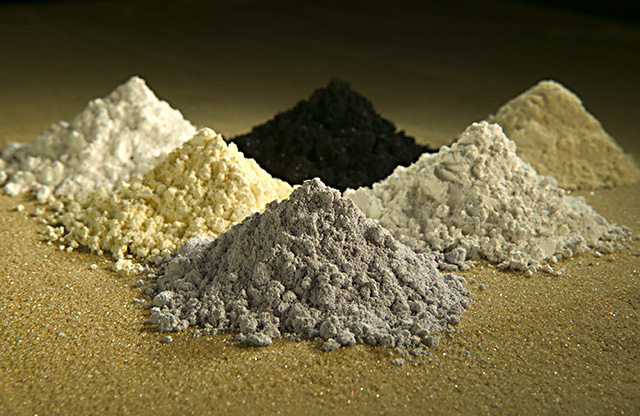
Rare earth elements have been the focus of a good deal of ink, a lot of anxiety, and a couple of tense international spats over the past year, but a Japanese discovery may make the valuable minerals a lot less rare. Geologists there say they’ve found huge concentrated deposits of rare earths in the Pacific seabed that could total 100 billion tons--or enough in a single square mile of seafloor to cover nearly half the world’s annual demand.
Rare earths--in case you missed last year’s high-tech sector fears and China’s short-lived unofficial “embargo” that rattled some Japanese and Western industries--are a group of metals that are integral to several cutting-edge technologies, including batteries, green technologies like wind turbines, and next-gen military technologies. They’re also used in lots of everyday technologies that are vital to developed economies, things like smartphones and computer monitors.
In short, the world needs rare earths and as developing economies continue their rapid upward climbs the world will need even more of them. Currently China controls 97 percent of the world’s usable supplies, and that’s been a source of tension as Chinese leaders have scaled back exports to protect industries at home. So the idea that there are perhaps hundreds of billions of tons of untapped rare earths lying in international waters is huge.But that’s just the first of many angles to this story. For instance, how do we get to the minerals? The two sites named by the Japanese researchers are near Tahiti and Hawaii in international waters ranging from 11,500 to 20,000 feet. Deep sea mining of manganese (and copper and nickel) is already underway in the Pacific, and so some of the technology there might be applicable, as might some of hardware being developed by oil and gas explorers seeking to tap deeper and deeper energy reserves.
Next, there are environmental concerns. The fact that these reserves are in international waters could complicate regulation of any undersea mining activities, and ocean floor ecosystems could be disrupted by the dredging of huge swaths of the seabed.
Then there’s the question of whether undersea mining of rare earths is commercially viable? It may be that getting to these seabed deposits is so expensive as to be prohibitive. Or the discovery might lead to the development of entire fleets of seafloor mining robots. Whatever the future developments may be, the immediate impact is limited: China’s grip on the rare earths market is no less strong today as it was yesterday, and it’s not likely to change in the foreseeable future.
[BBC, New Scientist]

The incredible innovations, like drone swarms and perpetual flight, bringing aviation into the world of tomorrow. Plus: today's greatest sci-fi writers predict the future, the science behind the summer's biggest blockbusters, a Doctor Who-themed DIY 'bot, the organs you can do without, and much more.


Online Content Director: Suzanne LaBarre | Email
Senior Editor: Paul Adams | Email
Associate Editor: Dan Nosowitz | Email
Assistant Editor: Colin Lecher | Email
Assistant Editor: Rose Pastore | Email
Contributing Writers:
Kelsey D. Atherton | Email
Francie Diep | Email
Shaunacy Ferro | Email
Deep sea mining of strategically critical resources - can Seaquest DSV (not the last season) be far behind?
I think this discovery will have an immediate effect on price and availability of Rare Earths. It will act as a cap on the prices China can charge. Just the knowledge alternative sources exist will change the way commodity markets behave. Speculators with bets on higher prices will unwind their positions lowering prices.
Resource recovery price behavior is well known. There are almost always small amounts of cheaply recovered ore and vast amounts of more costly ore. The owners of the cheap stuff know that if they raise prices too much, vast amounts will quickly become available threatening their monopoly - basic supply and demand economics.
If it turns out the resource is vast and the recovery costs comparable to land sources, many manufacturers will feel more comfortable planning to use Rare Earths in their future products without a built-in "commodity price hedge".
The key take home is that China no longer has a monopoly and, as a result of the Japanese discovery, will never have one. We all win.
Is it just me or is anyone else annoyed at POPSCI's choice of wording in this title? I feel tricked into reading this article because it was made to sound like china's monopoly was supposed to be ending and yet at the end of the article it states, "China’s grip on the rare earths market is no less strong today as it was yesterday, and it’s not likely to change in the foreseeable future." I mean... COME ON!!! contradict much?!?! fuckin popsci
Uh...you need to calm down. The word "May" is in the title. The article spells out what would need to happen before the monopoly in China is broken. It's clear and informative. I'm sorry Santa Claus can't deliver cheaper rare earth elements sooner, but it is what it is. Chill.
Wildeye,
The episode where SeaQuest is abducted by aliens, and ever ep after that, should be burned and forgotten. That does was not the biggest shark jump moment in the history of TV I don't know what is.
RAGE!!!!! CHINESE!!!! RAGE!!!!! RARE EARTH!!!!!! RAGE!!!!!
well then this well have some effect, but who knows.
The premise that China has 97% of rare earth materials is flat out wrong. There are several rare earth mines in the United States and elsewhere. What is true is that currently China is minning for rare earth metals and are producing the 97% that is showing up for use. Big money in America has moved from investment in production and services to derivatives where there are no production costs or people to deal with. Since year 2000 the derivative market has gone from 10 trillion to 450 trillion. Another reason big money likes the derivative market is that there are no taxes on the money it makes. No products to spoil or go out of fashion, no employees, no taxes, no investment in any country. Oh, you have to be invited into the market. Money for nothing...Chics for free...
I think the potential showstopper will be over whether or not deep sea mining of rare earths will be too environmentally risky/destructive.
The flip side to this is that the price of the commodities will actually increase. Since they are aware of the new deposits, they can push the price up until it reaches the point where deep sea mining of it becomes economical. Then they can really monopolize the market, just like the oil companies.
Also, since it is in international waters, what is to stop the Chinese from mining those reserves?
The answer is to develop comparable magnets with more abundant materials.
Since a bunch of these reserves are in international waters off Hawaii, you'll have US companies voluntarily following US environmental law while the Chinese will just do whatever the heck they please.
Well, we DID put a man on the moon (please don't argue this here and now), NASA knows more about our Solar System than our Sea Floor, the next frontier is down, not up. Shuttle is getting shelved, its high time to go deep. I'll volunteer to get in one of those michelin man diving suits and start panning for 'em.
Something tells me that the Chinese are NOT going to back off, or ease their restrictions on export to Japan. China doesn't work that way. They WILL wait to see what is actually true with their own personnel and equipment. Japan knows this even if we don't. We are not going to suckerplay the Chinese like we did in our conflict with the USSR. They hold enough cards and more than enough wealth potential to be patient, as is their way. If the intent was to get the Chinese to lower their prices and restrictions, there should have been a ship coming back heavy-laden with rare earths that was known to be on location at that site.
Rare earths are not rare. The only reason China has 97% of the market is because they have been selling rare earths at a price that has forced all other country's rare earth mines to close down. Now that the price is going up and supply from China is being restricted, the other mines will be re-started.
Yes, my Chinese folks, when you push you, invariably, get pushed back sooner or later.
i agree with ender7718, i feel tricked as well.