
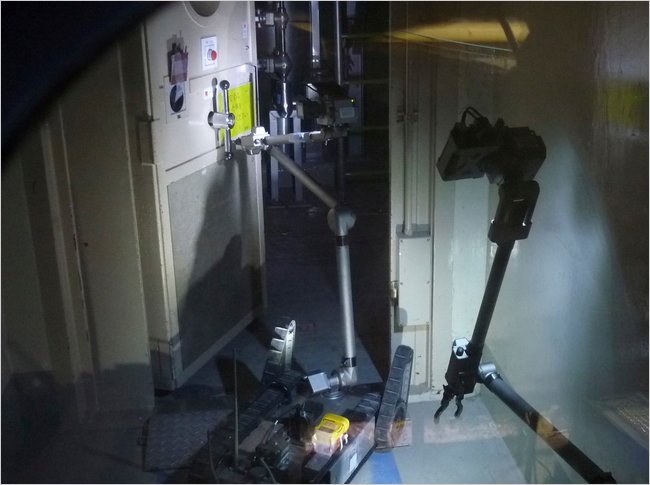
PackBots enter areas where workers cannot safely go

In Through the Out Door Tokyo Electric Power Co.

Nudging open a door with its extendable arm, a bomb-disposal robot became the first robot to enter a reactor building at Japan’s stricken Fukushima Daiichi nuclear plant, confirming high radiation levels that are unsafe for humans.

A pair of iRobot PackBots carefully rolled through double doors at the reactor building on Unit 3 and Unit 1, both of which were damaged in the March 11 earthquake and tsunami. Tokyo Electric Power Co. officials spent much of the day Sunday using the robots to conduct radiation and oxygen-level surveys in the crippled reactor buildings. A robot also explored Unit 2 on Monday.

Although details are still scarce, the robots apparently confirmed the high radiation levels that officials had already feared: readings of up to 49 millisieverts per hour inside Unit 1 and up to 57 inside Unit 3, way too high for humans. For comparison, workers in the U.S. are exposed to a maximum of 50 milliserverts per year, according to the Associated Press.

In the days after the natural disasters — and ensuing hydrogen explosions that destroyed the reactor buildings’ roofs — power plant workers initially remained on site trying to avert further problems, but they could only remain in the buildings for a few moments.

iRobot has four robots in Japan, including the two PackBots and two Warriors, which were equipped with radiation-monitoring equipment and other payloads. The robots were the first to enter the plant, although previous reports from Japanese media indicated some Japanese monitoring robots have also been at the site.

The British defense firm QinetiQ also sent in a tank-like robot called Talon, which was used to drive through the rubble of the World Trade Center after 9/11. Talon is equipped with radiation monitoring equipment. QinetiQ also has modified Bobcat front-end loaders, powered by Xbox 360 controllers, which can move debris, according to the BBC.

The iRobot PackBots and Warriors both roll along tank-like treads, using video cameras and other equipment to conduct surveillance and other activities. The U.S. military uses them for bomb disposal, bunker searches and other dangerous situations.

It appears Japan may need the robots’ services for some time to come. On Monday, Tokyo Electric Power Co. officials said fuel pellets at the reactors had melted, sometimes called a partial meltdown. Officials had assumed as much, but Monday was the first time the company described the damage in detail, according to the AP.

Robots will be able to perform some functions, including monitoring and debris removal, but humans will eventually have to enter the facilities to fix electrical and cooling systems, officials told AP.

“What robots can do is limited,” TEPCO official Takeshi Makigami said.

Officials hope the robots can remove some stagnant radioactive water and other debris to limit workers' radiation exposure.

[via New York Times/AP, IDG News]

6 Comments

yey! first comment, cool they are able to use robots to help, they just will have keep plugging away at this until something permanent can be accomplished

"QinetiQ also has modified Bobcat front-end loaders, powered by Xbox 360 controllers, which can move debris, according to the BBC. "

I didn't realize that xbox controllers were an energy source?! Why don't we just hook our cars to xbox controllers. Mine charge in an hour or two.

That humanoid NASA robot comes to mind here. Couldn't someone develop a...centaur-configuration to go into highly radioactive situations like this? If it can work on a space station I'd think it could work in a reactor complex.

Ionizing radiation in space is one of the things NASA has to deal with.
So why can't some of what was used to build the space station (to protect the occupants from radiation)be turned inside out and used for a containment sarcophagus for the Fukushima nuclear reactors?
And protective gear for the workers . . .wouldn't NASA have some helpful stuff??

It is ridiculous that this situation has gone this far. I feel for the people in Japan, but they need to neutralize the threat as they did in Chernobyl. Why are we sending in robots like this is some school science fair instead of boric acid, sandbags, and cement? Do they actually think that they can repair the reactor or that it would be worth the potential risk/damage to the environment?

Robert1234 It's really simple. The Japanese government is one of the most corrupt in the world, interested in only covering it's political ass while thousands of it's own citizens are being poisoned by radiation and radio active materials being exported from the plant. they could have had video robots in the plant in 10 days and chose not to. These people, like America's politicians, are playing games with our lives. Seattle has a 35% increase in infant deaths since this disaster yet the feds claim there are no hazards to the radiation falling all over the west coast. The real problem is that there is no solution to the problem. Millions will ultimately die of this disaster but the nuke industry soldiers on, bribing our, and Japan's, politicians.


July 2013: The Future Of Flight

The incredible innovations, like drone swarms and perpetual flight, bringing aviation into the world of tomorrow. Plus: today's greatest sci-fi writers predict the future, the science behind the summer's biggest blockbusters, a Doctor Who-themed DIY 'bot, the organs you can do without, and much more.


Online Content Director: Suzanne LaBarre | Email
Senior Editor: Paul Adams | Email
Associate Editor: Dan Nosowitz | Email
Assistant Editor: Colin Lecher | Email
Assistant Editor: Rose Pastore | Email

Contributing Writers:

Kelsey D. Atherton | Email
Francie Diep | Email
Shaunacy Ferro | Email

circ-top-header.gif
circ-cover.gif
bmxmag-ps