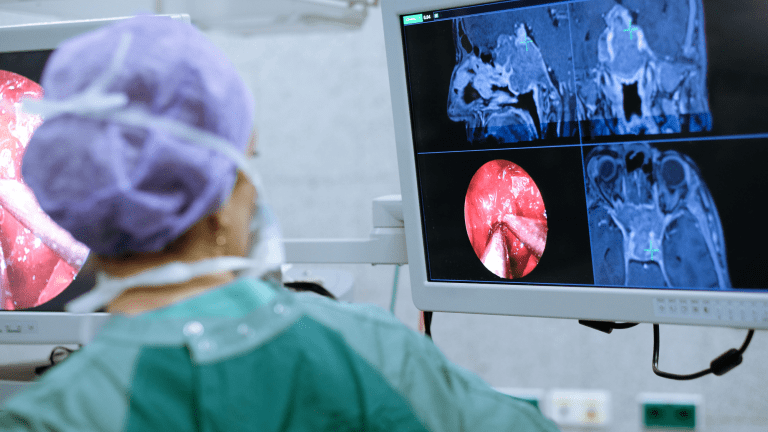
After cardiac arrest, lowering someone’s body temperature can prevent life-threatening brain damage. It’s so critical that New York City requires ambulances to take some patients up to 20 minutes out of the way to hospitals with cooling equipment. EMTs could improve patients’ chances further using RhinoChill, a new portable nose spray that cools the brain on the scene.
In the past decade, doctors learned to safely induce hypothermia to slow brain cells’ metabolism, preventing the buildup of toxic molecules that can cause lasting damage. Many hospitals insert a refrigerated tube into a major vein, a technique too dangerous to attempt in the field.To take the treatment on the road, medical company BeneChill left the refrigerator behind. The key is a fast-evaporating liquid that, squirted up the nose, cools the brain.
Last November, a study of 200 patients showed that those who received RhinoChill were 15 percent likelier to live, and those survivors were 15 percent likelier to avoid brain damage. The San Diego company expects to sell the device in Europe by July and hopes for FDA approval within two years. The inspiration for the nasal route? A secondary job of the nose is sucking in cool air to keep the brain comfortable, says BeneChill COO Allan Rozenberg. “RhinoChill just accelerates the process.”

1. HOOK IT UP A paramedic slides the RhinoChill tubes up the nostrils and into the nasal cavity.
2. SPRAY A gas propellant drives perfluorocarbon coolant through the tube, which turns it into a fine mist.
3. COLD RUSH The mist settles on nasal-cavity and upper-throat membranes and evaporates instantly, cooling the blood running to the brain to lower its temperature to 93.2ºF in 90 minutes.
Five amazing, clean technologies that will set us free, in this month's energy-focused issue. Also: how to build a better bomb detector, the robotic toys that are raising your children, a human catapult, the world's smallest arcade, and much more.


Online Content Director: Suzanne LaBarre | Email
Senior Editor: Paul Adams | Email
Associate Editor: Dan Nosowitz | Email
Assistant Editor: Colin Lecher | Email
Assistant Editor: Rose Pastore | Email
Contributing Writers:
Rebecca Boyle | Email
Kelsey D. Atherton | Email
Francie Diep | Email
Shaunacy Ferro | Email
How long until kids are using these things to get high, or before they are sitting on the sideline of every NFL team to recharge their players (along with the now ubiqutious O2 tanks)?
Sounds to me like this the same way that you get brain freeze from flurries or ice cream – but far more extreme
Our "FDA" system sucks. It's going to take 2 years to get this approved? Really? But it was so easy to approve Yaz right? If you don't know what I'm referring to, maybe you've seen the commercial that starts, "If you or a loved one..."
Seems like a great life-saving device, but please make sure I'm unconscious before you use it on me!
Perhaps this can even be improved on. We still have eight other extremities, including the neck that can be rapidly cooled, and men have nine.
If I find out after a heart attack that someone went and iced my junk, I'm likely to have another as I try to choke out the EMS guy who though that would be a larf. There are some cures that are just not worth it.
This devise is inserted and we do have five orifices, and women have six.
There's more effective ways like chilled IV Saline and Paralytics to mitigate shivering. A patient is unconscious and usually given a hypnotic NOT to remember what is going on. You don't want to remember that, but it's some wonderful Technology/Care. This is after CPR/Defibrillation/Medication to bring back a heartbeat where there was none.
And a Medic putting an IcePack in your groin would be the absolute least of your problems if you're in this stage of treatment.
This devise is inserted and we do have five orifices, and women have six.
Jeff
http://burnwiigames.org/