
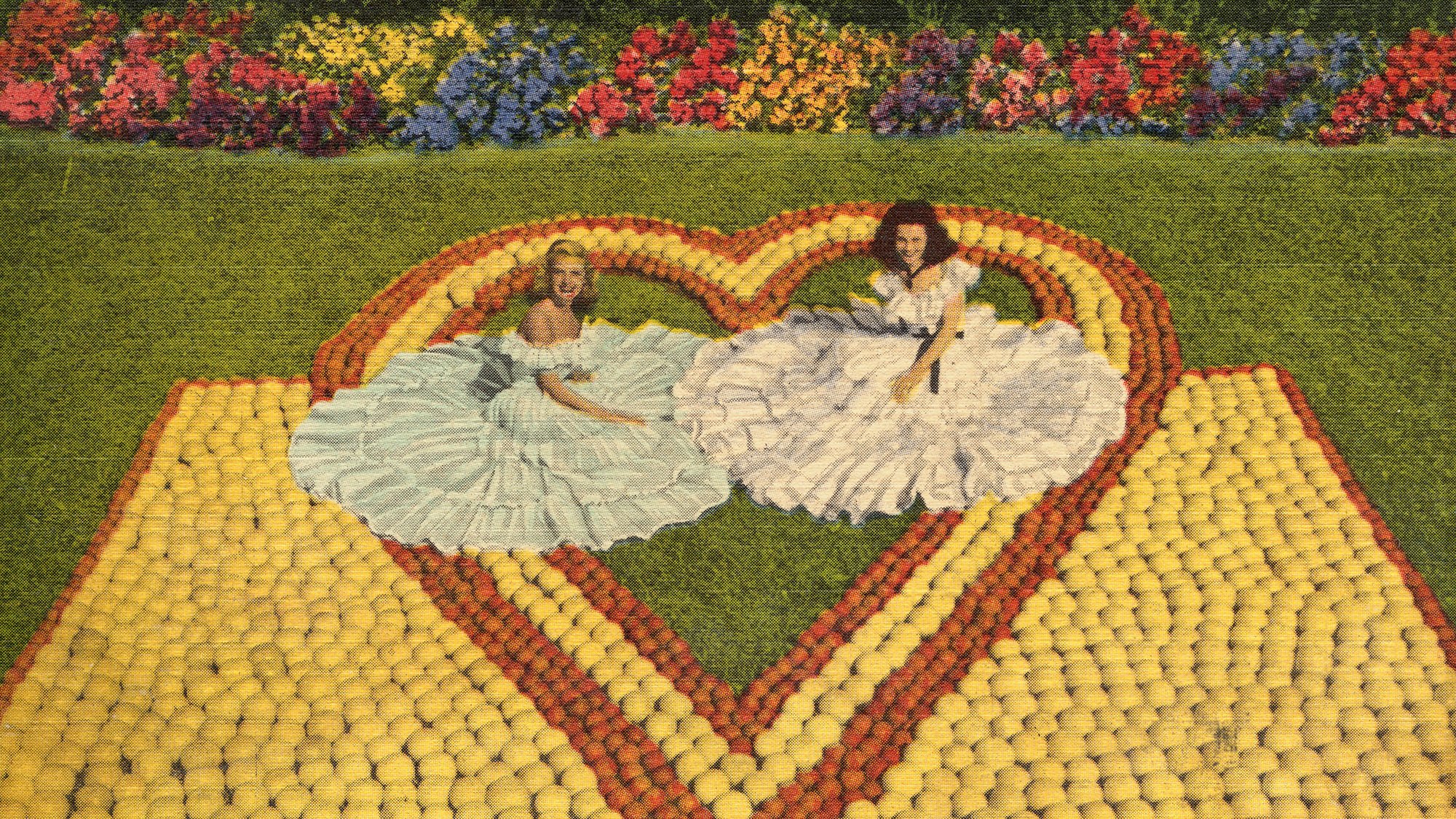
The ruby-red grapefruit is a staple of grocery stores’ produce section. In cereal-box ads promoting a “balanced breakfast,” it appears halved in a bowl and glistening. Its rosy-colored flesh is sweeter and more mellow than that of a yellow grapefruit, and has become a familiar favorite across the United States. In many fad diets of the 1970s and 1980s, pink grapefruits figured heavily, and occasionally appeared in recipe books dusted with sugar and caramelized under a broiler for a dash of sophistication.
The grapefruit, so named because it grows in clusters vaguely reminiscent of grapes on a vine, is actually an accidental hybrid. The first grapefruit seedling, a cross between a Jamaican sweet orange and an Indonesian pomelo, sprouted on the island of Barbados in the 18th century. Early English colonists called the new citrus “forbidden fruit,” as the fragrant golden spheres hung seductively in the lush tropical forest. George Washington tasted grapefruit during a visit to Barbados between 1750 and 1751, and noted the experience in his journal.
The first pink grapefruit, a chance mutation among the otherwise pale-yellow-fleshed fruits, was discovered in 1906. Finding the color appealing, growers propagated more of them. This pink grapefruit, though, was not quite the same as the varieties available in grocery stores today. For ruby-red and other trademarked grapefruit varieties, we can thank radioactivity. No need for panic, though! Today’s ruby red grapefruits aren’t themselves radioactive. They are descendants of plants that were altered using radiation. The story of this popular fruit is intertwined with the fascinating and often tragic history of radioactivity.
The story behind your grocery store grapefruit starts in 1896, Bavaria
In 1896, Wilhelm Roentgen accidentally discovered X-ray fluorescence while tinkering with ways of producing light using electromagnetic energy. During one of his experiments, Roentgen turned off the lights in his lab. As he did so, he noticed a faint glow from a chemical-coated screen on a table several feet away. The screen was too far away to be reflecting light, so Roentgen realized that instead, some type of invisible energy rays were emanating from his experimental setup.
Further experiments showed that these rays of energy could pass through most soft materials, but would leave shadowy imprints of materials like bone or metal that were too dense to penetrate. These X-rays, as they became known, quickly revolutionized medical science, becoming standard diagnostic equipment within a couple of years of Roentgen’s initial experiments.
Invisible energy from chemical elements became a hugely exciting field of research. In 1898, Marie and Pierre Curie extracted uranium from a type of mineral ore called pitchblende—and in the process, discovered that they had also extracted a second chemical element that also emitted energy. They dubbed this second element “radium,” and called the type of energy it gave off “radioactivity.”
Radium is rad
Radium was an absolute sensation in the years immediately after its discovery because it seemed to have such miraculous energy-producing qualities. It was touted as a supplement for increased vitality, and radium-infused water was sold as a health tonic.
Radium gave off so much energy that in its pure form, it was warm enough to melt ice. When mixed with other elements, like phosphorus, it threw off a greenish-yellow light. It was used to illuminate watch dials, and the women employed to paint the numbers on the watch faces would sometimes paint their teeth so that they could amuse their friends with glow-in-the-dark smiles.

Radium transforms from rad to bad
Tragically, in the early decades of the 1900s, it became clear that radium and other radioactive elements that had been discovered around the same time were deeply harmful instead of being the cure-all that people hoped for. The “radium girls” that had painted their teeth and licked their brushes to bring them to a fine point for watch-painting developed terrible wasting diseases that ate away at their bones and caused hundreds of early deaths.
Marie Curie herself succumbed to cancer caused by radiation exposure. Today, her notebooks are still so infused with radiation that they have to be handled while wearing protective lead-lined gear.
Radioactive power: the wave of the future?
By the 1930s, scientists understood that radiation was dangerous, though that didn’t prevent experimentation with radioactive elements in pursuit of a way to harness their power.
The entire world witnessed that ferocious power in early August of 1945. Two atomic bombs, products of a collaboration among scientists called the Manhattan Project, were dropped by American pilots onto the Japanese cities of Hiroshima and Nagasaki. This first and only use of atomic weapons in international warfare killed at least 200,000 people, most of whom were civilians. Thousands more received horrific injuries from the blast of radiation, and in the decades after the end of the war, countless more casualties arose from cancer and other diseases caused by radiation exposure.

The terrifying destructive power of atomic energy left its mark on the public consciousness to such an extent that popular culture became filled with allusions to nuclear power. Godzilla and other classic monsters in the kaiju genre had their origins in irradiated wildlife.
The Incredible Hulk and Spider-Man gained their powers from an overdose of gamma rays and the bite of a radioactive spider, respectively. The backlash against nuclear bombs was so profound that by the 1950s, the United States attempted to give nuclear energy a rebrand with a program titled “Atoms for Peace.”
Welcome to the gamma garden
Atoms for Peace supplied research equipment to hospitals, schools, and other institutions, and funded research meant to develop more productive and less devastating uses for nuclear power (like using atomic bombs to nuke Alaska—no, really). One of these research programs was nicknamed the “gamma garden.” These were horticultural centers around the world specially designed to test the effects of radiation on plant life.
Gamma gardens were typically laid out in five-acre plots, a space roughly the size of five football fields clustered together. The gardens themselves were arranged in a circular pattern with a retractable radiation source in the middle. Different plant species were laid out in wedges, like slices of pie. The radiation source could be raised and lowered from a lead-shielded compartment, meaning that researchers could control the duration of each exposure.
When the radioactive material was raised from its chamber at timed intervals, each plant would receive a different amount of exposure, depending on its distance from the source. Radioactive energy directly affects the DNA of living things, mostly by breaking the bonds within the DNA molecules or causing mutations that can be passed along to future generations.
Unsurprisingly, in the gamma gardens, the plants closest to the radioactive material usually died. A bit farther out, radioactive bombardment often resulted in odd growths, tumors, and other abnormalities. Past this zone of dangerous radiation, though, there was a sweet spot where potentially beneficial genetic mutations could arise.
One of these altered plants was the Rio Red grapefruit, originally developed at Texas A&M University in 1984. This grapefruit variant with pleasingly vibrant pink flesh was also hardier, and produced more fruit than other grapefruit varieties. Rio Reds now account for around 75 percent of all grapefruits produced in Texas.

Gamma gardening has mostly fallen by the wayside, or at least morphed into a different form. Food products labeled as GMO, or genetically modified organisms, have been tweaked by similar gene-altering methods.
As of 2017, though, there were still active gamma garden facilities, notably the Institute of Radiation Breeding in Hitachiohmiya, Japan.
Altering plants through radiation-induced mutation is essentially speeding up the kinds of genetic changes that naturally occur in a species over a much longer time scale. Descendants of irradiated plants include a peppermint variety resistant to a pernicious fungal disease.
We also have radiation research to thank for Calrose rice, a short-grained sticky variety that is now the most common rice produced in California. Golden Promise, a high-yield barley variety, was extremely popular in the 1970s and 1980s, and some of that barley can still be enjoyed today in aged Scottish whiskey.
So the next time you’re wandering past the citrus fruits in the grocery store, or sampling a glass of 45-year-old malt whiskey, take a moment to consider the legacy of gamma gardens. They’re a wonderful example of how seemingly unrelated things can be connected to one another, and to specific moments in time, in unexpected ways.
In That Time When, Popular Science tells the weirdest, surprising, and little-known stories that shaped science, engineering, and innovation.
Related 'That Time When' Stories
Charles Darwin’s daughter had an unusual hobby: Hunting phallic mushrooms
Beef tea was all the rage in the 1800s
4 times drinking coffee was illegal—or even punishable by death
In medieval France, murderous pigs faced trial and execution
The radioactive ‘miracle water’ that killed its believers
Andrew Jackson’s White House once hosted a cheese feeding frenzy
