A meteorite streaked through the sky Friday morning, exploding over central Russia. Plant your eyeballs here for the latest updates. 3:15 p.m. EST: Russia Today writes that the estimated cost of damage has been revised down from 1 billion rubles to 400 million rubles, or about $13 million.

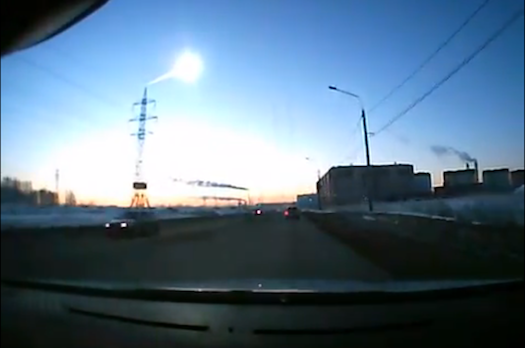
Fireball in the sky!
Fireball in the sky! Screenshot

3:15 p.m. EST: Russia Today writes that the estimated cost of damage has been revised down from 1 billion rubles to 400 million rubles, or about $13 million.

2:38 p.m. EST: The Wall Street Journal is reporting it's 3,000 buildings that were damaged by the meteorite.

2:27 p.m. EST: A video look at the crater left in Chebarkul Lake.

1:54 p.m. EST: Astrophysicist Neil deGrasse Tyson went on Today to give some context on how common a meteorite like this is (maybe a once-a-decade event) and why we didn't spot it (too small).

1:10 p.m. EST: Big update from Russia Today: There are reportedly 1,200 injuries in the Chelyabinsk region. The (admittedly early) estimated cost for repairs will be about 1 billion rubles, or about $33 million. There are some conflicting reports on damage to buildings, but the latest figure from Russia Today puts the number of damaged buildings in the region at about 300.

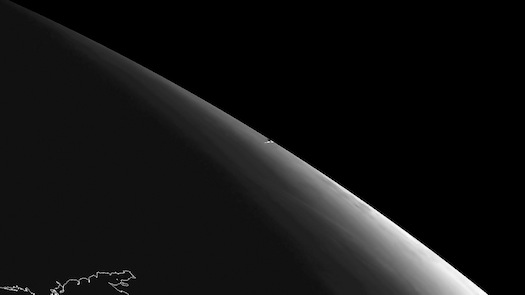
1:00 p.m. EST: This photo, taken from European weather satellite Meteosat-10, shows the vapor trail left behind the meteorite. (It's small, in the center of the photo.)

Meteorite Entering Atmosphere
Meteorite Vapor Trail:  Eumetsat via Astronomy Now

12:35 p.m. EST: Dmitry Rogozin, Russia's deputy prime minister, wants countries to come together and build a system that can intercept objects from space, the International Business Times is reporting.

12:25 p.m. EST: The Russian government's response to the meteorite has been appropriately huge. CNN reports that "20,000 emergency response workers have been mobilized."

11:48 a.m. EST: Photos of a heavily damaged zinc plant are circulating. We've seen this one on Reddit, and another on CNN.

Zinc Plant
Zinc Plant:  via Reddit

11:10 a.m. EST: From Nature: This "was the largest recorded object to strike the Earth in more than a century, scientists say." It was much more powerful than North Korea's recent nuclear weapons test and the biggest meteorite collision since a 1908 crash over Siberia's Tunguska river.

10:57 a.m. EST: NASA confirms the meteorite was unrelated to the asteroid passing earth today.

10:55 a.m. EST: The bulk of the damage apparently happened in the city of Chelyabinsk. It's about 950 miles east of Moscow and has a lot of defense production factories, including nuclear weapons factories, the Times reports. It doesn't look like the damage caused any radiation leaks.

10:41 a.m. EST: Another video of the shockwave, followed by the sound of car alarms and shattered glass.

10:30 a.m. EST: Phil Plait over at Slate writes that the meteorite "is almost certainly unrelated to the asteroid 2012 DA14 that will pass on Friday." Most we're seeing about that right now is a New York Times report saying it's "possible that the meteorite may have been flying alongside the asteroid."

10:12 a.m. EST: Russia Today is reporting that this image, of Chebarkul Lake, is a crater from where part of the meteorite fell.
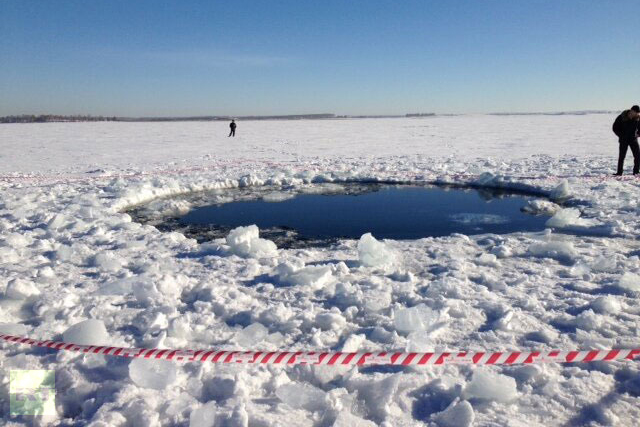
Crater Lake
Crater Lake: The hole in Chebarkul Lake reported to have been made by the meteorite landing.  Andrey Orlov via Russia Today

10:09 a.m. EST: Thousands of buildings have been damaged in six different cities, according to Forbes. At last count, 112 have been hospitalized.

9:51 a.m. EST: The stats on the meteorite, via The Guardian, are unbelievable. The space rock weighed 11 tons and hit the atmosphere going at least 33,000 mph. Also, for context: "Something like this probably happens every decade but usually takes place over an unpopulated area."

9:45 a.m. EST:The AP is reporting that the injury toll has reached "nearly 1,000."

8:35 a.m. EST: Meteorite strikes are actually pretty common, the AP says: "Experts say smaller strikes happen five to 10 times a year. Large impacts such as the one Friday in Russia are rarer but still occur about every five years, according to Addi Bischoff, a mineralogist at the University of Muenster in Germany. Most of these strikes happen in uninhabited areas where they don't cause injuries to humans."

7:53 a.m. EST: Reuters is reporting that more than 500 people are injured: "514 people had sought medical help, mainly for light injuries caused by flying glass... 112 of those were kept in [a] hospital." No fatalities have been reported.

7:15 a.m. EST: A meteorite whizzed through the sky early Friday morning, exploding over central Russia and sending fireballs crashing to the ground. Damaged buildings, shattered glass and disrupted phone networks were reported. We'll keep you updated with news, videos and more.

23 Comments

I want some of those rocks.

This meteor could have been much, much bigger, and we still would have had no warning before it hit. We know only about 30% of these dangerous near earth asteroids. We need to get serious about asteroid hunting or we are going to become extinct in a flash.

2012 DA14 was discovered by an amateur astronomer. NASA claims they don't have the "resources" to track asteroids.
How bizzare.

Once corporations can mine asteroids for valuable minerals and other raw materials, Nothing will go untracked!
So if averting disaster is profitable, it'll get done.

If it were a direct impact Russia would be missing a city right about now, thousands would be dead many thousands injured, and the rest of the world would be a bit closer to putting aside their petty differences, and realizing human advancement so far counts for nothing until we extend our colony to other worlds.
But then there are many many more of these rocks heading toward earth, so we could just as easily loose a couple cities tomorrow.

@Teotwawki

2012 DA14 wasn't discovered by a hobbyist in his back yard. It was discovered by the La Sagra Sky Survey, which is a team of amateurs using sophisticated equipment.

http://www.lasagraskysurvey.org/instrumental_in.html

NASA did not say they don't have resources to track asteroids. They said they don't have the resources to meet their congressional mandate. NASA was tasked with tracking "at least 90 percent of potentially hazardous NEOs larger than roughly 460 feet (140 meters) in diameter by the end of the year 2020".

It is difficult to find asteroids while looking into the sun. This makes finding asteroids that orbit closer to the sun difficult for earth based detectors. To get anywhere near the 90 percent mandate, NASA needs a space based observatory that orbits the sun, not the Earth. This costs big money.

sshhhh... everything will be ok democedes,
"Soft kitty, Warm kitty, Little ball of fur. Happy kitty, Sleepy kitty, Purr Purr..." :)

This one was only two (2) meters in diameter!! The Congressional mandate is to track only those over 140 meters in diameter (very, very few of them are that big), and NASA doesn't even have the funding to get THAT done.

Chelyabinsk produces nuclear weapons? Its like that meteor had our name on it. The news keeps getting worse and worse.
Biggest since Tunguska? Gees we are lucky!

Sumer (not verified)

So scientifically and in reality, there was no defense to this current event. Hello reality check!

Now what happens if a really big asteroid is coming our way, perhaps we have a chance if it is big enough to see and small enough to deflect.

What happens if several small bus size asteroids come our way, maybe several hundred asteroids? Will they be too small to see and to many to deal with to stop?

And finally, if a really gigantic asteroid is coming our way, then there is nothing to do, but die.

@sumer, I can sing to you too if you'd like :)

What if there was a special tax that went toward things like extinction level events?
Then all those who chose to pay that tax would be saved and everyone who thinks they have more important concerns would be allowed to take their (rather poor)chances at continued survival.

@lvriesling

Of the over 9,000 NEOs NASA is tracking, 3,700 have a diameter more than 300m. 850 have a diameter greater than 1,000m. I would say that is more than a few.

http://neo.jpl.nasa.gov/stats/

Sumer (not verified)

Did USA\NASA or Russia or any other scientific world establishment know about his incoming asteroid in advance and was this news withheld from the public?

I am curious!

Sumer it depends on what you mean by advance.
If they knew 30 mins in advance there would be no point in telling anyone.
As for knowing way in advance, I don't think that is possible with current technology. And thats the problem.

Since the beginning of time have you hard of anyone that been hit by a meteor? (If so, he probably had it coming haha.)
Of all the things to ring our hands about in life, I would think this would be on the lowest rung. Guaranteed, you & I will die of something else, & we probably won't even see it coming. But if your still worried, there is always church. :)

@ Fotobum, I have seen a house and a car hit by meteorites. That's pretty close callings.

Sumer (not verified)

"...Since the beginning of time have you hard of anyone that been hit by a meteor?..."

Really, since the beginning of time and you expect an answer?

Yea sure, I am 3 billion and 2 million and 1 years old. I saw my friend hit by one of those things. Dang, it was a mess! LoL.

@FotoBum

First, I sleep like a baby. No worries here. I would just like mankind to continue on a bit after I am dead and buried.

Secondly, you speak as if we are helpless to stop a large meteor strike. The US has the resources and the technology to catalog and track NEOs at 100% if we so choose. This would give us decades to deflect an asteroid. With that much advance warning, only a little nudge would be required to alter the asteroids course enough to miss Earth entirely.

It seems silly to me for people to wring their hands about anything else. What is a school shooting next to a mass extinction? Why not spend our efforts on preventing the mass extinction and then worry about global warming and education.

"Since the beginning of time have you hard of anyone that been hit by a meteor?"

Yes, the dinosaurs. They aren't here anymore because meteors were on their lowest rung.

haha! yes, good answers!

Why do these things always seem to happen in Russia?

Computer User, Howsabout the impact craters in Arizona, the gulf of Mexico and mainland Mexico?

until I saw the bank draft which said $8121, I be certain that my sister woz like truley taking home money in their spare time on their apple laptop.. there neighbor had bean doing this 4 only about thirteen months and by now took care of the morgage on their villa and bourt Lotus Esprit. this is where I went, ●❤● ℬuzz80.ℂOℳ ●❤●


140 years of Popular Science at your fingertips.


Popular Science+ For iPad

Each issue has been completely reimagined for your iPad. See our amazing new vision for magazines that goes far beyond the printed page


Download Our App

Stay up to date on the latest news of the future of science and technology from your iPhone or Android phone with full articles, images and offline viewing


Follow Us On Twitter

Featuring every article from the magazine and website, plus links from around the Web. Also see our PopSci DIY feed


April 2013: How It Works

For our annual How It Works issue, we break down everything from the massive Falcon Heavy rocket to a tiny DNA sequencer that connects to a USB port. We also take a look at an ambitious plan for faster-than-light travel and dive into the billion-dollar science of dog food.

Plus the latest Legos, Cadillac's plug-in hybrid, a tractor built for the apocalypse, and more.


Online Content Director: Suzanne LaBarre | Email
Senior Editor: Paul Adams | Email
Associate Editor: Dan Nosowitz | Email
Assistant Editor: Colin Lecher | Email
Assistant Editor:Rose Pastore | Email

Contributing Writers:
Rebecca Boyle | Email
Kelsey D. Atherton | Email
Francie Diep | Email
Shaunacy Ferro | Email

circ-top-header.gif
circ-cover.gif
bmxmag-ps