Researchers are already learning how a changing climate can affect populations of individual species, from plants to animals. But they haven’t been able to really pin down how entire communities of different species will respond to changing global patterns. Now a study that examines four super-hardy Arctic animals shows how climate change will bring the birth and death rates of each species into sync.
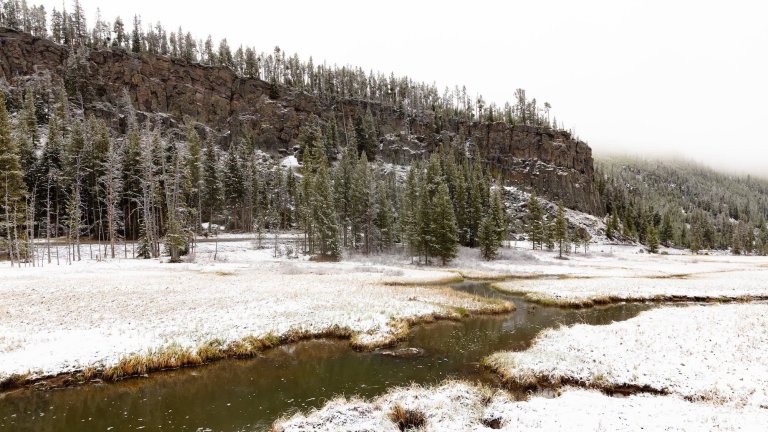
Just four animals make their year-round home in Norway’s frigid Svalbard archipelago: reindeer, rock ptarmigans, little rodents known as sibling voles, and Arctic foxes, which eat the other three. Scientists from the Norwegian University of Science and Technology studied populations of these animals living on the island of Spitsbergen, which is at 78 degrees north latitude. The three herbivores already fight for limited food supplies during winter, and when ice coats the frozen tundra, they have nothing to eat.Svalbard, which serves as a sort of Arctic bellwether, is experiencing an increase in freezing rain, which encases snow in a thick crust animals can’t penetrate. This is linked to shifting cycles related to a warming Arctic climate. The result: Fragile tundra vegetation will perish under the ice, and the herbivores will starve. Brage Bremset Hansen, from the NTNU’s Centre for Conservation Biology, studied years of data on ptarmigans, reindeer, voles and foxes and noticed population crashes among the herbivores after icy winters. Arctic fox populations lagged a year behind, however.

The Arctic is expected to see more ice fall in the winters as global climate patterns shift, according to the paper. “Svalbard is characterized by large weather fluctuations
and has been considered an ‘early warning’ system for the projected increase in extreme events and rainfall during winter across the Arctic,” the authors note. “As demonstrated here, such extreme events may have broad ecological implications.” The paper is published today in Science.

140 years of Popular Science at your fingertips.
Each issue has been completely reimagined for your iPad. See our amazing new vision for magazines that goes far beyond the printed page
Stay up to date on the latest news of the future of science and technology from your iPhone or Android phone with full articles, images and offline viewing
Featuring every article from the magazine and website, plus links from around the Web. Also see our PopSci DIY feed
Engineers are racing to build robots that can take the place of rescuers. That story, plus a city that storms can't break and how having fun could lead to breakthrough science.
Also! A leech detective, the solution to America's train-crash problems, the world's fastest baby carriage, and more.


Online Content Director: Suzanne LaBarre | Email
Senior Editor: Paul Adams | Email
Associate Editor: Dan Nosowitz | Email
Contributing Writers:
Clay Dillow | Email
Rebecca Boyle | Email
Colin Lecher | Email
Emily Elert | Email
Intern:
Shaunacy Ferro | Email
How cute, you can see Santa's face in the foxes fur. :-)
Also for the first time, scientists show that most Arctic mammals will flourish in a warming climate.
From the abstract of "Future Climate Change Will Favour Non-Specialist Mammals in the (Sub)Arctics" by Hof, Jansson, and Nilsson:
"Arctic and subarctic (i.e., [sub]arctic) ecosystems are predicted to be particularly susceptible to climate change. The area of tundra is expected to decrease and temperate climates will extend further north, affecting species inhabiting northern environments. Consequently, species at high latitudes should be especially susceptible to climate change, likely experiencing significant range contractions. Contrary to these expectations, our modelling of species distributions suggests that predicted climate change up to 2080 will favour most mammals presently inhabiting (sub)arctic Europe."
Read the study here:
http://www.plosone.org/article/info%3Adoi%2F10.1371%2Fjournal.pone.0052574
Pretty Animals!
We are all part of the circle of life and every animal is important and affects the other.
Protect GIA and all her creators!